Everyday Culture & Life
Thailand Explained
Clear answers to the everyday questions visitors ask about Thailand — customs, language, food, beliefs, transport and daily life.
Thailand Explained
Why Do Thai People Have Nicknames?
Thai nicknames can seem wonderfully random to visitors, but they are a normal part of everyday identity. Here is why a formal name and the name everybody actually uses can be completely different.
Thailand Explained
Thai Names Explained: Long Names, Surnames and Why They’re So Unique
Thai formal names can be long, meaningful and surprisingly recent in their modern form. The story of surnames, Pali-Sanskrit influence and everyday nicknames reveals how modern Thai identity developed.
Thailand Explained
What Is a Soi in Thailand?
A soi is one of the most useful Thai words a visitor can learn. Understand how sois branch from larger roads and Thai addresses suddenly become much easier to read.
Thailand Explained
Why Do Thai People Eat With a Spoon and Fork?
For many Thai rice dishes, the spoon does the eating and the fork does the pushing. Once you understand the food, the utensil system becomes completely logical.
Thailand Explained
Why Do You Take Your Shoes Off in Thailand?
Shoes often stay outside Thai homes and sacred spaces for reasons that are practical, social and symbolic. The easiest rule is also the best: look at the doorway.
Thailand Explained
Why Are There So Many 7-Elevens in Thailand?
Thailand turned the convenience store into everyday infrastructure. Dense cities, heat, ready food, long opening hours and a powerful local operator all helped 7-Eleven become part of daily life.
Thailand Explained
Why Does Thailand Drive on the Left?
Thailand drives on the left despite never having been a British colony. The history is less tidy than internet folklore suggests and is best understood through regional trade, transport and modernisation.
Thailand Explained
Why Do Thai People Say “555”?
In Thai, the number five is pronounced haa. Put three of them together and 555 becomes one of the easiest pieces of Thai internet culture to understand: hahaha.
Thailand Explained
Why Is Bangkok Called Krung Thep?
Bangkok and Krung Thep are both correct names for Thailand’s capital. One is the international name; the other is what Thai people normally call the city.
Thailand Explained
Why Are Spirit Houses Everywhere in Thailand?
Spirit houses beside hotels, homes, offices and skyscrapers reveal a side of Thai religious life that cannot be explained by Buddhism alone. They belong to a wider world of spirits, place and protection.
Thailand Explained
Why Do Thai People Love Lucky Numbers?
Numbers in Thailand can carry meanings far beyond mathematics. Language, astrology, Chinese influence, religion and lottery culture all help explain why some numbers feel especially auspicious.
Thailand Explained
Why Are Monks Everywhere in Thailand?
Thai monks are highly visible because the Sangha has long been connected to everyday community life. Alms, ceremonies, teaching, merit-making and temple life keep monastic and lay worlds in constant contact.
Thailand Explained
Why Is the Head Important and the Feet Considered Low in Thailand?
Thai etiquette gives symbolic meaning to physical height: the head is treated as high and respected, while the feet are low. That simple idea explains several everyday rules at once.
Thailand Explained
Saving Face in Thailand: Why Thais May Avoid Saying No Directly
Saving face is about dignity, relationships and avoiding unnecessary embarrassment — not dishonesty. Understanding indirect refusals helps, but culture should never become an excuse for mind-reading.
Thailand Explained
Mai Pen Rai, Sabai Sabai and Sanuk
Mai pen rai, sabai sabai and sanuk are famous Thai expressions, but none is a licence to reduce Thailand to ‘don’t worry, relax and have fun’. Their meanings are richer and more situational.
Thailand Explained
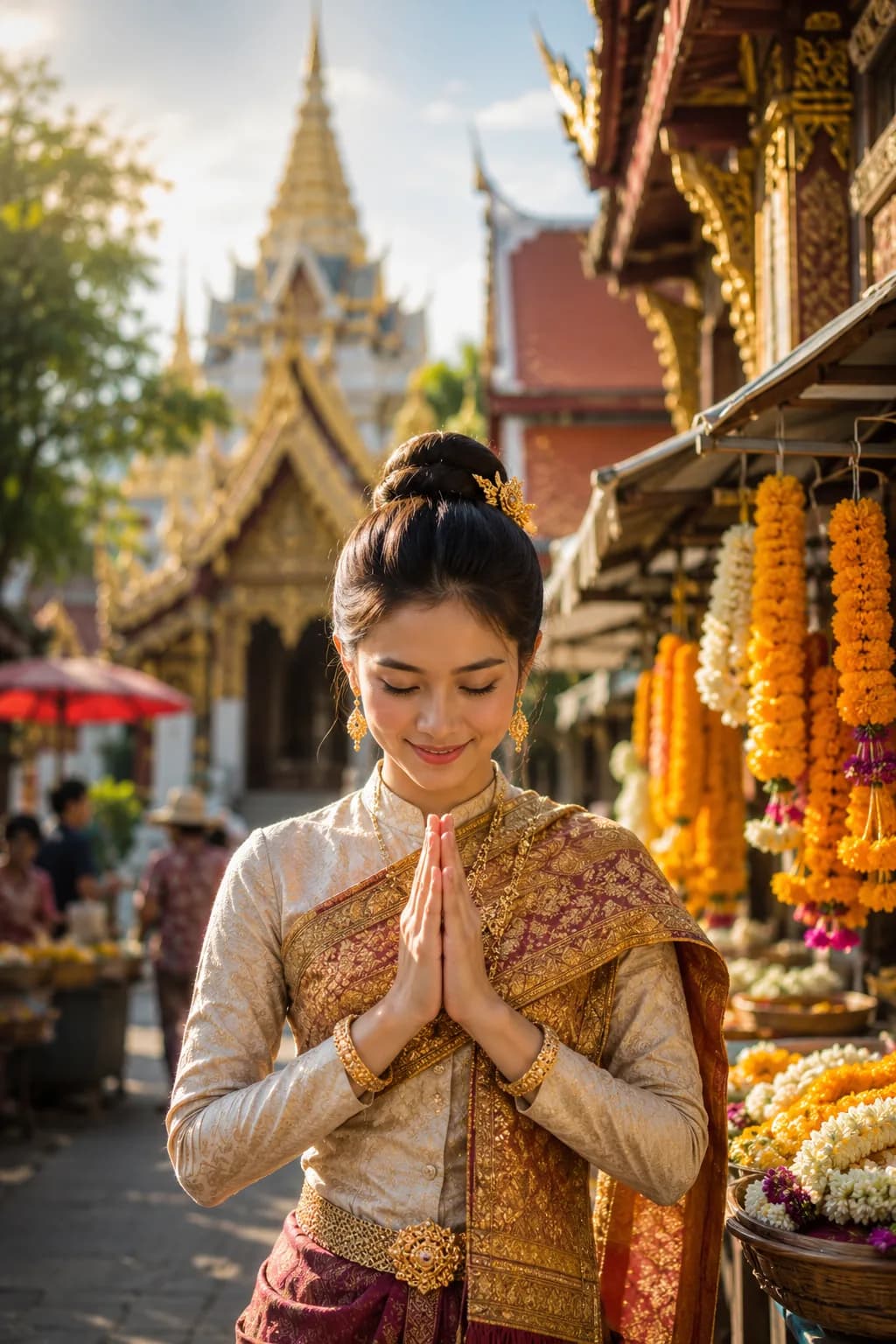
Why Do Thai People Wai?
The wai is more than a Thai hello. It is a flexible gesture of greeting, thanks, apology, reverence and respect whose form changes with relationship and context.
Thailand Explained
Why Is Rice So Important in Thailand?
Rice is not simply a side dish in Thailand. It has shaped agriculture, language, ritual, trade, regional identity and the basic structure of a Thai meal for centuries.
Thailand Explained
Why Is Isaan Food Everywhere?
Som tam, sticky rice, larb and grilled chicken travelled far beyond Thailand’s northeast because people did. Isaan food’s national reach is also a story about migration, labour and regional identity.
Thailand Explained
Why Are Thai Malls So Huge?
Thai malls are not just oversized shops. Heat, rain, food, entertainment, transit and mixed-use development have turned them into air-conditioned urban centres where people can spend an entire day.
Thailand Explained
Why Are There So Many Motorbike Taxis in Thailand?
Orange-vest motorbike taxis solve one of Bangkok’s most persistent transport problems: the last kilometre between major roads, rail stations and the deep sois where people actually live and work.
Thailand Explained
Why Are Bangkok Addresses So Confusing?
Bangkok addresses are not random — they are layered. Main roads, sois, yaeks, building numbers, districts, landmarks and map pins all overlap, which is why a technically correct address can still be difficult to navigate.
Thailand Explained
Why Are Thai Markets Open So Late?
Thai evening markets fit the rhythm of heat, work, food and social life. When the sun drops and people finish work, markets become places to eat, shop, meet and spend the evening.
Thailand Explained
Why Do Thai People Put Garlands in Cars?
The flower garlands hanging in Thai cars are part of a much older cultural language of respect, blessing and auspiciousness. In vehicles, they can become symbols of safe travel, protection and a good beginning.
Thailand Explained
Why Is the Year 2569 in Thailand? The Buddhist Calendar Explained
Thailand is not living 543 years in the future. The country commonly uses the Buddhist Era year alongside the Gregorian calendar, so 2026 CE is 2569 BE.
Thailand Explained
Sacred Ink: The Many Tattoo Stories of Thailand
Look closely at tattooed skin in Thailand and the designs can tell very different stories — from sacred sak yant and protective yantra to modern body art, identity and personal style.
Thailand Explained
What Makes Thailand Thailand? The Symbols of a Nation
From the tricolour and national anthem to the Garuda, elephant, ratchaphruek, Sala Thai and newer identity markers, Thailand’s symbols represent different layers of the country — each with its own history, role and meaning.
Thailand Explained
Kreng Jai: The Thai Idea That Is Almost Impossible to Translate
Kreng jai is one of Thailand’s most difficult social ideas to translate. It is about consideration, social sensitivity and making room for another person’s feelings, comfort and position — with meaning that changes according to relationship, context and situation.