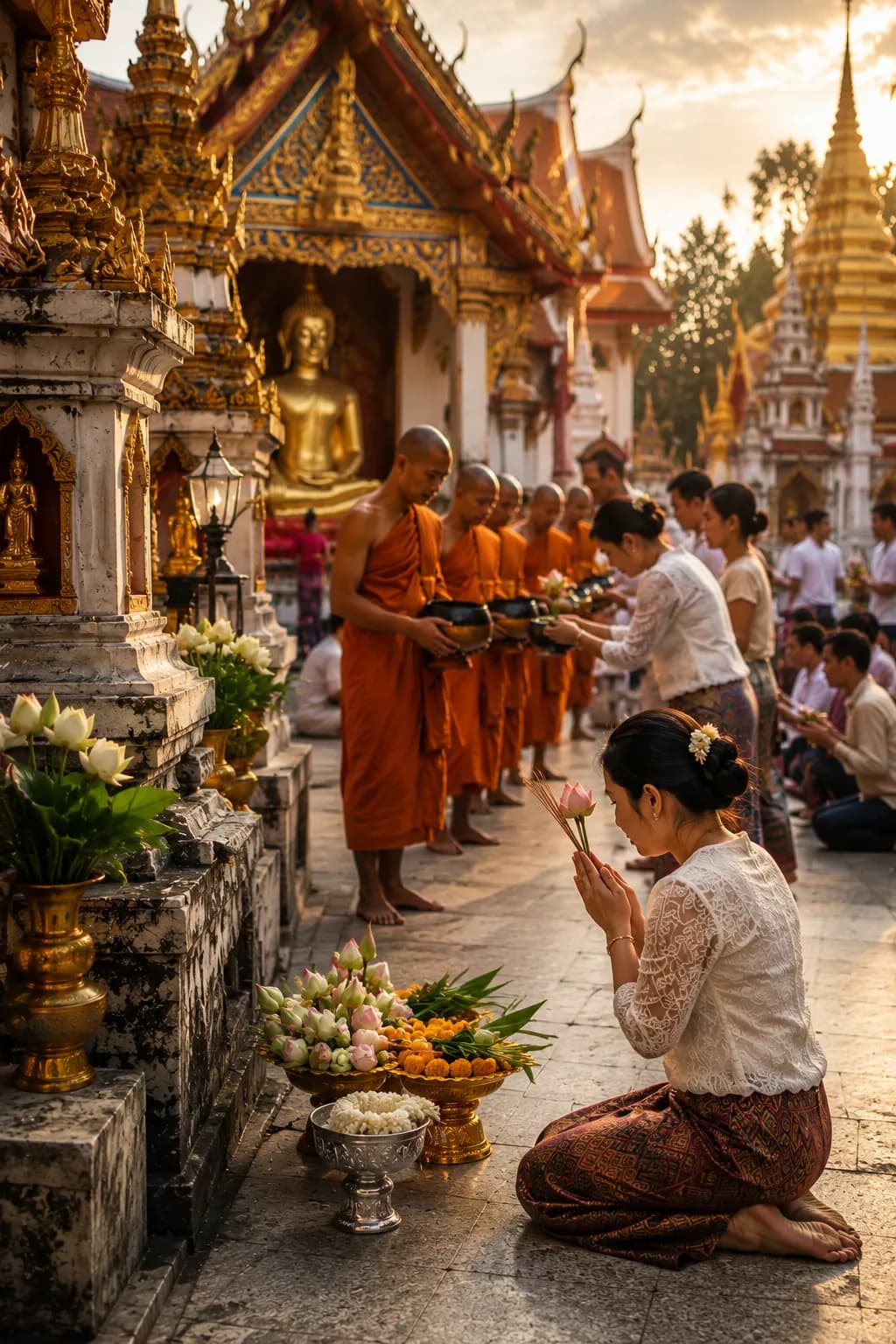
Arrive in Thailand and it does not take long to notice the orange robes. A monk walking beside a market at sunrise. Monks collecting alms outside a row of shops. A monk sitting near the front of a bus. A group of novices inside a temple. Monks chanting at a funeral, monks blessing a new house, monks studying and monks teaching. Monks travelling through an airport with everyone else. For a visitor, their visibility can make Thailand feel as if monastic life is somehow separate from normal society but constantly passing through it. The reality is almost the opposite. In Thailand, monks are visible precisely because the monastic community has historically been deeply connected with everyday community life.
The Simple Answer
Thailand is predominantly Theravada Buddhist. The community of ordained monks is called the Sangha. Together with the Buddha and the Dhamma — the teachings — the Sangha forms one of Buddhism's Three Jewels. Monks live according to a monastic discipline different from ordinary lay life. But they do not normally disappear from society. They depend on lay communities for material support. Lay Buddhists, in turn, interact with monks through merit-making, ceremonies, teaching, funerals, festivals and temple life. That relationship makes monks highly visible. “Sangha” can have several meanings in Buddhist contexts. In everyday discussion of Thailand, it often refers to the ordained monastic community. Monks are: Phra. พระ You may hear a Thai person refer respectfully to a monk using titles that depend on seniority, role and relationship. For a visitor, “monk” is enough to understand the basic category. Thailand's dominant Buddhist tradition is Theravada.
It is also historically important in: Sri Lanka. Myanmar, Laos, Cambodia and Theravada communities elsewhere. The tradition preserves an ancient monastic discipline known as the Vinaya. That discipline shapes much of what visitors notice about monks' daily behaviour. Thai monks usually wear robes in shades ranging from yellow and saffron to orange, ochre or brownish tones. There is not one internationally standard “Buddhist orange.” Colour can vary by: Monastic tradition. Temple, available cloth, dye and regional or institutional practice. The robe makes an ordained monk immediately recognisable in public. Early Buddhist monastic robes were associated with discarded or inexpensive cloth dyed into subdued colours. Over centuries, robe traditions developed differently across Buddhist countries. The modern bright orange often associated with Thai monks is one regional expression of a much older monastic clothing tradition. For an ordained monk, the robe represents a religious life governed by discipline.
It should therefore be treated with the same seriousness you would give religious clothing in other traditions. A monk is not a tourism prop. One of the most visible monastic practices happens early in the morning. Monks leave the monastery carrying alms bowls. Laypeople offer food. This is called: Tak bat. ตักบาตร For travellers, it is one of the clearest examples of the relationship between monks and lay society. English descriptions sometimes say monks “beg for food.” That can create the wrong image. The traditional alms round is a structured religious exchange. Monks do not ordinarily perform a sales pitch or negotiate for breakfast. They make themselves available to receive offerings. Laypeople voluntarily give food and create an opportunity for merit-making. The alms bowl is one of the classic possessions associated with Buddhist monastic life. Food placed into it supports the monk physically. The act of giving supports the layperson's religious practice. Both sides participate in the relationship.
The Monk Does Not “Sell” Merit
This is an important Buddhist idea. The monk receives food. The giver practises generosity. Generosity — dana — is itself spiritually valuable. The exchange is therefore not simply: Rich person feeds poor person. It belongs to a moral relationship between lay and monastic communities. Thai Buddhists commonly speak of making merit: Tham bun. ทำบุญ Merit can be cultivated through wholesome actions such as: Generosity, ethical behaviour, supporting the Sangha, temple activity, helping others and religious observance. Offering food to monks is one familiar form. This distinction matters. The monk is not supposed to function like a cashier exchanging spiritual points for rice. Buddhist merit is connected with intention and wholesome action. Popular language can sometimes sound transactional. The religious concept is more nuanced. Alms rounds normally occur early. That fits monastic meal discipline and the daily rhythm of temples.
Visitors who sleep until noon may spend an entire holiday wondering where the monks are. Thailand looks different at 6 a.m. Theravada monastic discipline traditionally limits monks' eating of ordinary solid food to the period from dawn until noon. After midday, monks generally refrain from regular solid meals until the following morning, although Vinaya traditions permit certain medicines and allowable consumables under specific rules. The practical result: Morning and midday meals matter. Religious rules have technical definitions and different practical interpretations. A travel article does not need to turn the Vinaya into a legal code. The important point is that Thai monastic eating schedules differ from ordinary lay schedules. A temple may receive food offerings very early. Monks can then eat before continuing study, teaching, meditation or other responsibilities. Temple meal times often look extremely early to foreigners.
11 a.m. can effectively function as the final substantial meal of the day. Because an ordinary evening restaurant meal does not fit traditional Theravada monastic food discipline. This is one reason seeing monks at breakfast or morning markets is much more common than seeing them ordering dinner at 8 p.m. A Thai Buddhist temple complex is called a: Wat. วัด A wat is not merely one building. It can include: Ordination hall, assembly hall, chedi, monks' residences, school buildings, crematorium, shrines, administrative spaces and community facilities. The temple can function as a religious institution and neighbourhood centre at the same time. A monk may sleep inside the temple grounds. But the temple is often located directly among homes, shops and streets. The separation between monastery and town can therefore be surprisingly thin. Step through a gate: Temple, step outside: Noodle shop, motorbike taxi, 7-Eleven and everyday Thailand resumes immediately.
The Community Comes to the Temple
People visit for: Merit-making, holy days, funerals, ordinations, festivals, blessings, meditation, dhamma teaching, donations and family ceremonies. A temple is not only a tourist attraction containing old architecture. Monks leave temples for: Alms rounds. Ceremonies, funerals, house blessings, community events, travel, medical appointments and study. Administrative work. So monastic life naturally appears in public space. Because monks are human beings who need transportation. There is nothing mystical about it. They travel between: Temples, universities, ceremonies, home provinces, hospitals and religious events. A monk on public transport is not “off duty.” He is simply travelling. Public transport in Thailand may provide designated or priority seating for monks alongside other priority categories. Visitors should pay attention to signs. If a seat is clearly reserved, respect it. This is one of the most important etiquette areas for visitors. Theravada monastic discipline places restrictions on physical contact between monks and women.
Women should avoid deliberately touching monks. If handing something directly creates contact, use an appropriate intermediary or follow the method being used locally. Visitors sometimes interpret the rule as: “The monk thinks women are dirty.” That is not an accurate explanation. The restrictions belong to celibate monastic discipline and boundaries surrounding physical contact. You do not need to share the theology to respect the rule. A woman should be particularly aware of avoiding unnecessary physical contact with a monk when sitting or moving through crowded transport. The monk may also move to preserve the required boundary. Do not take this personally. If you are unsure, observe. A woman may place an item on a cloth, tray or surface rather than directly into the monk's hand depending on the context. Thai participants usually know the local practice.
The absence of the same contact restriction does not mean male visitors can: Grab monks. Clap them on the shoulder, treat them like drinking buddies and basic respect applies to everyone. Detailed Vinaya questions can become complicated. Visitors do not need to construct their own interpretation. Follow the monk's behaviour and local practice. Traditional Vinaya discipline prohibits monks from personally accepting and using money in the ordinary manner. Modern reality can be complicated. Temples operate inside a monetary economy. Transport costs money, hospitals cost money and administration costs money. Different temples and monastic communities handle these practical issues in different ways. If donating, follow the temple's established system: donation box, temple office, lay attendant and official collection method. Do not assume direct cash into a monk's hand is the proper method simply because money is needed. At ceremonies, donations may be presented in envelopes or through formal arrangements. The social handling of the donation may involve laypeople assisting monks. Again, local practice is better than improvisation.
Why Monks Own Phones
Because the year is not 1350. Monastic discipline restricts certain forms of possession and behaviour. It does not require monks to pretend technology does not exist. Phones can support: Communication. Study, temple administration, dhamma teaching, travel and digital texts. Contact with family or lay supporters. Monks and temples may use social media. Dhamma talks appear on: YouTube, Facebook, TikTok, livestreams, technology changes the delivery system and religious teaching continues. No. Some traditions emphasise stricter simplicity. Forest monasteries may limit technology more strongly. Urban temples can be highly connected. Thailand contains many monastic styles. Thailand has an influential forest-monastery tradition associated with intensive meditation, simplicity and strict monastic discipline. Figures such as Ajahn Mun Bhuridatta and Ajahn Chah became internationally important. Forest traditions helped spread Thai Theravada practice far beyond Thailand. Ajahn Chah became one of the most influential modern Thai meditation masters.
His disciples established monasteries and teaching communities internationally. Western monks trained in his tradition helped make Thai forest Buddhism globally known. The Thai term “ajahn” means teacher and can be used in multiple educational and religious contexts. A respected monk may be addressed with titles reflecting teaching role and seniority. Monks can teach: Buddhist doctrine. Meditation, ethics, pali, temple students and lay visitors. Some Thai temples and Buddhist universities operate “monk chat” programmes where visitors can speak with monks. These programmes can help monks practise foreign languages while visitors learn about Buddhism. They are educational conversations, not exotic human exhibits. Good: Why did you become a monk? What does meditation mean in your tradition? How does daily temple life work? Less good: Can I photograph you pretending to drink my beer? Thai male ordination is one major reason monks seem so integrated with ordinary families.
Some men become monks for life. Others ordain temporarily. A temporary monk may remain ordained for: Days. Weeks, months, one rains retreat and longer. There is no single standard duration. Temporary ordination is a distinctive and highly visible feature of Theravada Buddhist life in Thailand. Historically, spending time as a monk could be an important stage in a man's life. It allowed study, discipline, religious practice and merit-making. Families could view the ordination with great pride. No. This is one of the most repeated oversimplifications. Temporary ordination has been culturally important. It has never meant every Thai male automatically becomes a monk. Modern education, jobs, family circumstances and personal beliefs all affect the practice. Older cultural descriptions sometimes say Thai men ordain before marriage. That describes an influential ideal or traditional pattern in some communities. It should not be turned into a universal rule for modern Thailand.
The Family Earns Merit?
Ordination is often discussed as a deeply meritorious act. Traditionally, families may see a son's ordination as creating great merit and honour. Popular explanations sometimes describe merit being dedicated especially to parents. Exact doctrinal descriptions vary, but the family significance is undeniable. A Thai ordination can be a major family event. Relatives gather. Food is prepared. Processions may occur. The candidate enters monastic life. The atmosphere can combine solemn religion with celebration. Before full ordination, the candidate may be referred to as a nak in Thai ceremonial contexts. The term is connected culturally with naga imagery and ordination tradition. Ceremonies can vary regionally. Ordination commonly includes shaving the head and eyebrows in Thai monastic practice. This visually marks the break from ordinary lay appearance. One day: Office worker, student, son, friend and next day: Ordained monk. Family and friends adjust how they behave toward him.
The robe changes the social relationship. If a Thai friend temporarily ordains, his old friends may now wai and address him differently. Religious status temporarily overrides the casual relationship. That can be striking for foreigners. Temporary ordination ends. The man returns to lay life. Grows hair. Returns to work. Perhaps marries. The period as a monk remains part of his life story. A Westerner may imagine: Real monk = lifetime monk. Temporary monk = pretending. That is the wrong framework. Temporary ordination is a legitimate religious practice within Thai Theravada culture. Not everyone in robes is a fully ordained monk. Young males may ordain as novices. A novice is called: Samanen. สามเณร Novices follow fewer precepts than fully ordained bhikkhus, Reasons vary, Religious education, family tradition, Schooling, Temple community, Personal interest and Temporary ceremonial ordination. Economic or educational opportunity historically played a role too.
For centuries, temples were major centres of education in Siam. Monks taught boys literacy, religious texts and other knowledge. Modern state schools changed this role dramatically. But temples and Buddhist educational institutions still teach today. In many communities, school and temple history are closely linked. A temple may contain or stand beside educational buildings. That connection is historical, not accidental. Pali is the canonical language of Theravada Buddhist scriptures. Thai monks may study Pali formally. Examinations and ecclesiastical education form an important part of institutional monastic life. Historically, literacy and manuscript culture were strongly connected with temples. Monks preserved texts and taught reading. This made the Sangha central not only to religion but to cultural transmission. In older rural communities, a monk might be among the most educated people available locally. He could provide guidance extending beyond purely ritual questions. Modern Thailand has universities, doctors, lawyers and digital information. The historical prestige of learned monks remains.
Counselling
People may approach monks for advice about: Family problems. Grief, Moral questions, Stress, Religious practice and Life decisions. A monk is not automatically a licensed psychologist. The role is religious and social rather than clinical. Some monasteries specialise in meditation instruction. Thai and foreign laypeople may stay temporarily to practise. Meditation centres vary from highly accessible programmes to strict retreats. Vipassana — insight meditation — is widely associated with Theravada practice. Different teachers and lineages use different methods. There is no single universal “Thai meditation technique.” Calming or concentration practices are also important. Meditation traditions can combine concentration and insight in different ways. Visitors should research carefully. Temple retreat, commercial wellness resort, yoga centre and monastery. These are not the same thing. Monks are deeply visible in Thai funeral culture. Families invite monks to chant. Make offerings. Listen to sermons. Dedicate merit. Temple crematoria are common.
The wat therefore becomes closely connected with death as well as ordinary religious life. Foreign visitors are sometimes surprised to see a crematorium inside a neighbourhood temple. In Thailand, Buddhist temples frequently serve an important funerary function. Life and death occupy the same community institution. Monastic chanting forms part of: Funerals, blessings, holy days, ordinations, merit ceremonies and temple services. The sound of Pali chanting is one of the most recognisable elements of Thai Buddhism. Not necessarily. Pali is not everyday Thai. A layperson may understand the ritual meaning without translating each syllable. This is similar to sacred languages in many religious traditions. Monks may be invited to bless a new home. Chanting, holy water, offerings, meal for monks, auspicious arrangements and exact customs vary. Companies can invite monks too. New office, factory, shop, major anniversary and ceremony. Religion is not restricted to private homes.
Some people ask monks to bless vehicles. Sacred markings or holy water may be used depending on tradition. This reflects a desire for protection and auspiciousness. Religion and practical safety should not be confused. Helmet, Seat belt, Insurance, Maintenance, Driving skill and Keep all of them. White sacred thread, often called sai sin, appears in Buddhist ceremonies. It can connect monks, Buddha images, participants or objects symbolically during chanting and blessing. After ceremonies, people may wear blessed thread around the wrist. Nam mon — blessed water — may be sprinkled during ceremonies. This can appear at: House blessings. Weddings, ordinations, new Year observances and other auspicious events. Thai Buddhist weddings are interesting because marriage itself is not a Buddhist sacrament in exactly the way some religions define it. Couples may invite monks for morning merit-making and blessings. The social wedding ceremony and Buddhist merit ceremony can be related but distinct.
Monks May Not Perform the “Marriage” Itself
This surprises Westerners. Monks can bless the couple. Chant, receive offerings and provide religious context. The legal marriage is a civil matter. People may make merit on birthdays. Offer food. Visit a temple. Release animals in some traditional practices, though wildlife welfare makes this complicated. Donate. Listen to Dhamma. Monks become part of marking personal time. Thai Buddhism does not organise ordinary lay participation around a mandatory Sunday-style weekly service equivalent. Temple involvement can instead cluster around: Buddhist holy days. Family events, Festivals, Personal merit-making and Daily practice. Buddhist observance days are often called Wan Phra. They follow the lunar calendar. Temples may be busier. People may observe additional precepts or attend religious activities. Makha Bucha commemorates an important gathering of the Buddha's disciples according to Buddhist tradition. Thailand observes it as a major Buddhist holy day. Monks and temples become especially visible.
Visakha Bucha commemorates events associated with the Buddha's birth, enlightenment and passing into Parinibbana in Theravada tradition. Thai Buddhists commonly make merit, offer alms, listen to teachings and join candlelight circumambulations. Asalha Bucha commemorates the Buddha's first sermon and the arising of the Dhamma teaching. It falls immediately before the beginning of the rains retreat. Khao Phansa begins the Buddhist rains retreat: Vassa. Monks traditionally commit to remain based at a particular monastery during the rainy-season period except under permitted circumstances. The custom goes back to ancient Indian monastic life. Rather than wandering continuously during the rainy season, monastics remained in residence for an extended period. The retreat became a period associated with intensified study and practice. Popular summaries can make Vassa sound like monks are physically forbidden from leaving under any circumstance. Vinaya includes exceptions. The central idea is residence commitment, not imprisonment.
The rains retreat lasts roughly three lunar months. It remains one of the major organising periods of the Thai Buddhist calendar. Ubon Ratchathani's famous Candle Festival grew around Khao Phansa traditions. Large decorated candles are paraded. What became a tourism attraction remains rooted in Buddhist seasonal observance. The end of the rains retreat is marked by Ok Phansa. Monastic and lay practices continue into the period that follows. At the end of Vassa, monks hold the Pavarana ceremony. They invite fellow monks to point out faults that have been seen, heard or suspected so they can correct them. The Thailand Foundation describes this as a practice aimed at accountability, reconciliation and harmony within the monastic community. After the rains retreat comes the Kathina season. Lay communities offer robes and necessities to monks. Kathina ceremonies can become major community events.
Temples Need Resources
Supporting the Sangha materially has ancient Buddhist roots. Robes are among the traditional necessities of monastic life. Kathina ritualises that relationship on a large communal scale. At temple fundraising events, visitors may see decorative “money trees” with banknotes attached. These are lay donations supporting temple activities. The image is memorable. Do not confuse it with monks personally accumulating spending money. Even a monastery committed to simplicity must maintain: Buildings. Electricity, water, education, ceremonies and funeral facilities. Community work. Administration. Material support remains necessary. This is the central reason monks remain visible. Monks do not ordinarily produce all their own food and income like a self-sufficient private household. Lay communities support them. Monks provide teaching, ritual, moral example and religious continuity. The relationship requires contact. Some monks practise in remote forest settings. Others live in urban temples.
Theravada monasticism has never required every monk to become an isolated hermit. Early Buddhist monks wandered, taught and interacted with lay supporters. The tradition has always contained movement between retreat and society. You can understand the whole system in one Bangkok sunrise. Layperson waits with food. Monk approaches silently. Food is offered. Blessing may be given. Both continue their day. Religion happens on the pavement. Depending on practice, monks may chant a blessing or verses after receiving alms. The layperson may wai. Exact customs vary. A visitor sometimes expects ordinary commercial etiquette: “I gave you food. Why didn't he thank me?” The ritual operates differently. The giver is not purchasing gratitude. The opportunity to practise generosity is itself valuable. Monastic ideals encourage restraint. A monk should not inspect breakfast like a restaurant critic and say: Excellent curry, four stars.
Monastic discipline traditionally discourages demanding specific luxury food. Health needs and modern practical arrangements can complicate this. The ideal is dependence without excessive attachment. Thai Theravada monks are not universally vegetarian. This surprises many visitors. Monastic food rules differ from some Mahayana Buddhist traditions. Monks may eat meat that is appropriately offered under Theravada rules. Thailand immediately disproves that simplification. Individual monks or temples can choose vegetarian practice. It is not universal. Thailand occasionally has scandals involving monks. Money, sexual misconduct, crime, luxury and political influence. These stories receive enormous media attention precisely because monks are expected to follow stricter standards than laypeople. Ordination creates obligations. It does not magically remove human weakness. Buddhist institutions, like institutions everywhere, face questions of discipline and accountability. Millions of ordinary religious interactions never become news. Scandal is news because it violates expectation. A balanced travel guide should acknowledge reality without reducing Thai monasticism to sensational stories.
The Five Precepts Versus Monastic Rules
Fully ordained Theravada monks traditionally observe a large body of Vinaya rules. The commonly cited number for bhikkhus is 227 core training rules in the Patimokkha. That figure is useful. But the full Vinaya is much broader than simply memorising 227 bullet points. Lay Buddhists commonly orient themselves around the Five Precepts. Monks accept a far more extensive discipline. This difference creates the special social status of ordination. Fully ordained monks are celibate. This is fundamental. It explains several behavioural boundaries visitors notice, especially around physical contact and relationships. Monastic discipline excludes drinking alcohol. A monk drinking at a bar is not an ordinary culturally accepted variation. The monastic life traditionally limits entertainment, adornment and luxury. Modern contexts complicate technology and public communication. The underlying ideal remains renunciation. The early Buddhist ideal emphasises few possessions.
Modern temples and monks may operate within institutional systems far more complicated than the ancient wandering Sangha. The tension between simplicity and modern life is real. Do not imagine every monk spends every hour meditating. A monk may be: Student. Teacher, abbot, administrator, meditation practitioner, scholar, ceremonial specialist, community leader, missionary and temple caretaker. The Sangha contains division of labour like any large institution. A temple's abbot has significant responsibility. He may oversee: Monastic discipline. Property, temple staff, ceremonies, finances through appropriate administrative structures, relations with lay communities, maintenance and education. Being an abbot can involve a surprising amount of management. He may be coordinating a funeral. Not checking Tinder. Thailand has major Buddhist universities, including institutions that educate monks, novices and lay students. Formal Buddhist education therefore reaches university level. Yes. Bachelor's, master's and doctoral. Academic scholarship and monastic status are not opposites. Monks can study:
Buddhist studies, languages, education, social sciences and other academic subjects. The Sangha adapts to modern institutions. Thailand also has monks from other countries. Some Westerners ordain in Thai traditions. International monasteries may use English. Theravada Buddhism crossed national boundaries long ago. Wat Pah Nanachat in northeastern Thailand became famous as an international forest monastery connected with Ajahn Chah's tradition. Foreign monks train there within Thai forest Buddhism. Isaan therefore played a major role in global Buddhist exchange. Northeastern Thailand has produced highly influential forest monks and meditation traditions. The region often associated by tourists only with som tam and rural life also has major religious significance. Foreign monks may learn Thai. Thai monks may learn English or Pali. Temple communities can be surprisingly international. The mainstream Thai ecclesiastical system historically centres fully ordained male bhikkhus. Women participate extensively as lay practitioners and through other forms of renunciant life.
A Short Article Should Not Pretend This Is Simple
Thailand has female renunciants commonly known as: Mae chi. แม่ชี They usually wear white and observe a disciplined religious life. Their institutional status is different from fully ordained monks. Fully ordained Buddhist nuns — bhikkhunis — are a complex and sometimes debated subject in Thai Buddhism. Women have pursued bhikkhuni ordination through lineages connected with other countries. Their relationship with Thailand's official Sangha structures has been legally and institutionally complicated. The safe traveller takeaway: Women are deeply involved in Thai Buddhist practice. But the formal monastic institutions available to women do not mirror the mainstream male Sangha exactly. Because Thailand's recognised mainstream monastic structure historically produces a highly visible male monkhood. That visual reality should not be mistaken for women being absent from religious life. Women are among the most active temple supporters. Food offerings, donations, ceremonies, meditation, temple organisation and family religious practice.
The lay side of Buddhism is enormously important. Not officially. But anyone who has watched a Thai temple event knows older women can be formidable organisers. A family may invite monks at: Birth-related merit ceremonies. House blessings, ordination, wedding-related merit-making, funeral and death anniversaries. Important transitions repeatedly involve the Sangha. Beginning, growing up, entering adulthood, home, marriage, illness, death and memory. That is why the robe becomes familiar rather than exotic. A wat can function almost like social infrastructure. Not because it replaces the state. Because it creates: Meeting space, ceremony, identity, charity, education, memory and community organisation. Temples and monks may participate in charitable work. Food distribution, disaster support, education and community assistance. Exact activities vary enormously by temple. During the pandemic, religious institutions in Thailand adapted to public-health restrictions and community needs. Some temples participated in relief and funeral support.
The episode showed that temples remain practical community institutions as well as sacred sites. Monks are expected to occupy a particular religious role. In reality, Buddhism and politics have intersected throughout Thai history. This can become controversial. For a traveller, the important point is not to assume the Sangha exists outside society entirely. Thailand has formal national structures for governing the recognised Buddhist monastic order. Senior monastic hierarchy, temple administration and state law interact. The system is far more organised than the image of independent monks wandering freely might suggest. Thailand's recognised Sangha has a Supreme Patriarch at its highest formal level. Below this are administrative structures and ecclesiastical ranks. A neighbourhood temple therefore exists within a national religious institution. Age alone is not the only factor. Years since ordination matter. Ecclesiastical titles matter. Role matters. Learning matters. A senior respected monk may receive very different treatment from a newly ordained monk.
Thai Social Hierarchy Meets Monastic Hierarchy
Within the Sangha, seniority is traditionally calculated by time in ordination rather than ordinary biological age. A younger man ordained longer can be monastically senior to an older man who ordained recently. Thailand already pays attention to age and status. Ordination adds another hierarchy. This can produce relationships that look surprising to foreigners. An elderly layman may wai respectfully to a much younger monk. Why? Because the robe and monastic status change the relationship. Monks do not normally return a layperson's wai in the same symmetrical way expected between ordinary laypeople. Their monastic status changes the etiquette. Do not interpret this as arrogance. A respectful wai is appropriate if the situation naturally calls for it. You do not need to perform an exaggerated theatrical bow. Calm and simple works. Formal wai height varies with status. Monks receive a particularly respectful wai.
But foreign travellers do not need to obsess over centimetres. Observe Thai people, keep palms together and bow respectfully. Do not turn etiquette into choreography anxiety. At formal gatherings, monks may sit on raised seating or in a designated area. Laypeople sit lower. This reflects religious status. Again: Travel apparently requires sentences nobody expected to write. Avoid pointing the soles of your feet directly toward monks or Buddha images. Feet occupy the symbolically low position in traditional Thai etiquette. Do not casually touch a monk's head. Actually, do not casually touch most people's heads in Thailand. Monks can usually be photographed in ordinary public contexts. But ask or use judgement when the monk is: Meditating. Praying, eating, in a private ritual, counselling someone and at a funeral. A human being's dignity matters more than your travel album.
Some monks are perfectly happy to take a photograph with visitors. Others are not. Do not assume availability because the robe looks culturally interesting. Novices are not cute decorative characters for social media. Respect privacy and context. Visitors can participate respectfully. But it is worth understanding what you are doing first. Ask hotel staff, a local guide or temple community about appropriate practice. Markets near popular alms locations may sell pre-packed food offerings. These can be convenient. But highly commercialised tourist alms experiences can become performative. Choose respectfully rather than treating monks as part of a morning photo package. This sounds obvious. Yet travel photography of alms rounds across Southeast Asia gets mixed together online. Thai customs resemble those in other Theravada countries. Local etiquette still varies. If participating or photographing: Stay out of the path. Keep appropriate distance. Do not make a religious routine revolve around your camera.
Beachwear Belongs at the Beach
If entering relevant temple interiors: Yes, where required. The shoe rule belongs to the sacred space rather than simply to the presence of a monk. Dress respectfully at temples. Shoulders and knees are common practical reference points at major religious sites. Exact enforcement varies. Highly formal sites may have stricter requirements. A bikini top and temple hall are not an interesting cultural fusion. Do not be shocked. Monks study, travel, teach internationally and watch YouTube. Use smartphones. Some spent years abroad, also normal, smile and wai. You do not need a conversation. Novice ordination can happen before adulthood. Temporary novice programmes also occur. The person in robes may therefore be a school-age novice rather than an adult fully ordained monk. During school holidays, some boys participate in short novice ordination programmes. These can combine religious education, discipline and family tradition.
Usually families and participants have their own reasons. Do not assume either forced misery or spiritual enlightenment from one photograph. A male relative may temporarily ordain in connection with a funeral. This can be understood as a way of making merit for the deceased. Thailand Foundation's funeral guidance describes forms of short ordination associated with cremation ceremonies. For a family, ordination can turn grief into religious action. The mourner does something meaningful. Discipline replaces helplessness. Merit is dedicated. Ritual gives structure to loss. Thai Buddhist funerals can involve chanting over several evenings before cremation. The schedule varies by family, status, region and circumstance. Monks become repeatedly present. Families may make merit again on later anniversaries or significant intervals. Religious relationship continues beyond the cremation. Buddhist merit may be dedicated to deceased relatives. This differs from direct ancestor worship in Chinese tradition.
Thai families can participate in both systems depending on background. Popular religion is more complicated than that. Avoid reducing funeral chanting to supernatural transaction. To really understand why monks matter, return to the Three Jewels. Buddha: the awakened teacher. Dhamma: the teaching. Sangha: the monastic community — and in broader contexts, the community of noble disciples. Lay Buddhists traditionally “take refuge” in these three. Historically, monks: Memorised texts, copied manuscripts. Taught doctrine, maintained temples, ordained new generations and preserved ritual. Without monastic continuity, Theravada Buddhism would look very different. Thailand's landscape contains tens of thousands of Buddhist temples and monastic establishments. The exact registered count changes over time. For an evergreen travel article, the useful fact is not one frozen number. It is the extraordinary density of temple institutions across cities, towns and villages. Not literally every settlement. But the village temple has historically been a central feature across much of Thailand. That institutional density naturally produces visible monks.
Bangkok Too
Do not imagine monks belong only to rural Thailand. Bangkok contains major royal temples, neighbourhood temples, monasteries, Buddhist universities and meditation centres. The city is full of monastic life behind traffic and skyscrapers. Tourists know Wat Pho for the Reclining Buddha. It is also a functioning religious complex with monks and religious activity. The photographable monument is only one layer. Wat Arun is one of Bangkok's most iconic landmarks. It also belongs to a living Buddhist religious environment. A temple can be heritage site and active sacred institution simultaneously. Visitors climb the Golden Mount for views. Religious practice continues around them. Tourism and devotion occupy the same site. Tourists see famous architecture. Thai people may see: Their temple. Merit-making location, Funeral site, Community institution and Religious teacher. The same wat holds different meanings. This may be the most useful mental correction.
The temple existed before your Instagram story. The monk has a schedule. Respect that. Because Buddhist monasticism is not hidden away from Thai society. Because temples are woven through communities. Because monks depend on lay support. Because laypeople depend on monks for religious teaching and ceremony. Because temporary ordination connects ordinary families directly with monastic life. Because funerals, festivals, blessings, holy days and merit-making repeatedly bring monks into public life. And because the Sangha has helped preserve Thai religious and cultural institutions for centuries. A Bangkok office worker may rarely speak directly to a monk. Another family may visit the temple frequently. A rural household may participate in alms giving every morning. Religious involvement varies enormously, smartphone, 7-Eleven, electric car, delivery app and orange robe. All can occupy the same street. Monks use digital technology. Temples run Facebook pages. Buddhist universities award degrees.
Forest monasteries teach international students. Old monastic rules encounter new economic systems. The institution adapts while arguing about where adaptation should stop. A dead tradition never needs to debate modernity. A living one does. If you remember only a few things: Treat monks respectfully. Women should avoid physical contact with monks. Follow temple rules. Do not point feet toward monks or sacred images. Use established donation systems. Do not turn alms rounds into photo shoots. Remember that a monk is a religious practitioner, not a tourist attraction. That is enough for most visitors. Why are monks everywhere in Thailand? Because Theravada Buddhism has shaped Thai society for centuries, and monks live in an interdependent relationship with lay communities. The monastery is not completely separated from ordinary life. Laypeople provide food and material support.
Monks teach, chant, study, preserve religious traditions and participate in important community ceremonies. Some men ordain temporarily, bringing monastic life directly into ordinary families. Temples remain embedded in towns, villages and cities. So monks appear where Thai life happens. At dawn, at funerals, at festivals, on buses, at universities, beside markets and inside ancient temples. And occasionally checking a smartphone beneath a Bangkok skyscraper. Instead of asking: “Why are there monks everywhere?” Ask: “Why is the monastery so connected to everyday Thai life?” Once you understand that relationship, the orange robes stop looking like something separate from Thailand. They become part of the structure holding many parts of Thai society together.