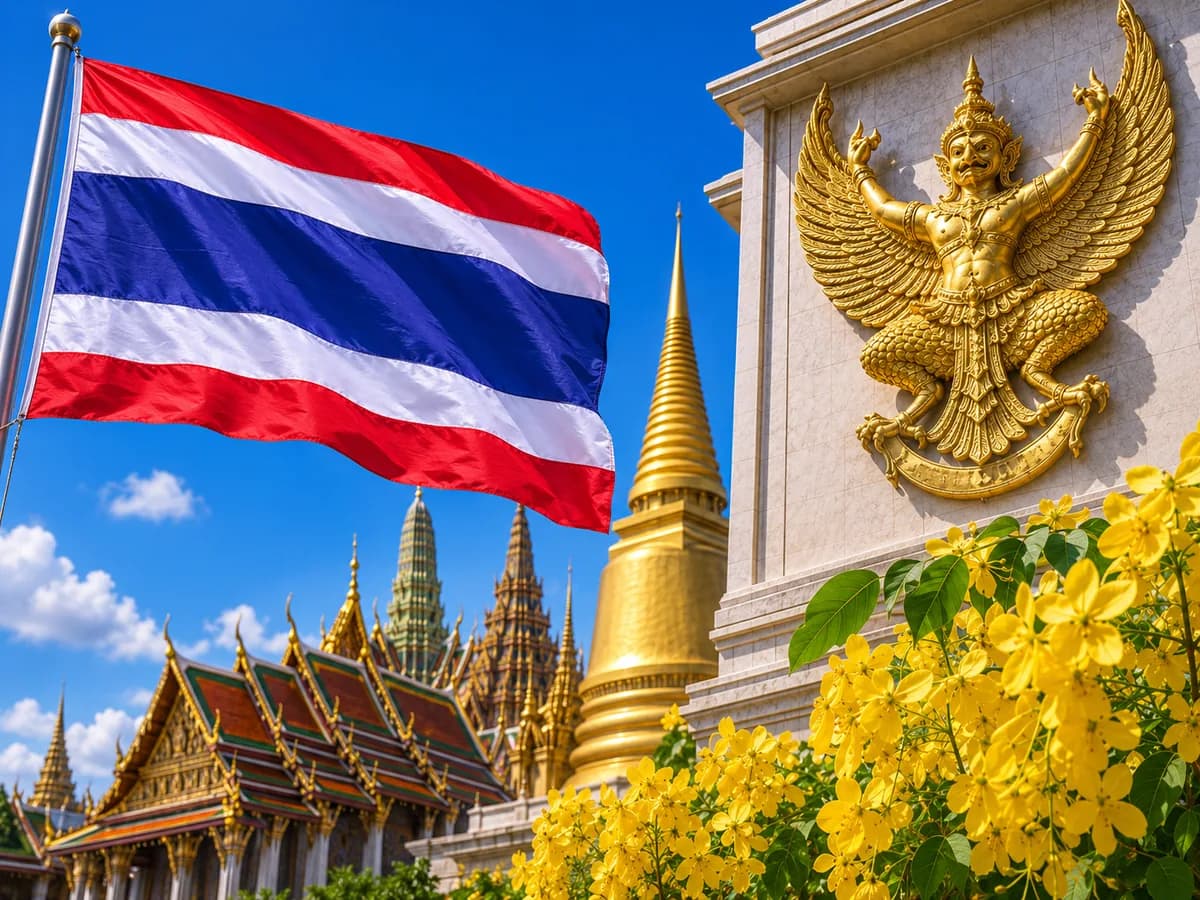
A traveller can spend only a few days in Thailand and already begin to recognise a visual and ceremonial language that appears almost everywhere.
The red, white and blue national flag flies outside schools, government offices and businesses. The Garuda appears above official entrances and on state documents. The national anthem can suddenly turn an ordinary railway station, park or public building into a quiet shared moment. Elephants, golden ratchaphruek flowers and elegant Thai pavilions appear in civic design, cultural events and public imagery.
These things are easy to notice. Understanding what they are, however, requires a little more care.
Thailand does not have one single emblem that explains the country. It has different kinds of symbols with different histories and official roles. Some belong to the nation as a whole. Some are state emblems. Some have been formally designated by Cabinet as national symbols or national-identity markers. Royal symbols belong to their own ceremonial and institutional tradition.
That distinction matters, because Thailand’s symbols are not interchangeable decorations. They represent different layers of national life: state, history, religion, monarchy, culture, public ritual and everyday identity.
Taken together, they offer a particularly interesting way to understand how Thailand presents itself — not through one image, but through many.
The Flag: Thong Trairong
The most visible national symbol is the Thai flag, known as Thong Trairong, the tricolour.
Its present form was adopted on 28 September 1917, during the reign of King Vajiravudh, Rama VI. The design consists of five horizontal bands: red, white, blue, white and red, with the central blue band twice the width of each of the others.
The official modern explanation of the colours is straightforward and important to preserve accurately. Red represents the nation and the unity of its people. White represents religion. Blue represents the King as Head of State.
For visitors, one detail is especially worth noticing: the official wording for white is religion, not specifically Buddhism. Theravada Buddhism is deeply important in Thai history and society, but the flag’s official symbolism uses the broader term.
The tricolour is now so familiar that it can be easy to imagine it has always looked this way. It has not.
Earlier Siamese flags developed through several forms over centuries. Plain red flags were used in maritime contexts. Later designs incorporated symbols associated with the monarchy, including the white elephant. By the nineteenth century, the white elephant on a red field had become one of the images most strongly associated with Siam abroad.
The transition toward the modern tricolour took place in the early twentieth century. A red-and-white striped design appeared before the blue central stripe was introduced in 1917. Official historical accounts place the change within a period when Thailand was modernising its state symbols and participating more visibly in an international world of national flags and diplomatic representation.
There are several historical explanations and contexts surrounding the introduction of blue. Rather than reducing the decision to one neat story, the safest conclusion is simply that the 1917 tricolour emerged from a longer evolution of Siamese flags and became the national flag that has continued into modern Thailand.
The date of its adoption is still commemorated. 28 September is Thai National Flag Day, formally established for national observance in 2017 on the centenary of the tricolour. It is a commemorative day rather than a public holiday.
A Flag With Older Stories Behind It
The older white-elephant flags are worth remembering because they show how national symbolism can change without disappearing completely.
The elephant no longer appears on Thailand’s national flag, but it never stopped being one of the country’s strongest cultural symbols. Its historical associations with kingship, warfare, labour, ceremony and prestige long predate the modern tricolour.
That makes the history of the flag a useful introduction to Thai national identity more generally. Symbols in Thailand often do not replace one another in a simple sequence. An older image can move into a different cultural role while a newer symbol takes on an official state function.
The white elephant moved away from the national flag. The Thai elephant remained deeply recognisable and was later formally designated as the country’s national animal.
The same pattern can be seen elsewhere. Ancient religious imagery appears on modern government buildings. Traditional architectural forms are used at international exhibitions. A greeting practised for generations can later receive a formal national-identity designation.
Thailand’s symbolic language is therefore both historical and living.
The Sound of the Nation
National identity is not only something you see. It is also something you hear.
Thailand’s current national anthem is Phleng Chat Thai. The melody was composed by Phra Chenduriyang, while the present lyrics were written by Luang Saranupraphan. The current version was officially adopted on 10 December 1939, after the country had changed its name from Siam to Thailand earlier that year.
The melody itself predates the present words. When new lyrics were selected in 1939, the existing melody was retained.
For visitors, what makes the anthem especially noticeable is its continuing place in public life. The national anthem is broadcast at 08:00 and 18:00 each day in public broadcasting and is heard in many official or public settings. Depending on where you are, you may see people pause what they are doing and stand respectfully while it plays.
For a traveller, there is no need to turn the moment into something complicated. If the people around you stop and stand, the respectful response is simply to do the same.
The national anthem should also not be confused with Sansoen Phra Barami, the royal anthem. The two belong to different contexts. Phleng Chat Thai represents the nation; Sansoen Phra Barami is associated with royal and ceremonial occasions.
That distinction is one of the simplest examples of why Thai national, state and royal symbols need to be described carefully rather than grouped together under one label.
The Garuda Above the Door
If the national flag is the symbol visitors see most often, the Garuda may be the official symbol they notice without immediately knowing what it means.
Look above the entrance of a government building, on an official document or in the visual language of the Thai state, and you may see the powerful bird-like figure known in Thai as Khrut or Phra Khrut Pha.
The Garuda is Thailand’s state emblem and official government symbol.
Its history reaches far beyond the modern Thai state. Garuda belongs to the religious and artistic traditions of South and Southeast Asia and is closely associated with Vishnu, or Narayana, in Brahmanical-Hindu tradition. Garuda also appears within Buddhist cosmology and has been represented in religious architecture and art across the region for many centuries.
The Fine Arts Department traces Garuda imagery in the territory of present-day Thailand at least to the Dvaravati period. Over time, the figure became closely connected with royal symbolism and later with the formal symbolism of the Thai state.
During the reign of King Vajiravudh, Rama VI, the Garuda seal became established in the official state and royal-seal tradition. Today the emblem remains one of the clearest visual signs that a building, document or institution belongs to the official sphere of government.
This is also why the Garuda should not be treated as a national mascot or simply as an attractive piece of Thai design.
Its use is legally regulated. Thailand has specific legislation governing the Garuda emblem and its authorised use, including circumstances in which private persons or businesses may receive permission to display it.
For a visitor, the practical lesson is simple: recognise the Garuda as an official emblem rather than assuming it is simply a general decorative motif.
Three Official National Symbols
In 2001, the Thai Cabinet approved a set of three national symbols representing the animal, floral and architectural identity of the country.
They are:
- The Thai elephant — the national animal
- Ratchaphruek — the national flower
- Sala Thai — the national architectural form
Each represents a different part of Thailand’s cultural landscape.
The Thai Elephant
Few animals are as closely associated with Thailand as the elephant.
Its place in Thai history reaches across royal ceremony, transport, warfare, forestry, religion, art and everyday working life. White elephants have had a particularly important association with the monarchy, while elephant imagery has appeared in state and national symbolism for generations.
The modern designation of the Thai elephant as national animal did not create that association. It formally recognised one that was already centuries old.
Thailand4U treats that history in detail elsewhere, so the elephant only needs a brief place here. In a national-symbols article, its importance is that it connects the modern state’s formal list of symbols with one of the oldest recognisable images of Thailand.
Ratchaphruek
Thailand’s national flower is ratchaphruek, commonly known in English as the golden shower tree, Cassia fistula.
Its long hanging clusters of bright yellow flowers are widely seen across Thailand, especially during the hotter months.
The 2001 Cabinet designation is specifically for ratchaphruek as the national flower. Thai forestry and botanical sources also refer to the ratchaphruek tree itself as Thailand’s national tree, reflecting a related designation history. Keeping those descriptions distinct avoids turning several official traditions into one simplified label.
The Cabinet designation gave the flower a formal place alongside the elephant and Sala Thai as one of the country’s three core national symbols.
Sala Thai
The third is not an animal or plant, but a form of architecture.
Sala Thai refers to the elegant open pavilion associated with traditional Thai architecture. Variations can be found in temple grounds, palace architecture, parks, public spaces and cultural exhibitions.
As a national architectural symbol, the Sala Thai represents something immediately recognisable in Thai visual culture: a roofline, proportion and openness that can communicate “Thailand” even before a sign or flag is added.
It is also a reminder that national symbolism does not need to be limited to heraldry. A building form can carry identity just as strongly as an emblem.
A Living List of Thai Identity
One of the most interesting discoveries when looking closely at official Thai sources is that the list of recognised national-identity markers did not stop with the three symbols approved in 2001.
Thailand has continued to give formal recognition to additional cultural symbols in different categories and through different institutional routes.
One older example is the Siamese fireback (Lophura diardi), known in Thai as kai fa phaya lo. Thai government, scientific and conservation bodies refer to it as Thailand’s national bird, following a 1985 proposal by the Wildlife Conservation Division of the Royal Forest Department. Its designation history is separate from the Cabinet’s 2001 three-symbol set, which is one reason it does not always appear in the same official summaries.
In 2019, the Siamese fighting fish, or Thai betta, was designated the national aquatic animal.
In 2022, the Cabinet approved the Naga as a national-identity symbol in the category of mythical creature.
The Naga has a particularly deep presence in Thai and wider mainland Southeast Asian religious culture. Serpent imagery appears in Buddhist architecture, temple stairways, local legends, river traditions and regional art. The official designation recognises that long-standing cultural presence without turning the Naga into the same kind of symbol as the national flag or state emblem.
In 2024, the wai was formally designated a national-identity marker in the category of Thai greeting and expression of respect.
That is especially interesting because the wai is not an object at all. It is a social practice: palms together, with the exact form and height varying according to context. Thailand had used and recognised the wai for generations before the Cabinet designation. The 2024 decision formally placed that practice within the country’s framework for preserving and presenting national identity.
In 2025, the Cabinet approved native Thai cats as a national-identity symbol in the pet category.
The Cabinet material identifies five surviving native Thai breeds: Suphalak, Korat, Wichien Maat, Konja and Khao Manee. The designation links their recognition to Thailand’s historical, cultural and genetic heritage and to efforts to preserve native breeds.
These newer designations are important, but they should not be misunderstood.
The betta fish, Naga, wai and Thai cats do not suddenly acquire the same legal or ceremonial status as the national flag, national anthem or Garuda. They belong to a growing framework of formally recognised cultural identity markers.
That difference in status is precisely what makes the modern list interesting.
Thailand is not simply preserving symbols inherited from the past. It is still identifying parts of its culture that it considers worthy of recognition and continuity.
Siam, Thailand and the Name of the Country
The country’s name is itself one of its most powerful identity markers.
For centuries, outsiders knew the kingdom as Siam. In 1939, the government formally moved to the name Thailand, with the English terms “Thailand” for the country and “Thai” for the people and nationality. Legal wording was aligned later that year.
The story did not end there.
On 7 September 1945, the government restored Siam and Siamese for English and other foreign-language use, while the country’s Thai-language name remained in use.
Then, on 11 May 1949, the government restored Thailand and Thai for foreign-language use. Thailand has remained the country’s English name since then.
For a traveller, that chronology is more useful than a slogan.
You will often encounter the memorable English gloss “Land of the Free” when Thailand’s name is explained. Whatever value that phrase has as a shorthand, it is not a substitute for the documented legal chronology of how the country’s modern official name changed. For this history, the dates and government announcements tell the story more reliably than a slogan.
Siam has not disappeared either.
The old name survives in institutions, businesses, historical writing, place names and cultural references. It has become part of Thailand’s historical vocabulary rather than its modern official English name.
So even the name of the country contains two layers at once: Thailand in the present, Siam in the historical memory.
National Days and Shared Public Ritual
Symbols become more powerful when they are used collectively.
Thailand’s National Day is 5 December, observed together with the birthday anniversary of King Bhumibol Adulyadej The Great, Rama IX, and Thailand’s Father’s Day.
Government agencies and Thai diplomatic missions mark the date with commemorative ceremonies and national-day events.
A separate observance takes place on 28 September, Thai National Flag Day, remembering the adoption of the tricolour in 1917. Flag Day is not a public holiday, but official agencies hold flag-raising and anthem ceremonies and encourage the display of the national flag.
These occasions help explain why national symbols remain so visible in Thailand.
The flag is not only something placed above a ministry. The anthem is not only something performed at a major state occasion. National symbolism also appears through repeated public ritual: school assemblies, government ceremonies, broadcasts, commemorative days and civic events.
For many visitors, the first encounter with this may be surprisingly ordinary: a station concourse at 18:00, people pausing while the anthem plays.
The moment lasts only about a minute.
But it reveals something important. A national symbol becomes meaningful not only through its design or history, but through the way people encounter it in everyday life.
National, State and Royal Are Not the Same Thing
Foreign-language travel writing sometimes uses “national symbol” as a convenient label for almost anything strongly associated with a country.
That approach does not work very well in Thailand.
The national flag and national anthem belong to the nation as formal national symbols.
The Garuda is the state emblem and official government symbol, with a specific legal and institutional role.
The Thai elephant, ratchaphruek and Sala Thai form the Cabinet-designated set of national symbols.
The betta fish, Naga, wai and Thai cats are later formally recognised national-identity markers in particular categories.
Other national cultural labels have their own histories too. Thai official cultural and diplomatic sources, for example, describe the Ramakien as Thailand’s national epic. That literary-cultural description is not the same kind of designation as a national flag, state emblem or Cabinet-approved identity marker.
And royal flags, royal monograms, royal seals and Sansoen Phra Barami belong to a distinct royal and ceremonial tradition associated with the monarchy.
All of these can be highly visible in Thailand. All can contribute to the country’s public visual culture. But they are not simply different versions of the same thing.
Understanding the category is part of understanding the symbol.
It is also the most respectful approach. Rather than assigning our own meaning to an emblem, we can begin by asking how Thailand itself officially describes it and where it is used.
What Visitors Should Understand
Travellers do not need to memorise a handbook of ceremonial rules to behave respectfully around Thai national symbols.
A few principles are enough.
Treat the national flag with the same basic respect you would give a country’s flag anywhere else. If the national anthem plays in a public place and people around you stop and stand, stand quietly with them. Recognise the Garuda as an official emblem rather than a casual design element. Follow local cues at ceremonies and government buildings.
Most importantly, approach unfamiliar symbolism with the same respect you would give important national symbols elsewhere.
The meaning of a symbol is not determined by whether an outsider immediately understands it. The Garuda can be simultaneously an ancient religious-artistic figure and a modern state emblem. The wai can be an everyday greeting and a formally recognised national-identity marker. The elephant can belong to ancient royal symbolism, working history, tourism imagery and modern conservation efforts at the same time.
Thai identity is large enough to hold all of those layers.
That is why the safest way to approach these subjects is with curiosity rather than certainty.
More Than One Symbol
So what makes Thailand Thailand?
The answer is not a flag alone. It is not the elephant, the Garuda, a temple roof or the sound of the national anthem.
It is the way many different symbols have accumulated around the country over time.
The tricolour adopted in 1917 carries a modern national identity built on older flag traditions. The anthem adopted in its current form in 1939 still marks shared moments in everyday public life. The Garuda connects ancient religious and artistic traditions with the formal authority of the modern state. The elephant, ratchaphruek and Sala Thai represent animal, natural and architectural identity. The national-bird tradition around the Siamese fireback and newer recognitions — the betta fish, Naga, wai and Thai cats — show that the official language of national identity has developed through several periods and institutional routes.
Even the country’s name carries layers: Siam in the historical record, Thailand in the modern state.
None of these symbols needs to stand alone as a complete definition of the country.
Together, they form something more interesting: a visual, musical, ceremonial and cultural vocabulary through which Thailand tells its story.
And once you begin to recognise that vocabulary, you start seeing it everywhere.