Ask an English speaker where Thailand’s capital is and the answer is obvious: Bangkok. Ask a Thai person and you are much more likely to hear: Krung Thep. Both are correct. That is the first thing to understand. “Bangkok” is the internationally established name. “Krung Thep” is the normal everyday Thai name. The city effectively lives with two identities at once.
What Does Krung Thep Mean?
In Thai, Bangkok is officially called: Krung Thep Maha Nakhon. กรุงเทพมหานคร In everyday conversation, Thai people usually shorten that to: Krung Thep. กรุงเทพฯ The Bangkok Metropolitan Administration itself uses “Krung Thep Maha Nakhon” as the Thai name of the capital. So when a Thai person says: “I’m going to Krung Thep” they mean Bangkok. Krung can mean a capital or great city. Thep relates to deities, celestial beings or angels. So “Krung Thep” is commonly translated into English as: City of Angels. That translation is useful. It is not a perfect word-for-word explanation of every historical linguistic layer. But it captures the basic idea. The official Thai form continues: Krung Thep Maha Nakhon. Maha means great. Nakhon means city. So the full everyday official form gives the sense of a great capital city of celestial beings or angels.
In normal speech, nobody needs all of that. Krung Thep is enough. This is where the history gets interesting. The name Bangkok predates the modern capital founded on the eastern side of the Chao Phraya River in 1782. Forms of the name were already used for a settlement or area around the river before the present city became the capital. Foreign visitors and traders encountered that older local name. They kept using it. The name survived internationally even after the royal capital developed under a different Thai ceremonial identity. A famous explanation says “Bangkok” came from: Bang Makok. Bang can refer to a riverside settlement or village. Makok is associated with a type of fruit tree, often identified with the olive-like Spondias species. That produces translations such as: Village of wild plums. Village of olive plums. Village of makok trees. It is a neat explanation.
It is also not completely certain. Older place names rarely arrive with a signed certificate explaining exactly why they were created. Different linguistic explanations for Bangkok have circulated. “Bang Makok” is probably the best-known and most commonly repeated. Thailand4U treats it as a plausible traditional etymology rather than pretending the debate is perfectly settled.
A City Built Around Water
The element “bang” appears in many Thai place names. It often refers historically to a settlement associated with water, especially a riverside or canal-side community. That makes sense in central Thailand. Before roads dominated Bangkok, water was the great transport network. The Chao Phraya River shaped the settlement. Canals shaped neighbourhoods, Boats carried people and Markets grew beside waterways. A place name beginning with “Bang” belongs naturally to this older landscape. Modern Bangkok may look like highways, malls and towers. Its naming history comes from a water city. For centuries, Ayutthaya was the great Siamese capital. The lower Chao Phraya area around modern Bangkok was strategically important because ships travelling toward Ayutthaya passed through it. Settlements, customs points, temples and defensive positions developed around the river. Foreign merchants became familiar with the area. That helped preserve the name Bangkok in foreign usage.
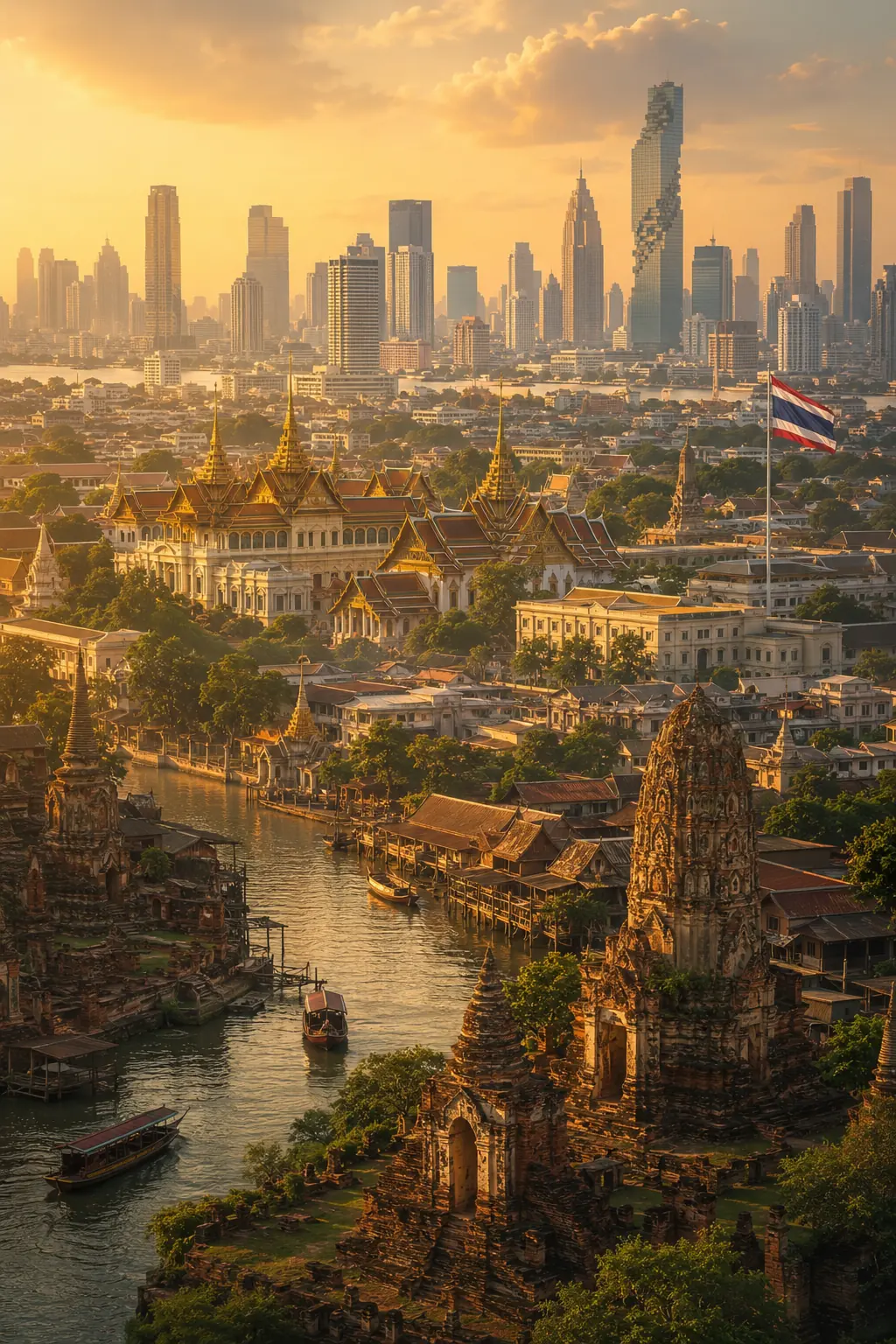
Ayutthaya fell to Burmese forces in 1767. The old capital was devastated. Siam needed a new political centre. King Taksin established his capital at Thonburi, on the west bank of the Chao Phraya. This is important because modern Bangkok did not instantly appear in 1767. For roughly fifteen years, Thonburi served as the capital. Today, Thonburi is part of metropolitan Bangkok. At the time, it represented the political centre of the restored Siamese kingdom. 1782 In 1782, King Rama I founded the new capital on the east bank of the Chao Phraya. The Chakri dynasty began. The Grand Palace was established. Wat Phra Kaew became the royal temple. The Rattanakosin era began. This is the decisive foundation moment of the modern Thai capital. The east-bank site offered strategic and defensive advantages. The river could protect part of the city. Canals helped create a fortified urban island around the royal centre. The new capital also allowed Rama I to construct a political and ceremonial city aligned with the restored kingdom.
The Capital Received a Royal Name
The historic royal centre is often called Rattanakosin. Visitors know it through: The Grand Palace. Wat Phra Kaew, wat Pho, sanam Luang and old royal and administrative districts. This is the Bangkok created as the new Chakri capital from 1782 onward. The new capital was not simply treated as “Bangkok” in Thai royal usage. It received an elaborate ceremonial name expressing sacred kingship, cosmology, royal power and the grandeur of the new capital. The short everyday form eventually became: Krung Thep. Bangkok is famous for having an extraordinarily long ceremonial name. In one commonly taught romanised form it begins: Krung Thep Maha Nakhon Amon Rattanakosin Mahinthara Ayutthaya Mahadilok Phop Noppharat Ratchathani Burirom Udom Ratchaniwet Maha Sathan Amon Phiman Awatan Sathit Sakka Thattiya Witsanukam Prasit Spellings vary because Thai does not have one perfectly intuitive English transliteration system. No. Not when ordering lunch.
Not when buying a train ticket. Not when telling a friend where they live. In normal life: Krung Thep. Royal capital names in the region could function very differently from ordinary geographic labels. They could express: Sacred legitimacy. Buddhist and Brahmanic cosmology, Royal authority, Auspicious meaning, Connections with earlier capitals and Divine protection. The name was not designed for airport baggage tags. The ceremonial title praises the capital rather than merely locating it. English translations vary, but the general imagery includes ideas such as: City of celestial beings, great city, precious jewels, royal residence, divine construction and sacred protection. The language connects the capital with an ideal cosmic and royal order. One fascinating feature is the reference to Ayutthaya. The new Bangkok capital did not imagine itself as a complete break from Siamese history. The early Chakri kingdom consciously drew legitimacy and culture from Ayutthaya. Architecture.
Court traditions, religious institutions and administrative practices. The new capital inherited the memory of the old one. Rattanakosin was new. But it was also designed as a restoration. Siam had survived catastrophe. The monarchy rebuilt a capital. Temples were restored or created. Texts were recovered. Court culture was reconstructed. Bangkok became a new city carrying an older civilisation.
Why Foreigners Kept Saying Bangkok
Foreign languages are stubborn. Once merchants, diplomats and mapmakers adopt a place name, it can remain in international use for centuries. The outside world already knew the river settlement as Bangkok. The new royal capital grew in the same general area. The old foreign name stuck. Cities often have different names in different languages. München becomes Munich. Köln becomes Cologne. Firenze becomes Florence. Wien becomes Vienna. Places accumulate names through history. Bangkok is simply a particularly dramatic example because Thai everyday speech uses a visibly different name. A name used by outsiders that differs from the local name is often called an exonym. “Bangkok” functions in that way today. English and many other languages use Bangkok. Thai speakers commonly use Krung Thep. That distinction matters. Sometimes people discover “Krung Thep” and announce: “Bangkok isn’t really called Bangkok!” That goes too far.
Bangkok is the internationally recognised English name and is used officially in international contexts. Thailand itself uses “Bangkok” extensively in English. Airport signs, government material, tourism promotion and international addresses. Both naming traditions are legitimate. You do not need to correct the Tourism Authority of Thailand. Or Bangkok Metropolitan Administration English-language material. Or airline systems. When communicating in English: Bangkok is normal. Krung Thep is normal. This is one of those rare travel lessons where the answer changes entirely with language. In English, someone from Bangkok can be called a Bangkokian. In Thai, identity is expressed through Thai language in different ways. The English demonym belongs to the English name. No contradiction exists. Then modern travel created a third identity: That abbreviation is everywhere. Airport codes, hotel bookings, social media, travel itineraries and business shorthand. Bangkok became three letters. Suvarnabhumi Airport uses the IATA code: Don Mueang uses: So “BKK” often refers specifically to Suvarnabhumi in aviation systems even though travellers also casually use BKK to mean Bangkok as a city. Context matters.
Suvarnabhumi Is Not “Bangkok Airport” in the Name
Suvarnabhumi has its own Thai name. Yet internationally it is usually marketed and understood as Bangkok’s main airport. Again, Thai geography contains multiple naming layers. Visitors who begin recognising Thai can spot: กรุงเทพ or forms including กรุงเทพมหานคร on signs. Suddenly the mysterious script becomes useful. That sign is pointing toward Bangkok. Thai frequently abbreviates Krung Thep Maha Nakhon as: กทม. You may encounter this in addresses and official contexts. It essentially functions like a compact Bangkok abbreviation in Thai. Because your interface language matters. English map: Bangkok. Thai map: กรุงเทพมหานคร or local Thai naming. Modern digital maps adapt place labels to the user. A foreign traveller waiting for “Bangkok” may hear “Krung Thep” in Thai announcements. That can initially sound like an entirely different destination. It is not. You are going to the same city.
Thailand’s rail system historically used Hua Lamphong as Bangkok’s famous central terminal. The newer Krung Thep Aphiwat Central Terminal became the principal long-distance railway hub. Notice the name: Krung Thep. Thai official naming naturally appears where English-speaking visitors might expect “Bangkok.” The name of the central terminal gives travellers a useful language lesson. Krung Thep = Bangkok. Once you know that, transport signage becomes easier to understand. Because transliteration practices vary. Some Thai government decisions and style changes occasionally generate news stories suggesting that “Bangkok has changed its name.” These stories are often misleading. Krung Thep Maha Nakhon has long been the official Thai name. Bangkok remains the established English name. In 2022, a Thai government terminology update generated international headlines claiming Bangkok was being renamed Krung Thep Maha Nakhon. That interpretation overstated what happened. The Thai name was not newly invented.
The adjustment concerned official transliteration and naming presentation. “Bangkok” continued to be recognised and used. Thai people had already been saying Krung Thep for generations. Foreigners had already been saying Bangkok for generations. A terminology decision did not suddenly transform the capital.
Language Headlines Love Drama
“Bangkok officially changes name!” gets clicks. “Administrative naming convention clarifies a bilingual usage that has existed for a long time” does not. “City of Angels” carries obvious poetry. Bangkok sounds more abrupt. For travellers who learn the Thai name, Krung Thep can feel like discovering the city’s hidden identity. But Thai speakers are not necessarily thinking about angels every time they say it. Words become ordinary through use. English speakers say Los Angeles without constantly imagining angels. Thai speakers say Krung Thep without necessarily contemplating celestial beings on the BTS. Etymology can be poetic. Daily language becomes practical. Modern Bangkok is enormous. The historical royal centre is only one part. Sukhumvit, silom, sathorn, chatuchak, ratchada, thonburi, lat Phrao, bang Na and dozens of districts. The metropolitan region spreads far beyond the original river settlement associated with early Bangkok.
Modern Bangkok is a special administrative area governed by the Bangkok Metropolitan Administration. Its Thai official territorial name is Krung Thep Maha Nakhon. The modern administrative city includes both sides of the Chao Phraya. This produces a historical irony. Thonburi was once a separate capital across the river. Today it is part of Bangkok. The city absorbed the capital that came before it. Many Bangkok residents still talk meaningfully about the Thonburi side and the Phra Nakhon/east-bank side. Bridges and rail lines connect them. The historical geography remains socially visible. Phra Nakhon is now one of Bangkok’s districts and contains much of the historic Rattanakosin core. The name relates to the royal/capital city. Again, Bangkok contains layers of names inside names. One of Bangkok’s most historically important roads contains “Krung” in the name: Charoen Krung. Often translated approximately as “Prosperous City.”
Opened in the 19th century, it became one of Bangkok’s landmark modern roads. The vocabulary of the capital appears in the city’s infrastructure. Bangkok’s BTS also includes Krung Thon Buri station. Thai urban names repeatedly preserve older geographic and political language. Learning a few words starts connecting the map.
Krung Does Not Automatically Mean Bangkok
Krung is a general concept connected with a capital or great city. Historically it can appear in references to other capitals too. Krung Thep became the familiar short name for this particular capital. Historical capital naming is complicated. Ayutthaya had its own formal royal names and titles. Modern simplified place names often conceal much richer historical terminology. Bangkok’s long name belongs to that wider Southeast Asian royal tradition. In premodern Southeast Asian kingship, a capital was more than municipal administration. It could represent: Political order. Religious merit, cosmic geography, royal legitimacy and sacred protection. Naming the capital could therefore be an ideological act. Thai royal culture historically combined Theravada Buddhist kingship with Brahmanic-Hindu court traditions. The ceremonial name reflects that layered intellectual world. Deities, Sacred geography, Royal power and Buddhist legitimacy. These ideas could coexist.
When Rama I established the new capital, a city pillar — Lak Mueang — was erected. The Bangkok City Pillar Shrine remains near the Grand Palace. City pillars in Thai tradition symbolically anchor and protect settlements. The foundation of Bangkok was therefore ceremonial as well as practical. A capital required: Palace, Temple, Defences, Administration, Religious legitimacy, Ceremony and Cosmological order. The royal name belonged inside that foundation process. Wat Phra Kaew and the Emerald Buddha became central symbols of the new capital and kingdom. The sacred centre strengthened continuity between monarchy, Buddhism and the new city. That helps explain why Bangkok’s royal name carries such elevated language. The Grand Palace was not simply a royal residence. It was the political and ceremonial heart of early Rattanakosin Bangkok. The city grew outward from this royal core. Over the 19th and 20th centuries: Canals expanded. Roads expanded. Foreign quarters developed.
Chinese communities grew, railways arrived, trams arrived, modern government buildings appeared, cars arrived, skyscrapers arrived and mass transit arrived. The sacred royal capital became a giant commercial metropolis. Krung Thep once described a royal capital centred around palace and temple. Today it includes: Mega malls, expressways, condominiums, night markets, office towers, TikTok creators, street food, luxury hotels and motorbike taxis. The City of Angels got very busy.
Bangkok as a Global Brand
Internationally, “Bangkok” became one of the strongest city brands in Asia. Travel, food, Nightlife, business, Film, Literature and Air travel. The name acquired meanings far beyond its old river-settlement origins. For Thai residents, Krung Thep can feel less like a tourism brand and more like the normal name of home. That difference is subtle but important. Visitors know Bangkok. Thais live in Krung Thep. They can, particularly when speaking with foreigners, discussing English-language branding or using international terminology. Language is flexible. But Krung Thep remains the normal Thai reference. No. If speaking English: Bangkok is completely correct. If speaking Thai: Krung Thep sounds natural. There is no cultural prize for forcing Thai terminology into every English sentence. You recognise road signs. Transport names make sense. Thai conversations become easier to follow. You understand why a friend says a city name that sounds nothing like Bangkok.
One tiny piece of vocabulary unlocks a lot. A rough foreign-friendly pronunciation is: Groong Thep. The initial sound in Krung is not exactly identical to an English “kr.” Thai pronunciation contains sounds and tones that Roman spelling cannot represent perfectly. Listen to a Thai speaker if you want to say it naturally. A slightly imperfect Krung Thep will still be understood in context. Thai people have heard worse. Because the two names come from different historical layers. Bangkok: an older local geographic name preserved internationally. Krung Thep: the royal-capital name associated with the city founded under Rama I. Both survived. Different languages chose different layers. No secret renaming, no fake city name and no historical conspiracy. Just two naming traditions that never displaced each other. Foreigners say: Bangkok. Thai people usually say: Krung Thep. The official Thai administrative name is: Krung Thep Maha Nakhon.
“Krung Thep” is commonly understood as “City of Angels.” “Bangkok” is an older name associated with the area before the Chakri capital was established in 1782. Foreigners kept using the older name. Thai royal and everyday usage developed around the newer capital name. Both survived into the modern world. Bangkok is the name on your airline ticket. Krung Thep is the name you will hear from the person sitting next to you. Same city. Two histories. Learn it if you want to impress somebody. But if a taxi driver asks where you are going, please do not recite the entire thing. Just say: Krung Thep. Or better yet: Give them the actual district. Bangkok is rather large.