One of the easiest ways to spot a first-time visitor in Thailand is at the doorway. They walk in. Then notice a line of shoes outside. Then look down. Then look back. Then perform the universal traveller expression: “Oh.” Taking your shoes off is one of the most common pieces of everyday etiquette in Thailand. Homes, temple buildings, some guesthouses, certain shops, massage businesses, small offices and private rooms. The exact rule changes with the place. But the basic idea is simple: Outside shoes often stay outside.
The Simplest Rule
If you see a pile or row of shoes at the entrance, remove yours. That one observation will solve most situations. You do not need a cultural lecture every time. Look at the doorway. Look at what Thai people are doing. Copy the pattern. There are several overlapping reasons: cleanliness, respect and the symbolic status of feet. The separation between outside space and inside space. Religious etiquette. Habit. Thai culture does not usually reduce the practice to one single explanation. All of these can matter. Start with the practical explanation. Thailand is hot. Roads can be dusty. Rain creates mud. Pavements are not always spotless. People walk through markets, car parks, streets and public areas. Bringing all of that onto the floor inside a home is unnecessary. Removing shoes keeps the interior cleaner. People may sit on floors. Children play on them. Families eat near them.
Buddhist practice may involve kneeling or sitting low. A clean floor therefore matters more when the floor is actively part of daily life rather than simply something beneath furniture. Thai etiquette traditionally treats the head as the highest and most respected part of the body. The feet are the lowest. This is both literal and symbolic. Pointing your feet toward people or sacred objects can be disrespectful. Stepping over food or important objects can also be inappropriate. Shoes, being attached to the feet and carrying outside dirt, naturally belong to the less respected side of this symbolic system. A bare foot is already culturally associated with the lowest part of the body. A shoe has touched roads, toilets, pavements and dust. So bringing footwear into a clean or sacred interior can feel doubly inappropriate.
This is why shoe removal makes intuitive cultural sense even beyond hygiene. Thailand Foundation's etiquette guidance is very direct: When entering a Thai person's home, footwear should normally be removed. This applies whether the house is modest or expensive. For travellers, this is one of the safest etiquette assumptions you can make.
The Shoe Pile Is the Sign
You arrive at someone's house. There are shoes outside. Do not ask: “Should I take mine off?” You already have the answer. Add yours to the group. Then observe. Some homes have a shoe rack inside the entry area. Some residents may tell you to leave shoes on. Modern apartments can have different household habits. The safest rule is: Follow the host. If someone says: “No problem, keep them on.” You do not need to insist on removing them to prove cultural awareness. Etiquette is about making the host comfortable. Not winning a Thai-culture competition. Usually either is fine in an ordinary home. If your socks are soaked from rain, use common sense. If your feet are very dirty, clean them if possible. The goal is cleanliness and respect, not rigid ceremony. Now you understand why slip-on footwear is so convenient in Thailand.
Shoes go on. Shoes come off. Shoes go on again. A complicated pair of boots with seventeen laces becomes less charming after the sixth doorway. This is one of those small ways culture and climate reinforce each other. Hot weather already makes sandals practical. Frequent shoe removal makes them even more practical. The result: A country where footwear can come off in roughly 1.3 seconds. Temple etiquette is the second major context. Thailand Foundation notes that visitors remove footwear before entering important temple interiors such as buildings housing Buddha images and certain specially sacred areas. Shoes do not necessarily need to be removed throughout the entire outdoor temple compound. A common tourist misunderstanding is: “Temple = no shoes anywhere.” Usually not. You can often walk around the outdoor grounds wearing footwear. Then remove it before entering the relevant sacred building.
Look for shoe racks and signs. Tourism Authority of Thailand travel guidance also instructs visitors to dress politely and remove shoes before entering Buddhist temples. So this is not an obscure etiquette rule. It is one of the standard expectations visitors should know.
The Ubosot and Viharn
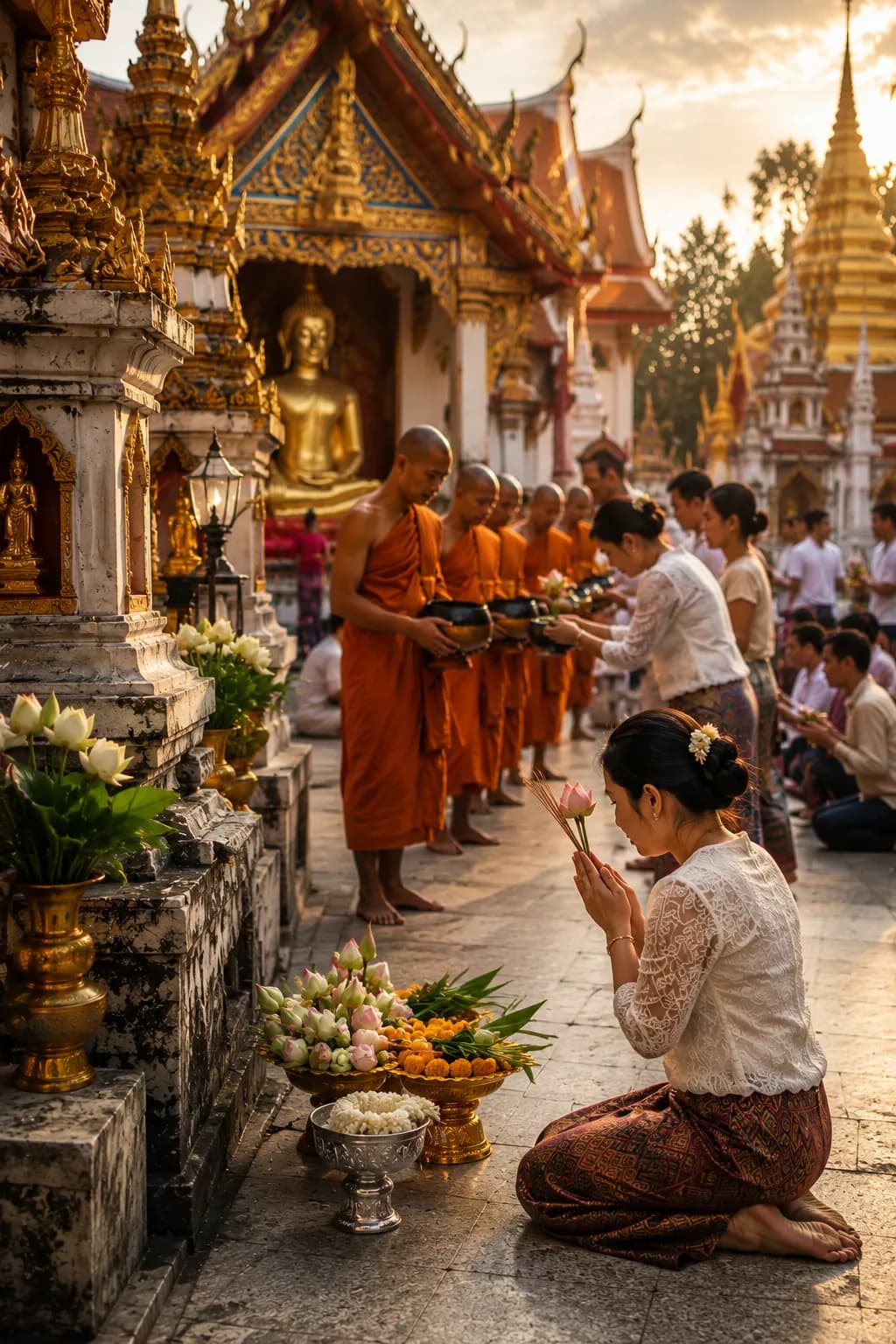
Important temple halls such as the ubosot and viharn typically require shoe removal. These buildings contain sacred Buddhist spaces and images. Leaving outdoor footwear at the entrance helps preserve both physical cleanliness and ritual respect. Think about what happens inside, people kneel, bow, sit on the floor, pray, meditate and pay respect to Buddha images. The room is treated differently from an ordinary commercial interior. Removing shoes physically marks the transition into sacred space. Traditional etiquette can also attach significance to thresholds. At some temple buildings and older houses, it is better to step over the threshold rather than stand or tread directly on it. You do not need to obsess over every doorway. But watching local behaviour can reveal these small customs. At major tourist temples, rows of footwear can look chaotic. Usually, people leave shoes in designated areas without drama.
If a temple provides racks or bags, use them. Do not bring extremely precious footwear if leaving it unattended would ruin your entire day. Walk in wearing 300-euro designer shoes. Spend twenty minutes thinking about the shoes instead of the Buddha. Lesson learned. Socks can often remain on unless local rules indicate otherwise. The key rule concerns shoes and outdoor footwear. Some places or traditions may differ. Again: Observe signs and local practice. At highly important religious or royal locations, dress and footwear rules may be more formal. The Grand Palace and Wat Phra Kaew, for example, enforce specific visitor standards. Do not assume casual beachwear and whatever footwear worked at a small neighbourhood temple will automatically fit every formal site. Thailand is religiously diverse. Mosques also commonly require footwear to be removed before entering prayer spaces. This is part of Islamic practice rather than specifically Thai Buddhist etiquette. In southern Thailand and Muslim communities elsewhere, visitors will encounter this frequently.
Shoes and Religious Universality
Some Sikh religious sites in Thailand also require visitors to remove footwear before entering. Tourism Authority of Thailand guidance for Bangkok's Sikh temple in Phahurat notes shoe removal among the etiquette expectations. So shoe removal in Thailand can belong to several religious traditions, not just Buddhism. Thailand's habit can therefore feel culturally broad because several communities share similar practical rules around sacred interiors. The reason may differ. The behaviour looks familiar: Shoes stay outside. Many massage businesses ask customers to remove shoes at the entrance. This makes practical sense. Customers may walk through treatment areas barefoot or wearing indoor slippers. Floors need to remain clean. Some businesses provide sandals or slippers specifically for indoor use. Large spas may have formal reception areas where shoes remain on until changing rooms. Small neighbourhood massage shops may want them off immediately. Look at the entrance.
The shoe rack continues to be your friend. Some small shops operate partly like homes. A family may live behind or above the business. The customer area may be raised or kept especially clean. You may see shoes outside. If so, take yours off unless told otherwise. Do not walk into 7-Eleven barefoot because you have learned Thai etiquette. Shopping malls, Supermarkets, Convenience stores, Department stores, Most restaurants, Normal commercial public spaces and Shoes stay on. New visitor learns: “Thai people remove shoes indoors.” Next morning: Shoes come off in Starbucks. No. The real rule is contextual. Most conventional restaurants allow footwear. But certain traditional restaurants with raised seating platforms or floor seating may ask you to remove shoes before stepping onto the platform. Again, the architecture gives you the clue. A raised wooden platform often represents cleaner or more intimate interior space. Shoes may stay below. This pattern appears in traditional homes and some restaurants. The elevation itself marks the transition.
Your Hotel Room
Small guesthouses and family-run accommodation may ask guests to leave shoes near the entrance. Larger hotels usually do not. A boutique property can fall anywhere in between. Read signs, watch staff and follow the house rule. Do you have to remove shoes in your own hotel room? There is usually no cultural enforcement. Many people still prefer not to wear outdoor shoes inside. Some hotels provide slippers. This becomes personal cleanliness rather than social etiquette. Thai condominium households often follow the same basic home practice. Shoes near the entrance, indoor floor kept clean and but household habits vary. A modern condo does not automatically mean Western shoe habits. Most conventional offices allow shoes. Employees are not normally working barefoot in corporate towers. Small family businesses or informal workplaces can differ. The company culture wins. Footwear rules vary between schools and specific spaces.
Students may wear shoes in some areas and remove them for particular rooms or activities. Do not assume one national school rule. Some small clinics or specialist rooms may ask for shoes to be removed. Large hospitals generally operate like modern public institutions where footwear stays on. Follow signs. Shoes often come off where people use floor mats. This is practical and not uniquely Thai. The difference is that in Thailand the habit feels more culturally natural because shoe removal is already normal elsewhere. Visitors sometimes imagine shoe removal as an exotic ritual. It is also basic engineering. If people sit, kneel or sleep closer to floor level, keeping outside dirt away becomes extremely sensible. In a cold country, removing heavy boots and then walking on an icy floor sounds unpleasant. Thailand has fewer such problems. Bare feet indoors fit the climate naturally. During heavy rain, footwear becomes wet and dirty quickly. Leaving soaked shoes at the entrance prevents the entire interior becoming a muddy skating rink. Practicality wins again.
The Shoes-outside-house Image
Rows of sandals outside a home tell you something socially. People are inside. Guests have arrived. A family event may be happening. The footwear itself becomes evidence of community. At temple or home ceremonies, many people may remove shoes before entering a particular space. The resulting mountain of footwear can become impressive. Remember roughly where you left yours. Or accept your destiny. Religious events may move between outdoor and indoor spaces. Footwear can repeatedly go on and off. This is another situation where easy sandals suddenly feel like advanced technology. Songkran is famous internationally for water fights. Many Thai families also visit temples and make merit. The same temple etiquette continues: Appropriate clothing. Respectful behaviour. Shoes removed where required. Monks themselves follow monastic customs around footwear and sacred spaces. Visitors do not need to copy every monastic practice.
The important part is respecting the rules of the temple area you are entering. Shoe etiquette becomes easier when you understand Thailand's symbolic body hierarchy. Head = high. Feet = low. Thailand Foundation explicitly describes the head as treated with special respect and the feet as the lowest part of the body in Thai etiquette. This does not mean Thai people spend every second consciously ranking body parts. It is cultural background that explains several everyday rules. Inside a temple, avoid sitting with the soles of your feet aimed directly toward Buddha images. Fold your legs to the side or sit in another comfortable respectful position. Nobody expects foreign visitors to achieve yoga-level flexibility. Visible effort matters. Especially elders or monks. Again, context matters, nobody panics because your foot accidentally faces someone under a restaurant table. The rule becomes more important in formal or sacred situations. Putting feet on tables, chairs, pillows or objects associated with respect can look rude. Using your feet to move something important is also best avoided.
Stepping Over People
Foreign travellers sometimes point toward something with a foot because their hands are full. In Thailand, this can look especially disrespectful. Use your hand. Avoid stepping over someone sitting or lying on the floor when you can walk around. The feet passing above another person's body create the wrong symbolic hierarchy. Also avoid stepping over food. The combination of feet and something people eat is obviously undesirable hygienically and culturally. Do not put your shoes on chairs or tables. This would be rude in many countries. In Thailand, the symbolic role of shoes makes it even more obvious. The sole is the dirtiest and symbolically lowest part. Avoid deliberately displaying it toward sacred images or people in formal contexts. Once again, casual sitting is not a minefield. Just be aware. After reading etiquette guides, some visitors become terrified of moving. Foot pointed somewhere.
Was that offensive? Touched shoe. Was that offensive? Stepped over a bag. Was that offensive? Relax. Thai people generally distinguish between deliberate disrespect and a visitor making a harmless mistake. You are unlikely to create an international incident because you forgot your shoes for thirty seconds. If someone points to them: Smile. Say sorry. Remove them. Problem solved. If the host asks you to remove shoes and you refuse because: “My culture doesn't do that.” Now you are creating a real etiquette problem. Respect means adapting when the local expectation is obvious. Which is the “real” reason for shoe removal? Both. Cultures rarely develop practices from only one cause. Clean floors make sense. Sacred spaces require separation. Feet carry symbolic meaning. Homes are private. Over generations, these reinforce each other. Visitors familiar with Japan may immediately understand the concept. But Thai shoe etiquette is not identical to Japanese genkan culture. There is usually less architectural formalisation in ordinary Thai homes. Do not assume every Asian country shares one system.
The Sweden Connection
For Swedish visitors, removing shoes at home is not particularly exotic either. The cultural surprise is more about how often the rule can extend into temples, small businesses and other spaces. In that sense, a Swede may adapt faster than someone from a culture where outdoor shoes are commonly worn through the house. Visitors from cultures where shoes often stay on indoors may need the bigger adjustment. The rule feels personal at first. It is not. Nobody is evaluating your socks. They just do not want the pavement on the living-room floor. If you worry about leaving expensive footwear outside, use the available shoe rack or storage system. At heavily visited locations, consider wearing something less valuable. Travel practicality sometimes beats fashion. A question nobody asks until the shoes are already off. Thailand is hot. Feet sweat. Life continues.
Basic hygiene solves more than cultural philosophy here. Thailand will eventually expose them. Plan accordingly. Some major sites may offer plastic bags or other systems for carrying footwear. Use whatever arrangement the location provides. Do not improvise by hiding shoes behind sacred architecture. At busy temples, avoid stopping directly in the entrance to untie complicated shoes while forty people pile up behind you. Move aside, Remove footwear and Then enter. Likewise, do not block the exit while reconstructing your hiking boots. Tiny etiquette. Big improvement. Because it is habitual. Someone raised in a shoe-removal household does not consciously debate it. The body simply stops at the threshold and the shoes come off. Foreign visitors often become the same after a few weeks. Spend enough time in Thailand. Return to a country where people walk through the house in outdoor shoes.
Suddenly you are the person staring at them thinking: “You walked where in those?” The habit is taught through repetition. Come inside. Shoes off, temple, shoes off, raised platform and shoes off. The behaviour becomes automatic before anyone needs an anthropological explanation.
Shoe Racks as Cultural Technology
An object can reveal a habit. A shoe rack outside a home. A row of hotel slippers. A temple shelf. Architecture and furniture evolve around social customs. Here is a useful traveller trick. Before entering a small business, glance down. Shoes outside? Remove yours. No shoes outside and customers walking in wearing footwear? Keep yours on. This takes one second. That is a good clue too. If employees inside are wearing outdoor shoes, you probably can. If everyone is barefoot or in indoor slippers, pause at the door. Some businesses or homes provide indoor slippers. Take off your outdoor shoes and use the provided pair. This maintains the clean/dirty boundary while keeping feet covered. Occasionally you may encounter separate slippers for bathrooms or wet areas. Do not wear them around the rest of the property.
If something looks suspiciously like dedicated toilet footwear, there is probably a reason. Some resorts contain shrines or small temple-like spaces. Do not assume normal hotel footwear rules apply inside the sacred area. The function of the space matters more than who owns the property. You normally do not remove your shoes merely because you walk past an outdoor spirit house. Spirit houses are sacred objects, but they are usually placed outside. Respectful behaviour does not require stripping footwear in the car park. Rules can vary at Chinese shrines and temples. Some allow footwear inside areas where a Thai Buddhist temple hall would not. Others ask for removal. Follow signs and local worshippers. Do not take one temple rule and apply it to every sacred place in Thailand: Buddhist, Chinese, hindu, muslim, sikh and christian. Each tradition has its own practices.
Respect begins with observing the actual place. Christian churches in Thailand generally follow ordinary Christian footwear practices. Shoes usually remain on unless a specific local custom says otherwise. Being in Thailand does not make every religious building shoe-free.
The Cultural Rule Versus the Building Rule
Think of it this way: Thai culture creates a strong preference for removing shoes in certain contexts. The individual building decides whether the rule applies there. This prevents overgeneralisation. Because it is easy to remember. But the more accurate version is: Remove shoes before entering temple buildings or sacred areas where this is required. Thailand Foundation makes that distinction explicitly. This surprises people, outdoor courtyards, paths, car parks, open areas and footwear commonly stays on. Then a shoe rack appears before a hall. That is the transition point. If a sign says: remove them. If another place clearly allows footwear, follow that practice. Local instructions outrank generic travel advice. Observe. Thailand communicates many etiquette rules visually. Shoes, clothing, queues, seating, offerings and temple behaviour. You can learn a huge amount simply by watching what everyone else does.
Outdoor footwear is often removed before entering Thai homes and important sacred interiors because cleanliness, respect and the symbolic low status of feet all reinforce the same behaviour. Before entering: 1. Is this a private home? Probably shoes off. 2. Is this a Buddhist temple hall or sacred interior? Shoes off. 3. Are there shoes lined up outside? Definitely shoes off. 4. Is this a normal mall, restaurant, shop or office? Probably shoes on. 5. Unsure? Watch someone local. Most Thai etiquette becomes easier once you stop searching for universal rules. Context is the rule. Removing shoes takes seconds. But it communicates something larger: I noticed your space. I respect your home. I understand this place is different from the street outside. I am willing to adapt. That is why such a small habit matters. Why do you take your shoes off in Thailand?
Because Thai homes and sacred spaces are often kept separate from the dirt of the outside world. Because floors are actively used for sitting, kneeling and daily life. Because feet occupy the lowest symbolic position in traditional Thai etiquette. Because religious spaces demand additional respect. And because after generations of doing it, taking shoes off is simply normal. If there are shoes at the door, yours probably belong there too. Thailand does not get much easier than that.