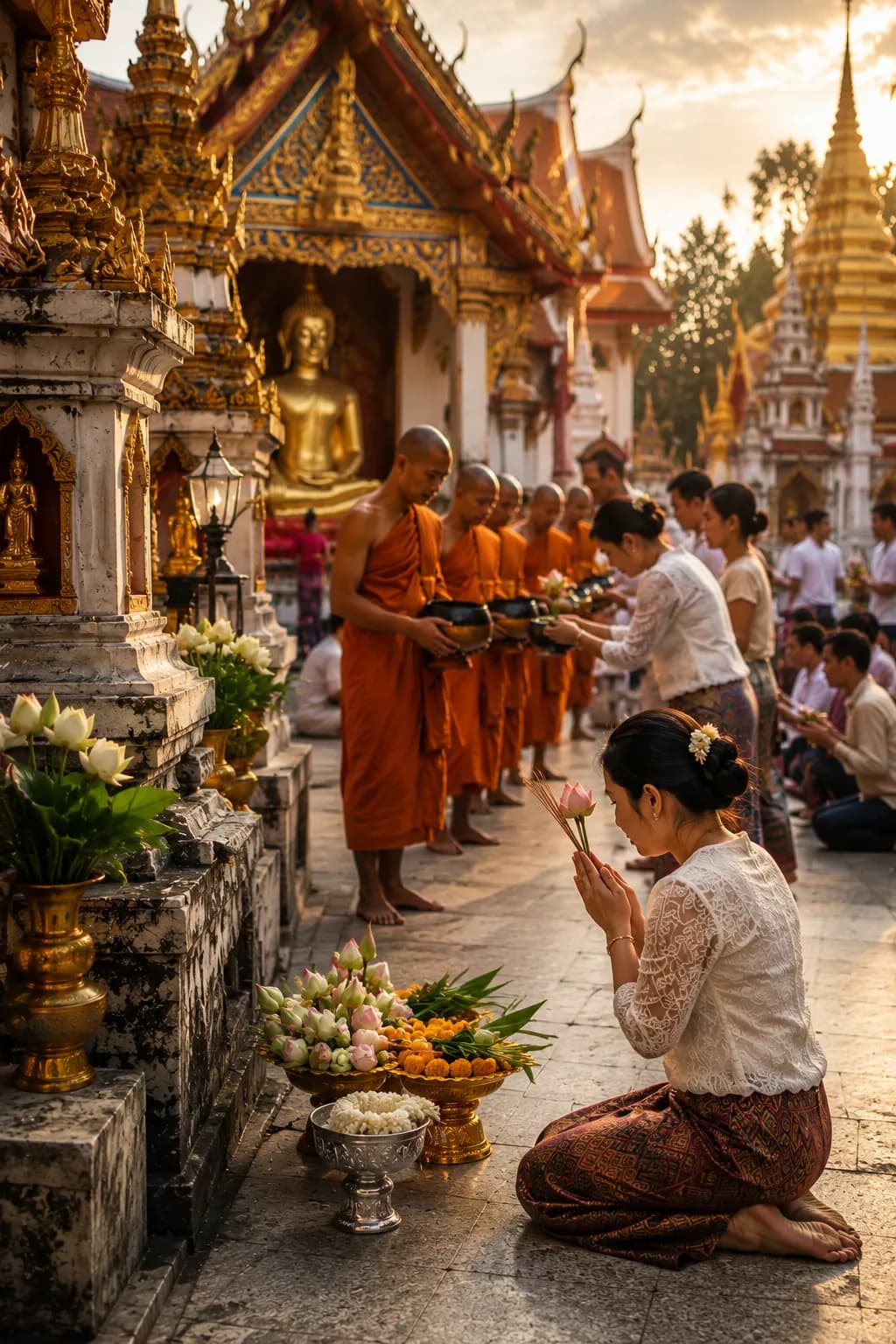
Walk through Bangkok and you can find one outside a skyscraper. Walk through a quiet village and you may find one beside a house. Hotels have them. Shopping centres have them. Offices have them. Factories have them. Petrol stations have them. Condominiums have them. Sometimes the building beside the shrine is ultra-modern. Sometimes the shrine itself looks like a miniature traditional temple. There may be flowers. Incense, fruit, rice, water, soft drinks, tiny figurines and garlands. And very often, someone has stopped for a moment to wai. These are usually described in English as spirit houses. They are one of the clearest examples of something visitors eventually learn about Thailand: Thai religious life does not fit neatly into one box.
They Are Not Little Buddhist Temples
Spirit houses are shrines connected with guardian spirits associated with a place or piece of land. The most familiar type is commonly called: San Phra Phum. ศาลพระภูมิ Roughly speaking, this is a shrine for the guardian spirit of the land. Another related type commonly seen is: San Chao Thi. ศาลเจ้าที่ This is associated with the spirit or guardian of the place. The distinctions can become much more complicated than a tourist needs. For a first visit, the important point is: These shrines acknowledge unseen beings believed to have a relationship with the land and the people using it. This is probably the most important correction. Spirit houses are often seen beside Buddhist homes and businesses. People who make offerings may also visit temples and identify strongly as Buddhist. But the spirit-house tradition is not simply a miniature form of Theravada Buddhism.
It belongs to Thailand's wider world of spirit belief, local religion and Brahmanic influence. Thai religious practice has developed through centuries of overlap rather than through perfectly sealed categories. A visitor may ask: “How can someone be Buddhist and also believe in spirits?” For many Thai people, the question itself is too rigid. Theravada Buddhism provides teachings about karma, merit, rebirth, ethics, monks and liberation. Spirit traditions concern places, protection, luck, danger, ancestors and the unseen world of everyday life. People do not necessarily experience these as competing religions. They can exist side by side. A textbook may ask: What religion is Thailand? Answer: Predominantly Theravada Buddhist. Walk around Thailand and reality becomes richer. Buddhist temple, spirit house, Chinese shrine, brahmanic ceremony, ancestor offering, amulet, astrologer, monk blessing and lucky number. These can appear in the life of the same family.
The word “animism” is often used to explain Thai spirit beliefs. It broadly refers to traditions in which places, natural features, objects or environments can be understood as inhabited or influenced by spiritual beings. The term is useful. It can also oversimplify. Thailand does not have one universal animist doctrine or one official list of spirits believed identically by everyone.
You Bought the Land. the Spirit Did Not Move Out.
A common Thai word connected with spirits is: Phi. ผี It can refer to spirits or ghosts across an enormous range of beliefs and stories. Some are frightening. Some protective, some local, some associated with nature, some with particular places and some with people who died. Thai spirit culture is much broader than horror-film ghosts. “Chao thi” can be understood as a guardian or lord of a place. The idea is that land is not spiritually empty simply because a developer purchased it. Human legal ownership and spiritual relationship are different concepts. A title deed does not necessarily settle matters with the unseen residents. This is the basic logic that makes spirit houses easy to understand. A human arrives, builds a home, hotel, office, shopping centre, factory and the land changes. A shrine acknowledges that the place already has a spiritual dimension.
Respect is offered rather than simply assuming humans are the only occupants who matter. A spirit house provides an honoured location for the guardian spirit. Offerings can be made there. Respect can be shown. The relationship between humans and the unseen guardians of the place is maintained. The shrine therefore performs both symbolic and practical religious work. The familiar San Phra Phum often stands high on a single pedestal. It can resemble a miniature temple or pavilion. Elevation distinguishes the sacred structure from ordinary ground level. Different shrine traditions have different designs. A San Chao Thi may resemble a small traditional Thai house and is often lower than a San Phra Phum. Some properties contain both. To an untrained foreign visitor, they may simply look like two spirit houses. For Thai practitioners, the distinctions can matter. You may therefore see:
A taller shrine on a single column. A lower house-like shrine nearby. This does not necessarily mean somebody accidentally bought two. They may serve different spiritual roles. No. Spirit houses are common. They are not mandatory. Not every family believes in them equally. Not every property has space. Urban lifestyles change. Condominium residents may rely on a shared shrine for the whole development. Some people are deeply observant. Others barely think about the practice. Thailand is not religiously uniform.
The Condo Spirit House
This is modern Thailand in one image: Forty-storey condominium. Keycard access, EV charging, swimming pool, fitness room, Wi-Fi and spirit house by the entrance. Tradition does not have to disappear when architecture becomes modern. The same applies to business. A corporate headquarters can have a shrine outside. Employees in office clothes may stop briefly before work. The building may contain international companies using cloud computing and artificial intelligence. None of that makes the shrine feel contradictory. Major commercial developments can maintain highly visible shrines. Customers and staff may make offerings. A shrine can become closely associated with a particular property. In some cases, it becomes famous beyond the building itself. Hotels often maintain spirit houses. This can be especially noticeable to tourists because the shrine may stand near: Entrance. Garden, car park, driveway, reception approach and the hotel serves international guests.
The shrine serves a different relationship entirely. No. You do not need to make an offering. You do not need to wai. You do not need to adopt beliefs you do not hold. Simply behave respectfully, do not climb on the shrine. Do not move objects. Do not use it as a drinks table. Do not pose with it in a mocking way. This is a useful Thailand rule in general. You can respect a practice without personally believing in its supernatural explanation. Thai people generally do not require tourists to convert before behaving decently. Placement can be taken seriously. Traditionally, knowledgeable ritual specialists may advise on: Location. Direction, height, date, time and installation ceremony. Different traditions and practitioners use different systems. A shrine may look decorative to a visitor. For believers, placement can affect whether the arrangement is auspicious and respectful. Sunlight, building shadows and direction.
Entrances, sacred orientation and astrological considerations. These may all matter depending on the tradition being followed. One often repeated principle is that the shrine should be placed thoughtfully rather than treated as leftover landscaping. Exact placement rules vary. This is another reason property owners may consult someone experienced rather than install one randomly.
Can You Buy One?
Brahmanic ritual specialists have historically played important roles in Thai royal and ceremonial culture. Elements of Brahmanic practice also appear around shrine installation and auspicious ceremonies. This is another reminder that Thai spiritual life cannot be reduced to Buddhism alone. A spirit house is not necessarily considered spiritually active simply because somebody bought a decorative miniature building. Installation can involve ritual: invocations, offerings and auspicious timing. The guardian spirit is respectfully established or invited into the arrangement according to the tradition being followed. Yes. Spirit houses are physical objects and can be purchased. Specialist shops sell them in many styles and sizes. But buying the structure is not the same thing as understanding the religious practice around it. One of the wonderful visual surprises of Thailand is a shop filled with miniature shrines. Rows of them, small, large, simple, ornate, traditional and modern materials.
For a visitor, it can look like an architectural model village. For customers, these are religious objects intended for real properties. Common materials can include: Concrete, stone-like composites, wood and other durable materials. Decoration ranges from plain to highly elaborate. The style may reflect architecture associated with temples, palaces or traditional houses: white, gold, red, cream and bright decorative combinations. There is no single universal spirit-house colour. A property's shrine may visually complement or deliberately stand apart from the building behind it. Many shrines contain miniature figures: attendants, dancers, animals, servants, elephants, horses and other figures. These may symbolically provide company, service or an appropriate environment for the spirit. Foreigners often notice elephant figurines. Elephants carry powerful symbolic and historical associations in Thailand. At a shrine, the exact meaning depends on the context and tradition. Do not assume every elephant has one universal explanation.
Small dancing figures are also common around some shrines. Dance can function as an offering or symbolic entertainment. At larger shrines, real traditional dancers may also be hired by worshippers fulfilling vows or giving thanks. Common offerings may include: Flowers, garlands, incense, candles, water, fruit, rice, prepared food and sweet drinks. The exact offering varies by shrine and practitioner.
Do Spirits Literally Eat It?
Offerings express hospitality, gratitude and respect. If an unseen guardian is treated as a meaningful presence, providing food and drink makes intuitive sense. Humans across many cultures use meals and gifts to maintain relationships. The spiritual relationship follows a similar social logic. Beliefs and explanations vary. Some people understand the spirit as receiving the essence of the offering rather than physically consuming the material food. Others may not articulate a precise theological mechanism at all. Religious practice does not always require laboratory-style explanations. Offerings do not remain forever. They are eventually removed. Practices around disposal or reuse vary. A traveller should not assume that food sitting at a shrine is abandoned public food available to take. This should not need saying. But travel creates ambitious people. One of the most photographed details of Thai spirit houses is the bottle of bright red soft drink.
Often Fanta or another sweet red soda. Sometimes with a straw, the sight has become so iconic that foreign articles frequently ask: Why do Thai spirits love strawberry soda? There is no single explanation that should be presented as proven fact. Several theories circulate. The colour red has ritual associations. Sweet drinks are considered attractive offerings. Modern soda replaced older forms of sweet or coloured offerings. Some explanations connect red liquid symbolically with earlier sacrificial traditions. But the exact reason varies by source and community. So the safe answer is: Red sweet drinks became a popular modern offering, but stories explaining precisely why should be treated cautiously. That distinction matters. A plastic bottle of strawberry soda is obviously not an unchanged ritual from ancient Siam. Religious traditions adapt. A modern commercial product can enter an older offering system. That does not make the practice fake.
It makes it alive. You may even see a straw placed into the bottle. The gesture makes the offering look strikingly human. Drink, straw and ready for the recipient. Religious hospitality adopts the objects of everyday life. Offerings are not limited to one brand or colour. Different drinks can appear. Water remains common. Coffee may appear. The offering reflects contemporary consumption as much as ancient tradition.
Garlands
Flower garlands are among Thailand's most visible offerings. Jasmine and marigold garlands are common in religious and auspicious settings. They may be placed at spirit houses, shrines, vehicles and sacred objects. Thai floral garlands are often called phuang malai. They can express: Respect. Blessing, gratitude, welcome and auspiciousness. Their use extends far beyond spirit houses. Incense creates another visible connection between worshipper and shrine. The number of incense sticks can vary with the place and tradition. Do not blindly copy a number from one shrine and assume it is universal across Thailand. Candles can also appear. Again, exact ritual practice varies, if you are a visitor at a major public shrine and want to participate, follow the posted instructions or observe respectful local practice rather than inventing your own ceremony. A passer-by may briefly wai toward a spirit house. The gesture can be quick. Almost automatic.
This does not mean they are performing a long ritual every time. Everyday religion often happens in seconds. Some people may wai or make a small gesture while passing a shrine in a vehicle. Others do not. Belief and habit vary greatly. You can observe a fascinating modern rhythm in Bangkok: Motorbike rider. Helmet, smartphone holder, delivery app, passes shrine, quick wai and continues through traffic. Traditional ritual and digital economy occupy the same five seconds. People may ask a spirit or deity for help. Success, Safety, business, Exams, Love, Health and Travel. The exact requests depend on the shrine and the being associated with it. A person may promise an offering or action if a request is fulfilled. If success follows, they return to fulfil the vow. This logic appears at many Thai shrines.
At famous shrines, traditional dance performances can be commissioned as fulfilment of a vow or expression of thanks. To a tourist, it may look like scheduled cultural entertainment. It may actually be a personal religious act happening in public. The Erawan Shrine in central Bangkok is one of the best-known examples of Thai urban shrine culture. But here we need an important distinction: It is not simply an ordinary spirit house.
Why Erawan Confuses Foreigners
The Erawan Shrine houses Phra Phrom, the Thai representation of Brahma. The Tourism Authority of Thailand identifies it as a shrine dedicated to Phra Phrom. Brahma comes from Hindu religious tradition, while Phra Phrom has been incorporated into the Thai religious landscape in distinctly Thai ways. It has: Offerings. Garlands, incense and dancers. A shrine beside a commercial development. To an unfamiliar visitor, that looks like a giant spirit house. But the deity and religious background are different. “Shrine culture” is a wider category than “spirit houses.” The shrine was established in connection with the former Erawan Hotel in the 1950s after difficulties surrounding the project were interpreted through an inauspicious lens. The shrine eventually became far more famous than the hotel. Today it stands beside the Grand Hyatt Erawan in one of Bangkok's busiest commercial districts. This is Bangkok in perfect miniature. BTS above.
Traffic below, luxury malls nearby, digital billboards, office towers, phra Phrom shrine, incense smoke, traditional dancers and worshippers. Nothing has to choose between being modern and traditional. Brahma is a Hindu deity. Yet many Thai Buddhists worship or make requests at the shrine. Again, Western categories can fail, Thai religious practice often absorbs beings and rituals into a broader sacred landscape without requiring a person to abandon Buddhist identity. Thai culture has centuries of Brahmanic and Hindu influence. Royal ceremonies, language, mythology, art, literature, sacred beings and city rituals. Spirit-house practice developed within this larger religious environment. Ganesha is another Hindu deity with visible popularity in Thailand. Shrines and images appear in Bangkok and elsewhere. He is especially associated with arts, success and removing obstacles in many modern Thai contexts. This is not a spirit house tradition in the narrow sense.
It belongs to the same broader lesson: Thailand's sacred world is layered. Indra, known in Thai as Phra In, appears throughout Thai religious art and mythology. The Erawan elephant itself connects with Indra's mythic mount in Thai and Hindu-Buddhist tradition. Thai sacred imagery often contains beings whose origins cross what modern Westerners label separate religions.
Brahma, Buddha and Spirits
A Thai person can: Make merit at a Buddhist temple. Wai at a spirit house, Pray at the Erawan Shrine, Consult an astrologer and Wear an amulet. No identity crisis is required. Some sources use that word. It can sound dismissive. One person's superstition is another person's religious practice. Thailand4U prefers language such as: Belief, folk religion, spirit tradition, ritual practice and auspicious custom. These describe without deciding for the reader whether the supernatural claim is true. No. Thailand contains: Deep believers. Occasional believers. People who participate because family does. People who do it “just in case.” People who enjoy the tradition. People who are sceptical. People who reject it completely. Never turn a widespread custom into a claim about every Thai mind. Human beings often maintain rituals without demanding certainty. Maybe it works. Maybe it does not. But showing respect costs little.
This practical ambiguity is common in folk religion worldwide. An engineer can make an offering. A doctor can consult an astrologer. A university student can wear an amulet. Scientific education and ritual practice are not always experienced as mutually exclusive. Business and shrine culture often intersect. A shop owner may make offerings seeking: Good trade. Protection, stability and prosperity. The shrine becomes part of the moral and spiritual ecology of the business. Large industrial sites can have shrines too. Heavy machinery, safety helmets, production lines and guardian spirit. For employees, spiritual protection may sit beside modern occupational safety rather than replacing it. A blessing does not replace: Seat belts. Helmets, fire codes, engineering and medical treatment. Good ritual practice and practical safety can coexist. A travel guide should never present religious protection as a substitute for real-world precautions. Vehicles may receive blessings. Garlands hang from mirrors.
Sacred markings can appear inside taxis. Drivers may visit monks or shrines. This connects with a wider Thai desire for protection in uncertain environments. Driving involves risk. A blessing offers psychological and spiritual reassurance. Humans have sought supernatural protection for dangerous journeys for thousands of years. Thai vehicle rituals belong to that wider human pattern.
The Sacred Tree
Some large or unusual trees become associated with spirits: offerings, coloured cloth, incense and requests for luck. These practices show how spirit belief extends beyond constructed spirit houses. A tree can become significant because of: Age. Shape, location, stories, dreams, reported supernatural events and community belief. There is no national registry determining which tree is spiritually important. Sacred trees and shrines sometimes become linked with lottery number seeking. People may interpret: Marks in bark. Wax patterns, Dreams and Numbers associated with events. This belongs to Thailand's wider lucky-number culture. The human imagination does the rest. Traditional Thai belief contains spirits associated with: Forests, trees, water, fields, homes and places. This helps explain why spiritual respect can attach strongly to landscape. Mae Phosop is associated with rice and agricultural fertility. Respect for rice is not simply culinary. Traditional farming culture gives rice deep symbolic significance. For centuries, rice shaped: Economy.
Landscape, labour, ritual and social life. A spirit associated with rice belongs naturally to an agricultural civilisation. Certain beliefs concern female spirits associated with takhian trees. Stories about tree spirits appear widely in Thai folklore. They may be frightening, protective, beautiful or dangerous depending on the story. Nang Tani is another famous female spirit associated with banana plants. She appears frequently in folklore and popular culture. Spirit belief and ghost storytelling overlap constantly. Mae Nak Phra Khanong is probably Thailand's most famous ghost story. It concerns a woman whose love for her husband continues after death. The story has been retold in: Films. Television, books, theatre and popular culture. A shrine associated with Mae Nak remains at Wat Mahabut in Bangkok. Spirit houses are not horror props. But Thailand's enormous ghost-story culture shows how familiar the idea of an active unseen world remains.
Ghosts appear in comedy as easily as horror. Fear and familiarity coexist. Thailand became internationally famous for horror films. The genre draws on: Ghost beliefs. Karma, family, revenge, unfinished obligations, improper death and sacred objects. Modern horror repackages older spiritual ideas. Thai ghost stories are often hilarious. A terrifying spirit can appear in slapstick comedy. This surprises foreigners who expect religious fear to require solemnity. Thai popular culture happily mixes fear and humour.
Not Every Phi Is a Dead Person
Another useful correction. “Spirit” and “ghost” overlap imperfectly. Some beings are associated with land or nature rather than being understood simply as dead humans. Translation into English can flatten these differences. Ancestor respect is another important part of Thai religious life, especially within Thai-Chinese communities. Ancestor worship and spirit houses should not automatically be treated as the same practice. Again: Several traditions can occupy one household. Thai-Chinese families may maintain: Ancestor altars. Chinese deity shrines, spirit-related practices and Buddhist images. The religious landscape becomes even more layered. Chinese New Year, Hungry Ghost traditions, Vegetarian Festival and Ancestor rituals. These add additional relationships between living people and unseen beings. Inside a home, families may have a Buddhist altar with Buddha images. This is separate from the outdoor spirit house. One home can therefore contain several sacred zones serving different purposes.
Do not treat everything sacred in Thailand as interchangeable. Buddha images belong to Buddhist reverence. Guardian spirits belong to another religious category. Hindu deities another. Ancestors another. The fact that Thai practice overlaps them does not erase their distinctions. Likewise: Wat = Buddhist temple complex. San Phra Phum = spirit-house shrine. Shrine = broader word covering many sacred installations. Learning these distinctions makes Thailand much easier to understand. Their relationship is with the property and land. They often stand outdoors in a carefully chosen location. They create a sacred point between human-built space and the wider environment. Shrines are often visible near entrances. That makes them easy for residents, workers and visitors to acknowledge. But exact placement is based on more than visibility alone. Moving or retiring a shrine may also be treated seriously.
If a building is demolished or property changes, believers may perform rituals rather than simply throw the shrine into ordinary rubbish. Visitors sometimes encounter places where old spirit houses have accumulated. This can create an eerie visual impression. The reality reflects the fact that sacred objects may require respectful disposal or relocation. Thailand sells plenty of legal souvenirs. Choose one of those.
The Land Remembers
A damaged shrine may still be treated with respect. Do not assume broken means spiritually meaningless. A shrine can remain while the building around it changes. Modern development may be designed around an existing sacred point. The result can look architecturally strange to an outsider. Culturally, moving the shrine may be the stranger choice. That is perhaps the deeper idea. Humans can demolish a building. The relationship with the place continues. Spirit beliefs make land more than real estate. Modern property contracts define ownership. Spirit traditions define obligation. These are two different maps of the same land. A major development can involve: Architect, engineer, developer, lawyer, financial adviser and ritual specialist. Modern Thailand does not always see these roles as mutually exclusive. Businesses may conduct Buddhist blessings, Brahmanic rites or other auspicious ceremonies when opening.
A spirit house can be part of this larger effort to begin well. The date of construction, opening or shrine installation may be chosen according to astrology or auspicious timing. Not every business does this. Enough do that visitors regularly encounter it. When millions of baht are invested in a property, spending a small amount to make the opening spiritually auspicious can seem completely rational to believers. Even sceptics may decide: Why take the chance? Businesses worldwide use rituals around beginnings. Ribbon cutting, blessing, groundbreaking ceremony, prayer, lucky objects, feng shui and opening champagne. Humans like symbolic control over uncertain futures. Thai-Chinese cultural influence means feng shui also appears in Thailand. But do not simply label spirit-house placement “Thai feng shui.” They come from different traditions even if practitioners sometimes combine ideas. Thai spiritual life accumulated rather than replacing everything that came before. Local spirit traditions.
Indian religious concepts, Theravada Buddhism, brahmanic court ritual, Chinese migration and modern consumer culture. Red Fanta enters at the end. All of it can stand on one property. Spirit houses are adaptable. They do not require a rural village. They need a relationship with place. Cities still occupy land. Office towers still have entrances. Factories still need protection. People still worry about luck. Modernisation therefore did not remove the basic reason for the shrine.
The Shrine Shrank. the Building Grew.
A wonderful Bangkok contrast: Tiny spirit house. Fifty-storey tower. Physically, the human building dominates. Symbolically, the shrine still gets its own protected space. Spirit houses now appear on: TikTok, Instagram, YouTube and Google Maps. Religious tradition becomes digital content. That can increase visibility without necessarily changing the belief itself. Digital culture has begun affecting many religious practices worldwide. Thailand is no exception. But physical offerings at physical shrines remain highly visible. The material relationship with place is difficult to digitise completely. Spirit houses are beautiful. That makes photography understandable. Usually photographing a shrine from a respectful distance is fine in ordinary public settings. But remember: It is not decorative street furniture. If someone is making an offering: Wait. Do not stand between them and the shrine. Do not shove a camera into their face. Basic respect beats content creation. A respectful photograph is one thing.
A comedy selfie pretending to kiss, ride or mock sacred figures is another. The fact that a shrine is outside does not make it culturally disposable. Avoid touching figurines or offerings unnecessarily. You do not know their ritual significance. Because feet are treated as symbolically low in Thai etiquette, avoid placing feet toward sacred objects or climbing around shrines. This connects spirit-house etiquette with the wider Thai head-and-feet system. Thai children may grow up seeing spirit houses as ordinary parts of the environment. Adults teach appropriate behaviour through habit. The shrine becomes culturally familiar long before a child studies religion formally. For some people: Respect, for others: Fear, for others: Habit and for others: Family tradition. Do not assume every offering is driven by terror of angry ghosts. The relationship can be positive. Humans care for the shrine. The guardian protects or supports the place.
Offerings express gratitude. It can resemble a reciprocal social relationship more than a horror narrative. Imagine moving onto land where another presence already belongs. Instead of fighting: Acknowledge them, give them a respected place and maintain relations. That is a much better conceptual model than: “Tiny haunted house.”
Why Foreigners Call Them “Ghost Houses”
The phrase appears occasionally. “Spirit house” is generally better. Ghost suggests dead human apparition. The guardian beings associated with these shrines do not fit that category neatly. It may look miniature. It is not a toy. Architecture can resemble play objects without sharing their function. Visitors often spend all their religious attention on famous temples. But spirit houses teach something equally important about Thailand. Temples show institutional religion. Spirit houses show everyday religion. A person spends one hour at a temple. Then lives six days beside a shrine. Religion is not only what happens at major monuments. It can be woven into: Leaving home. Opening a shop. Starting work. Building a hotel, buying land and passing an intersection. Long-term foreigners often experience a transition. First week: Photograph every spirit house. Six months later: Walk past without noticing. Then one day:
Realise how strange the street would look without them. That is when a cultural object has become part of your mental Thailand. Why are spirit houses everywhere in Thailand? Because many Thai traditions recognise guardian spirits connected with land and places. A spirit house gives those beings a respected location and allows people to maintain a relationship through offerings and ritual. The practice exists alongside Theravada Buddhism rather than being simply part of Buddhist doctrine. Brahmanic, local spirit and other religious influences overlap with it. Modern life did not make the tradition disappear. It adapted. So a spirit house can stand just as naturally beside a wooden family home as beside a luxury hotel or Bangkok office tower. Do not ask: “Is Thailand Buddhist or animist?” Ask: “How do these traditions coexist?” That question gets you much closer to the real country. Yes. You really did see it. No. We cannot confidently tell you that every spirit in Thailand has collectively chosen strawberry as its preferred flavour. Some mysteries deserve to remain slightly mysterious.