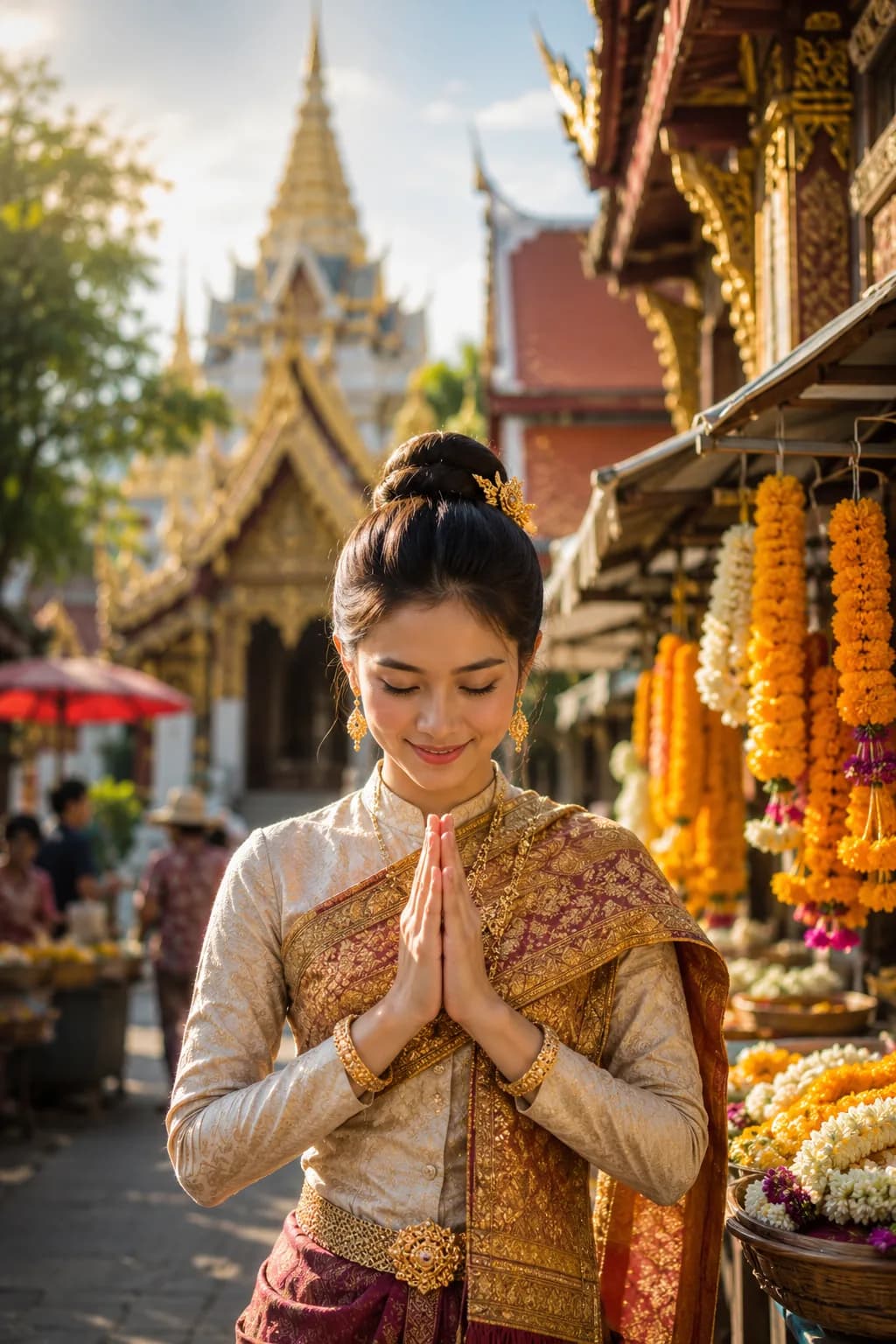
One of the first Thai gestures most visitors learn is the wai. Palms together, fingers pointing upward and A slight bow. It can mean: Hello. Thank you, Goodbye, Respect, Apology, Acknowledgement and Reverence. And depending on how it is performed, it can communicate quite a lot about the relationship between two people. That is why the wai is more than a greeting. It is a small piece of social language.
It Is Not Just “Thai Namaste”
A wai is a traditional Thai gesture made by placing the palms together in front of the body and slightly bowing the head. The exact hand height and depth of the bow can vary depending on who is being greeted. For most visitors, a simple respectful wai at chest level with a small bow is enough. Wai is written: ไหว้ The word refers to the gesture of paying respect. It can be used in social and religious contexts. Visitors often compare the wai with the Indian namaste. They look similar. Both use joined palms. Both can express respect. But they are not interchangeable cultural systems. The Thai wai has its own etiquette, hierarchy and social meaning. The wai can be used when: Meeting someone. Leaving, thanking someone, apologising, showing respect to an elder and greeting a monk. Paying respect to a Buddha image. Acknowledging a teacher.
The same basic gesture changes meaning through context. For an ordinary respectful wai: Palms together. Fingers pointing upward. Hands roughly in front of the chest. Elbows naturally close to the body. Small bow of the head. That is the tourist-friendly version. You do not need: Hands above the forehead. Deep theatrical bow. Closed eyes for ten seconds. A dramatic expression of spiritual enlightenment. You are saying hello. Not auditioning for historical television. Traditional Thai etiquette usually places responsibility for initiating the wai on the younger or socially junior person. The older or more senior person then returns or acknowledges it. That means the wai can communicate hierarchy. A younger person may wai an elder first. This can apply to: Family. Teachers, senior colleagues, respected community members and monks. But real life is more flexible than a rulebook. Age is not the only hierarchy. Professional role, religious status, formal position, relationship and context. A younger manager and older employee may navigate status differently depending on the workplace. Thai social etiquette is relational rather than mathematically fixed.
The Higher the Hands, the Greater the Respect?
Broadly, yes. Higher hand position and deeper bow traditionally indicate greater respect. But the system should not be treated like centimetre-based ranking software. This is the safest general version for foreigners. Hands together around the centre of the chest. Small bow. Friendly expression. You will almost never go badly wrong with this in an ordinary social situation. For parents, elders or people deserving higher respect, the hands may be raised higher. The thumbs may approach the nose. The bow can be deeper. A wai to Buddhist monks is typically performed more respectfully. The hands rise higher. The thumbs may be around the level between the eyebrows. The bow is deeper. Monks occupy a special religious status in Thai society. Respect toward Buddha images can involve an even more formal posture. In temples, people may kneel and perform full bows rather than only a standing wai.
The exact ritual depends on context. Thai Buddhists may bow three times before a Buddha image. These bows traditionally honour: The Buddha. The Dhamma. The Sangha. This is religious practice, not ordinary social greeting. A visitor entering a temple does not need to imitate every ritual movement without understanding it. Respectful behaviour matters more than perfect choreography. The person receiving a wai may respond with a simpler wai. This is sometimes called a rab wai — receiving the wai. The hands may remain around chest level. A small nod or bow can acknowledge the greeting. No. This is where visitors become confused. A senior person may acknowledge a junior person's wai without performing an identical full wai. A monk does not respond to laypeople in the same social way. Very young children may wai adults without receiving the same gesture back. The relationship affects the response. That distinction matters. Thai people generally understand that visitors did not grow up with the system. A polite wai is usually appreciated. An imperfect wai is rarely a disaster.
The Best Rule for Visitors
If a Thai person wai greets you: Return it politely. If meeting an older person or someone you clearly wish to respect: A simple wai is fine. If unsure: Smile, nod and follow the other person's lead. No. This is one of the funniest beginner mistakes. Taxi driver, cashier, waiter, hotel receptionist, security guard, random child, dog, every human within visual range, wai, wai and wai. You do not need to perform it constantly. Traditionally, customers do not necessarily initiate a wai to service workers simply because the staff wai first. Hotel or airline staff may wai customers as part of professional courtesy. A smile or nod may be enough. Returning the wai is also common among foreigners and is generally not offensive. The key is not to turn every transaction into ceremonial overkill. Cashier says hello.
You do not need to execute a monk-level wai before buying water. Relax. Staff may wai at check-in. A small wai or warm nod back works naturally. Nobody is scoring you. Thai airline staff often use the wai as part of service etiquette and brand identity. This shows how a traditional gesture became integrated into modern professional culture. In formal Thai business settings, the wai remains important. Introductions may involve: Wai. Handshake. Both. The exact combination depends on international exposure and context. Thai people regularly shake hands in international business. Do not assume the wai replaced every global greeting. Modern Thai business culture is hybrid. If your Thai counterpart offers a hand: Shake it. If they wai: Wai back. Do not freeze while trying to solve cultural algebra. This is the deeper point. It tells both people:
I recognise who you are in relation to me. That can include: Age, respect, role, religion and familiarity. A teacher receives a student's wai differently from how the same teacher greets a close friend. The individual is the same. The relationship changes.
Phi and Nong
Thai social language often uses: Phi — older person / older sibling. Nong — younger person / younger sibling. The wai belongs to the same relational world. Age is socially visible. Children may wai: Parents. Grandparents. Older relatives. Especially in formal moments or greetings. Family hierarchy is reinforced through gesture. Songkran provides one of the clearest examples. Younger people may respectfully pour scented water over elders' hands. They wai. Ask for blessings. The modern public water fight is only one side of the festival. In northern Thai and broader Songkran traditions, respectful water-pouring ceremonies honour elders. The wai often appears naturally within these rituals. A wai can accompany: Khop khun khrap. Khop khun kha. Thank you. The gesture adds respect and warmth. No. A spoken thank-you is enough in many ordinary situations. The wai adds formality or sincerity depending on context. A wai can also accompany an apology.
This can make the apology feel more respectful. For a serious mistake, words and actions still matter. A wai is not a magical reset button. If you break something expensive: Apologise. Offer to fix it, the gesture helps and responsibility still exists. Funerals involve respectful wai gestures toward: Monks. Buddha images, the deceased's memorial area and family members. Exact practice depends on the ceremony. Guests may wai elders. The couple may wai family members during traditional ceremonies. Respect and family hierarchy become visible. Wai Khru ceremonies honour teachers, students offer respect and gratitude, this appears in: Schools, universities, traditional arts, muay Thai, music and dance. Before a Muay Thai fight, the wai kru ram muay ritual honours: Teachers. Gym. Tradition. Family or spiritual influences depending on practice. This is not simply a greeting. The wai becomes part of ritual performance. The fighter may wear a mongkhon headpiece during the ritual. The entire sequence expresses respect before competition begins. Classical performing arts also contain wai gestures. The physical language of respect extends beyond ordinary conversation.
The Wai in Religion
At a temple, the wai can be directed toward: Buddha image. Monk. Sacred object. The meaning shifts from social politeness toward reverence. Monks receive especially respectful wai. A layperson's body language acknowledges religious status. This sometimes surprises tourists. Monks and laypeople are not equals inside that ritual relationship. The monk may acknowledge in another way. The wai makes sense within Thailand's broader body hierarchy. Head = high. Feet = low. Hands move upward toward the face as respect increases. The body becomes a map of social status. Lowering the head also expresses deference. The highest part of the body is deliberately lowered. This physically shows respect. Hands go higher. Head goes lower. Respect increases. Thai etiquette uses both directions at once. In respectful situations, people may lower the gaze slightly with the bow. Direct staring can feel too confrontational in some formal contexts. Natural behaviour matters.
You are greeting a person, not undergoing interrogation. A wai often comes with a smile. Thailand's social style values warmth. The gesture does not need to look solemn unless the context is solemn: palms together, eyes closed, mysterious spiritual smile and please stop. You are doing great. Historically, status distinctions shaped wai behaviour strongly. Modern Thailand is more socially fluid. But hierarchy still influences the gesture. A junior employee may wai a senior executive. The executive may return a simpler gesture. This can feel asymmetric to foreigners. That asymmetry communicates status. Yes, in a social sense. Thai culture traditionally acknowledges hierarchy more explicitly than many northern European societies. The wai makes it visible. Many do. But usage is becoming more flexible in casual peer settings. Friends may simply say: Hi. Wave, smile and hug. Use English. Modern Thai communication contains many greeting styles. Despite globalisation, it remains deeply recognisable. Schools teach it. Families use it. Government officials use it. Businesses use it. Temple life preserves it. It adapts.
The Covid Period
During COVID-19, the wai received international attention because it provides a greeting without physical contact. Some people outside Thailand suggested replacing handshakes with wai-like gestures. Thai people had been doing this for centuries. No hand contact, No cheek kissing, Simple, Elegant and Pandemic-compatible. Obviously, modern usefulness does not explain historical origin. The exact historical origins are difficult to pin to one moment. Joined-palm gestures have ancient roots in South Asian religious traditions. Indian anjali mudra influenced Buddhist and Hindu cultures across Asia. As Indic religious and courtly traditions spread through Southeast Asia, related gestures developed locally. Thailand's wai became its own distinct social system. In Sanskrit traditions, anjali refers to the gesture of joined palms used in reverence and greeting. Buddhist art and ritual spread versions of the gesture widely. As with many cultural forms, Thailand did not merely copy one unchanged Indian gesture.
Local court hierarchy, Buddhist practice, social etiquette and language. Thai society shaped the wai into a specifically Thai form. Cambodia has the sampeah, another joined-palm greeting with hierarchical hand positions. The similarity reflects shared regional histories. Laos also uses the nop, a similar respectful greeting. Again, related regional traditions, not identical national practices. Myanmar has its own forms of respectful greeting, though the joined-palm wai is not used in exactly the same way as Thailand. Namaste or namaskar uses joined palms and has its own linguistic and religious history. Foreigners often recognise the resemblance immediately. These gestures belong to a large historical family shaped by centuries of Indian cultural influence across South and Southeast Asia. The beauty of the wai is efficiency. No words required. You can communicate: Respect. Hierarchy, acknowledgement, thanks, greeting, apology, religious reverence, all with one gesture, same movement and different meaning.
Thai greetings often include: Sawasdee khrap. Sawasdee kha. The wai can accompany the spoken greeting. Interestingly, sawasdee as the standard modern greeting is itself relatively recent compared with the ancient history of Thai culture. It was promoted as a standard greeting in the 20th century. The wai gesture is older.
This Surprises Many People
They assume “sawasdee” has been Thailand's universal hello for thousands of years. Modern national language standardisation created familiar forms. A silent wai can communicate perfectly in context: thank you, add wai if appropriate and sorry / excuse me. Wai can strengthen the apology. In temples or solemn situations, no words may be needed. Someone passes a spirit house. Hands lift briefly from the steering wheel area or passenger position. Quick wai. Continues. Everyday religious practice can happen in one second. Spiritual respect does not require dangerous driving. People may wai: Spirit houses. Shrines, Sacred trees and Religious images. Again, the gesture is broader than human greeting. Thai people may show formal respect in royal contexts through gestures that differ by event. Visitors should simply follow local ceremony and maintain respectful behaviour. Do not improvise theatrical royal wai rituals.
Standing respectfully during the anthem is a different form of public respect. The wai is not required in every patriotic context: tourism marketing loves the wai, hotel staff wai, flight attendant wai, temple silhouette, sunset and Thailand branding achieved. The wai can become a visual cliché. Used respectfully: recognisable national symbol. Used lazily: every Thai person permanently standing with palms together. Occasionally they use phones. 🙏 The folded-hands emoji is often used to represent: Prayer. Thanks, please, high five in some interpretations and wai. Thai users may use it naturally. Emoji meaning is global and context-dependent. Thai messages can combine: 🙏 Khrap. Kha. Khop khun. A traditional gesture gets compressed into one Unicode character. Not inherently. The emoji is designed as folded hands and is interpreted differently around the world. In Thai communication it can function as a convenient digital equivalent of respectful palms. People may also write: ไหว้
or describe sending a wai. Digital culture does not remove physical etiquette. A tourist greets hotel receptionist with hands at forehead and huge bow. This can look oddly over-respectful. The mistake is harmless. But it shows why basic calibration helps.
The Foreigner Who Wais Children Like Monks
Also unnecessary. No legal problem. But returning a polite wai when someone greets you warmly is an easy sign of respect. That distinction matters. Cultural respect does not require imitation of every local gesture. A smile and polite greeting can work. The wai is optional for foreigners in many settings. After a few weeks, many visitors stop thinking. Someone wai. You wai back. The gesture becomes comfortable. Hands too high, phone trapped between palms, sunglasses fall, bow collides with backpack and normal. Culture enters the body through repetition. Foreigner starts handshake, Thai person starts wai and both change halfway. Hands go everywhere. Everybody laughs, diplomatic relations survive and let the other person lead. Because the wai requires no contact, it fits Thai social environments where physical touch between strangers can be relatively restrained compared with some cultures. For many northern Europeans: Excellent news. Thai friends may hug.
Young people may adopt global social habits. Romantic partners obviously touch. The wai is not evidence that Thai society prohibits physical affection. Public affection has historically been more restrained than in some Western settings. Modern urban Thailand is changing. Context matters. The basic gesture is used by all genders. The polite spoken particles differ: Khrap — commonly used by male speakers. Kha — commonly used by female speakers. Hierarchy and context matter more. Schools often teach children wai etiquette. Greeting teachers, respecting elders and ceremonies. The gesture becomes part of social education. Students may wai teachers in the morning. This makes hierarchy visible daily. Formal teacher-honouring ceremonies reinforce gratitude toward educators. Students may present symbolic flowers. The wai is central. Traditional Wai Khru offerings can include flowers with symbolic meanings connected with qualities expected of students. Exact practices vary. Teachers historically hold considerable cultural respect in Thailand. The wai reflects that. Students may wai professors or senior academics. International university environments may also use handshakes. Hybrid etiquette again.
The Family Shop
A young employee may wai a senior manager when arriving. Another modern workplace may simply say: Morning. Both can be Thai. Customer arrives, owner knows them, casual greeting, no formal wai and context constantly changes. You do not need to wai after every mango purchase. A smile and khop khun is enough. Same. A wai can feel natural when someone has gone beyond a routine service role. Gratitude changes the social context. A respectful wai may be appropriate if you are introduced formally. Again, follow local lead, Thai visitors may perform a deeper respectful wai toward a very elderly person. Age carries status. Highest everyday social wai most travellers will encounter. Religious reverence, beyond ordinary social hierarchy. Royal etiquette belongs to another formal system and is not something tourists need to improvise: friendship, age, job, religion, family, setting and all influence behaviour.
No smartphone app can calculate the perfect wai score. The bigger mistakes are: Mocking. Refusing obvious respect. Performing deliberately inappropriate gestures. A slightly imperfect wai is fine. Not three centimetres apart like you are warming them over a fire. Natural, not rigid. Keep them reasonably close to the body. No need for chicken wings. Small, natural and respectful. A normal wai takes a moment. Do not hold the pose waiting for applause. Natural. You may lower the gaze slightly during the bow. No need to avoid eye contact for the rest of the conversation. Optional but usually friendly. Everything. Because it combines several major Thai social values: Respect. Hierarchy, restraint, grace, relationship, religious influence, non-confrontational body language, A child wais grandparent, student wais teacher, layperson wais monk, visitor wais host and the body tells the relationship. Two friends may exchange informal wai gestures playfully or sincerely.
Modern usage is flexible. Thai humour can exaggerate the wai dramatically. Deep bow, hands high and repeated wai. This can communicate: Please! Sorry!, thank you so much! and mock desperation. The gesture is culturally familiar enough to be played with.
You Need Cultural Knowledge to Understand the Joke
That is what makes a gesture part of language. Watch Thai drama. You will see differences between: Child and parent. Employee and boss, student and teacher and layperson and monk. The gesture quietly communicates status even if you cannot understand the dialogue. Learning the wai improves your understanding of Thai media too. It is visual. Simple, elegant and different from the handshake. A visitor can learn the basic form in seconds. Because the hand position is easy. The relationship system is harder. The palms are the words. The height is the tone. The bow is the punctuation. The relationship supplies the meaning, wai ≠ hello, sometimes hello, sometimes thank you, sometimes reverence, sometimes apology and sometimes acknowledgment. You only need: Polite chest-level wai. Small bow. Return a wai when appropriate. Higher/deeper respect for monks and elders if you feel comfortable. Learn: Who initiates. How hierarchy works.
How religious wai differs. When no wai is necessary. How body position changes meaning. Stop thinking about it. That is when you have actually learned it. The gesture can help maintain social smoothness. A respectful wai after a small mistake can make an apology easier. It shows humility without requiring a dramatic speech. A wai can express consideration and gratitude when someone has helped you. Again, one gesture connects several Thai social concepts. The calm, restrained movement fits the wider preference for composed public behaviour. And yes, friends can also use it jokingly. Thai culture does not preserve every respectful gesture under glass. That is the point. It is old. It is formal. It is religious. It is commercial. It is casual. It is digital. It changes by context. Living traditions survive because they remain useful. Why do Thai people wai?
Because the wai is a traditional Thai gesture of respect that can communicate greeting, thanks, apology, farewell and religious reverence. It reflects Thai sensitivity to age, status and relationship. The younger or junior person traditionally initiates the wai, while the senior person may return or simply acknowledge it. Higher hand position and deeper bow generally indicate greater respect. For most visitors, palms together at chest level with a small bow is enough. Do not worry about perfect hand height. Be sincere. Be respectful. Watch the person in front of you. That will take you much further than memorising a diagram. Someone wais you, smile, wai back and dii mak.