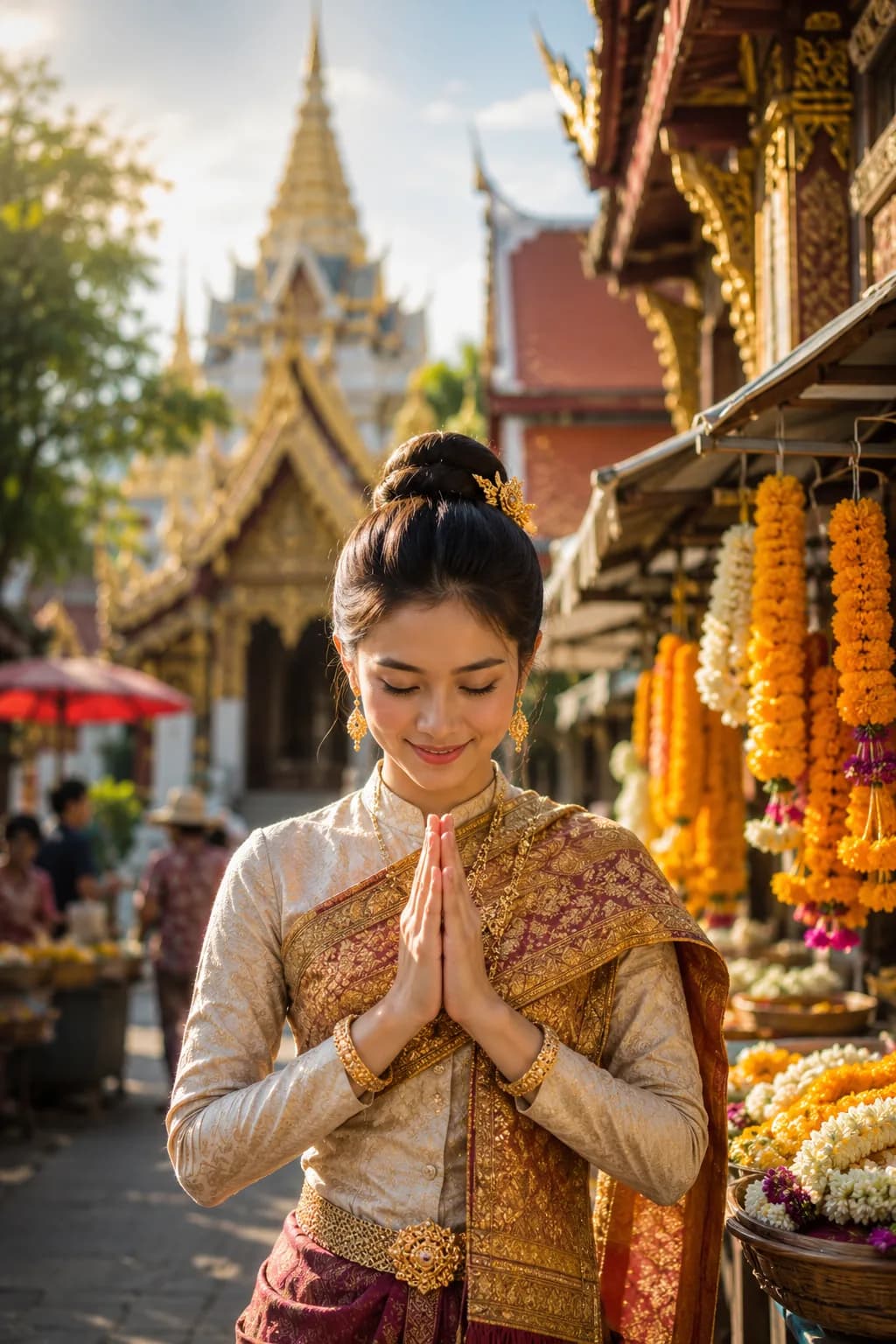
Visitors to Thailand often hear the same warning: Do not touch people on the head. Do not point your feet at people. Do not put your feet on tables. Do not point the soles of your feet toward a Buddha image. At first, this can sound like a collection of unrelated etiquette rules. It is not. They are connected by one simple cultural idea: The head is symbolically high. The feet are symbolically low. This hierarchy is both physical and cultural. Your head is literally the highest part of your body. Your feet are literally the lowest. Thai etiquette turns that physical arrangement into a language of respect.
Why the Head?
In traditional Thai social thinking: Head = high, respected, elevated. Feet = low, dirty, least respectful. That does not mean Thai people spend every second consciously ranking body parts. It means the symbolism is culturally familiar enough to shape everyday behaviour. The head is associated with the highest part of the person. It contains the face. The mind. The identity. It is physically elevated above the rest of the body. In older Thai social and religious symbolism, “high” and “low” often carry more than spatial meaning. They can suggest: Respect. Status, purity, dignity, appropriateness, feet touch the ground, shoes touch roads, dust, pavements, bathrooms and mud. The lowest part of the body naturally becomes associated with what is physically and symbolically low. That is why the soles of the feet matter especially. They are the part most directly connected with the ground.
A common misunderstanding is to hear “feet are low” and imagine some philosophical claim that feet are bad or shameful. No. Thai people need feet too. The symbolism is about relative position and etiquette. It creates rules for how the body should be oriented around: Other people. Elders, Monks, Buddha images, Sacred objects, food and Formal spaces. This is the famous rule. In ordinary Thai etiquette, touching another adult's head without invitation can be disrespectful or overly familiar. The head is treated as the highest part of the body. So casually patting or ruffling someone's hair can cross a boundary. In some cultures, patting somebody on the head can feel affectionate. Especially with children. In Thailand, the gesture can feel patronising or intrusive. The easiest rule: Do not touch people's heads unless your relationship clearly makes it appropriate. Foreign travel guides sometimes say:
“Never touch a Thai person's head.” Then another source says: “Children are fine.” Real life is more nuanced. Parents touch their children. Friends and partners may touch each other's hair. Hairdressers obviously touch heads. Doctors may need to. The issue is not that the skull is magically forbidden. The issue is unwanted casual contact and respect.
The Barber Is Allowed
Otherwise Thailand would have a serious haircut problem. Context always beats slogans. Do not panic. A crowded train, A clumsy movement, A bag brushes someone, smile, apologise and move on. Accidental contact is not the same as deliberately treating someone disrespectfully. Thai etiquette is relational. Age, status, closeness, setting and intent. All matter. Touching your partner's head is not the same as patting an elderly stranger on the head. The corresponding rule is: Avoid using your feet in ways that direct them toward people or respected objects. Examples: Do not point with your foot. Do not rest your feet on a table. Do not place your feet near somebody's head. Do not step over people unnecessarily. Do not point the soles directly toward a Buddha image in a temple. The sole is the part that touches: Ground. Dust, roads and shoes.
It is therefore the least respectful surface of the body in symbolic etiquette. A visitor relaxes, feet on chair, feet on table and completely normal at home. In Thailand, this can look much more disrespectful. Especially in: Formal homes, temples, restaurants, offices, public transport, around elders and bad idea. The table is associated with: Food. Work. Shared social space. Putting feet on it combines the lowest part of the body with a surface that should remain clean and respectful. This can also look rude, especially if the soles are visible toward people. Casual settings vary. But a traveller loses nothing by keeping feet on the floor. Imagine a bag is on the ground. Your hands are full. You stretch out your foot and say: “That one.” In Thailand, that can look disrespectful. Use your hand if possible. Kicking or sliding an ordinary object gently may seem harmless. But using your feet to move something respected, sacred or associated with food is especially inappropriate.
Do Not Step Over Food
This is one of the clearest applications. Food should not have feet passing over it. The practical hygiene explanation is obvious. The symbolic explanation reinforces it. If someone is sitting or lying on the floor, walk around rather than stepping over them. Having your feet pass above another person's body reverses the expected high-low order. Thai people may sit on floors in: Homes. Temples, Ceremonies, Traditional restaurants and Family gatherings. This creates more situations where your feet can accidentally end up above, toward or too close to someone. Imagine someone sitting on the floor. You step over them. Your foot passes above their head. Symbolically: Lowest part above highest part. That is precisely the configuration the etiquette system tries to avoid. Inside Buddhist temples, people sit or kneel low. Buddha images are elevated. Monks may sit in designated positions. The physical arrangement itself expresses hierarchy.
Avoid sitting with the soles of your feet pointed directly at a Buddha image. Instead: Kneel, sit cross-legged if appropriate. Or fold your legs to the side. The exact posture matters less than keeping the soles from being deliberately aimed at the sacred image. Foreign visitors sometimes become physically miserable trying to imitate perfect temple posture. Respect does not require suffering. Sit comfortably. Keep your feet positioned away from the Buddha image as best you can. Similarly, avoid pointing soles directly at monks in formal or religious settings. The monk's religious status makes the orientation especially inappropriate. Do not touch a monk's head. This combines ordinary head etiquette with respect for monastic status. Thai language and etiquette contain many ideas of higher and lower position: older person, younger person, teacher, student, monk, layperson, senior and junior. The body itself mirrors this social sensitivity. Sometimes “high” means: Sacred, respected. Pure, elevated, sometimes social status and sometimes literal physical position. The meanings overlap without being identical.
Low Does Not Always Mean Insult
Similarly, lowering yourself can express respect. A person may: Bow. Kneel, Sit lower than a monk and Lower the head. So physical “low” can actually demonstrate social respect depending on context. It is not. The body part hierarchy says the head is the most respected part. The posture hierarchy says lowering your overall body can show deference. Different symbolic systems operate at once. The wai itself combines hands and body position. Palms together. Head lowered slightly. The deeper bow can indicate greater respect. The body physically expresses social relationship. This is interesting. The highest part of the body is deliberately lowered. That lowering expresses respect. So the symbolism is dynamic, not simply: Higher always equals better. In formal Buddhist settings, laypeople may kneel before monks. This creates a visible hierarchy of religious status. The layperson is not being humiliated. The posture expresses reverence.
Historically, physical height also mattered in court etiquette. People did not casually place themselves physically above royalty. Older palace customs could be highly formal. Modern everyday Thai behaviour is much less rigid, but traces of high-low symbolism remain culturally familiar. In some traditional family or ceremonial settings, a younger person may sit lower than an elder. Again, this is relational respect expressed spatially. Thai social language contains many ways of marking status: titles, kinship terms, polite particles, pronouns and body posture. Height symbolism fits into a wider system where relationships matter. Some popular explanations say: “The head is sacred because the spirit lives there.” Be cautious. That kind of one-line mystical explanation is often repeated without strong evidence and can flatten several traditions into one claim. The safer explanation is: The head has long been treated as the most elevated and respected part of the body within Thai social and religious etiquette. There is no need. The observable etiquette is enough.
The Hairdresser Test
A useful reality check for cultural rules: If a literal interpretation would make normal life impossible, the rule is probably contextual. Thai people: Wash hair, cut hair, touch family, wear hats and visit doctors. The rule is about respect, not supernatural danger from scalp contact. Then comes the obvious traveller question: “If feet are considered low, why is foot massage everywhere?” Because “low” does not mean untouchable. A massage therapist can touch and work on feet in a professional context. Again, symbolism depends on situation, pedicure. Massage, medical treatment, washing and all normal. The etiquette concerns how feet are used socially around others and respected objects. Thailand's shoe-removal custom makes more sense when combined with foot symbolism. Shoes carry outside dirt. Feet are symbolically low. Homes and sacred interiors are cleaner and more respected spaces. So outdoor footwear often stops at the threshold. Shoes off.
Do not point feet. Do not touch heads. Sit appropriately in temples. These are not random tourist rules. They all come from a shared cultural logic about the body and space. A home entrance creates another high-low transition. Dirty outside. Clean inside. Shoes remain outside. The physical environment reinforces social meaning. Do not put feet on pillows. A pillow supports the head. Placing feet on it reverses the symbolic order. This is one of the clearest objects where head and foot symbolism meet directly. The object's association matters. Nobody is monitoring you through the ceiling. But understanding the principle explains why using a pillow as a footrest can feel culturally wrong. In traditional thinking, clothing associated with the upper body and lower body may also be treated differently in washing or storage. Some households separate certain laundry. Practices vary widely today. Do not turn this into a universal Thai laundry law. Older etiquette can distinguish clothing worn above and below the waist. Again: High and low, clean and less clean and symbolic categories extend beyond anatomy.
The Laundry Question
A modern Bangkok household with one washing machine may simply wash everything efficiently. Culture adapts. Never assume every traditional distinction survives identically in every apartment. Books, especially religious texts or school materials, can be treated with respect. Do not casually place them on the floor and then step over them. Education carries high cultural value. Teachers traditionally receive considerable respect in Thai society. The head-foot hierarchy fits inside a wider respect culture involving knowledge and status. Using a book as a footrest is a particularly poor choice. For obvious reasons. Thai banknotes carry the image of the King. Stepping on a banknote to stop it blowing away can therefore be disrespectful. This combines: Feet = low. Royal image = highly respected. Tourist drops cash, wind catches it, tourist instinctively stamps on it and culturally unfortunate solution. Use your hand if possible. Coins can also bear royal imagery.
The same principle applies. A banknote is not physically dirtier because your shoe touched it than many other objects. The issue is symbolic orientation: Foot versus respected image. Thai culture places deep importance on rice and food. Stepping over food or placing feet near it can therefore combine hygiene and respect concerns. Rice is not just carbohydrate. Historically it has shaped: Agriculture, economy. Ritual, language and family life. So casual disrespect toward food can carry more weight than a visitor expects. Simple enough. Should you put a handbag on the floor? This is not automatically a major cultural violation. But personal items and sacred or status-related objects can be treated differently. Do not overgeneralise the foot rule into: “Nothing may ever touch the floor in Thailand.” People sit on it. Sleep on mats, Eat near it, Pray on it and Children play on it.
The issue is relative hierarchy, not contamination panic. Cross-legged sitting can be acceptable in many casual settings. In front of Buddha images or monks, position matters. Do not let the soles point directly toward the sacred focus.
Why It Can Hurt Foreigners
A common respectful posture is sitting with legs folded to one side. This keeps feet away from the person or image being honoured. Because your hips have opinions. Shift carefully. Nobody wants your first temple visit to end with an ambulance. In many Western contexts, feet disappear under tables and people rarely think about their orientation. Floor-seated cultures make feet much more visible. That visibility produces more etiquette around them. Putting feet on the seat opposite is generally rude. This is true in many countries. In Thailand, the foot symbolism adds another layer. If someone is sitting lower or sleeping, be careful where you place your feet. Small spaces can create accidental awkwardness. International aircraft rules are not uniquely Thai. But resting bare feet on another passenger's seat is still a terrible way to test cultural tolerance. At the beach, feet are everywhere.
People lie down, walk barefoot and stretch. The social setting is casual. The rules do not disappear, but expectations are less formal. Sacred context still matters. Traditional Thai massage involves therapists using: Hands. Elbows, knees, feet and body weight. This might appear to contradict “feet are low.” It does not. A trained therapist may use the foot as a professional tool within a treatment technique. Context changes the meaning. In some massage techniques, carefully controlled pressure using feet may be part of the treatment. That is not an insult. Consent and professional context transform the action. Foot on client's back during massage: Professional technique. Foot pointing at Buddha image: Disrespectful. Foot on football: Correct. Foot on dinner table: No. Culture is contextual. Muay Thai uses feet and shins as weapons. Again, sport operates under its own rules.
The fighter is not committing etiquette offences every time they kick. Traditional ritual around the head can be highly significant. The mongkhon headpiece worn before a fight is treated respectfully. It should not simply be placed anywhere.
Do Not Step Over a Mongkhon
The mongkhon is associated with the wai kru ram muay ritual and with respect for teacher, gym and tradition. Its placement on the head reinforces the symbolic importance of the upper body. That would be an especially clear reversal of high and low symbolism. Sacred tattoo traditions also interact with body placement. Different yantra designs may be placed on upper or lower parts of the body according to traditional rules. Sacred imagery is often kept above the waist in more conservative practice. Modern tattoo culture is diverse. Do not assume every Thai tattoo obeys one ritual system. Images of the Buddha used as decorative tattoos can be sensitive in Thailand. The placement matters especially. Buddha imagery on lower body areas may be viewed as highly disrespectful. A traveller may think: Cool Buddha ankle tattoo. Thai religious culture may interpret: Sacred image placed near the feet.
Those perspectives are not equivalent. Historic Buddha heads have become popular decorative objects internationally. In Thailand, fragmented sacred images can carry religious and heritage sensitivity. Do not treat them as casual décor without context. At Wat Mahathat in Ayutthaya, the Buddha head entwined in tree roots is one of Thailand's most photographed images. Visitors are often expected to lower themselves when posing nearby rather than standing with their own head towering over the Buddha image. This is high-low symbolism made practical. You avoid placing yourself visually above the sacred image in a disrespectful way. It is a small physical gesture that demonstrates awareness. Do not climb on Buddha images. Do not sit on sacred structures. Do not use them as props. Again, the relative position of your body matters. Parents naturally touch their children's heads. Teachers may in some contexts. Relatives may. Do not interpret the cultural rule as emotional coldness. Better to avoid randomly touching unfamiliar children anyway. This is good global etiquette, not just Thai etiquette.
Touching Statues' Heads
The head rule applies to humans, not an abstract ban on every head-shaped object. Petting a friendly dog is a separate issue. Ask yourself whether the dog agrees first. Do not touch the head of sacred statues for photographs. The fact that the object is not alive does not remove its religious significance. Passing objects over someone's head can also feel inappropriate. If possible, move around rather than reaching across a seated person's head. In crowded houses or markets, life happens. Nobody can maintain perfect symbolic geometry at every second. Use common sense. This belongs to the same symbolic system. Lower-body garments placed physically above sacred images can be inappropriate. Modern high-rise living makes spatial symbolism messy. People still negotiate these ideas practically. Sacred objects should not be stepped over, kicked or placed in low positions. The principle generalises from body hierarchy to object hierarchy.
Monastic robes should be treated respectfully. They represent ordained life. A young man may normally be junior to older relatives. Once ordained, relatives may wai to him. Religious status temporarily reorganises the hierarchy. Do not imagine literal head height determines rank. A tall teenager is not socially senior to a short grandmother. Physical symbolism expresses respect. It does not calculate authority in centimetres. If elders or monks are seated on the floor, walking directly in front of them at full height may feel awkward. People may stoop slightly when passing. This is another way physical height becomes polite behaviour. You may see Thai people bend slightly when walking between seated people. This can communicate: Sorry to pass through. I am not trying to tower over you. It is a subtle courtesy. Foreigners sometimes think: Why is everyone ducking? The ceiling is high.
They are lowering themselves socially, not architecturally. In Thai homes, a person may stoop when passing between others and the television or conversation. This is related to not blocking or towering over seated people. Again, practice varies.
The Head Rule and School Culture
Teacher-student relationships can reinforce bodily respect. Students may wai teachers. School ceremonies can involve kneeling or bowing. The larger hierarchy becomes familiar from childhood. Wai Khru ceremonies honour teachers. Students express gratitude and respect. Body posture, offerings and ritual all reinforce the social value placed on teaching. You may hear folk explanations connecting the head with intelligence or spiritual essence. Some may be meaningful within particular traditions. But the safest general explanation remains: The head is culturally treated as the highest and most respected body part. Cultural practices often survive because several meanings reinforce each other. Physical height, cleanliness, religion, social hierarchy and habit. You do not need a single founding event. Not by itself. Similar high-low body symbolism appears across parts of South and Southeast Asia. Thai etiquette developed through local, Buddhist, Brahmanic and regional cultural traditions.
Reducing it to one Buddhist command would be inaccurate. Modern travel etiquette emerges from society, not one scripture. Ideas of purity, hierarchy and sacred placement also interacted historically with Brahmanic court culture. Again, Thailand accumulated systems rather than replacing one with another. Neighbouring cultures may share similar etiquette around: Head touching. Feet, sacred images and monks. That does not mean every country has identical rules. Cambodian etiquette also traditionally treats the head and feet differently. Shared regional history helps explain similarities. Laos, another Theravada Buddhist society, has comparable respect conventions around feet and sacred spaces. Myanmar likewise contains etiquette shaped by Buddhist and regional ideas of bodily respect. Visitors encounter it constantly because: Temple tourism is widespread. Shoes come off frequently. Floor seating still exists. Monks are visible. Body language matters socially. Usually not from innocent mistakes.
A visitor who accidentally points a foot somewhere is different from someone deliberately placing feet on a Buddha statue for a joke. This is probably the most useful principle in Thai etiquette. People generally distinguish: Ignorance, accident and deliberate disrespect.
The Internet Can Make Thai Etiquette Sound Terrifying
Travel lists often say: Thai people will be OFFENDED. Reality is usually more forgiving. Most Thai people understand foreigners did not grow up with the same rules. Observe, Adapt, Apologise if necessary and Move on. A mistake is easy to forgive. Mocking the custom after someone explains it is much less charming. When you see local people adjusting their posture: Notice. When they remove shoes: Notice. When they avoid pointing feet: Notice. When they wai: Notice. Observation teaches faster than memorising twenty prohibitions. English also uses vertical metaphors: High status. Low class, top position and bottom of the hierarchy. Thailand did not invent the idea that vertical space carries meaning. It simply expresses it through body etiquette more visibly. English says: I look up to her. That is also a height metaphor for respect. So the Thai system is not as alien as it first appears.
English can describe degrading work as: Beneath me. Again: Low = lower status, human languages repeatedly turn vertical space into social meaning. Thai etiquette more directly connects those metaphors to: Head. Feet, seating position, shoes and sacred spaces. That is why visitors notice it. Imagine the body as a cultural compass. Top: head, respect. Bottom: feet, ground. Then ask: What am I pointing toward whom? That solves many etiquette situations. Would you put your feet on something designed for the head? No. Now you understand the logic, would you point the lowest part of your body directly at the most sacred image in the room? No. Logic again. Would you step over your grandmother while she sits on the floor? Probably not. Thailand simply gives that instinct a stronger cultural framework. Would you put road-dirty shoes where everyone eats? Also no. Hygiene and symbolism agree. Because it keeps making practical sense. It creates: Clean floors, respectful posture, personal boundaries, clear sacred-space behaviour and social awareness. Traditions survive more easily when daily habits reinforce them.
Tradition Does Not Require Old-fashioned Personality
Young Thais may be: Casual. International, tattooed, online, progressive and globally connected. They can still find feet on a table rude. Etiquette can survive even when society changes dramatically. A Bangkok teenager living in a high-rise and speaking excellent English may still take shoes off at home and dislike somebody touching their head. Modern housing did not erase bodily symbolism. TikTok does not change which end of the body touched the pavement. After reading this article: Walks around Bangkok staring nervously at own feet. Please do not. The goal is awareness, not anxiety. 1. Do not casually touch people's heads. 2. Do not point your feet or soles at people, monks or Buddha images. 3. Do not put feet on tables, pillows or respected objects. 4. Avoid stepping over people, food or sacred objects. You now know enough. If you make a mistake: Smile. Say sorry.
Fix it. Thailand continues. Why is the head important and the feet considered low in Thailand? Because traditional Thai etiquette uses the body's physical hierarchy as a symbolic one. The head, being highest, is treated with particular respect. The feet, touching the ground and carrying dirt, are treated as the lowest and least respectful part. That symbolism helps explain why Thais may avoid casual head touching, pointing feet at people or sacred images, stepping over others, placing feet on furniture, and wearing shoes inside certain spaces. The rules are contextual, not magical. They are about respect. Thai etiquette often makes more sense when you stop memorising rules and start looking for the system underneath: shoes, head, feet, wai, seating, monks, Buddha images and elders. All belong to a culture where social relationships are expressed through physical behaviour. Once you understand the logic, the rules stop feeling random.