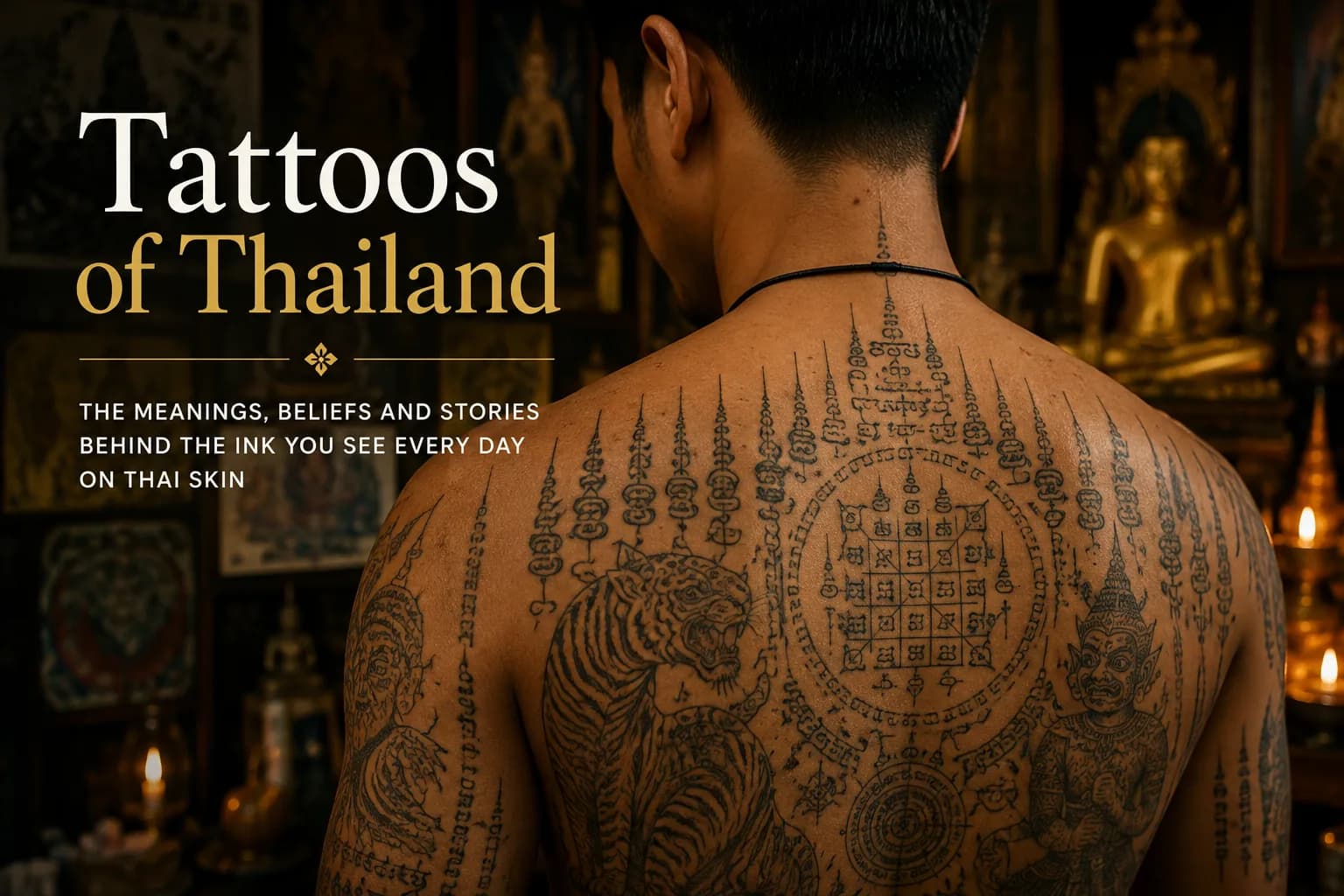
1. Thailand Has More Than One Tattoo Story
Walk through Bangkok, Phuket, Chiang Mai or Pattaya and tattoos are not difficult to find.
They appear on bartenders, office workers, musicians, Muay Thai fighters, shop owners, motorbike riders, artists and people whose jobs tell you absolutely nothing useful about why they chose the ink on their skin.
Some tattoos look globally familiar: fine-line flowers, Japanese-inspired sleeves, blackwork, portraits, lettering, cartoons and small minimalist designs. Others look unmistakably connected with Thailand: rows of sacred script, geometric peaks, animals surrounded by Khom characters, Hanuman figures, tigers, yantra diagrams and dense compositions across shoulders and backs.
It is tempting for a visitor to put all of the second group into one box marked “traditional Thai tattoos”.
That is where the confusion begins.
Thailand does not have one tattoo tradition. Older regional practices, sacred sak yant, protective yantra, personal belief, masculinity, identity, fashion and the modern professional tattoo industry all overlap. Some of those worlds are deeply religious. Some are not religious at all. A modern Thai wearer can choose sacred imagery because of belief, because of family or cultural familiarity, because it represents qualities they value, because it looks beautiful — or because several of those reasons are true at the same time.
Research supports that complexity. Deborah Hill’s major study of traditional Thai tattooing found differences in form, placement and meaning between northern and central traditions and between different kinds of practitioners. More recent work with Thai wearers shows that sacred tattoos can function not only as objects of magical belief but also as expressions of contemporary identity and style.
So there is no useful rule that says a tattooed Thai person is superstitious, religious, rebellious or fashionable.
The design may tell you something.
The person wearing it tells you the rest.
2. Before the Tattoo Studio: Ink, Identity and the Older Thai Body
The modern tattoo studio is only the latest chapter.
Historical evidence for tattooing in Thailand is uneven, which is one reason sweeping origin stories should be treated carefully. B. J. Terwiel noted that central Thai tattooing was surprisingly under-documented compared with the extensive literature on magical diagrams, protective spells, amulets and astrology. In other words, the surrounding belief system often left a clearer paper trail than the tattoos themselves.
Northern Thailand gives us another window. In the Lanna world, traditional leg tattoos known as sak khalai formed part of a social language around masculinity, endurance, maturity and local identity. Recent research using temple murals in Chiang Mai examines these tattoos as embodied cultural markers rather than decoration. The tattooed body could signal that a man had passed through pain, social expectation and ideas about strength.
That does not mean every tattooed man in old northern Thailand carried the same message. It means tattooing could operate inside local systems of belonging.
Sacred tattooing developed in another closely connected landscape: yantra.
Yantras are not unique to skin. In Thailand they can appear on cloth, metal, buildings, vehicles, amulets and other objects. The Thailand Foundation describes them as sacred diagrams shaped by Brahmanic-Hindu traditions and reinterpreted through Buddhist practice in Thailand. Their scripts, geometry and figures are used for aims that believers may describe as protection, prestige, popularity, wealth, auspiciousness or spiritual security.
Putting the yantra onto the body changes the medium, not necessarily the underlying logic.
A cloth yantra can be carried. A takrud can be worn. A protective diagram can be placed above a doorway. A sak yant makes the body itself the place where the protective object lives.
That is why calling it merely a “tattoo style” misses something fundamental.
For many wearers, the ink is also an amulet.
3. Why Thai People Choose Sacred Tattoos
The most useful question is not “Why do Thai people get sak yant?”
There are too many Thai people and too many reasons for one answer.
A better question is: what kinds of things have Thai wearers and practitioners said they seek from them?
Recent Thai research gives us a useful, but deliberately limited, view. A 2025 qualitative case study in Pattani interviewed tattoo practitioners, recipients and local believers connected with one sak yant network. Within that community, sak yant was associated with protection, fortune, auspiciousness, mental strength, invincibility and charm. The master was described as selecting tattoos according to the individual, and the surrounding rituals linked the wearer to the teacher and to a continuing belief system.
Those ideas fit a much broader yantra vocabulary found across Thai sources: protection from danger, strengthening confidence, attracting goodwill, improving fortune, supporting business or livelihood, enhancing prestige and seeking spiritual reassurance.
The Thailand Foundation divides common yantra purposes into broad groups including protection or invincibility, popularity and charm, fortune and wealth, auspiciousness and prestige. It also notes an important modern change: where older male wearers were often associated with protection for warfare or dangerous journeys, contemporary men and women may seek designs associated with popularity, fortune and livelihood.
That does not mean the wearer believes every supernatural claim literally.
A qualitative study based on in-depth interviews with nine Thai sacred-tattoo wearers found something more contemporary. Magical discourse had not disappeared, but some younger wearers also understood sacred tattoos through fashion, individual identity and cultural hybridity. The traditional and modern meanings could coexist.
This is a useful corrective.
One Thai wearer may believe a yant protects him. Another may value it as a connection with a respected ajarn. Another may see it as Thai cultural identity. Another may like the design and attach a personal meaning to it. Another may believe in the blessing without believing every story told about invulnerability. And the same person may move between several of those explanations depending on what you ask.
Belief is rarely a simple on/off switch.
That is especially true in Thailand, where a person can be thoroughly modern, use a banking app, visit a monk, wear an amulet, check an auspicious date and think none of those actions contradict each other.
4. What Are Those Tattoos? A Guide to the Designs You See on Thai Skin
Once you begin noticing sak yant, certain shapes repeat.
The dangerous mistake is assuming repetition means every example carries an identical message. Yantra traditions vary by master, region and lineage. Sacred script can differ. Formulae can differ. Individual designs can be adapted. Even when two tattoos belong to the same named family, the details may not be identical.
With that warning in place, several motifs are useful to recognise.
Gao Yord — the Nine Spires / Nine Peaks
The Nine-spire yantra is one of the most recognisable forms, often placed high on the back. The Thailand Foundation connects it with the nine virtues of the Buddha and with protection. It belongs to the broad protective side of yantra practice and is frequently treated as a foundational design.
The safest way to read it is therefore not “this guarantees one specific thing”, but “this belongs to a powerful protective and Buddhist-virtue tradition”.
Hah Taew — the Five Rows
Five lines of sacred writing became perhaps the most internationally famous sak yant format after celebrity exposure made the design globally recognisable.
Popular explanations often assign one neat blessing to each of the five lines. Some Thai cultural sources do describe the design broadly in terms of luck, success, charm, protection and favourable destiny. But lineages and formulae vary. A five-row yant from one master should not automatically be translated using a diagram found on another master’s website.
The number of rows is visible.
The full ritual meaning is not.
Tiger yantras
Animal imagery enters yantra through older animist as well as Buddhist-Brahmanic worlds. The Thailand Foundation gives the tiger as a clear example: it is associated with power and authority.
That helps explain why tiger yants have been attractive in settings where strength, courage or command matter. But again, “tiger equals power” is only the first layer. Composition, script, master and ritual context can add further meanings.
Hanuman
Hanuman is particularly interesting because he shows how a character can carry both widely shared and strongly local meanings.
A Chulalongkorn University thesis based on fieldwork in Chiang Mai, Chiang Rai and Lamphun interviewed northern Thai practitioners and recipients of Hanuman yants. Participants associated Hanuman with qualities including compassion, protection, influence and fortune, while also using the figure to express personal and local cultural values. The research specifically warns us against assuming one Central Thai reading explains every northern wearer.
Hanuman is therefore not merely “the warrior monkey tattoo”.
He is a character from a huge regional story-world whose qualities can be selected and reinterpreted by the people wearing him.
Birds and other animals
The Thailand Foundation notes that animal imagery can invoke qualities associated with the animal: tigers with power and authority, birds with charm and grace. This fits the wider animist logic in which animals are not decorative fillers but beings whose perceived qualities can be symbolically carried.
Maha Uttama, Diamond Shield and Vessavana
Not every familiar yant is an animal or rows of writing. Thai cultural sources describe Maha Uttama in connection with invincibility and popularity; the Diamond Shield yantra with protection from danger; and Vessavana — the guardian king known in Thai as Thao Wessuwan — with protection against harmful spirits as well as strength and prosperity.
These examples reveal why the category is so broad.
A Thai sacred tattoo can be geometry. It can be script. It can be an animal. It can be a deity or mythic figure. It can be several of those things at once.
The skin is carrying a diagram, but the diagram belongs to a much larger system.
5. Buddhism, Spirits, Astrology — and the Problem with the Word “Superstition”
Visitors often describe sak yant as a mixture of “Buddhism and superstition”.
It is not entirely wrong.
It is also not a particularly good explanation.
Popular religious life in Thailand does not always respect the neat categories outsiders expect. Theravada Buddhist practice can exist alongside Brahmanic ritual, spirit belief, amulets, astrology, auspicious timing, protective chants, numerology and older animist ideas. A person may make merit at a Buddhist temple and later consult an astrologer without experiencing a theological crisis.
Yantra sits comfortably inside that overlap.
The Thailand Foundation traces Thai yantra through Brahmanic-Hindu geometry, Buddhist reinterpretation, sacred Pali formulae, Khom and regional scripts, and animist ideas about the powers of animals. The result is neither simply “Buddhist tattooing” nor an unrelated folk practice pasted onto Buddhism.
Academic work makes the same point more cautiously.
Angela May’s study of sak yant describes popular Thai religion as a hierarchy in which Buddhism remains central while animist and Hindu-Brahmanic elements coexist. Research on Southeast Asian sacred writing also warns that earlier scholarship often dismissed amulets, tattoos and protective inscriptions as inferior “superstition” because it measured real religious life against an idealised textual version of Buddhism.
That history matters.
Calling something superstition can describe a belief in supernatural efficacy. But it can also carry the suggestion that the believer is naïve and the observer is enlightened.
Thailand4U does not need that hierarchy.
A better approach is to describe what people actually believe.
Some wearers believe sacred tattoos can protect against danger. Some seek metta — loving-kindness, favour, charm or positive social response. Some seek fortune, authority or confidence. Some believe a blessing can lose efficacy if behavioural rules are broken. Some take part in Wai Khru ceremonies to honour teachers and renew the spiritual relationship around their yants.
Reuters documented thousands of devotees at Wat Bang Phra in 2024 gathering for precisely that purpose. Some participants entered trance-like states associated with tattoo imagery; some described the tattoos as protective; monks emphasised moral conduct and the Buddhist Five Precepts.
A journalist can document all of that without announcing that bullets bounce off tattooed skin.
Belief belongs to the believer.
Accuracy belongs to us.
6. The Tattoo Is Part of a Bigger Protective World
One reason sak yant can be easier to place in context within Thailand than it sometimes is for visitors is that the underlying logic is already visible elsewhere.
Yantra is not confined to bodies.
Protective diagrams can appear on cloth banners known as pha yant, on metal amulets or takrud, above doors, in shops, in vehicles and on other personal objects. Thai amulet culture, auspicious objects, protective chants and spirit-related practices all provide familiar ways of thinking about unseen protection.
The tattoo is therefore not necessarily an isolated leap into magic.
It can be understood as another way of carrying something sacred.
The Thailand Foundation describes six broad intentions associated with yantra — protection or invincibility, popularity and charm, fortune and wealth, auspiciousness, prestige and other specific purposes. Those goals are remarkably ordinary once the supernatural packaging is removed.
People want to be safe. They want to succeed. They want others to treat them well. They want confidence. They want help through uncertainty.
The methods differ.
This also explains why modern livelihood can sit comfortably beside old ritual. A business owner seeking a yant associated with attraction or prosperity is not necessarily re-enacting a warrior tradition. The same cultural technology has been adapted to a different problem.
That adaptability is one of the most interesting things about Thai sacred tattooing.
The symbol survives because the reasons people need reassurance keep changing.
7. Monks, Ajarns and the Relationship Behind the Ink
One of the most persistent travel-guide shortcuts is that sak yant is “a tattoo done by a monk”.
Sometimes it is.
Sometimes it is not.
Sak yant may be performed by Buddhist monks, but it is also practised by lay ritual masters commonly called ajarn or ajahn. The term means teacher or master; it does not automatically mean monk. Academic work on contemporary sak yant explicitly makes this distinction.
The difference matters because the tattoo is traditionally embedded in a relationship.
At a temple associated with sak yant, the process may sit within monastic rules, offerings, chanting and respect for a teacher lineage. A lay ajarn may work within knowledge inherited from previous masters. A commercial tattoo studio may reproduce a sak-yant-inspired design purely as body art. Some practitioners and spaces sit somewhere between those categories.
From outside, the resulting photographs can look similar.
Inside the tradition, they may represent very different things.
Recent Thai research in Pattani describes Wai Khru and Pan Khru rituals in which prospective recipients prepare offerings and formally position themselves as disciples of a master. The practitioner then selects or applies a yant according to the person and the tradition.
Wat Bang Phra in Nakhon Pathom offers the best-known public example of the teacher relationship. Its annual Wai Khru ceremony centres on respect for the late abbot Luang Phor Pern and the lineage connected with his sak yant tradition.
The most useful distinction for a visitor is therefore not temple versus tattoo shop.
It is ritualised sacred practice versus visual reproduction.
A modern studio can make excellent Thai-inspired tattoo art. A monk or ajarn can perform a sacred tattoo ritual. A Thai wearer may value either — or both.
The image alone does not tell you which world you are looking at.
8. Blessings, Rules and the Life After the Tattoo
In sak yant tradition, getting the tattoo can be the beginning rather than the end.
That is another point at which sacred tattooing differs from ordinary body art.
Consecration matters. Chanting matters. Teacher authority matters. And, in many lineages, behaviour after the tattoo matters too.
The internet loves lists of sak yant prohibitions because unusual rules make excellent content. Depending on the source, wearers are told not only to follow Buddhist moral principles but also to avoid particular foods, places or behaviours.
The problem is that there is no single universal rulebook.
Different masters and traditions give different instructions. Some emphasise the Buddhist Five Precepts and broad moral conduct: do not kill, steal, engage in sexual misconduct, lie or cloud the mind with intoxicants. Other lineages add particular prohibitions. Thai cultural sources also mention respect for parents and teachers and avoidance of conduct considered degrading to the sacred object carried on the body.
Within the belief system, breaking those rules may weaken or cancel the yant’s protective efficacy.
Whether a reader personally accepts that supernatural mechanism is beside the point.
The rule itself can serve a very worldly function.
A tattoo associated with power comes with an expectation of self-control. A protective symbol can also become a reminder not to behave recklessly. A relationship with an ajarn can become a relationship with moral expectations.
Reuters’ reporting from Wat Bang Phra captured this tension well: the event is visually famous for trance states and dramatic behaviour, yet one of the temple’s tattoo masters emphasised something much less cinematic — the tattoos should remind wearers to live according to Buddhist virtues.
The spectacle photographs better.
The moral obligation may be closer to the point.
9. Sacred, Fashionable, Personal — Modern Thai Wearers Do Not Fit One Box
There is a danger in writing about traditional tattoos as though every Thai person wearing one lives inside an unchanged religious world.
Thailand has changed.
Tattoo meanings have changed with it.
A qualitative study of nine Thai sacred-tattoo wearers examined how sak yant participates in modern identity construction. Its conclusion was not that magical belief disappeared. Instead, globalisation and contemporary fashion had changed the way sacred tattoos could be understood. Younger Thai wearers could treat them as personal identity, aesthetics and cultural expression while traditional meanings remained present in more complicated ways.
That finding is modest — nine interviews cannot represent a country.
But it captures something visible in modern Thailand.
A person can wear a sacred-looking tattoo and not spend every morning thinking about supernatural protection. Someone can admire the cultural form without sharing every belief associated with it. Someone else may take the ritual very seriously. Another may combine belief, fashion and personal meaning so thoroughly that asking them to choose only one category makes no sense.
And beside all of them are Thais wearing tattoos with no sak yant connection whatsoever.
Bangkok’s modern tattoo studios work in realism, Japanese-inspired composition, fine line, minimalism, blackwork, lettering and almost every international style. Phuket, Pattaya and Chiang Mai have similarly diverse scenes.
This matters for travellers who start noticing tattoos on Thai skin.
Do not assume the tattoo explains the person.
Ask if the context allows it. Listen if they want to explain. And accept that “I just liked it” is as valid an answer in Thailand as anywhere else.
10. From Thai Skin to the Global Tattoo Map
Sak yant became internationally visible long before social media, but celebrity exposure accelerated the process dramatically.
Angelina Jolie’s Thai tattoos are often cited as a turning point in global awareness. They did not create sak yant, and they did not transform an obscure tourist product into a tradition. They did something simpler: millions of people who had never heard the term suddenly recognised the look.
Tourism followed the recognition.
Some visitors came looking for a sacred ritual with a monk or ajarn. Others wanted the aesthetic in a commercial studio. Some wanted hand-poked tattoos but no religious content. Some simply wanted a permanent memory of Thailand.
By 2026 this was substantial enough to study at scale. Research into tattoo tourism analysed 21,632 English-language Google reviews from 664 active tattoo studios across Thailand. Bangkok dominated the sample, followed by major clusters in Phuket, Chon Buri and Chiang Mai.
Interestingly, visitors talked about more than “authenticity”. They cared about artists, design, skill, cleanliness, service, studio environment and value. Terms associated with sak yant, faith, blessing and tradition remained highly visible, but they existed alongside the ordinary expectations of a professional tattoo industry.
That is the modern Thai tattoo scene in one dataset.
Sacred culture and customer service. Ancient-looking script and Instagram portfolios. Ajarns and fine-line specialists. Belief and business.
They do not cancel one another out.
They share the market.
11. The “Bamboo Tattoo” Problem
Few phrases in Thai tattoo tourism have done more work with less precision than “bamboo tattoo”.
You will see it on signs, websites and travel blogs. It usually suggests a tattoo applied by hand rather than by electric machine, often using a long rod. From there, the phrase is frequently treated as synonymous with “traditional Thai tattoo” and then, one step later, with sak yant.
Those three things are not automatically identical.
Historical and academic descriptions of Thai sacred tattooing document non-mechanical tattooing tools, including metal implements. Specialist practitioners strongly emphasise the long metal khem sak in many lineages. Other modern scholarship and commercial sources use bamboo more broadly when describing hand-poked practice.
The evidence is messier than the tourist slogan.
The important point is therefore not winning an argument about the rod.
The material of the tool does not determine whether a tattoo is sacred.
A decorative hand-poked tattoo can be exactly that. A machine-made copy of sacred geometry can be tattoo art. A traditional sak yant involves a practitioner, a sacred design, intention, lineage and ritual elements that cannot be reduced to whether the implement looks sufficiently ancient for a holiday photograph.
“Bamboo” has become a very effective shorthand for authenticity.
Authenticity is also a very effective thing to sell.
Visitors do not need to feel foolish for using the phrase; the tourism industry itself uses it constantly.
Just ask the better question:
What exactly is being offered?
12. A Tattoo Is Still Permanent After the Holiday Ends
Thailand can make permanent decisions feel suspiciously easy.
There is sunshine. There is food. There is a studio three doors down from the hotel. Someone else in the group is getting one. The design looks excellent at 11:30 p.m.
None of those things make tattoos temporary.
For ordinary studio tattooing, the standard should be boringly professional: clean workspaces, sterile or single-use equipment where appropriate, hygienic handling, gloves and inks intended for tattooing. International health authorities warn that unsterile tattooing can transmit bacterial infections and blood-borne viruses including hepatitis B and C.
The cultural side deserves the same attention.
Sacred script, Buddha imagery, deities and yantra may carry meanings a visitor does not immediately recognise. A reputable Thai artist or knowledgeable practitioner can help explain whether a design is religious, whether the script is correct and whether a proposed placement may be considered disrespectful.
With sak yant, that principle becomes stronger.
If the spiritual meaning is the reason you want the tattoo, understand what kind of practitioner you are visiting and what kind of experience you are receiving.
Then there is the simple problem of being on holiday.
Fresh tattoos and tropical travel are poor roommates. Sun, sweat, swimming, sand and long days outside are exactly what healing skin does not need. Getting tattooed immediately before three days of island hopping is less a spiritual challenge than a scheduling error.
Thailand sells plenty of souvenirs that fit into a suitcase.
A tattoo is the version you have to clear through customs on your own skin.
That is not an argument against getting one here. Thailand has living sacred traditions, remarkable artists and a tattoo culture with far more depth than the phrase “bamboo tattoo” suggests.
It is an argument for knowing which part of that culture you are carrying home.