Getting Around Thailand
Thailand has everything from elevated metro systems and ride-hailing to songthaews, island ferries and overnight trains. Use the Route Finder for a practical route, then use the guide below to understand which transport options fit different parts of the country.
Choosing the Right Way to Travel
Thailand's transport network combines modern mass transit in the capital with flexible local solutions in coastal, mountainous, and island destinations.
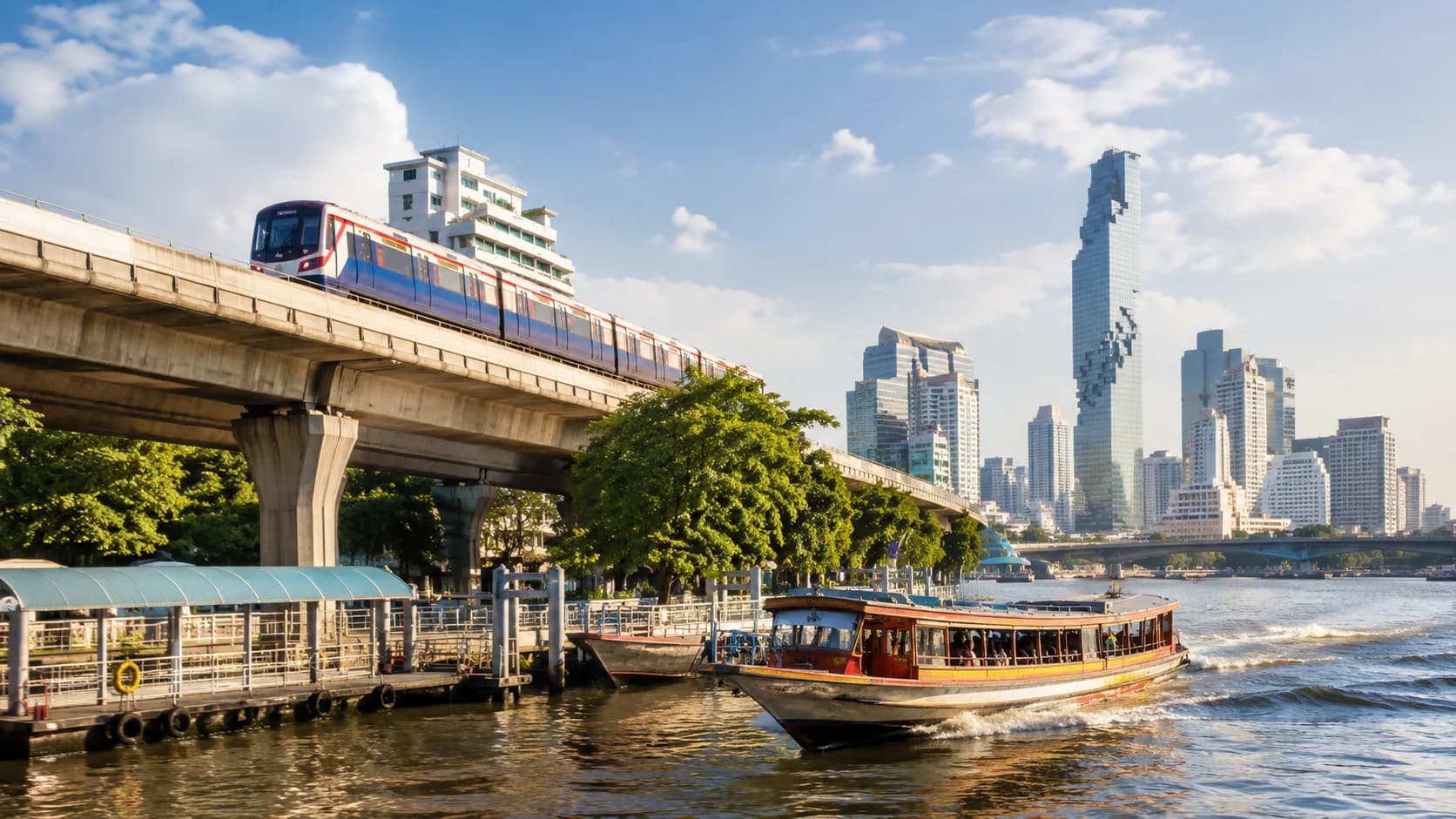
BTS Skytrain & MRT Metro
Best for: Beating Bangkok's notorious traffic jams
Tap contactless credit/debit card for MRT; buy Rabbit Card or QR single tickets for BTS.
Grab & Bolt Ride-Hailing
Best for: Upfront price certainty & language-free destinations
Bolt is often cheaper; Grab has broader nationwide fleet availability and airport permits.
Metered Street Taxis
Best for: Direct point-to-point travel in Bangkok when rail isn't nearby
Always ensure the meter is turned on ('Meter na krub/ka'). Surcharges & expressway tolls are paid separately.
Shared Songthaews (Baht Buses)
Best for: Cheap local trips in Pattaya, Chiang Mai, Hua Hin & islands
Hop on along route, ring roof buzzer to stop, pay flat or zone fare directly to the driver upon exiting.
SRT Intercity Rail & Sleepers
Best for: Scenic, comfortable journeys (e.g. Bangkok to Chiang Mai / Surat Thani)
Book 1st & 2nd class air-con sleeper berths well in advance on official SRT D-Ticket website.
Island Ferries & River Express
Best for: Gulf & Andaman islands and Bangkok river sightseeing
Check weather/sea conditions during monsoon months; high-speed catamarans are fastest.
Domestic Air Travel
Best for: Saving hours of overland travel across Thailand's 1,600 km length
Bangkok has two airports: Suvarnabhumi (BKK) for Thai/Bangkok Airways vs Don Mueang (DMK) for AirAsia/Nok.
BTS Skytrain, MRT Metro & Urban Rail
Bangkok's integrated elevated and underground rail networks are the fastest way to travel through the city, completely bypassing heavy street-level traffic jams.
💳 Quick Ticketing Guide:
- MRT Blue/Purple Lines & SRT Red Lines: Tap any international contactless EMV credit or debit card (Visa / Mastercard) directly at turnstiles.
- BTS Skytrain (Green Lines): Purchase a reloadable Rabbit Card or buy single-journey QR tickets at station vending kiosks.
- Airport Rail Link (ARL): Buy single-journey plastic tokens or use contactless EMV cards at dedicated gates.
Bangkok Rail Lines & Connections
BTS Sukhumvit Line (Light Green)
Elevated SkytrainServes: Siam, Asok, Nana, Phrom Phong, Thong Lo, Ekkamai, Mo Chit / Chatuchak, Ha Yaek Lat Phrao
Key Interchanges: MRT Blue Line (Asok/Mo Chit/Ha Yaek Lat Phrao) • Airport Rail Link (Phaya Thai) • BTS Silom Line (Siam) • MRT Yellow Line (Samrong)
BTS Silom Line (Dark Green)
Elevated SkytrainServes: National Stadium, Siam, Sala Daeng (Silom), Chong Nonsi (Sathorn), Saphan Taksin (Riverside Pier), Krung Thon Buri
Key Interchanges: BTS Sukhumvit Line (Siam) • MRT Blue Line (Sala Daeng / Silom & Bang Wa) • Chao Phraya Express Boats (Sathorn Pier / Saphan Taksin) • BTS Gold Line (Krung Thon Buri)
BTS Gold Line (Gold Monorail / AGT)
MonorailServes: Krung Thon Buri, Charoen Nakhon (ICONSIAM), Khlong San, Prajadhipok
Key Interchanges: BTS Silom Line (Krung Thon Buri) • Chao Phraya River Piers (ICONSIAM Pier)
MRT Blue Line (Chaloem Ratchamongkhon)
Underground MetroServes: Sukhumvit, Silom, Chinatown (Wat Mangkon), Old Town / Grand Palace (Sanam Chai), Chatuchak Park, Krung Thep Aphiwat Central Station, Huai Khwang
Key Interchanges: BTS Sukhumvit (Sukhumvit / Asok & Chatuchak Park) • BTS Silom (Silom / Sala Daeng & Bang Wa) • Airport Rail Link (Phetchaburi / Makkasan) • SRT Red Lines (Bang Sue / Krung Thep Aphiwat) • MRT Yellow Line (Lat Phrao) • MRT Pink Line (Min Buri)
MRT Purple Line (Chalong Ratchatham)
Elevated SkytrainServes: Tao Poon, Bang Son, Nonthaburi Government Center, Khlong Bang Phai
Key Interchanges: MRT Blue Line (Tao Poon) • MRT Pink Line (Nonthaburi Civic Center) • SRT Light Red Line (Bang Son)
MRT Yellow Line (Lat Phrao – Samrong Monorail)
MonorailServes: Lat Phrao, Chok Chai 4, Bang Kapi, Srinakarin (Rod Fai Night Market), Hua Mak, Samrong
Key Interchanges: MRT Blue Line (Lat Phrao) • BTS Sukhumvit Line (Samrong) • Airport Rail Link (Hua Mak)
MRT Pink Line (Khae Rai – Min Buri Monorail)
MonorailServes: Nonthaburi Civic Center, Chaeng Watthana (Immigration Complex), Lak Si, Wat Phra Sri Mahathat, Min Buri
Key Interchanges: MRT Purple Line (Nonthaburi Civic Center) • SRT Dark Red Line (Lak Si) • BTS Sukhumvit Line (Wat Phra Sri Mahathat)
Airport Rail Link (ARL)
Airport ExpressServes: Suvarnabhumi Airport (BKK), Hua Mak, Ramkhamhaeng, Makkasan, Ratchaprarop, Phaya Thai
Key Interchanges: BTS Sukhumvit (Phaya Thai) • MRT Blue Line (Makkasan / Phetchaburi) • MRT Yellow Line (Hua Mak)
SRT Dark & Light Red Lines
Commuter RailServes: Krung Thep Aphiwat Central Station, Don Mueang Airport (DMK), Lak Si, Rangsit, Taling Chan
Key Interchanges: MRT Blue Line (Bang Sue / Krung Thep Aphiwat) • MRT Pink Line (Lak Si) • MRT Purple Line (Bang Son)
Verified Official Transit Portals & Interactive Maps
BTS SkyTrain Official Portal ↗
Official interactive route map, fare calculator, service hours, and Rabbit Card information.
MRT Bangkok Metro Official Portal ↗
Official MRT Blue and Purple line timetables, station maps, and contactless EMV guide.
Mass Rapid Transit Authority of Thailand (MRTA) ↗
Comprehensive official masterplan and current lines map across Greater Bangkok.
State Railway of Thailand (SRT D-Ticket) ↗
Official nationwide train schedule lookup and online sleeper/express ticket reservation portal.
Taxis, Grab, Bolt & Ride-Hailing
Metered taxis and mobile ride-hailing apps provide 24/7 door-to-door transit throughout Thailand's cities and tourist provinces.
How Street Taxis Work in Bangkok
- Meter Requirement: Bangkok street taxis are legally required to use the meter. The meter starts at 35 THB. Always politely confirm: “Meter na krub/ka?”
- Airport Taxi Surcharge: When taking a taxi from the official airport dispatch queues at Suvarnabhumi or Don Mueang, an official airport taxi surcharge may apply in addition to the metered fare. Check current airport taxi signage and queue information.
- Expressway Tolls: If you take the elevated tollways to avoid gridlock, toll fees (typically 25–75 THB per plaza) are paid by the passenger in cash directly or added to the fare.
- Resort Islands vs Bangkok: On resort islands (Phuket, Samui, Koh Phangan), taxis often operate on fixed negotiated zone rates rather than meters. Use ride-hailing apps as a price benchmark.
Using Grab & Bolt in Thailand
- Grab: The most widely available ride-hailing app in Thailand. Provides fixed upfront pricing, English driver chat with automatic translation, credit card payments, and official airport pickup points.
- Bolt: Highly popular in Bangkok, Pattaya, Chiang Mai, and Phuket. Fares are frequently 15% to 30% lower than Grab, making it an excellent budget-conscious choice.
- Motorbike Taxis (GrabBike / Bolt Bike): Available for solo travellers carrying light backpacks to weave rapidly through dense Bangkok traffic. Helmets must be worn by law.
- Designated Pickups: Major airports and shopping malls have clearly signposted ride-hailing pickup doors (e.g., Door 4 at Suvarnabhumi Airport).
Songthaews, Baht Buses & Tuk-Tuks
Shared open-air pickup trucks (songthaews) and iconic three-wheel tuk-tuks represent the authentic pulse of local Thai transport outside the capital.
How to Ride Songthaews by Region
Pattaya & Jomtien (10-Baht Buses):
Dark blue songthaews circle Beach Road and Second Road continuously. Hop on anywhere, ring the roof buzzer when you want to get off, and hand 10 THB per person directly to the driver upon exiting.
Chiang Mai (Rod Daeng / Red Trucks):
Red songthaews operate as shared shared taxis. Flag one down, state your destination through the passenger window, and the driver will agree if it fits their general heading (typically 30–50 THB within the city).
Islands (Samui, Phangan, Chang, Samet):
Open-back trucks meet every ferry at the main piers. They operate as shared fixed-route shuttles to main beach towns or can be chartered privately for groups.
Tuk-Tuk Etiquette & Negotiation
- Not Metered: Tuk-tuks do not have meters. The fare is completely negotiated between you and the driver before you step inside the vehicle.
- Agree on Total Price: Always clarify that the quoted price is for the entire group, not per person, and that it goes directly to your destination with no shopping stops.
- Experience vs Everyday Transit: Tuk-tuks are fantastic for short scenic rides, evening breezes, and temple hops in Bangkok's Old Town or Ayutthaya, but air-conditioned metered taxis are often cheaper for longer distances.
- Ayutthaya & Isaan Variants: Ayutthaya features bulbous “frog-nose” tuk-tuks, while Udon Thani and Isaan feature motorcycle-fronted “Skylabs”.
Trains, Buses, Ferries & Domestic Flights
Crossing Thailand's diverse landscapes from northern mountains to southern archipelagos.
Intercity Rail (SRT)
Bangkok's main long-distance terminal is Krung Thep Aphiwat Central Terminal (Bang Sue). Modern Chinese-built CNR sleeper trains run overnight to Chiang Mai, Nong Khai, and Surat Thani.
Long-Distance Buses & Vans
Bangkok has three major bus terminals: Mo Chit 2 (Northern/Northeastern/Isaan), Ekkamai (Eastern/Pattaya/Koh Chang), and Sai Tai Mai (Southern/Phuket/Krabi).
Island Ferries & Speedboats
Gulf Islands (Samui, Phangan, Tao) are linked by high-speed catamarans (Lomprayah) and car ferries (Seatran). Andaman islands (Phi Phi, Lanta, Lipe) use passenger ferries and speedboats.
Domestic Aviation
Domestic flights take 1–1.5 hours between Bangkok, Chiang Mai, Phuket, Krabi, and Samui. Don Mueang (DMK) hosts AirAsia, Nok Air, and Lion Air; Suvarnabhumi (BKK) hosts Thai Airways, Bangkok Airways, and VietJet.
Getting Around Thailand's 23 Destinations
Local transport nuances, airport connections, and practical mobility advice for every destination covered by Thailand4U.
Bangkok
Thailand's premier multimodal metropolis. Heavy road traffic makes urban rail (BTS and MRT) significantly faster than taxis along central corridors. River ferries provide scenic, traffic-free travel between the Old Town, Grand Palace, and modern commercial centers.
Pattaya
Pattaya is famous for its simple 10-baht shared songthaew loop connecting Beach Road (southbound) and Second Road (northbound). Ride-hailing apps (Bolt and Grab) are widely available for custom routes.
Chiang Mai
The historic Old City is highly walkable. For longer trips across the moat or up to Nimman and Doi Suthep, iconic red pickup trucks (Rod Daeng) and ride-hailing apps provide flexible on-demand transport.
Hua Hin
Hua Hin's main strip along Phetkasem Road is linked by frequent green songthaews running between Khao Takiab in the south and the northern night markets. The scenic railway station is a historic landmark.
Jomtien
Quieter coastal neighbour to Pattaya. Shared songthaews run steadily along Jomtien Beach Road and connect northward into South Pattaya and Walking Street for 10–20 THB.
Korat (Nakhon Ratchasima)
The major gateway to Isaan. Numbered city songthaews connect the central Ya Mo Monument, big shopping complexes (The Mall, Terminal 21 Korat), and the bus terminals.
Khon Kaen
A modern northeastern university hub with smart city bus routes linking the airport, Bueng Kaen Nakhon Lake, and Central Plaza.
Udon Thani
Major transport crossroads for Upper Isaan and the Lao border crossing at Nong Khai. Features unique motorised three-wheelers called 'Skylabs'.
Ayutthaya
The ancient island city is flat and exceptionally bike-friendly. Iconic bulbous 'frog-nose' tuk-tuks can be chartered by the hour to tour temple ruins across the archaeological park.
Buriram
Motorsport and football capital of Thailand. Transport focuses around Chang International Circuit, Chang Arena, and historic Phanom Rung sanctuary.
Nonthaburi
Northern neighbour seamlessly integrated into Bangkok's metropolitan transit. Served by the elevated MRT Purple Line and the Chao Phraya Express Boat terminal at Nonthaburi Pier.
Phuket
Thailand's largest island is geographically extensive and hilly. Traditional taxis have higher baseline rates, but the Phuket Smart Bus offers scenic coastal transit between the airport and major western beaches.
Krabi
Ao Nang and Krabi Town are connected by steady white songthaews. Iconic longtail boats serve as the primary highway to road-inaccessible Railay Beach and surrounding karst islands.
Koh Phi Phi
Koh Phi Phi Don't central village is completely pedestrianised with zero cars or motorbikes. Transport is on foot along stone paths or by longtail boat to outlying bays.
Koh Samui
Ring road connects all major beach towns (Chaweng, Lamai, Bophut, Maenam, Nathon). Red songthaews circle the ring road during daytime; fares increase after dark.
Khao Lak
A relaxed 20-km stretch of wide beaches in Phang Nga province. Transport is linear along the main highway with songthaews and resort shuttles.
Koh Lanta
A long, laid-back island connected to the mainland by vehicle ferry and bridged between Lanta Noi and Lanta Yai. Famous for motorised sidecar tuk-tuks (Saleng).
Koh Tao
Thailand's premier scuba hub. The paved brick footpath between Mae Haad Pier and Sairee Beach is flat and walkable. Mountainous dirt tracks to remote bays require 4WD songthaews or water taxis.
Koh Phangan
Songthaews meet every arriving ferry at Thong Sala Pier with shared rates to Haad Rin, Baan Tai, Srithanu, and Thong Nai Pan.
Koh Lipe
A tiny island in Tarutao National Marine Park. Walking Street links Pattaya Beach to Sunrise Beach in just 10–15 minutes on foot.
Koh Chang
Large, mountainous jungle island. White songthaews meet car ferries at Ao Sapparot and Center Point piers and shuttle along the western beach coast.
Chiang Rai
Chiang Rai's city center is compact around the Night Bazaar and Clock Tower. The famous White Temple, Blue Temple, and Black House are spread across surrounding valleys.
Koh Samet
A protected national park island close to Bangkok. Green open-back songthaews line Nadan Pier to transport visitors south to Sai Kaew, Ao Phai, and Ao Tubtim.
Thailand Transport FAQs
Practical answers to the most frequent transit, ride-hailing, and routing questions from travellers.
1. What is the easiest way to get around Bangkok?
The easiest, most predictable way to travel around central Bangkok is combining the BTS Skytrain, MRT Metro, and river boats. Urban rail completely avoids Bangkok's famous road traffic jams. For destinations located away from train stations or late at night, metered taxis and ride-hailing apps like Grab and Bolt fill the gap efficiently.
2. Should I use BTS, MRT, or a taxi in Bangkok?
During rush hours (07:30–09:30 and 17:00–19:30) and in central corridors (Sukhumvit, Silom, Siam, Ratchada), the BTS and MRT are vastly faster than taxis. Taxis become more cost-effective and practical if you are travelling with 3–4 people, carrying heavy luggage, travelling late at night after trains close around midnight, or going to areas without train access like the Old Town (Khao San / Grand Palace).
3. Does Grab work in Thailand?
Yes, Grab operates extensively across Thailand, including Bangkok, Pattaya, Phuket, Chiang Mai, Hua Hin, Koh Samui, Krabi, and major provincial cities. You can book standard cars, larger 7-seaters, premium vehicles, and motorbike taxis with upfront fixed pricing charged to credit card or cash.
4. Does Bolt work in Thailand?
Yes, Bolt is widely popular in Thailand—particularly in Bangkok, Pattaya, Chiang Mai, and Phuket. Fares on Bolt are often 15% to 30% cheaper than Grab during standard hours. However, during peak rain or heavy demand, driver availability may be slightly lower than Grab.
5. What is a songthaew and how do I use one?
A songthaew (literally 'two rows') is a converted pickup truck with two bench seats in the covered truck bed. In Pattaya and Jomtien, they run continuous fixed circular loops along the beach roads for a flat 10 THB. In Chiang Mai, red songthaews (Rod Daeng) act as shared taxis where you tell the driver your destination and agree on a fare (usually 30–50 THB within the city). To get off, simply press one of the buzzer buttons on the ceiling and pay the driver through the front window upon stepping down.
6. Are tuk-tuks metered in Thailand?
No, tuk-tuks do not have meters. Fares are always negotiated before you board. While iconic for short tourist hops, night markets, or experiencing the breeze, tuk-tuks often cost more than air-conditioned metered taxis for the same distance. Always agree clearly on the total price for your entire group before stepping in.
7. Is train travel useful in Thailand?
Yes, Thailand's railway network (SRT) is fantastic for scenic travel, budget journeys, and overnight sleepers. Popular routes include the Northern Line from Bangkok to Chiang Mai, the Southern Line to Hua Hin, Chumphon (for Koh Tao), and Surat Thani (for Koh Samui / Phangan), and the Eastern Line. Day commuter trains from Bangkok to Ayutthaya cost under 20 THB. Long-distance express trains depart from Krung Thep Aphiwat Central Terminal in Bangkok.
8. How do I get to Thailand's islands?
Islands without airports (such as Koh Tao, Koh Phangan, Koh Phi Phi, Koh Lanta, Koh Lipe, Koh Chang, and Koh Samet) are reached by passenger ferries, speedboats, or catamarans from mainland piers. You can book combined train/bus + ferry tickets through major operators like Lomprayah and Seatran. Always verify sea conditions and ferry schedules during the regional monsoon seasons (see our Weather & Seasons guide).
9. Can the Thailand4U Route Finder use my current location?
Yes. If you click 'Use Current Location', your device browser will prompt for one-time location permission. If granted, your current GPS coordinates will be formatted as the starting origin for your route. Thailand4U does not store, log, or track your location on our servers—it is used strictly in your browser session to construct the Google Maps directions request.
10. Does Thailand4U calculate the route itself?
No. Thailand4U prepares and validates your origin, destination, and preferred travel mode (Public Transport, Driving, Walking, or Cycling) using our local Thailand landmark and destination registry, then opens the route directly in official Google Maps. This ensures you always receive real-time live traffic, actual transit schedules, platform numbers, and road conditions without relying on a proprietary or stale routing database.