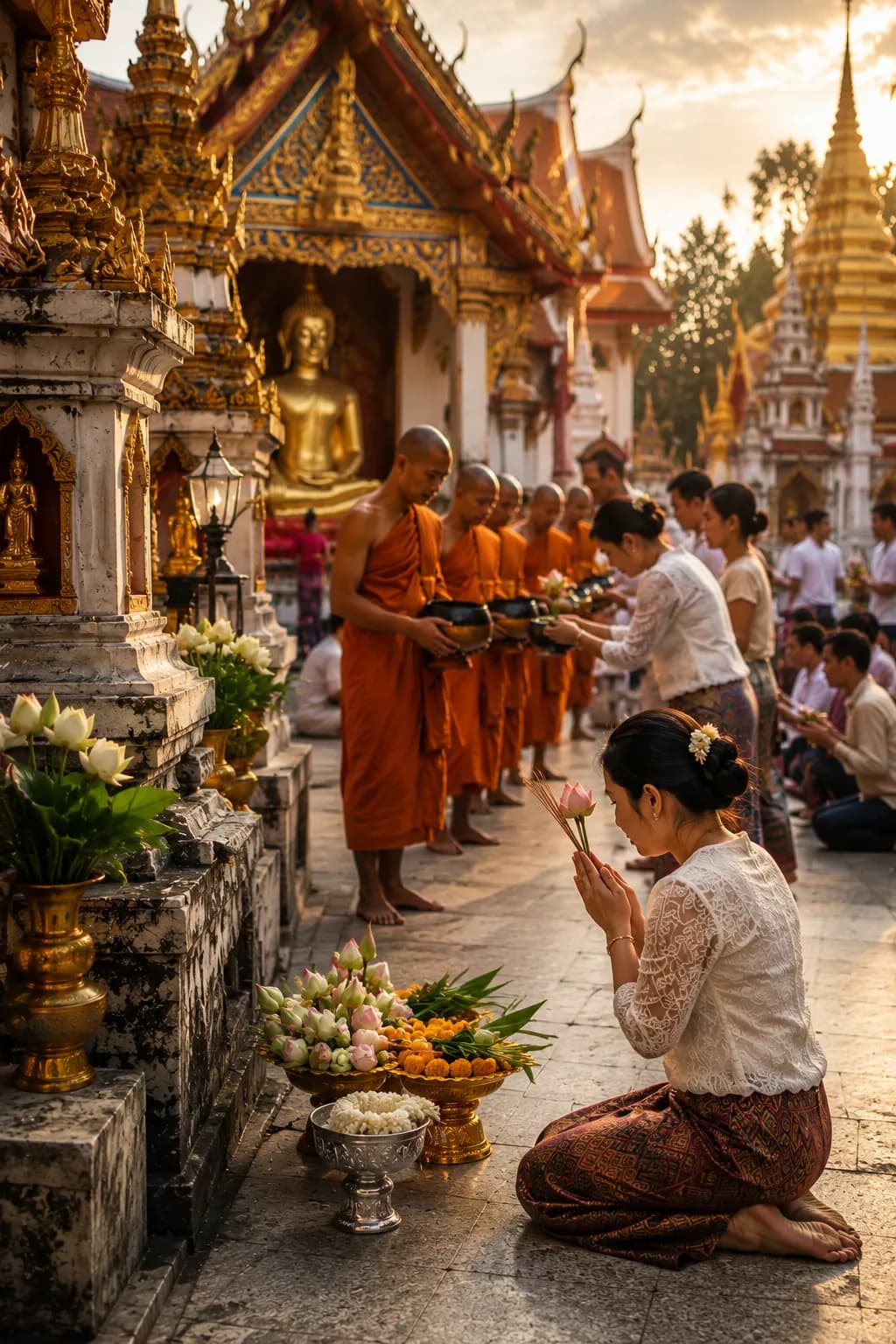
Walk into almost any busy Thai temple and women are everywhere. They prepare food, organise ceremonies, donate, meditate, support monks and maintain the social life around the wat. Then look at the formal monastic community and the picture changes. Thailand’s recognised Theravada Sangha is overwhelmingly male. Women who renounce ordinary life often enter a different category, most visibly as mae chi. This creates one of the most complicated subjects in modern Thai Buddhism. It is easy to simplify it into “women cannot be monks.” The reality deserves more care.
Women Have Always Been Central to Buddhist Life
A religion is not only its clergy. Thai Buddhist communities depend heavily on female lay supporters. Women make merit, provide food, support temples, organise events and maintain family religious traditions. In many households, women are the people most actively involved in day-to-day Buddhist practice. Older women may be particularly visible at temples, although this should not become another stereotype. Thai Buddhist participation spans generations. The point is structural: if you looked only at ordained monks, you would miss a huge part of the religion.
The most recognisable female renunciants in Thailand are known as mae chi. They normally shave their heads and wear white rather than the saffron or ochre robes associated with monks. Mae chi commonly observe eight precepts, although practice and institutional arrangements vary. Their lives may involve meditation, chanting, temple work, study and service. To a visitor, they can look like Buddhist nuns. That translation is understandable but imperfect. Mae chi do not occupy the same formal status within the Thai Sangha as fully ordained monks. Their position is distinct and historically complicated.
Why White?
The white clothing of mae chi visually separates them from the male monastic community. White is commonly associated with lay religious observance and renunciation in Thai Buddhism. Laypeople staying at a temple for intensive practice may also wear white. The colour therefore communicates a religious life of greater restraint without claiming the same institutional status as a bhikkhu. Translating every white-robed woman as “nun” can therefore hide important distinctions. English wants a familiar category. Thai Buddhism provides its own.
Many mae chi observe eight precepts. These extend beyond the Five Precepts commonly associated with lay Buddhist ethics. Additional commitments traditionally include celibacy and greater restraint around food, entertainment and personal adornment. The exact daily life of mae chi varies by institution. Some communities emphasise meditation. Others are closely connected with larger temples. Certain mae chi become respected teachers. The shared idea is renunciation: stepping away from ordinary household life in order to devote more time to religious practice.
An Ambiguous Institutional Position
Mae chi have historically occupied an ambiguous position. They are more renunciant than ordinary laypeople but are not fully ordained members of the recognised Thai Sangha. That affects institutional support, authority and public perception. Some mae chi communities have created strong educational and meditation institutions despite that ambiguity. Scholars have spent considerable time examining their role because it reveals a larger question: how does a religious system classify women who live highly disciplined spiritual lives outside its central ordination structure?
The institutional answer remains complicated. A bhikkhuni is a fully ordained Buddhist nun within traditions that maintain female monastic ordination. Early Buddhism had both bhikkhu and bhikkhuni communities. The historical bhikkhuni lineage disappeared in Theravada regions centuries ago. That created a major modern debate. Can full Theravada bhikkhuni ordination be legitimately restored? Different Buddhist communities and scholars answer the question differently. This is not merely an academic dispute. It affects real women seeking full monastic ordination.
The Thai Bhikkhuni Debate
Thailand’s mainstream official Sangha does not recognise a domestic Theravada bhikkhuni order in the same way it recognises bhikkhu ordination. Some Thai women have nevertheless received bhikkhuni ordination through lineages connected with other Theravada Buddhist communities. Those ordinations remain contested within Thailand. Supporters argue that women should have access to the full monastic path and that valid ordination can be restored through surviving lineages. Opponents raise questions about Vinaya legitimacy and institutional authority. The disagreement involves scripture, law, history and modern ideas about gender equality.
It should not be presented as settled. It is easy to turn the issue into a dramatic headline: Thailand bans female monks. That wording creates more confusion than clarity. Women are not banned from practising Buddhism. They are deeply involved in Buddhist life. The controversy concerns full monastic ordination and institutional recognition within a particular Theravada structure. Mae chi renounce ordinary life. Women meditate, teach and lead religious communities. Female practitioners can become highly respected. None of that makes the institutional inequality irrelevant. The distinction makes the reality more precise.
Female Teachers
Religious authority does not always follow formal titles. Some Thai women have become respected meditation teachers and Dhamma instructors. Their influence may grow through teaching, practice and personal reputation rather than official Sangha rank. This mirrors something seen among male monks as well: formal hierarchy and spiritual authority are not always identical. A person can have limited institutional status and substantial religious influence. The importance of female donors is difficult to overstate.
Monastic Buddhism depends on lay support, and women form a major part of that support. Food, money, organisation and volunteer labour flow through networks in which women are often central. That raises an interesting contrast. Women can be indispensable to the functioning of Buddhist institutions while remaining underrepresented in their highest formal monastic roles. Modern debates about women in Thai Buddhism often begin with that tension.
Meditation and Retreat Life
Women participate extensively in meditation practice. Thai temples and meditation centres may offer programmes for laywomen, often involving white clothing and stricter precepts during the retreat. Some women spend long periods in this kind of practice without becoming mae chi permanently. Others choose a more sustained renunciant life. This creates a spectrum rather than a sharp divide between ordinary laywoman and formal nun. Religious commitment can take several institutional forms.
Visitors often encounter another gender-related rule before they know anything about mae chi. Women generally avoid physical contact with monks. Objects are passed using local arrangements that prevent direct touching. This comes from monastic discipline rather than a claim that women are impure. That distinction matters. The rule regulates the monk’s conduct. It should not be transformed into a moral judgement about the woman standing in front of him.
Generational Change
Thai society has changed rapidly. Women have high levels of participation in education, professions, business and public life. Those changes inevitably affect how religious institutions are discussed. Younger Thai Buddhists may approach questions of ordination and gender differently from older generations. At the same time, traditional views remain strong in many communities. The debate therefore sits at the intersection of religion and social change. The debate is not a simple contest between “traditional” and “modern” Thailand.
Different Buddhists are arguing from different understandings of tradition itself. Ordination also concerns the continuity and legitimacy of monastic lineage. It concerns the continuity of monastic lineage and the interpretation of Vinaya. For conservative monastics, changing ordination structures can feel like altering something they are responsible for preserving. For supporters of bhikkhuni ordination, exclusion can appear incompatible with the early Buddhist history of female monasticism and modern equality. Both sides therefore see the issue as fundamentally important. That makes careful language essential.
What Visitors Should Notice
Understanding women’s role in Thai Buddhism does not require taking a position in the bhikkhuni debate. Notice who is preparing the offerings. Who is sitting through the chanting. Who is organising the temple event. Who is teaching meditation. Who is wearing white and living under a discipline far stricter than ordinary lay life. Those observations immediately make the religion look more complete. Women in Thai Buddhism cannot be reduced to the question “Can women be monks?” Ordination matters.
So do mae chi, lay practice, meditation, teaching, donation, family tradition and community organisation. The formal monastic structure gives men advantages that are real and significant. The lived religion depends heavily on women anyway. Understanding both facts at the same time is the only way to see the subject clearly. Thai Buddhism is not a male institution with women standing at the edge of religious life. Women have always been part of the religion’s substance, even when the institution has struggled to decide exactly where to place them.