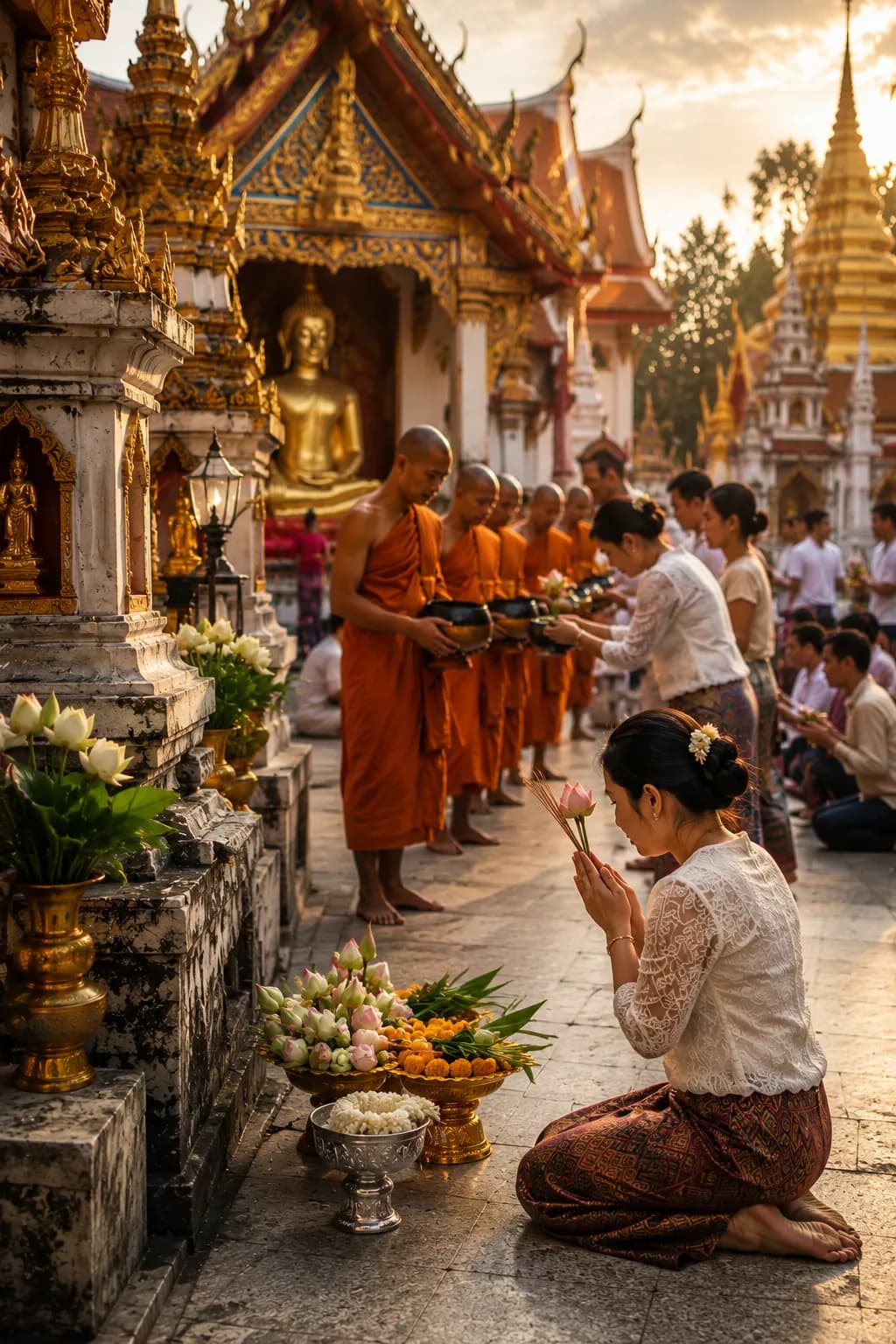
For many visitors, monkhood looks permanent. A man shaves his head, puts on robes and enters a monastery; naturally, you assume he has chosen a lifelong religious vocation. In Thailand, that assumption can be wrong. Temporary ordination has long been an important part of Thai Buddhist culture. A man may spend a limited period as a monk and later return to ordinary lay life. Some stay for weeks or months. Others remain for years. A smaller number discover that monastic life is where they want to stay. The tradition is religious, social and deeply connected with family. It is also changing.
Temporary Ordination
The idea of temporary ordination can surprise travellers from religious traditions where clergy normally make long-term or permanent commitments. Theravada Buddhism works differently. A monk can leave the order and return to lay life. In Thailand, temporary ordination has historically been common enough to become a recognisable stage of life for many men. Many Thai men never ordain, and participation has never been universal. Participation varies by family, region, generation and personal belief.
Modern work, education and urban life have changed the practical possibilities. Even so, the tradition remains culturally important because ordination is understood as more than a career choice. It can be a period of religious training, reflection and merit-making. Within Theravada monastic discipline, full ordination as a bhikkhu, or monk, normally requires the candidate to be at least twenty years old. Younger males may enter monastic life as novices, known in Pali as samanera.
A novice follows fewer rules than a fully ordained monk but still adopts a disciplined religious life. This distinction explains why you sometimes see very young boys wearing robes in Thailand. They have not necessarily received full monk ordination. Novice ordination can have educational, religious and family dimensions, and its importance differs across communities.
Merit for Parents
One of the most widely discussed meanings of ordination in Thailand is the idea of creating merit for parents. Historically, a son’s ordination could be a major family event. Parents and relatives participated in the ceremony, supported the new monk and shared in the religious significance. The connection is especially often expressed in relation to gratitude toward mothers. The theological language varies, but ordination often carries meaning for the family as well as for the individual.
It can also be understood as something offered back to the family. That makes the ceremony emotionally powerful even for relatives who are not especially interested in Buddhist doctrine. For generations, ordination also functioned as a rite of passage into adulthood. A period in the monastery exposed young men to discipline, religious teaching, communal living and responsibility. Historically, temples also played important educational roles in Thai society.
Monastic life could therefore provide practical learning as well as religious training. In modern Thailand, the role has changed. State education, university, work and military service now occupy much of the space once filled by temple-based formation. Yet the cultural memory remains strong. An ordained son can still be a source of pride for a family.
Buat Nak
One traditional term associated with Thai ordination ceremonies is buat nak. The ceremony surrounding ordination can be colourful, social and highly local. A candidate may be dressed in white before ordination. Family and friends gather. Processions, music and community celebration can accompany the event. Some elements around the formal Buddhist ordination draw on local custom or Brahmanic and folk traditions rather than monastic doctrine itself. That mixture is typical of Thai religious culture. The formal act of ordination belongs to Theravada Buddhism. The way a community celebrates it can reflect centuries of local tradition.
The pre-ordination candidate is often called a nak, a term connected with the naga, the serpent beings found throughout Buddhist and Southeast Asian religious imagery. Traditional stories explain the connection through a naga who wished to become a monk. Whether every family discusses the story is another matter. The symbolism survives in the language and ritual vocabulary of ordination. This is a good example of how religious culture works. A tradition can remain meaningful even when participants do not consciously analyse every historical layer behind it.
How Long Do Men Stay?
There is no standard answer. Some men may ordain for a relatively short period. Others remain through the Buddhist rains retreat. Some discover a deeper religious commitment and stay indefinitely. Historically, spending a significant period in the monastery could be considered valuable preparation before marriage or adult responsibility. Modern life has made shorter ordinations more common in some contexts. Employment and university schedules do not always accommodate months away. A shorter stay can still carry real religious and family meaning. Religious traditions adapt to the realities of the people practising them.
Temporary ordination can also happen in connection with death. A man may ordain for a period as an act of merit associated with a deceased parent or relative. This gives monkhood an emotional role during grief. Rather than being only a personal search for enlightenment, ordination becomes part of a family’s religious response to loss. The exact practice varies, so it is unhelpful to turn it into a rule. But it illustrates why monkhood in Thailand cannot be understood only as an individual lifestyle choice. Family remains central.
Personal Reasons
Not every ordination is primarily about family tradition. Some men enter a monastery because they are genuinely drawn to Buddhist practice. They may want time away from ordinary life. Some are interested in meditation. Others are dealing with loss, uncertainty or a major life transition. A monastery offers a structured environment in which daily life is simplified. Monkhood should not be recast as a form of therapy; it remains a religious commitment governed by monastic discipline. It remains a religious commitment governed by monastic discipline.
But human beings often turn toward religion during periods when ordinary life feels unstable. Thailand is no exception. A man can enter intending to stay only briefly and later change his mind. Monastic life may become a long-term vocation. Thailand’s most respected monks include men who spent decades in robes, studying, meditating, teaching and leading monasteries. The possibility of disrobing does not make their commitment casual. Theravada monasticism allows movement between lay and monastic life in ways that can look unfamiliar to outsiders.
Is Ordination Expected?
This is where guidebooks often overstate the tradition. It is sometimes said that every Thai Buddhist man is expected to become a monk at least once. That is too absolute. Ordination has historically been an important ideal in many families, but reality has always been more varied. Religion, family background, region and personal circumstances matter. Thailand is also religiously diverse; not every Thai man is Buddhist in the first place. Modern generations may feel less social pressure to ordain than their grandfathers did. A tradition can be culturally powerful without being universal.
Temporary ordination exists within a society very different from the Thailand of a century ago. Young adults may be studying abroad, working for multinational companies or managing careers that make extended absence difficult. Some employers are supportive of ordination leave. Others may be less flexible. Families also change. Urban households may have weaker day-to-day connections with a local wat. These pressures influence how long men ordain and whether they ordain at all. The tradition has not disappeared. Its place in life is negotiated alongside modern commitments.
Novice Ordination
Young boys in robes are another visible part of Thai Buddhism. Novice ordination can be temporary and may take place during school holidays or special programmes. In some communities it remains an important educational and religious opportunity. Novices follow a simpler discipline than fully ordained monks. They study, chant, learn temple routines and live under monastic supervision. For some, the experience ends after a short period. For others it becomes the first step toward later full ordination. The paths from novicehood are varied.
Ordination often reveals something important about Thai Buddhism: religious practice is rarely only about the individual. Relatives organise food. Friends attend. Money and effort go into the ceremony. Older family members may become visibly emotional. The new monk is entering a disciplined life, but the family is also participating in an event that carries religious meaning. That family dimension helps explain why photographs of an ordination can look surprisingly festive. The celebration is not in conflict with the seriousness of monkhood. It expresses the importance of the transition.
Leaving the Monastery
When a temporary monk disrobes, he returns to ordinary life. He can work, marry, raise a family and participate in society like anyone else. Former monks are common enough that the experience is not automatically treated as extraordinary. Some carry the lessons of monastic discipline with them. Others may speak about the period as an important family obligation or life experience. The experience does not transform every former monk in the same way. A monastery is not a factory producing identical personalities.
Temporary ordination remains one of the clearest examples of how Buddhism connects personal life with family and society in Thailand. It can create merit, honour parents, mark adulthood, offer religious training or open the door to a permanent vocation. Different men emphasise different reasons. That diversity is important. The tradition is not meaningful because every Thai man follows it. It is meaningful because it has shaped how generations of Thai families understand monkhood, gratitude and religious responsibility. Once you know that, the sight of a young monk surrounded by a large excited family makes much more sense.