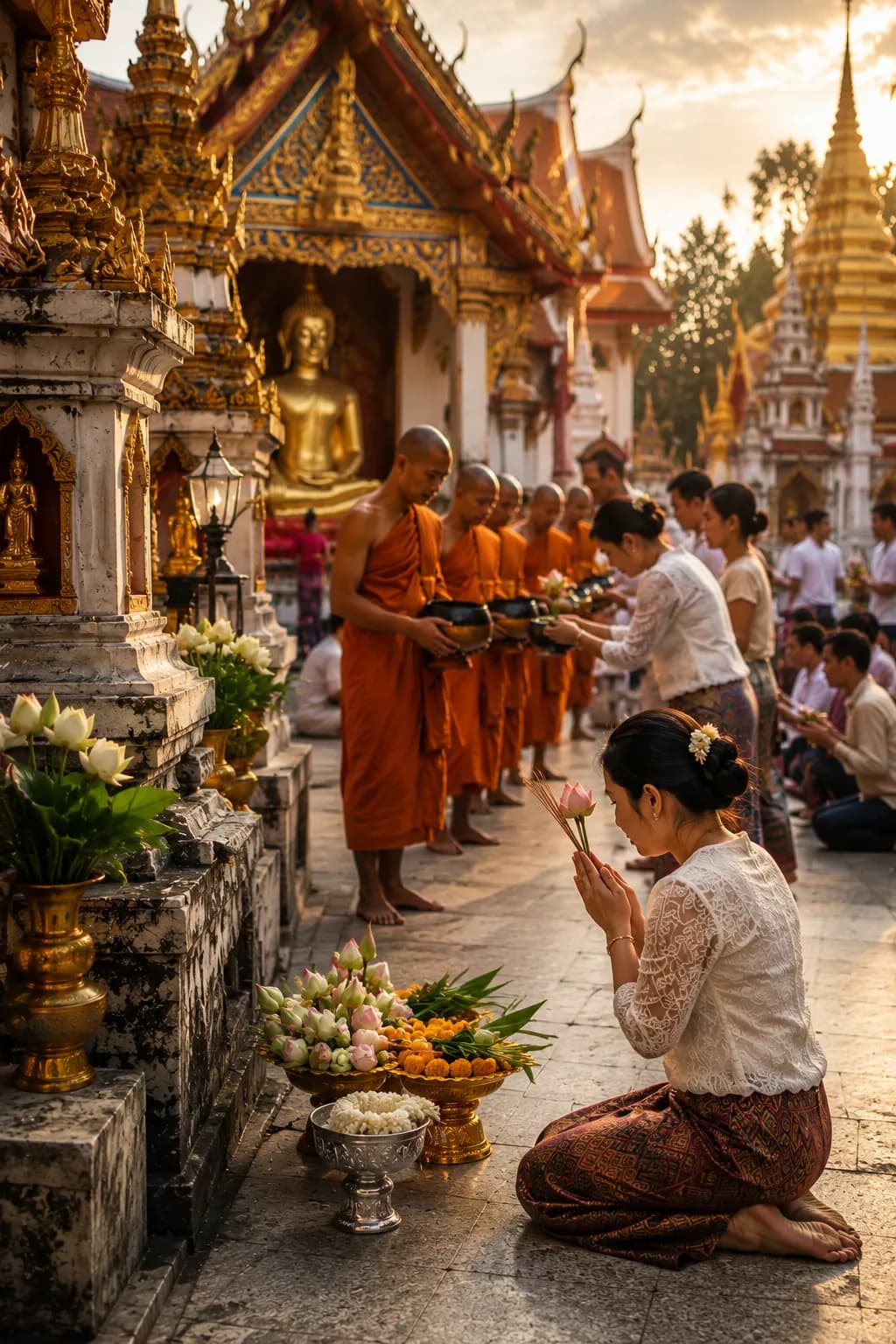
Thailand is often described as a Buddhist country, which is broadly true but leaves out the tradition behind the label. That is broadly true, but it leaves out the part that matters most if you actually want to understand what you are seeing. The dominant tradition is Theravada Buddhism, a form of Buddhism shared in different ways across Thailand, Sri Lanka, Myanmar, Laos and Cambodia. It shapes temple life, monastic discipline, religious holidays and a large part of Thailand’s moral vocabulary.
Practice, however, varies enormously from person to person. Some meditate regularly. Some visit temples mainly on important days or for family events. Some are deeply interested in doctrine, while others relate to Buddhism more through custom, merit-making and respect for monks. Thai religious life can also include spirit beliefs and Brahmanic or Hindu-influenced practices that sit alongside Buddhism without being identical to Buddhist teaching. A useful starting point is therefore to separate Theravada Buddhism as a religious tradition from the many ways Buddhism is lived in Thailand.
What Theravada Means
The word Theravada is usually translated as “Teaching of the Elders.” The tradition places great importance on a body of scriptures preserved in Pali, known collectively as the Pali Canon or Tipitaka. These texts contain teachings, monastic rules and philosophical material associated with the early Buddhist tradition. For a traveller, the key point is not the size of the canon or the details of ancient textual history.
It is that Thai Buddhism developed within a tradition that gives strong weight to monastic discipline, ethical conduct, meditation and the Buddha’s path to liberation from suffering. Theravada is sometimes described as “the oldest form of Buddhism.” That can be useful shorthand, but it is too simplistic if taken literally. Buddhist traditions changed over many centuries, and modern Theravada is itself the result of long historical development. In Thailand it was shaped by contact with Sri Lankan lineages, royal patronage, local traditions and later monastic reforms.
The Buddha, Dhamma and Sangha
Three ideas sit at the centre of Buddhist religious life: the Buddha, the Dhamma and the Sangha. Together they are often called the Three Jewels. The Buddha is not generally understood in Theravada Buddhism as a creator god. He is the awakened teacher whose insight revealed a path out of suffering. The Dhamma is his teaching and, more broadly, the truth and practice that lead toward liberation.
The Sangha can mean the Buddhist monastic community, although in some contexts the word is used more broadly for the community of practitioners. You see all three constantly in Thailand. Buddha images occupy the sacred centre of temples. Monks preserve and teach religious traditions. Chanting, sermons, meditation and moral instruction are all expressions of the Dhamma. For many Thai Buddhists, taking refuge in the Buddha, Dhamma and Sangha is a simple way of expressing Buddhist identity.
The Problem Buddhism Is Trying to Solve
Buddhism begins with an observation rather than a commandment: ordinary life contains dissatisfaction, instability and suffering. The Pali term dukkha is often translated as “suffering,” although it can also include frustration, unease and the basic unsatisfactoriness of things that do not stay the way we want them to. The Buddha’s teaching is traditionally summarised through the Four Noble Truths. Suffering exists; it has causes; it can cease; and there is a path leading toward that cessation. That path is the Noble Eightfold Path, usually grouped into wisdom, ethical conduct and mental cultivation.
It includes areas such as right understanding, right speech, right action and right mindfulness. Thai Buddhists may not recite all eight factors in everyday conversation, but the underlying ideas help explain why morality, restraint, mindfulness and mental training matter within the tradition. The central issue is attachment. People want pleasant things to remain, painful things to disappear and the world to conform to their expectations. Buddhism argues that a more realistic understanding of impermanence changes the relationship we have with those desires.
Monks and Lay Buddhists
One of the most visible differences between Thai Buddhism and the religious life many Western visitors grew up around is the importance of the monastic community. Theravada Buddhism maintains a formal distinction between monks and laypeople. Monks live under a detailed disciplinary code known as the Vinaya. Their lives are ideally organised around simplicity, study, meditation, ethical discipline and religious practice. Laypeople do not follow the same monastic rules. They have families, jobs, businesses and ordinary social lives.
Their relationship with Buddhism is therefore different, but not secondary. Laypeople support temples and monks, make merit, observe moral precepts, meditate, attend ceremonies and participate in religious festivals. The relationship is reciprocal. Monks traditionally depend on the lay community for material support, while the monastic community provides teaching, ritual continuity and an important religious focus. Seen in that context, the early-morning sight of monks receiving food from local people is more than a picturesque Thai tradition. It represents a relationship at the heart of Theravada religious life.
Merit and Everyday Practice
If you spend enough time in Thailand, you will hear the idea of making merit. In Thai, the phrase tham bun is extremely common. Merit is associated with wholesome actions. Giving, supporting monks and temples, observing moral precepts, helping others and practising meditation can all be understood as meritorious. Merit-making is connected to karma and the cultivation of good qualities, not to a supernatural rewards counter.
It can also have a deeply social dimension. Families may make merit together. Merit may be dedicated to deceased relatives. Temples can become centres for community donations, ceremonies and collective activity. This is one reason Thai Buddhism cannot be understood only by reading doctrine. The religion is experienced through repeated actions: giving food, attending a funeral, joining a temple ceremony, listening to monks chant or visiting a wat with family.
The Five Precepts
For lay Buddhists, the Five Precepts provide a basic ethical framework. They involve refraining from killing, stealing, sexual misconduct, false speech and intoxicants that lead to heedlessness. These are not always followed perfectly, and Buddhism does not require us to pretend otherwise. Thailand has bars, nightlife, conflict, crime and every other feature of modern society. A country can be strongly influenced by a religion without every citizen consistently living according to that religion’s ideals.
That distinction matters. When travellers hear that Thailand is Buddhist, it can be tempting to expect Buddhist teaching to explain every social behaviour. It cannot. Religion is one influence among many, alongside family, economics, education, politics, regional culture and individual personality. Meditation has an important place within Theravada Buddhism, but visitors sometimes overestimate how regularly the average person practises it.
Thai Buddhist meditation traditions include approaches connected with samatha, or calming and concentration, and vipassana, usually translated as insight. Breath meditation, mindfulness and other forms of mental cultivation are taught in different monasteries and lineages. Some monks devote much of their lives to meditation. Some laypeople attend retreats or practise regularly at home. Others may rarely meditate at all. Their Buddhism is expressed through a different mix of practices. Religious identity can be expressed through many different activities. A person who does not sit in meditation each morning may still visit temples, make merit, support monks and participate fully in Buddhist family traditions.
Buddhism Is Not Worship of a Creator God
Visitors sometimes look at people kneeling before a Buddha image and assume they are worshipping the Buddha as a god. That is not the best way to understand the act within Theravada Buddhism. Bowing can express respect, gratitude and devotion. Buddha images remind practitioners of the Buddha and the qualities associated with awakening. Offerings of flowers, candles or incense may similarly express reverence and religious intention.
Popular Thai religious life can of course be more complicated than a textbook distinction. People may pray for good fortune, protection or help with personal problems. Temples may contain sacred objects associated with protective power, revered monks or local tradition. The useful distinction is that canonical Buddhist teaching does not present the Buddha as a creator deity who controls the universe.
Thai Buddhism in Real Life
The Buddhism you encounter in Thailand rarely arrives in neat academic categories. At one temple, you may see monks chanting before a Buddha image. Nearby there may be a shrine connected with a Hindu deity. Outside, a spirit house may receive offerings. A visitor might wear a Buddhist amulet for protection and later make merit for a deceased relative. It is easy to declare that one part is “real Buddhism” and everything else is superstition.
That approach usually explains less than it claims. Thai religious culture developed over centuries. Theravada Buddhism became the dominant religious framework, but it interacted with older local beliefs, court ritual, Brahmanic traditions and regional practices. Many Thai people move comfortably between these layers without feeling a need to classify each action. Understanding the difference between them is useful. Insisting that ordinary people must keep them separate is less useful.
The Role of the Temple
The Thai word wat is usually translated as temple, but a wat is generally an entire religious complex rather than a single building. Temples can be places for ordination, funerals, meditation, education, festivals, community gatherings and merit-making. Some are internationally famous monuments crowded with tourists. Others are quiet neighbourhood institutions woven into local life. That difference is important.
Wat Pho or Wat Arun can feel like major visitor attractions, but the religious function of a wat is clearer when you see an ordinary local temple early in the morning or during a family ceremony. A temple can be architecturally spectacular and still be a working religious institution. Thai Buddhist identity does not fit one model. One person may meditate daily and study Dhamma seriously. Another may visit a temple only for major holidays, funerals and family events.
Someone else may describe themselves as Buddhist while also placing great importance on amulets, auspicious numbers or spirit beliefs. Age, family, education, region and personal interest all influence religious practice. Any claim beginning with “Thai Buddhists always…” deserves immediate caution. Buddhism is deeply embedded in Thai history and culture, but real people are never as uniform as cultural summaries make them sound.
Theravada as the Foundation, Not the Whole Story
Theravada Buddhism provides the main religious framework through which Thai temples, monks, merit-making and many national religious observances make sense. It offers a vocabulary of karma, impermanence, ethical conduct, generosity and mental cultivation that has shaped Thai society for centuries. But it is the foundation, not a complete explanation of Thailand. To understand the religion as travellers actually encounter it, you also need to understand monks, ordination, merit-making, meditation, festivals, spirit beliefs and the history that brought these elements together. Once those pieces begin to connect, Thailand’s temples stop looking like isolated attractions and start making much more sense as part of a living religious culture.