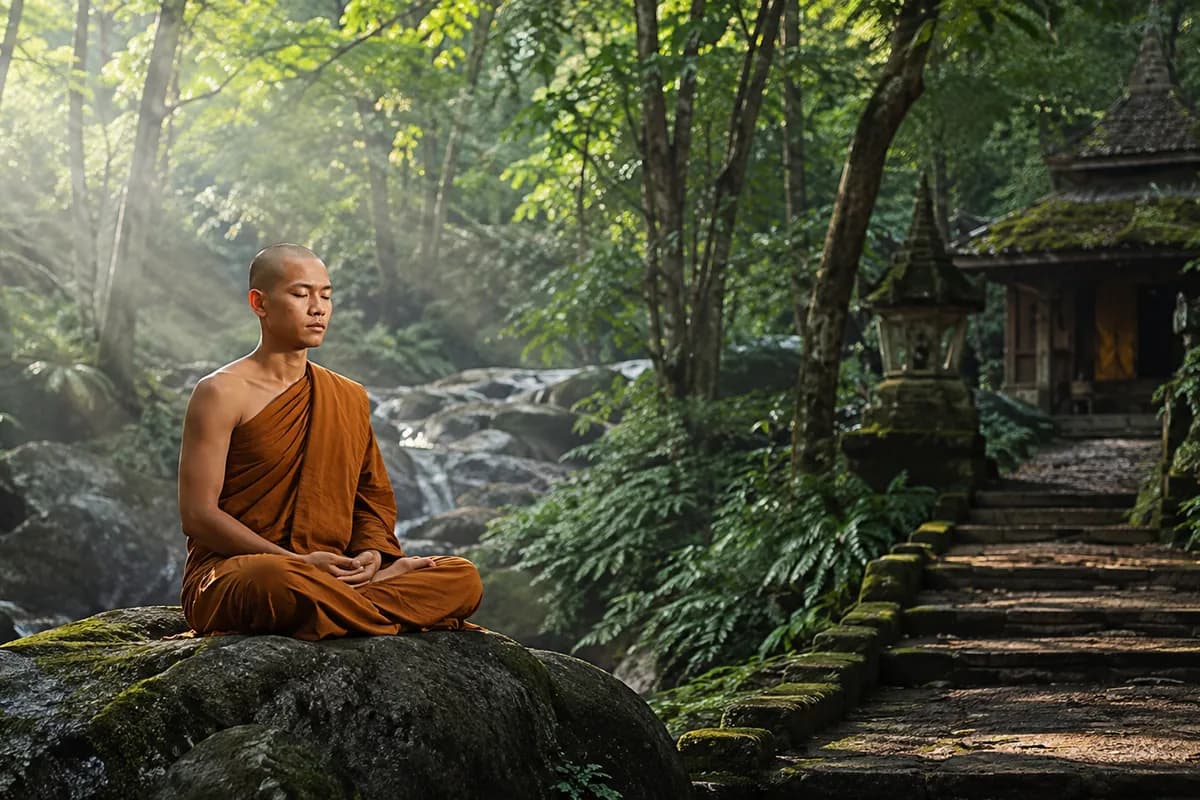
For many international visitors, Buddhism and meditation are almost synonyms, even though Thai religious life makes the distinction clear. Meditation is an important part of the Buddhist path, and Thailand has produced influential meditation traditions and teachers. But ordinary Thai Buddhist life also includes merit-making, chanting, temple ceremonies, ethical precepts, family rituals and support for monks. A person can identify strongly as Buddhist without meditating every day. Understanding that wider context makes meditation easier to appreciate for what it is: one major form of Buddhist mental cultivation rather than the entire religion.
Meditation in the Buddhist Path
Buddhist meditation is traditionally connected with a much larger path of practice in which ethical behaviour, understanding and generosity all matter. Mental cultivation happens inside that framework. This is different from the way meditation is often marketed internationally as a stand-alone technique for relaxation. A Buddhist meditator is aiming at more than feeling calmer. The deeper goal involves seeing experience more clearly, weakening attachment and developing wisdom. Calm can be useful, but it is not the final destination.
The Pali term samatha refers to calming or tranquillity practice. The mind is trained to become more stable and concentrated. Different objects can be used, including the breath. As concentration deepens, the ordinary restlessness of the mind can settle. Theravada traditions contain sophisticated teachings about concentration. Visitors do not need to master that entire system to understand the basic idea. Samatha trains steadiness because a scattered mind has difficulty seeing anything clearly.
Vipassana
Vipassana is commonly translated as insight. The word has become internationally famous through modern meditation movements, sometimes to the point that people treat vipassana as a separate religion. Within Theravada Buddhism, insight concerns understanding experience in ways connected with core Buddhist teachings such as impermanence, unsatisfactoriness and non-self. Meditation becomes a way of observing how sensations, thoughts and emotions arise and pass. Again, traditions explain the process differently. Thai monasteries teach vipassana through several methods rather than one national technique.
Meditation discussions often create an artificial contest. Are you practising samatha or vipassana? In Theravada traditions, calm and insight are closely related. A stable mind can support clear observation. Insight can change the way the mind relates to experience. Different teachers emphasise the relationship in different ways. The important point for travellers is not choosing a side. It is recognising that Thai meditation contains several approaches within one broader Buddhist path.
Breath Meditation
Breath meditation is among the most widely recognised Buddhist practices. Attention is placed on the natural process of breathing. It sounds simple until the mind starts producing its own programme: thoughts and memories appear, the body becomes uncomfortable and a completely irrelevant song begins playing in the head. The practice is not about winning an argument with those experiences. It trains attention and awareness. In Thai monasteries, breath practice can be taught in different ways depending on the lineage.
The English word mindfulness now appears in schools, hospitals, smartphone apps and corporate training. Its Buddhist background is far richer than the modern wellness version. Within Buddhist practice, mindfulness is connected with careful awareness of body, feelings, mind and experience. It also sits inside an ethical and philosophical system. Secular mindfulness can still be useful; it is a different context. It means the word changes meaning when removed from its religious context. A Thai monk speaking about mindfulness may be discussing something much broader than a five-minute stress break before a meeting.
Walking Meditation
Meditation does not always mean sitting. Walking meditation is common in Thai Buddhist practice, especially in meditation-oriented monasteries. The practitioner walks slowly and deliberately along a defined path while maintaining awareness. In forest traditions, walking meditation can occupy substantial periods of practice. That practice explains the straight meditation paths often seen near monks’ dwellings. The body is moving, but the practice remains meditation.
Visitors sometimes treat chanting and meditation as opposites, dismissing one as noisy ritual and treating the other as “real” Buddhism. Thai religious life does not fit that hierarchy. Chanting can collect attention, express devotion and reinforce remembered teachings. Meditation develops the mind in other ways. A monastery may use both. Together, the practices show that Buddhism extends beyond inward psychological technique. It is also a tradition transmitted through communities and ritual forms.
Monastic Meditation
Monks have more opportunity than most laypeople to organise life around religious practice. Monastic life, however, is not an all-day meditation schedule for every monk. Some monasteries specialise in study. Others have extensive ceremonial responsibilities. Senior monks may spend large amounts of time teaching or administering a temple. The intensity of meditation therefore varies; a forest monastery may build much of the daily schedule around sitting and walking practice. A major city wat can have a very different rhythm.
Both remain Theravada institutions, and meditation is not restricted to monks. Some laypeople attend regular temple sessions, others join retreats for several days, and many practise only occasionally. And plenty do very little formal meditation. This surprises foreigners who imagine a Buddhist country as a society of natural meditators. Religious identity is broader than one practice. A Christian does not need to become a monk to be Christian. A Thai Buddhist does not need to meditate three hours a day to be Buddhist.
Meditation Retreats
Thailand has many monasteries and centres offering meditation retreats. Some are designed primarily for Thai practitioners. Others welcome foreigners and provide instruction in English. Schedules, discipline and teaching style can vary dramatically. One centre may be highly structured. Another is quiet and informal. Some retreats expect long hours of practice and limited talking. Visitors should therefore research the specific institution rather than assuming every “meditation retreat in Thailand” offers the same experience.
Lay meditators at Thai temples often wear white. White is associated with religious observance and simplicity. During a retreat, participants may take additional precepts and follow a more disciplined schedule than in ordinary life. This does not make them monks or mae chi. They remain lay practitioners; the clothing signals a temporary change in lifestyle and religious focus. For visitors, it is another reminder that Thai Buddhist practice includes many levels between ordinary daily life and full ordination.
Meditation and Mental Health
Meditation is frequently marketed as a solution to anxiety, stress, trauma and almost everything else. A Buddhism article should be more careful. Meditation can be meaningful and beneficial for many people. It is not a substitute for medical or psychological care. Intensive retreats can also be challenging. Traditional Buddhist practice developed for religious purposes, not as a universal clinical treatment. Travellers should be wary of grand promises from anyone claiming a few days of meditation will solve every problem.
Buddhism itself tends to be more realistic about the difficulty of training the mind. Meditation instructions can sound deceptively simple. “Watch the breath,” “observe sensations” and “walk mindfully” can all sound straightforward on the page. The challenge lies in understanding what to do when the practice becomes confusing. Experienced guidance matters because deceptively simple instructions can become difficult in practice. Experienced monks or lay teachers help interpret the practice. Different teachers use different language. One teacher may emphasise concentration while another focuses on moment-to-moment observation. Good instruction provides context rather than just technique.
Thai Forest Meditation
Thailand’s Forest Tradition became internationally influential partly because of its strong emphasis on meditation and disciplined monastic life. Teachers such as Ajahn Mun and Ajahn Chah inspired lineages extending far beyond Thailand. Forest practice often emphasises simplicity, direct observation and learning from the conditions of monastic life itself. The forest is not magical. It is an environment with fewer distractions and stronger reminders of impermanence. Mosquitoes are also available in generous quantities.
Spiritual romanticism usually leaves that part out. Modern meditation culture often asks, “Will this make me feel better?” Buddhist meditation asks a harder question: “Can I understand experience more clearly?” Sometimes clarity is comfortable, and sometimes it is not. The practice examines attachment, aversion and the constantly changing nature of experience. That is why Buddhist meditation cannot be reduced to relaxation. Relaxation may happen along the way; awakening is a much more ambitious project.
What Travellers Should Take Away
A retreat is not required to understand meditation’s place in Thai Buddhism. Notice that it exists alongside merit-making, chanting, ethical precepts and monastic discipline. Recognise the variation in methods rather than assuming every monk is a meditation master or every Thai Buddhist practises daily. And if you do choose to meditate in Thailand, approach the practice as more than a wellness activity packaged in exotic surroundings. Thai Buddhism has spent centuries developing ways of training the mind. The techniques are simple enough to describe. The tradition does not claim they are easy.