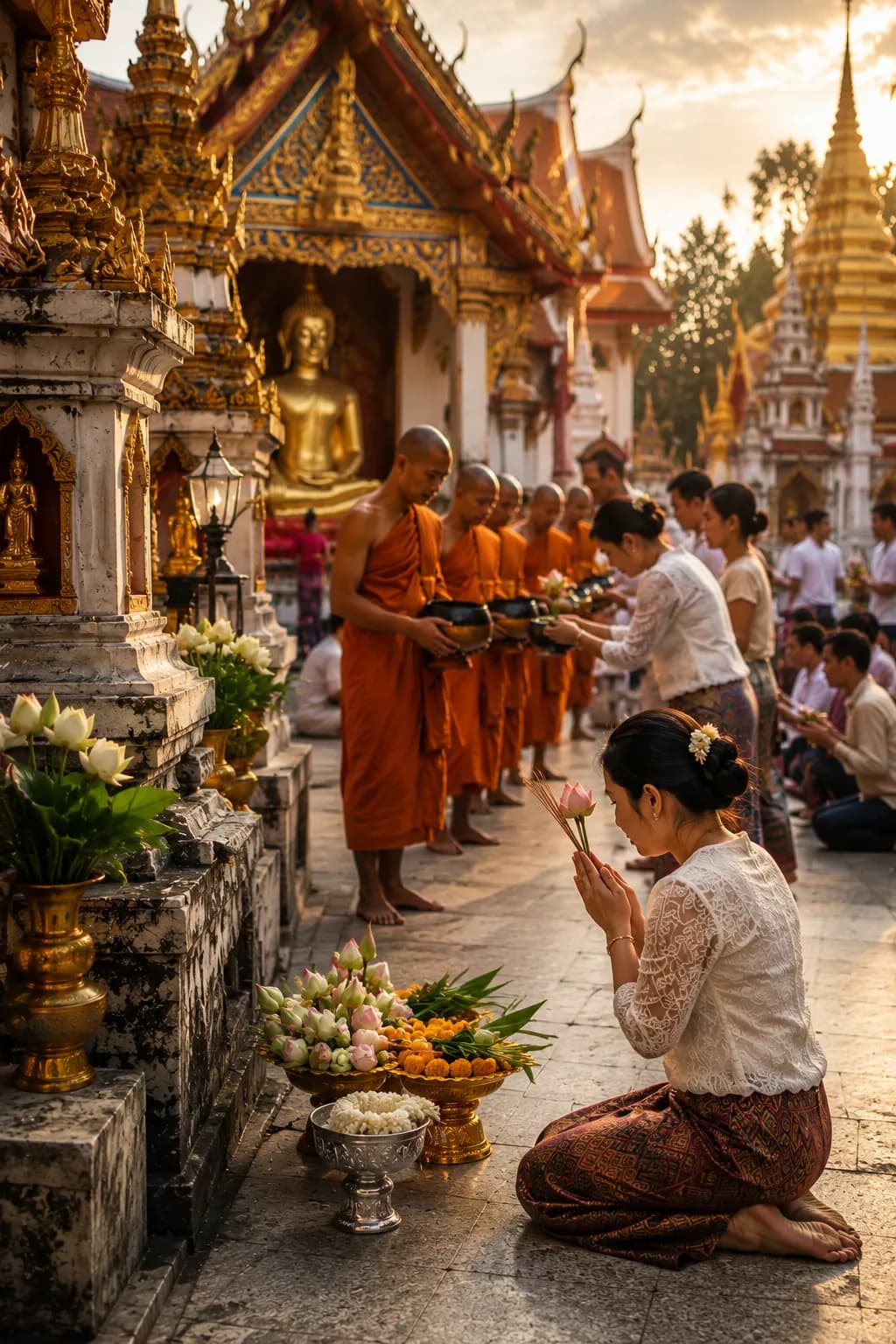
A traveller can spend weeks visiting Thai temples without ever noticing that the monks belong to a national institutional structure. At street level, each wat can feel local. One temple is known for meditation. Another is famous for its architecture. A small provincial monastery may be closely tied to one village. Behind that diversity is the Thai Sangha, the organised monastic community recognised within Thailand’s Buddhist institutional system. The word itself is ancient. The modern administration around it is not. Understanding the difference helps explain how Thai Buddhism combines a centuries-old monastic tradition with the bureaucracy of a modern state.
What Sangha Means
In Buddhism, Sangha can have more than one meaning. In everyday discussion it often refers to the community of Buddhist monks and nuns. In traditional Buddhist language, the term can also have a more specific religious meaning connected with the community of noble disciples. In Thailand, Sangha is additionally used in an institutional sense for the officially organised monastic community. That is the meaning most relevant when talking about monastic administration, ecclesiastical ranks and the relationship between monasteries and the state. The same word therefore carries both spiritual and bureaucratic weight.
Every Thai wat has its own character. The abbot matters enormously. Local supporters matter. Regional history matters. Yet officially recognised monasteries do not operate entirely outside wider structures. Senior monks can hold administrative responsibilities beyond their own temple. Monastic administration extends through local, provincial and national levels. For most laypeople, the details remain largely invisible. You can make merit at your neighbourhood temple without knowing which ecclesiastical official supervises the district. The system becomes more visible when questions of senior appointments, discipline or national Buddhist policy arise.
The Supreme Patriarch
At the top of the official Thai Sangha hierarchy is the Supreme Patriarch. The office represents the highest formal ecclesiastical position in the country’s recognised Theravada monastic structure. The comparison with a Buddhist pope is misleading, however, because Theravada Buddhism has no single worldwide head. Theravada Buddhism has no single worldwide head. Sri Lanka, Myanmar, Thailand and other Theravada countries maintain their own institutions and lineages. The Thai Supreme Patriarch belongs specifically to Thailand’s Sangha structure.
This distinction matters because travellers often assume religions organise themselves according to familiar models from home. Buddhism rarely cooperates with those expectations. Thailand’s officially recognised monastic world is dominated by two major fraternities, or nikayas. The larger is Maha Nikaya. The smaller is Dhammayuttika Nikaya, which emerged from a nineteenth-century reform movement associated with Prince Mongkut before he became King Rama IV. Both belong to Theravada Buddhism.
The distinction is not equivalent to two separate religions, nor is it necessarily obvious to an ordinary visitor looking at monks in robes. Differences involve lineage, institutional history and aspects of discipline and practice. In everyday life, many laypeople care far more about the reputation of a particular temple or monk than about the administrative label of the nikaya.
Maha Nikaya
Maha Nikaya includes the large majority of Thai monks and monasteries. Its scale means it contains enormous internal diversity. Some Maha Nikaya monasteries emphasise scholarship. Others are known for meditation. Some are rural community temples; others are major urban institutions. Important forest lineages also exist within Maha Nikaya. That last point matters because simplified descriptions sometimes present Dhammayuttika as disciplined or meditative and Maha Nikaya as something else.
Reality is much more complicated. Institutional affiliation does not tell you the spiritual quality of a monastery. Dhammayuttika Nikaya developed through monastic reform in the nineteenth century. Prince Mongkut spent many years as a monk before becoming king. During that period he pursued reforms intended to emphasise careful monastic discipline, textual study and what reformers regarded as more accurate practice. The movement became institutionalised as a separate monastic fraternity.
Dhammayuttika remained smaller than Maha Nikaya but gained substantial influence. Several major Thai forest teachers had connections with Dhammayuttika traditions, although forest practice cannot be reduced to one nikaya. Thailand’s monastic history therefore includes repeated reform from within Buddhism rather than an unchanged tradition handed down intact from antiquity.
The Sangha and Thai Law
The monastic community is religious, but its official organisation also exists within Thai law. Modern Sangha legislation created administrative structures governing recognised monastic institutions. The legal framework has changed over time through amendments and political developments. For a travel article, memorising every clause is unnecessary. The useful idea is that the Sangha occupies an unusual space. Monks follow a religious discipline rooted in ancient Buddhist tradition while recognised monasteries also operate within a modern national legal framework.
The two systems overlap without being identical. At the temple level, the abbot is a central figure. An abbot oversees the monastery and carries both religious and practical responsibilities. In a small wat, the relationship between abbot, monks and local community may be highly personal. At a large urban temple, administration can be far more complex. An abbot’s reputation may rest on teaching, meditation, scholarship, leadership or decades of respected service. Formal position matters. So does personal credibility.
Ecclesiastical Rank
Thailand has formal monastic titles and ranks. These can reflect seniority and institutional responsibility, but visitors should resist treating them as a spiritual leaderboard. A monk with an impressive title may have major administrative responsibilities. Another monk with little bureaucratic rank may be widely revered as a meditation teacher. Religious authority and institutional authority overlap, but they are not identical. This distinction is important in many religions. An administrative leader is not automatically the person practitioners consider the deepest spiritual teacher.
Monastic seniority is traditionally connected with the number of rains retreats a monk has completed since ordination. This can influence etiquette within the monastic community. A monk’s age as a person and his seniority as a monk are therefore not necessarily the same thing. Someone who ordained at twenty can be monastically senior to an older man who ordained much later. Visitors rarely need to navigate these distinctions themselves, but they help explain seating arrangements and patterns of deference among monks. The robe creates a community with its own internal social order.
The Sangha Council and Administration
National Sangha administration includes senior monastic bodies responsible for institutional governance. Their work can involve education, discipline, administration and the management of monastic affairs. The details can become highly technical, and they change with law and policy. What matters for travellers is understanding that Thailand’s monastic world has organised leadership beyond individual temples. A wat may feel timeless. Its paperwork probably is not. Thailand does not have a simple Western-style separation between religion and state.
Buddhism has historically been tied to monarchy, national identity and public institutions. At the same time, Thailand recognises other religions and contains significant Muslim, Christian, Hindu, Sikh and other communities. The relationship between Buddhism and the state has changed across different political periods. Discussing that history seriously requires more space than a Sangha explainer. The basic point is that official Thai Buddhism developed partly through interaction with royal and state authority. Modern monastic administration reflects that history.
Spiritual Teachers Outside the Bureaucratic Spotlight
Some of Thailand’s most influential monks became important because people respected their teaching and practice rather than because tourists knew their official rank. Forest masters are the clearest example. A meditation teacher can attract disciples from across Thailand and abroad because of reputation, discipline and teaching style. That kind of authority grows from below. It is one reason the Sangha should not be imagined as a corporate hierarchy in which every important monk can be identified from an organisational chart. Formal structure tells only part of the story.
The institutional status of monks also explains why monastic scandals receive so much attention in Thailand. When a monk seriously violates religious expectations, the issue is not viewed only as one individual behaving badly. It can affect trust in temples, senior monks and Buddhist institutions. Public scrutiny can therefore be intense. This is another reminder that monks occupy both spiritual and social roles. People support the Sangha because it represents Buddhist ideals. Failures inside that institution matter precisely because the expectations are high.
What Ordinary Thai Buddhists Need to Know
Most laypeople do not need detailed knowledge of Sangha bureaucracy to practise Buddhism. They support a local temple, listen to monks, participate in ceremonies and make merit. Institutional hierarchy operates in the background. This is similar to many large organisations. Members can participate fully without knowing every administrative level. For visitors, understanding that background adds context without requiring you to become an expert. Ordinary respect does not require identifying a monk’s nikaya first.
The Thai Sangha provides continuity. It helps organise ordination, temple administration, monastic education and discipline across a country with tens of thousands of monasteries and a huge variety of local traditions. At the same time, Buddhist life constantly exceeds the bureaucracy. Personal teachers matter. Local temples matter. Forest lineages matter. Family relationships with a wat matter. The Sangha is therefore both an institution and a living religious community.
Thailand’s monks belong to an organised religious system, but that system does not make every monastery the same. Maha Nikaya and Dhammayuttika Nikaya contain different histories and lineages. Abbots shape local temples. Senior monks hold formal responsibilities. Meditation teachers gain influence through personal reputation. The institution provides structure. The religion provides far more variation than the structure can capture. That combination—central organisation and local diversity—is one of the keys to understanding how Thai Buddhism actually works.