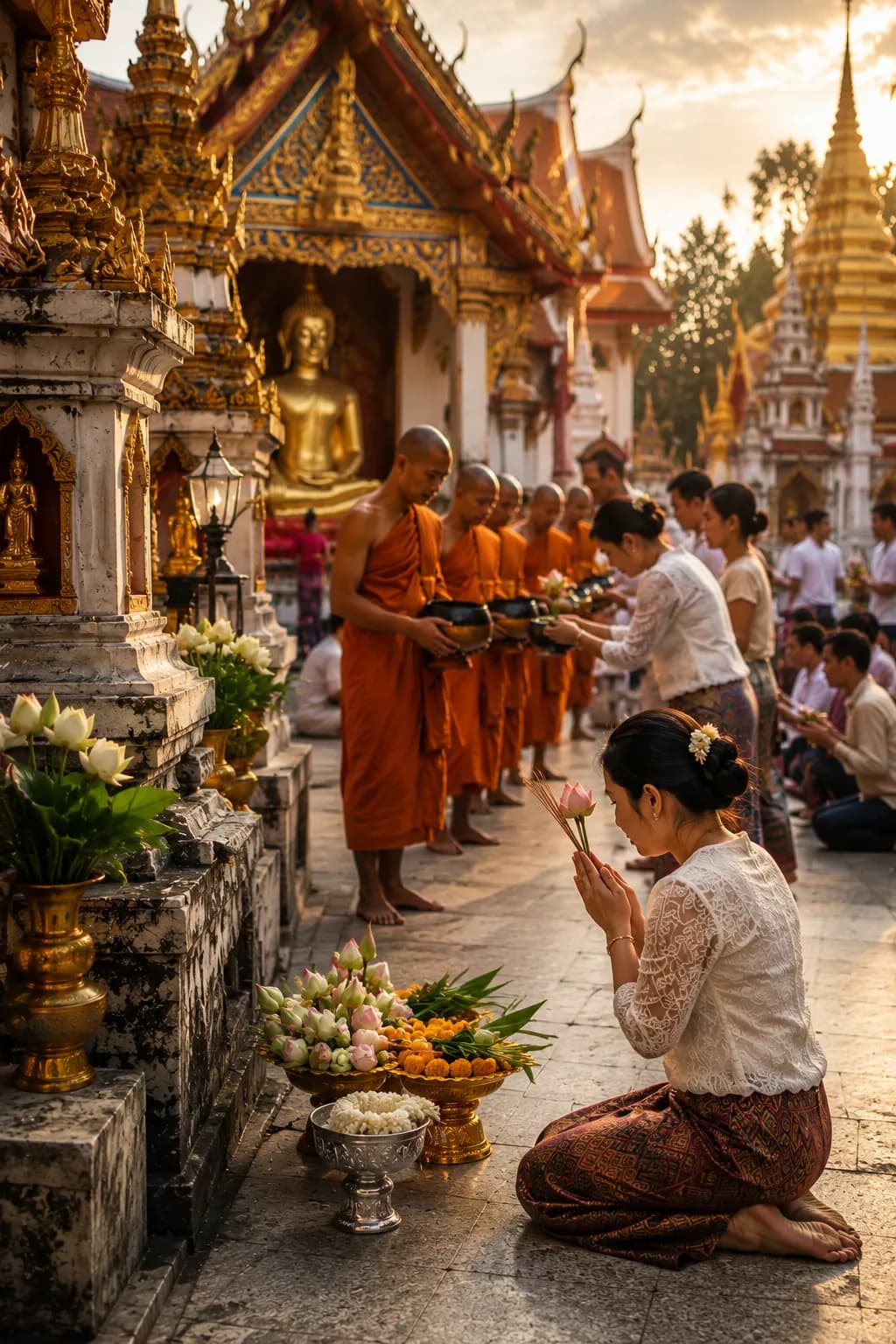
Ask twenty Thai people what Buddhism means to them and you should not expect twenty identical answers. One may talk about meditation. Another thinks first about making merit for parents. Someone else visits the temple mostly on major holidays. A fourth wears an amulet, believes strongly in spirits and rarely discusses Buddhist doctrine at all. All four may describe themselves as Buddhist. That makes the question “What do Thai Buddhists actually believe?” more interesting than it first appears. There is a formal Theravada tradition with scriptures, monastic discipline and established teachings. There is also the religion people practise in ordinary life, shaped by family, region, education, local custom and personal experience. The two overlap, but they are not identical.
There Is No Single Thai Buddhist
The first rule is simple: avoid sentences beginning with “Thai Buddhists all believe…” Religious identity varies enormously. A monk who has spent decades studying Pali texts does not approach Buddhism exactly like a Bangkok office worker who visits a temple on family occasions. A grandmother in a provincial village may maintain practices that mean little to her university-educated grandchildren. A young Thai person can identify strongly as Buddhist while rarely attending temple outside major events. This is normal. It is also true of other religions. Calling Thailand a Buddhist country describes an important cultural reality. It does not turn millions of individuals into copies of one religious model. At the level of formal doctrine, Thai Buddhism belongs primarily to the Theravada tradition.
Its basic framework includes the Buddha, the Dhamma and the Sangha; the Four Noble Truths; the Noble Eightfold Path; ethical precepts; karma and rebirth; generosity; meditation; and the goal of liberation from the cycle of suffering. Monks live according to a formal code of discipline. Temples preserve religious traditions. Chanting, sermons and meditation transmit Buddhist teaching. These elements are not decorative additions to Thai culture. They form the religious foundation. But knowing them still does not tell you exactly how one individual practises Buddhism.
Belief and Practice Are Not the Same Thing
People often discuss religion as if belief comes first and behaviour follows. In everyday life, the relationship can work in both directions. Someone may join their family at a temple ceremony because that is what the family does. They participate, make merit and hear monks chant. Over time, those repeated practices can become part of how religion is understood. Another person may know Buddhist teachings well but rarely participate in public ceremonies.
Thai Buddhism therefore cannot be measured only by asking whether somebody can explain doctrine. Religious identity can live in habits, relationships and repeated family practices as much as in formal theology. International discussions of Buddhism often focus heavily on meditation. In Thailand, meditation is important, but merit-making is often more visible in ordinary public life. People give food to monks in the morning. Families donate to temples. Ceremonies are held for deceased relatives.
People join religious activities on Buddhist holy days. A visitor may therefore encounter Buddhism first as a culture of generosity, ritual and community rather than as silent meditation. The practice remains firmly within Buddhist religious life. Generosity and ethical conduct have always been fundamental parts of the tradition. Western ideas about Buddhism are often shaped more by modern meditation culture than by the way religion appears in Thai daily life.
Do Thai Buddhists Pray?
You may see people kneeling before Buddha images with their hands together, apparently praying. What exactly they are doing can vary. Some are chanting established Buddhist verses. Some express reverence toward the Buddha. Some reflect on moral or religious intentions. Others may ask for success, health, protection or good fortune. Formal Theravada doctrine does not present the Buddha as a creator god who grants requests. Yet lived religion is often more complicated than doctrinal categories.
People can participate in devotional practices without stopping to ask whether every part fits neatly into a philosophical definition of Buddhism. This is another reason the distinction between canonical teaching and popular religious practice is useful. The monastic community occupies a highly visible position in Thai Buddhism. Monks receive food from laypeople, conduct ceremonies, teach Dhamma, chant at funerals, participate in ordinations and maintain temple communities.
A Thai person does not need to attend temple every week to understand monks as part of the religious landscape. This is particularly obvious around major life events. Family funerals, temporary ordination, merit-making ceremonies and Buddhist holidays can bring people into contact with monks even when religion is not a major part of their everyday routine. The connection can be cultural, familial and religious at the same time.
What About Amulets?
Buddhist amulets are everywhere in Thailand. Some people wear them for protection. Others collect them. Certain amulets associated with respected monks or famous temples can become highly valued. It is tempting to label the entire amulet culture either “Buddhist” or “superstition.” Neither category fully captures what is happening. Many amulets carry Buddha images or are linked with monks and temples. Their religious meaning can involve faith, memory, protection and respect for revered teachers.
At the same time, beliefs about sacred power extend beyond the central philosophical teachings of Buddhism. The important point is that lived religion often combines layers of meaning. A Thai person wearing an amulet does not necessarily spend time deciding which academic category the practice belongs in. Spirit beliefs create even more confusion for visitors. Thailand has long traditions involving phi, a broad Thai term used for many kinds of spirits.
Homes and businesses may maintain spirit houses. Local guardian spirits receive offerings. Ancestor traditions remain important in some communities. These practices should not be folded wholesale into Theravada Buddhist doctrine. They have different historical roots. Yet they coexist comfortably with Buddhism in many parts of Thailand. A family can invite monks for a Buddhist ceremony and still maintain a spirit house. Someone can make merit at a temple and later make an offering associated with a local guardian spirit. For many practitioners, there is no urgent contradiction to solve.
Brahmanic and Hindu Influences
Thai religious culture also contains important Brahmanic and Hindu-derived traditions. Royal ceremonies have historically used Brahman ritual specialists. Shrines to Hindu deities are prominent in Bangkok and elsewhere. Figures such as Brahma, Ganesha and other deities appear in popular devotional life. Nor does Thailand practise one single blended religion. Different traditions have different histories and meanings. They overlap socially and culturally without becoming identical.
Visitors understand Thai religious life better when they recognise these layers rather than forcing every shrine, ritual and belief into the category “Buddhist.” Ideas about auspicious timing, lucky numbers and protective objects are also common in Thailand. Some people take them very seriously. Others enjoy them casually. Many are selective. A person may consult an auspicious date for a wedding but laugh about lottery numbers.
Someone else may have little interest in spirits but wear an amulet given by a parent. These practices should not be used as evidence that “Thai people are superstitious.” That phrase is too broad to be useful. A better approach is to recognise that religious culture includes formal teaching, inherited custom, personal belief and ordinary human hopes for protection and good fortune.
How Observant Are Thai Buddhists?
There is no useful national answer. Some Thai Buddhists follow the Five Precepts seriously and attend temples often. Some meditate. Some study Dhamma. Others participate mainly during important holidays or family occasions. Modern work schedules, urban life, education and changing family structures all affect religious practice. Younger generations may relate differently to institutions than their grandparents. Urban and rural experiences can differ. Even within one family, levels of belief can vary dramatically.
The diversity reflects changing forms of practice rather than the disappearance of Buddhism. It means religious practice changes with society. Visitors sometimes assume a person who rarely meditates or cannot explain Buddhist doctrine must be “Buddhist only culturally.” The phrase can be useful, but it can also create a false hierarchy in which intellectual or meditative practice is treated as more authentic than family tradition. Religion is often carried through rituals and relationships.
Attending a parent’s merit-making ceremony, supporting a local temple or participating in a Buddhist funeral may be deeply meaningful even if the person never reads Buddhist scripture. The distinction between “religious” and “cultural” is not always as clear in life as it is in analysis.
What Thai Buddhism Does Not Explain
Buddhism is important in Thailand, but it does not explain everything Thai people do. Respect for hierarchy, attitudes toward family, communication styles, regional identity and social behaviour all have multiple historical and cultural influences. A convenient Buddhist explanation can quickly become a stereotype. Someone avoids open conflict? It must be Buddhism. Someone accepts a setback? Karma. Someone behaves politely? Buddhist values. Sometimes religion is relevant. Sometimes personality, upbringing or ordinary social calculation explains far more. Using Buddhism as the universal key to Thai behaviour creates a Thailand that exists mainly in guidebooks.
Look for patterns without demanding uniformity. When you see monks receiving alms, you are looking at a recognisably Buddhist institution. When a family makes merit for a deceased relative, Buddhist ideas are strongly present. When offerings are placed at a spirit house, you are entering another layer of Thai religious culture. Sometimes those worlds meet in the same household. Understanding which tradition an activity comes from is useful. Expecting every practitioner to maintain perfect theological boundaries is not.
A Living Religion Is Supposed to Be Complicated
Textbooks like clean categories. Living societies rarely provide them. Thai Buddhism contains formal Theravada teaching, monastic institutions, meditation traditions, family merit-making, devotional practices and centuries of interaction with local spirit beliefs and Brahmanic ritual. Different people emphasise different parts. That complexity is not evidence that Thai Buddhists misunderstand their own religion. It is evidence that Buddhism in Thailand is a living tradition rather than a museum exhibit. Once you accept that, the question changes. Instead of asking “What do Thai Buddhists believe?” as if one sentence could answer it, a better question is: How is Buddhism lived by different people in Thailand? That is where the interesting answers begin.