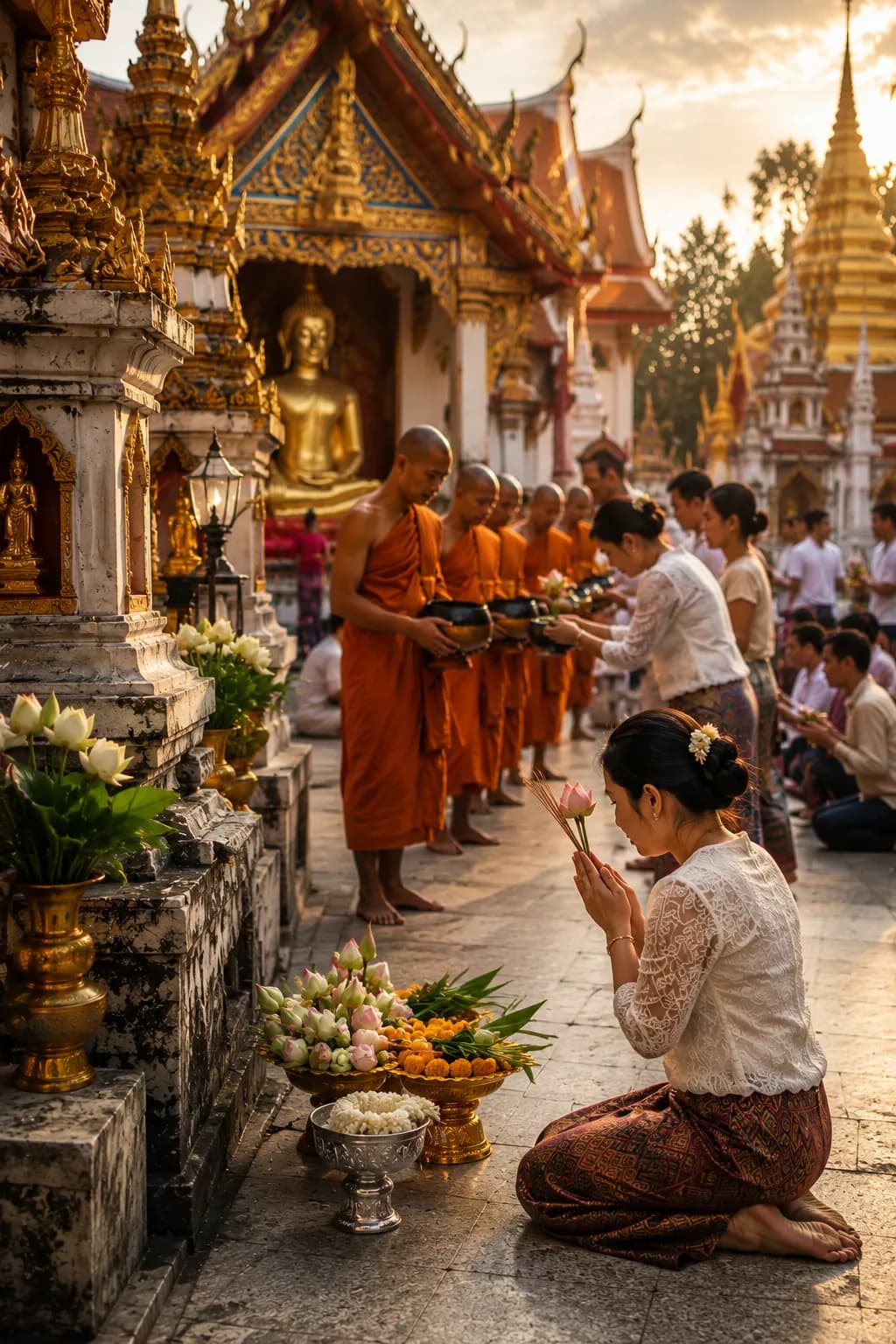
Thailand can look religiously confusing if you arrive with neat categories. A Buddhist temple stands on one side of the road. A spirit house sits outside a hotel. A shrine to a Hindu deity attracts crowds nearby. A monk blesses a new business. Someone wearing a Buddhist amulet also worries about a local spirit. From the outside, the obvious question is: which religion is this? Thai religious life often answers with something less tidy. Theravada Buddhism provides the dominant religious framework, but spirit traditions and Brahmanic or Hindu-derived practices have interacted with Thai society for centuries. The result is not one perfectly blended religion. It is a layered religious culture.
Buddhism at the Centre
Thailand’s mainstream Buddhist tradition is Theravada. Temples, monks, merit-making, Buddhist holidays and monastic ordination are central institutions. For many Thai people, identifying as Buddhist means participating in this world to some degree. That foundation matters because not every religious practice seen in Thailand should be placed on the same level. A spirit house belongs to a different religious layer from a Buddhist shrine. A ceremony involving a Brahman priest has a different historical background from a monk chanting Pali. The practices can coexist without becoming identical.
The word animism is often used as shorthand for beliefs involving spirits associated with places, nature, ancestors or other aspects of life. It can be useful. It can also become too broad. Thailand does not have one national “animist religion” with one scripture and one set of rules. Spirit traditions vary by region and community. The Thai word phi can refer to many kinds of spirits, from frightening ghosts to local beings associated with place and protection. Treating all of them as one category loses much of the local meaning.
Spirit Houses
The most visible spirit-related structures for travellers are spirit houses. They stand outside homes, hotels, offices, shopping centres and construction sites. Offerings may include flowers, drinks, food or incense. Spirit houses are often associated with guardian spirits connected with a place. The underlying logic is different from Buddhist devotion to the Buddha. Yet a Thai Buddhist family can maintain a spirit house without feeling that it has abandoned Buddhism. For many people, the practices belong to different parts of religious life.
One important theme in Thai spirit belief is that places are not religiously empty. Land can have guardians. A large tree may be associated with a spirit. A new building can require rituals intended to create a harmonious relationship with the unseen world surrounding the site. This helps explain why spirit houses appear beside highly modern buildings. Glass towers, luxury malls and corporate headquarters do not automatically erase older ideas about place. Modernity changes the architecture faster than it changes every inherited belief.
Offerings
Offerings at spirit houses can look surprisingly practical. Fruit. Flowers. Drinks. Small meals. The purpose is not the same as feeding a person in a literal ordinary sense. The offering expresses respect and maintains a relationship. People may make offerings regularly or only at certain times. Some take the practice very seriously. Others follow it because family or workplace custom expects it. Once again, individual belief varies. Not in the narrow doctrinal sense.
Theravada Buddhist scriptures do not instruct Thai hotels to install miniature spirit houses in their car parks. The practice comes from a different layer of religious culture. But Buddhism has coexisted with spirit beliefs for centuries in Southeast Asia. Monks and Buddhist institutions sometimes participate in wider ritual environments where several traditions meet. Coexistence does not turn every element into Buddhism. It shows that people can participate in more than one religious system at the same time.
Brahmanic and Hindu Layers
Thai religious life also contains important Brahmanic and Hindu-derived influences. These are especially visible in royal ritual and major urban shrines. Figures such as Brahma and Ganesha attract large numbers of devotees. Hindu mythic beings appear throughout Thai art and architecture. The Garuda, for example, has deep Hindu mythological roots and became an important symbol associated with Thai kingship and the state. None of this makes Thailand a Hindu country. It demonstrates how Indian religious ideas travelled, adapted and became embedded in Thai culture.
Bangkok’s famous Erawan Shrine is a perfect example of religious categories becoming complicated. The central figure is Brahma, a deity with Hindu origins. Many worshippers are Thai Buddhists. Offerings, music and dance surround the shrine. Tourists often call it a Buddhist shrine because it sits inside a predominantly Buddhist society. That description is inaccurate. The shrine belongs to a broader Thai religious world in which Buddhist identity does not prevent devotion at a Hindu-derived shrine. Understanding that distinction makes Bangkok less confusing.
Brahmins in Thailand
Brahman ritual specialists have played important roles in Thai court ceremony. Historical Thai kingship drew on both Buddhist and Brahmanic traditions. Royal rituals could therefore contain elements from different religious sources without anyone needing to choose only one. This history helps explain why modern Thailand can be officially and culturally Buddhist while still retaining Brahmanic ceremonial traditions. Religions rarely develop inside sealed containers. Thailand makes that especially visible.
What happens when monks enter this layered world? The answer depends on context. Monks may chant blessings at homes or businesses. People may seek protective objects or advice from respected monks. Some monks are associated in popular imagination with supernatural knowledge or powerful amulets. Formal Buddhist teaching often approaches such matters differently from popular belief. This can create tension. It can also create accommodation. A religion can contain debates about its own boundaries.
Amulets
Thai Buddhist amulet culture sits near the border between several religious categories. An amulet may contain an image of the Buddha or a revered monk. It can be connected with a temple. People may wear it for protection or good fortune. Some amulets become objects of serious collecting and commercial value. Are they Buddhist? Often yes, in a broad cultural and devotional sense. Are beliefs about supernatural protection identical to the central teachings of the Four Noble Truths? No. Both statements can be true.
Highly respected monks can become associated with sacred power after death. Images, amulets and relics linked with them may attract devotion. Stories of miraculous protection circulate. Academic language may classify some of this as popular religion. Devotees may describe the same thing more naturally as faith. The important thing is not to mock either side. A traveller can recognise that a practice goes beyond formal Buddhist doctrine without reducing it to stupidity. People everywhere attach religious meaning to objects, places and charismatic figures.
Ancestors and Family
Ancestor-related practices also appear in Thai religious life. The exact forms vary considerably between ethnic and regional communities. Chinese-Thai families may maintain traditions influenced by Chinese ancestral religion. Other communities have local practices tied to family spirits or deceased relatives. Buddhist merit-making for the dead can operate alongside those traditions. This is another example of religious layers touching without becoming the same thing. Family history often determines practice more strongly than any national label.
Thai religious life also contains strong ideas around auspiciousness. People may seek an auspicious time for a wedding or business opening. Numbers can carry special meaning. Astrological traditions may influence decisions. Some practices have Brahmanic, local or popular roots rather than being straightforward Buddhist doctrine. The category boundaries matter for accuracy. They matter less to many participants. A person can make merit in the morning and consult an auspicious date in the afternoon without experiencing a crisis of religious identity.
Is This Syncretism?
Scholars sometimes use the word syncretism to describe the mixing or interaction of religious traditions. The term can be helpful. It can also suggest that there were once completely pure traditions that later became mixed. History is rarely that clean. Theravada Buddhism entered societies already containing local beliefs. Brahmanic traditions had their own long history in Southeast Asia. Chinese migration introduced additional practices. The layers developed together over centuries. “Religious coexistence” may sometimes describe the reality better than “mixing.” Some do.
Some do not. A highly doctrinal Buddhist teacher may reject certain spirit practices as irrelevant to the path. Another person participates in both without concern. Someone else maintains a spirit house mainly because the family always has. Thai practice is too varied for one national answer. That diversity should not be surprising. People in every religious culture negotiate tradition differently. What looks contradictory from outside may feel completely normal from inside.
Modern Thailand Has Not Removed the Spirits
Bangkok has skyscrapers, apps, digital payments and some of Asia’s largest shopping centres. It also has spirit houses. The contrast is often presented as charmingly exotic. A better interpretation is that technological modernity and religious belief answer different human needs. A smartphone solves communication problems. It does not tell you how to relate to family tradition, sacred space, luck or death. Old religious practices therefore do not automatically disappear when a society becomes technologically advanced.
They change. The easiest mistake is labelling every non-Buddhist element as “superstition.” The second-easiest mistake is calling everything Buddhism. Both approaches flatten Thai culture. A spirit house belongs to spirit traditions. A Buddha image belongs to Buddhist religious life. A shrine to Ganesha has Hindu roots. Thai practitioners may participate in all three. Accuracy requires recognising both the differences and the coexistence.
Layers, Not Confusion
Thai religion is not confusing because Thai people forgot to separate their beliefs properly. It is layered because history is layered. Theravada Buddhism became deeply rooted in Thailand without erasing every older or neighbouring tradition. Spirit beliefs remained. Brahmanic ritual influenced kingship and ceremony. Hindu deities entered popular devotion. Chinese religious practices arrived with migration. Modern Thai life inherited all of it. Once you stop expecting one label to explain every shrine, the landscape becomes much easier to read. The temple is Buddhist. The spirit house is something else. The family visiting both may see no problem at all.