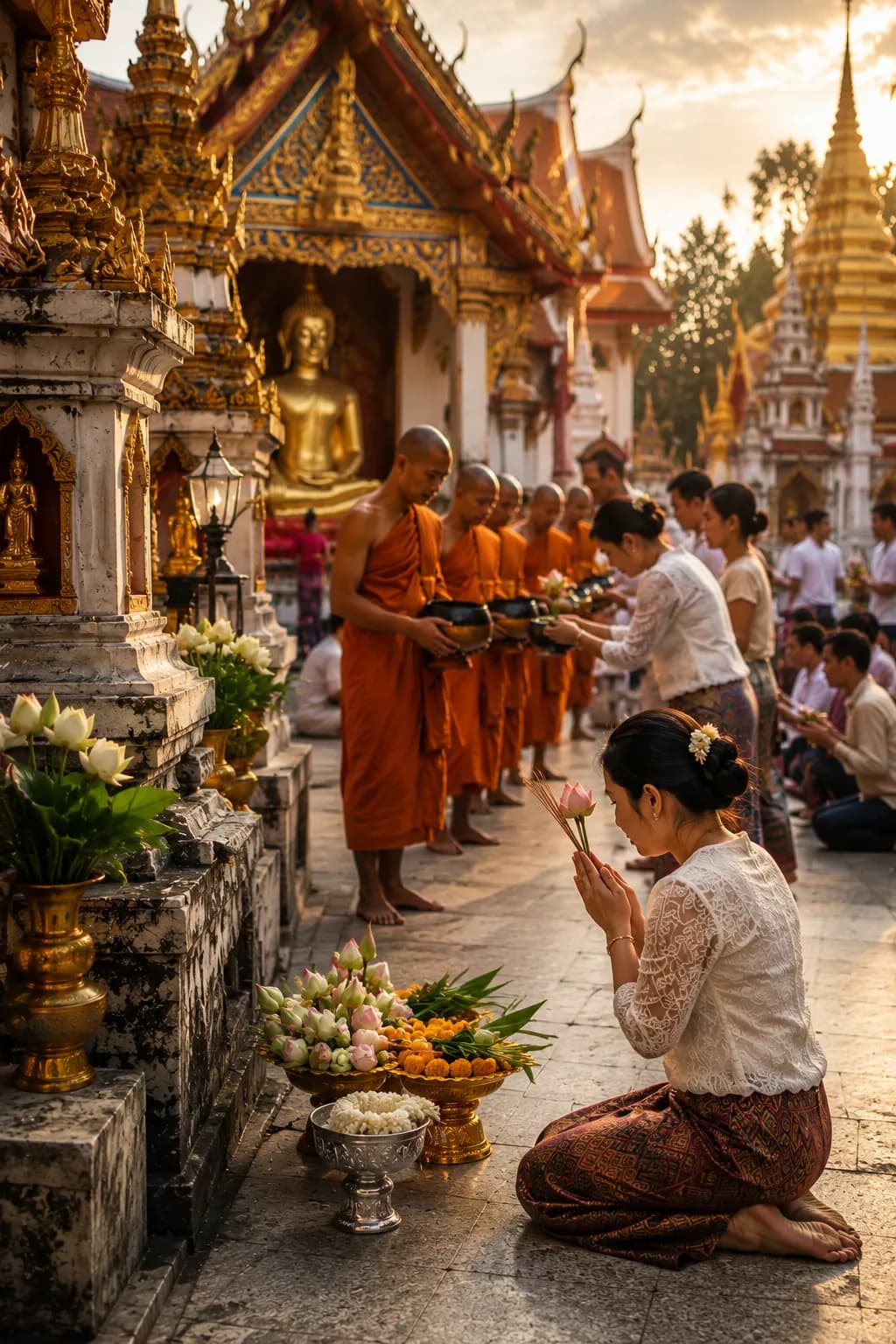
Spend enough time in Thailand and you will eventually hear someone explain an event with the word karma. You will also see people giving food to monks, donating at temples or making merit for relatives who have died. These ideas are closely connected, but they are often simplified in English until they sound like a system of supernatural points. That is not a very useful way to understand them. Within Theravada Buddhism, karma, merit and rebirth belong to a larger moral picture in which actions have consequences, intention matters and human behaviour shapes future experience. Thai religious practice adds its own social and cultural expressions to those ideas. The result is a worldview that is both philosophical and extremely practical.
Karma Is About Action
The Pali word kamma, better known internationally through the Sanskrit form karma, literally concerns action. In Buddhist thought, however, not every movement has the same moral significance. Intention is crucial. An accidental act is not morally identical to a deliberate one because the physical result happens to be similar. Karma therefore cannot be reduced to “something bad happened because you did something bad.” The Buddhist idea is broader and more complex.
Intentional actions shape habits, character and future consequences. Generosity cultivates one kind of mind. Cruelty cultivates another. Repeated behaviour matters because it changes both the world around us and the person doing the acting. In that sense, karma is not only about some distant future life. It is also about what our actions are making of us now.
Karma Is Not Instant Cosmic Justice
Popular culture often uses karma as if the universe were running a fast revenge service. Someone behaves badly. Five minutes later they fall over. “Karma.” That can be funny, but it is not a serious description of Buddhist teaching. Theravada Buddhism does not require every event to be traced to a simple moral cause. Illness, accidents, economics, other people’s choices and ordinary physical circumstances all matter. Buddhist texts themselves discuss many kinds of causes and conditions. Reducing every hardship to past karma can also become morally ugly. It risks turning suffering into an accusation: if something terrible happened to you, perhaps you deserved it. That is not a responsible way to talk about Buddhist karma, and it is not necessary to understand Thai religious culture.
Why Intention Matters
The emphasis on intention helps explain why Buddhist ethics is concerned with the state of mind behind an action. Two people might give the same amount of money to a temple. One acts from genuine generosity. Another is mainly interested in being seen. The outward act resembles itself, but the mental quality is different. Buddhist practice therefore asks more than “What did you do?” It also asks “What was happening in the mind when you did it?” Motives need not be perfectly pure before an action has value.
Human motivation is usually mixed. A person can give because they care about the temple, because their family expects it, because they hope to make merit and because participating feels right. Real religious life is rarely as tidy as philosophical examples.
What Merit Means
Merit is often the English translation of the Pali term puñña. In Thailand, making merit is commonly called tham bun. Merit is associated with wholesome actions and beneficial mental qualities. Generosity is one of the most visible examples, which is why food offerings to monks and donations to temples are so strongly associated with merit-making. But merit is broader than money. Ethical conduct can be meritorious. Meditation can be meritorious. Supporting parents, helping others and participating in religious activity may all be understood within a wider moral culture of doing good. For a traveller, this helps explain why merit-making is visible in such different situations: a morning alms round, a funeral, a birthday, a temple festival or a family ceremony.
The Lay–Monk Relationship
One of the clearest examples of merit-making is the relationship between monks and the lay community. Theravada monks traditionally live without ordinary employment and depend on lay support for basic material needs. Laypeople provide food and other necessities. Monks preserve monastic discipline, study and teach the Dhamma, conduct ceremonies and maintain a religious way of life. The relationship is therefore reciprocal without being a normal commercial exchange.
A person giving food to a monk is not purchasing a service. The monk is not selling merit. Rather, generosity toward the monastic community is traditionally understood as a wholesome act that supports Buddhism while cultivating generosity in the giver. That distinction is useful when watching an alms round. What appears simple from the pavement belongs to a religious relationship that is centuries old.
Merit Beyond Donations
Because donation boxes are highly visible at temples, visitors can come away thinking merit-making is mostly financial. It is not. Traditional Buddhist teaching places generosity alongside ethical conduct and mental cultivation. A person may observe moral precepts more carefully on a holy day, spend time meditating, listen to a sermon or volunteer in a religious activity. Family care can also be understood through a moral lens.
Gratitude toward parents is especially important in Thai cultural and religious life. This wider picture prevents merit from becoming a kind of spiritual accounting system in which everything is reduced to how much somebody gave. Money can be involved. The moral intention behind the action matters more. Thai Buddhist ceremonies often include the idea of dedicating or transferring merit to others. This is particularly visible in rituals connected with death.
Family members may make merit and dedicate it to a deceased relative. Water-pouring rituals can symbolically accompany that dedication during ceremonies. The underlying idea is not always explained in exactly the same way by every Buddhist teacher, but the practice is deeply familiar in Thai religious life. Merit may also be dedicated to parents, relatives or other beings. For visitors attending a Thai funeral or temple ceremony, this can explain why generosity and remembrance are so closely connected. Supporting monks or a temple may also become an act of love directed toward somebody who is no longer alive.
Rebirth in Theravada Buddhism
Karma becomes easier to understand once it is placed within the Buddhist concept of rebirth. Theravada Buddhism traditionally sees existence as a continuing cycle called samsara. Beings are reborn according to causes and conditions shaped in part by karma. The ultimate Buddhist goal is not to secure a perfect rebirth forever, but to become free from the cycle entirely through awakening. In everyday religious life, however, ideas about future rebirth can be more immediate.
People may hope that good actions contribute to favourable conditions in the future. Individual Thai Buddhists differ in how often they think about rebirth and in how literally they understand it. Religious belief has different levels of importance for different people. Someone can participate in merit-making because it is spiritually meaningful, because it connects them with family tradition or because it is part of how important life events are marked.
Is Merit a Way to Buy a Better Rebirth?
This is one of the easiest misunderstandings to create. If merit influences future consequences, it can sound as if Buddhism offers a transaction: donate enough, receive a better next life. The problem is that this ignores the emphasis on intention and character. Generosity is valuable partly because it weakens greed and strengthens a habit of giving. Ethical conduct matters because it changes how a person lives.
Meditation matters because it trains the mind. The act is therefore not only a payment toward the future. It is part of transforming the person performing it. Popular religious practice can certainly use language about gaining merit in very practical ways. People are people, and religious traditions often become more concrete in everyday life. But the underlying Buddhist framework is richer than a celestial loyalty programme.
Karma and Fatalism
Thailand is sometimes described as culturally fatalistic because of Buddhist ideas about karma. That conclusion is too easy. Believing that actions have consequences is almost the opposite of saying nothing can be changed. Karma makes deliberate action morally significant. What you choose to do now matters. At the same time, Buddhist teachings encourage recognition that not everything can be controlled. Conditions change. Bodies age. Relationships end. Possessions disappear.
Other people make choices we cannot manage. Accepting impermanence is not the same as refusing to act. The more useful distinction is between accepting what cannot be controlled and abandoning responsibility for what can. Merit-making is religious, but it is also social. Temple festivals bring communities together. Families attend ceremonies as groups. Donations can support institutions that have local importance. Funerals combine grief, religious practice and social obligations.
A person may participate because they believe strongly in karmic merit and because it is what their family does. Those motives do not cancel each other out. This is common in religion everywhere. A Christmas service can be theological, cultural and familial at the same time. A Thai merit-making ceremony can similarly carry several meanings at once. Seeing that complexity helps visitors avoid treating every temple activity as either deep spiritual practice or empty tradition. It can be both religious and social.
What Travellers Usually Notice
Even without studying Buddhist philosophy, you can recognise karma and merit in everyday Thailand. You may see people placing food in monks’ bowls shortly after sunrise. Families bring offerings to a temple. Donation envelopes appear at ceremonies. A funeral includes chanting and merit dedicated to the deceased. Somebody explains that they are going to the wat to “make merit.” Once you understand the underlying ideas, these scenes become easier to read.
The key is not to turn them into formulas. Not every act is performed for exactly the same reason, and not every Thai Buddhist thinks about karma in the same way. Karma, merit and rebirth form part of a moral universe in which intention matters and actions have consequences. Merit encourages generosity, ethical behaviour and mental cultivation. Karma explains why choices matter beyond the immediate moment.
Rebirth extends that moral framework beyond a single lifetime within traditional Buddhist thought. But none of the three works well when reduced to a scoreboard. Thai Buddhism becomes much more understandable when merit is seen as the cultivation of wholesome qualities, karma as intentional action and rebirth as part of a much larger Buddhist understanding of existence. That is a less dramatic explanation than “instant karma.” It is also much closer to what the tradition is actually trying to say.