A Country of Overlapping Beliefs
Thailand is often described as a Buddhist country, and that's true — but it's an incomplete picture. Walk through everyday Thai life for more than a few days and you'll quickly encounter an entire additional layer of belief running alongside formal Buddhism: lucky numbers, auspicious dates, protective amulets, astrology, spirit shrines, sacred tattoos, dream interpretation, fortune tellers, monk-blessed objects, Chinese zodiac traditions, a wedding date chosen because it simply feels right, a sacred object hanging from a taxi mirror, a shop owner consulting tradition before opening for business.
None of this sits neatly inside one religious box, and it isn't meant to. These practices reflect centuries of Buddhism, Brahmanic-Hindu tradition, animism, Chinese influence and local custom mixing together over a very long time. To a first-time visitor, that can look contradictory. It isn't. Thai spiritual life has always been comfortable holding several overlapping systems at once, and understanding that comfort is the real key to making sense of what you'll see.
Buddhism, and Everything Around It
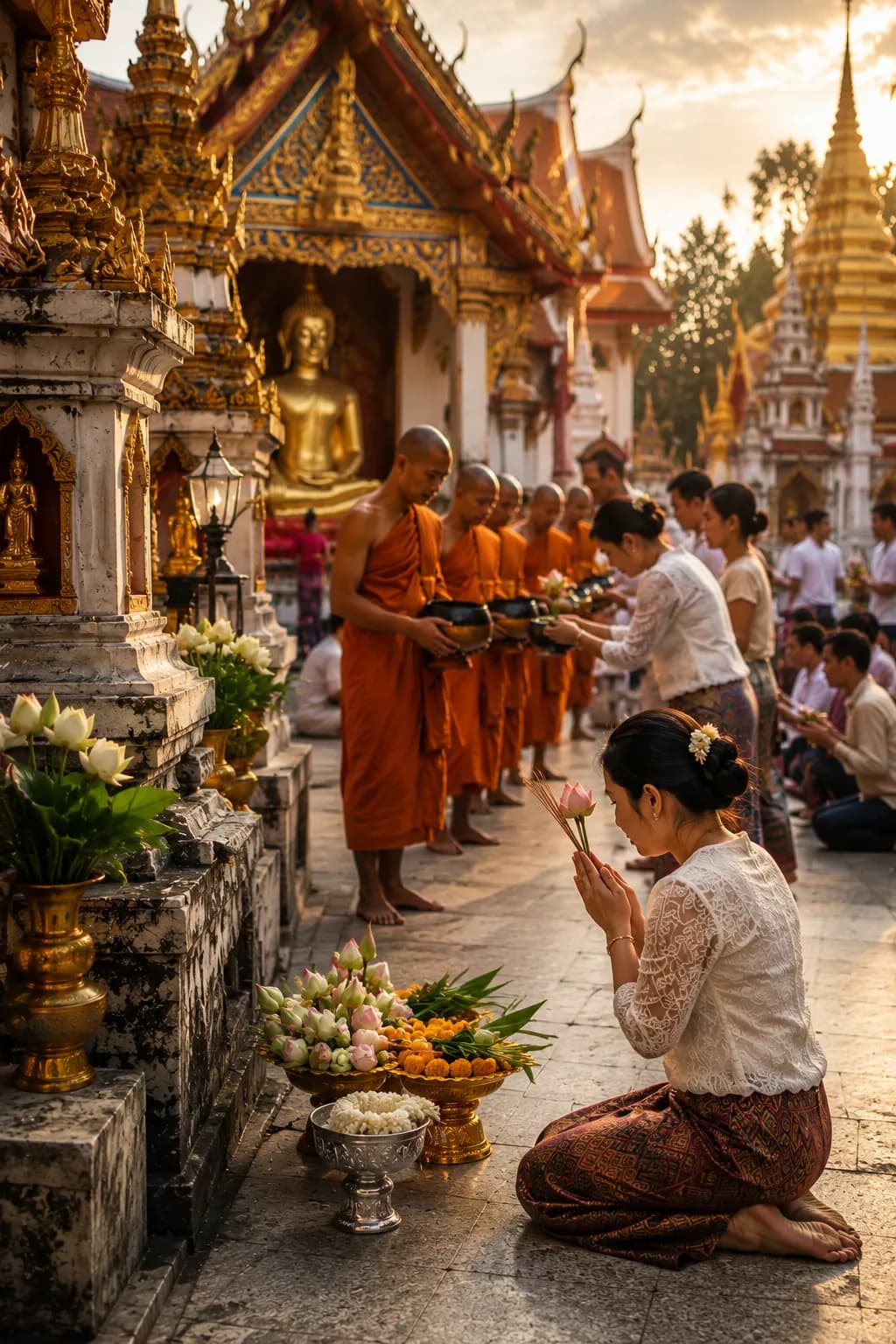
Theravada Buddhism provides Thailand's dominant religious framework — karma, merit, monastic life, temples, moral teaching, the Buddhist holy days that shape the national calendar. (Our guide to Buddhism in Thailand covers that foundation directly.) But everyday religious practice regularly includes traditions that don't come from Buddhist scripture at all. A person can make merit at a temple, wear a protective amulet, consult an astrologer and leave an offering at a spirit shrine without feeling that any of these actions contradict one another in the slightest. Western categories like "religion" and "superstition" are simply too rigid a fit here — for many Thai people, these practices belong to ordinary life rather than to any single labelled system.
It's worth pausing on the word "superstition" itself, because in English it often implies something irrational or false. It's used here mainly because travellers commonly search for exactly that phrase, but a better way to understand the subject is simply as everyday belief. Some people take these traditions very seriously. Others participate because their family always has. Others enjoy the culture around them while remaining personally sceptical. Others ignore the whole subject entirely. There's no single Thai attitude toward any of this, and assuming otherwise is usually where outside understanding goes wrong first.
Luck, Made Visible
Luck matters in most cultures; Thailand simply makes it unusually visible. A number can feel lucky. A date can feel auspicious. A monk might bless a new house. A driver might carry a sacred object for protection on dangerous roads. Someone buying a lottery ticket might choose numbers connected to a dream, a licence plate or some unusual recent event. The modern world and the supernatural world coexist here with remarkably little friction.
Numbers are one of the most visible expressions of this. Certain numbers can be considered auspicious for reasons rooted in religion, astrology, wordplay, personal experience or Chinese cultural influence — and there's no single universal chart that every Thai person follows, whatever a confident online list might claim. Nine is widely regarded as auspicious, largely because the Thai word for nine, "kao", sounds similar to a word associated with moving forward or progressing — a piece of wordplay that gives the number a naturally positive feeling connected with advancement, one you'll see reflected in auspicious dates, ceremonies, vehicle registration numbers and symbolic business choices. Eight carries similarly positive associations, mainly through Chinese cultural influence, where it's strongly connected with prosperity — visible especially in business, property and personal decision-making in Bangkok and other areas with strong Thai-Chinese heritage. Four, conversely, can carry negative associations in some Chinese-language traditions because its pronunciation resembles the word for death — a belief familiar internationally, but one that shouldn't automatically be treated as a universal Thai belief; its weight depends heavily on how strongly Chinese tradition influences the particular person or family involved. And thirteen, despite what many Western visitors assume, isn't traditionally central to Thai belief the way it is in parts of Europe and North America — if a modern international hotel avoids the number anyway, that says more about serving a global customer base than about traditional Thai numerology.
Chinese-Thai Belief
Chinese influence on Thai spiritual life runs deep: Chinese temples, ancestor worship, zodiac traditions, fortune telling, festival ritual and numerology have all mixed with Thai practice over many generations of shared history. A Thai-Chinese family may participate fully in Buddhist temple life and Chinese religious ceremonies without seeing any contradiction between the two — one more example of the layered, overlapping quality that runs through Thai belief generally. (Our guide to Thai festivals covers Chinese New Year and its place in the wider national calendar.)
The Lottery and the Stories Behind the Numbers
Thailand's government lottery is enormously popular, and for many participants choosing numbers becomes a genuine mixture of chance, habit, symbolism and belief. Some people simply pick at random. Others use birthdays, dreams, vehicle plates, house numbers, or numbers connected with some unusual recent event. Dream interpretation is one particularly common source: someone might dream of an animal, a deceased relative, a strange event or a specific object, and traditional interpretation systems connect elements of that dream with specific numbers, which then spread through families and social media before the next draw.
Unusual news events generate the same kind of number speculation almost automatically — a rare animal appears somewhere, a tree develops an unusual marking, a vehicle is involved in a widely discussed incident, a public event lands on a memorable date. People search the details for numbers, and licence plates or dates suddenly become genuinely interesting to a much wider audience than the event itself. It can look bizarre from the outside; it's better understood as the meeting point between gambling culture, storytelling and popular belief, three things that turn out to reinforce each other rather naturally.
Sacred trees fit into this same world. Large or unusually shaped trees can attract spiritual attention, and people may believe a tree is inhabited or protected by a spirit — offerings appear, coloured fabric gets tied around the trunk, people ask for luck, and some visitors specifically look for shapes or markings resembling lottery numbers. If you encounter a tree covered in offerings or coloured cloth, treat it respectfully: don't remove the fabric, don't scratch at the bark looking for numbers, don't move offerings for a photograph. Whether or not you personally share the belief, someone else very much does.
Timing, Astrology and Fortune Telling
Timing matters across a wide range of Thai traditions — weddings, house moves, ordinations, business openings, construction, vehicle purchases, important journeys. Families may consult monks, astrologers, Brahmins or other specialists when choosing an auspicious date, and while not everyone follows this practice, it remains common enough that most visitors will encounter it somewhere along the way.
Astrology has a genuinely long history in Thailand, drawing on Indian, regional and Chinese traditions in different combinations depending on the family and context; astrologers may weigh birth dates, times, zodiac signs and planetary positions, and people consult them about relationships, careers, business decisions and major life choices generally. Fortune telling itself is easy to find almost anywhere — markets, temple grounds, shopping centres, dedicated offices, online — through methods ranging from astrology and palm reading to cards, numerology and various Chinese systems, often combined differently by different practitioners. For some customers it's serious guidance; for others, pure entertainment; for most people, probably, something comfortably in between.
Bangkok's Erawan Shrine offers a particularly clear window into how modern this spiritual life actually is. Dedicated to Phra Phrom, the Thai representation of the Hindu god Brahma, the shrine draws people praying for success, health and relationships, with traditional dancers sometimes hired as an act of gratitude once a wish is believed to have been fulfilled — all of it sitting in one of Bangkok's busiest commercial districts, Skytrain tracks, luxury hotels and shopping centres surrounding it on every side. Modern Bangkok and sacred belief occupy exactly the same intersection, quite literally. (Our guide to spirit houses, animism and everyday beliefs explores the Erawan Shrine and similar sites in more depth, and our guide to the history of Bangkok traces how this particular corner of the city developed around it.)
Making a vow follows a familiar religious logic found across many traditions: a person promises an offering or an act if a particular wish is granted, and returns to fulfil that promise if it is. At Thai shrines, fulfilment might involve flowers, food, incense, symbolic objects or a sponsored performance, depending on the place and tradition involved. One detail visitors notice almost immediately is bottles of red soft drink, especially Fanta, placed at spirit shrines — there's no single universally accepted explanation for why the drink became so associated with these offerings, with theories ranging from the symbolic importance of red to sweetness as an attractive offering to a straightforward modern replacement for older, less available offerings. The safest way to understand it is simply as a widely recognised contemporary practice, whatever its precise origin.
Spirit Houses and Ghosts
Spirit houses are among the most visible expressions of everyday Thai belief — small shrines standing outside homes, hotels, shopping centres, offices, construction sites and car parks, usually placed in a carefully chosen corner of the property, with offerings of flowers, incense, food and drink left for the spirits associated with that particular piece of land. (Our guide to spirit houses, animism and everyday beliefs covers this tradition in full.) Their roots lie mainly in older animistic and Brahmanic tradition rather than in Buddhism directly, yet they sit entirely comfortably inside a predominantly Buddhist society — a hotel can easily contain a spirit house just outside its entrance and Buddhist images inside, with staff making offerings at both without any sense of tension between them.
The Thai word "phi" is commonly used for ghosts or spirits, of which there are many recognised types — some protective, some genuinely dangerous, some tied to particular places, some living mainly in folklore, and some who have become thoroughly famous through film and television. Belief in any of it varies enormously from person to person, though even people who joke openly about ghosts may still avoid tempting one unnecessarily. Thailand's most famous ghost story, Mae Nak Phra Khanong, concerns a woman named Nak who dies but continues living with her husband as though nothing has changed; the story has been retold repeatedly through film, television and theatre, and a shrine associated with her at Wat Mahabut in Bangkok continues to draw both visitors and genuine worshippers — the ghost has become folklore and living devotional figure at the same time, without any real contradiction felt between the two. Thailand also has a thriving horror-film industry precisely because the supernatural remains so culturally familiar; a Bangkok office worker using the newest smartphone may still refuse to rent a particular room because the number feels wrong, or because someone insists a ghost lives there. Modernity hasn't eliminated older beliefs here. It has, in a sense, simply given them Wi-Fi.
Amulets: Small Objects, Enormous Meaning
Thai amulets represent one of the country's most visible forms of sacred material culture. Small objects, commonly called phra khrueang when they depict the Buddha, may show the Buddha himself, revered monks, deities or other sacred symbols, and they're worn around the neck, carried in pockets, placed in vehicles or kept in homes. Some are produced at temples; some commemorate particular historical events; some become genuinely, seriously collectible. As the Thailand Foundation describes them, Thai amulets are objects believed by devotees to offer qualities such as protection and good fortune — a belief that belongs entirely to the wearer, and one this article describes as tradition rather than asserts as verified fact.
To an outsider, an amulet can look like a simple pendant. To its owner, it may represent faith, protection, a personal connection to a particular respected monk, family history, memory, collecting interest, social status and good fortune, often several of these meanings simultaneously. Some amulets become especially respected specifically because of their connection to a revered monk — reputation of the monk, history of the temple, ritual surrounding the original blessing, all of it matters, which creates a genuinely unusual situation where two visually near-identical objects can carry completely different significance depending on their history. Amulets depicting Luang Pu Thuat are among the best known in the country, surrounded by stories of miraculous protection and particularly associated by devotees with safety during travel. Phra Somdej amulets form another famous category, commonly connected with the revered monk Somdej Toh of Wat Rakang, with certain historical examples counting among the most prized objects in Thai amulet collecting anywhere.
That collecting world is real, serious and genuinely surprising to visitors who assume sacred objects should never carry monetary value. Amulets can be inexpensive or extraordinarily valuable; collectors study surface, material, mould, edges, wear, temple, era, teacher and provenance with an expertise resembling coin collecting, art history and religious devotion rolled into one, and dedicated specialist markets exist around old temple and market districts, particularly in Bangkok. Where valuable collectibles exist, fakes inevitably exist too, and a healthy scepticism toward anyone confidently claiming an expensive object is unquestionably ancient or miraculous is entirely compatible with genuine cultural respect. Interestingly, in Thai Buddhist contexts people often avoid describing the acquisition of a sacred amulet using the ordinary verb for buying — a phrase closer to "renting" or "inviting" the amulet is used instead, even though money changes hands exactly as it would in any other transaction. The language itself reflects respect for the object, regardless of the underlying commerce.
An amulet inherited from a parent or grandparent can carry value that has nothing to do with any market price at all — it holds memory, having been worn for decades, having survived a journey, having been given before military service, having accompanied a family member through an entire life. Sacred objects like these can function as genuine family archives, and in that sense lucky numbers work in a remarkably similar way: a number becomes lucky because something specific happened around it — a grandfather always used it, a child was born on that date, a dream contained it, a business succeeded while using it, a respected astrologer recommended it. Meaning accumulates around both objects and numbers over time. Both, in their own way, become stories as much as things.
Sacred Tattoos and Everyday Protection
A yantra is a sacred diagram or symbolic design, incorporating geometric forms, script, numbers, figures and sacred formulas, drawing heavily on Brahmanic-Hindu influence while developing distinctly Thai forms of its own over centuries. Yantra can appear on cloth, metal, walls, vehicles, amulets — and on skin, through sak yant, sacred yantra tattooing that combines design, script and spiritual tradition into a single object worn permanently on the body. Different patterns are associated by believers with different qualities — protection, authority, charm, confidence, good fortune — and sak yant became internationally famous through tourism and celebrity culture, even though its underlying meaning is fundamentally religious and magical rather than purely decorative. It may be applied by monks in certain temple contexts, or by lay ritual specialists commonly called ajarn, with practices varying by tradition; the tattoo is typically accompanied by real ritual elements and a formal blessing, which is one reason copying a sacred design purely as fashion tends to miss most of its actual cultural meaning.
The five-line design widely known internationally as Hah Taew is probably the most recognisable sak yant pattern, though different traditions explain its individual lines differently, and tourist websites offering one confident, universal translation should generally be treated with caution — yantra traditions vary meaningfully between individual teachers and lineages. Gao Yord, often translated as Nine Peaks, is another widely recognised design associated with sacred geometry and protective symbolism, again with interpretations that shift depending on who's teaching them. The important cultural point sits above these specifics: the tattoo functions as a genuine sacred object within its tradition, not merely as body art, and any behavioural rules connected with receiving one vary by teacher and lineage rather than following one single universal list, whatever a confident online article might claim.
The related concept of wai khru, showing respect to teachers, extends well beyond sak yant into Thai education, music, dance and Muay Thai generally — traditional Muay Thai contains visible ritual elements of its own, including the mongkhon headpiece worn before a bout, pra jiad armbands, and wai khru and ram muay rituals honouring teachers and lineage before a fight even begins. (Our guide to modern Thailand explores how these traditional rituals now sit alongside globally streamed matches and international sponsorship.)
Handling Sacred Objects With Basic Respect
A short list of etiquette points covers most situations a visitor will encounter. Don't place a Buddha amulet on the floor, and don't step over one. Don't turn a sacred object into a joke. Avoid placing sacred Buddhist images in disrespectful locations on the body or clothing — Thailand's tourism industry sells enormous numbers of Buddha-themed souvenirs, which can confuse visitors into treating a genuinely religious image as simple decoration; using a Buddha head casually as a bar ornament, a floor decoration or provocative body art can be considered disrespectful regardless of where it was purchased, since availability for sale doesn't automatically make every use culturally appropriate. Traditional Thai belief also places real symbolic weight on vertical hierarchy, treating the head as the highest and most respected part of the body and the feet as the lowest — a belief that directly explains why pointing feet toward Buddha images or stepping over sacred objects can cause genuine offence. If you're ever uncertain how to behave around a sacred item, simply watch how Thai people nearby are handling similar objects and follow their lead.
Monks can be asked for blessings on new businesses, homes and vehicles; sacred white thread known as sai sin is used in Buddhist ceremonies and may be tied around a wrist as a piece of blessed thread representing the connection, something visitors themselves may receive during a temple ceremony or another religious occasion; and holy water, sprinkled by monks during ceremonies or important life events, carries strong symbolic weight of its own throughout Thai culture — most visibly during Songkran, when water becomes both festival and religious symbol at once. (Our guide to Thai festivals covers Songkran's dual identity in full.)
Believing "Just in Case"
Perhaps the most universal spiritual philosophy anywhere is a simple one: do I actually know this works? No. Would I still rather not risk offending whatever might be watching? Also yes. Just in case. Many beliefs of this kind survive precisely because they become habit rather than active conviction — a driver touches a sacred object before starting work, a shop owner makes a small morning offering, a family checks a calendar before choosing a date, and nobody holds a formal theological debate every single time. The action itself simply becomes part of ordinary life, the way knocking on wood does almost everywhere else in the world.
You don't need to search hard to notice these beliefs while travelling in Thailand — look at taxi dashboards, spirit houses outside hotel entrances, flower garlands, temple amulet stalls, lottery vendors, shrines tucked inside shopping districts, yantra markings on vehicles, sacred string worn around wrists, Chinese shrines, people quietly checking dates before a major ceremony. The invisible world here is, in a very real sense, unusually visible.
Old Belief, New Platform
Old traditions have adapted to smartphones with striking ease. Online fortune tellers, numerology apps, lucky-number services, viral lottery stories and livestreamed temple ceremonies all move at genuinely algorithmic speed now, and a shrine can go viral just as easily as a lucky-number story can spread nationwide within hours. A young person can consult astrology through an app while sitting in an entirely modern Bangkok café. None of this means tradition is disappearing — it's simply changing platform, and it's part of a much broader pattern across contemporary Thai life. (Our guide to modern Thailand explores that wider pattern of tradition adapting to digital platforms in far more depth.)
Reading the Country More Clearly
Once you understand this layer of belief, a lot of small everyday details start making a great deal more sense: why a hotel has a tiny house standing just outside its entrance, why a taxi roof carries sacred markings, why someone genuinely cares about their licence plate, why a new business invites monks before opening, why a friend insists on a particular wedding date, why red drinks appear at roadside shrines, why an amulet is handled with visible care. None of this makes the country more mysterious. If anything, it makes it considerably more legible.
The most useful question to ask isn't "do Thai people really believe this?" That framing assumes a single national answer that simply doesn't exist. A far better question is: which Thai people believe this, how strongly, and in what context? Thailand is too large and too diverse for one uniform level of belief — the deeply devout, the playful believer, the confirmed sceptic, the serious collector, the traditional family, the modern digital astrologer all exist here at once, sometimes within the very same household. Perhaps the simplest image to hold onto is an amulet hanging around someone's neck. To you, passing by, it may look like a small object. To the person wearing it, it may contain religion, family history, protection, personal memory, identity and hope, all at the same time. That's worth understanding not because you need to believe in any of it yourself, but because someone else, quite genuinely, has given that small object real meaning.