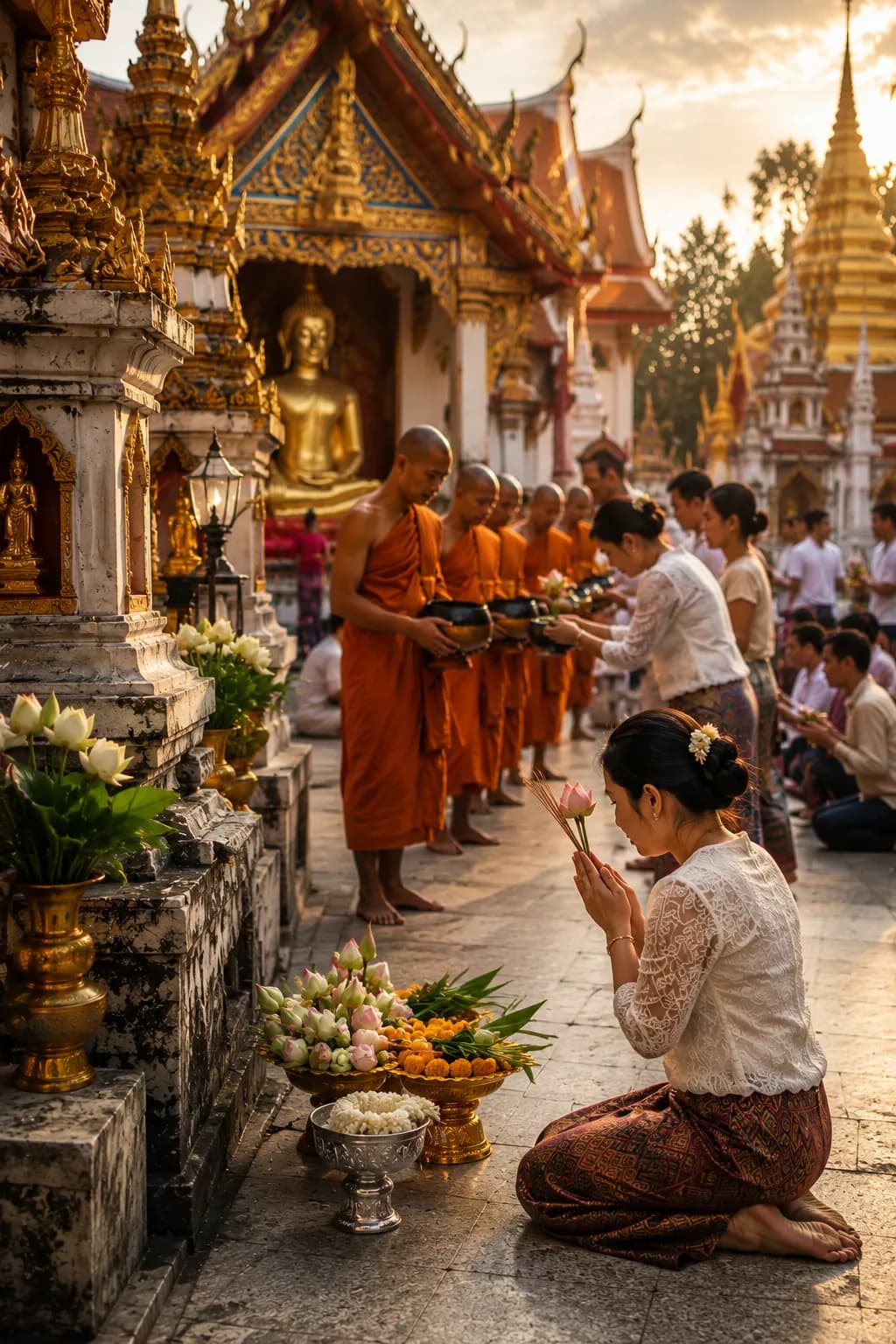
You wake early in Thailand and see a monk walking quietly along the street with an alms bowl. A shopkeeper steps outside with food. Hands come together in a wai. The exchange takes less than a minute. Later, a family visits a temple with offerings. At a funeral, relatives sponsor chanting and dedicate merit to the person who has died. On a birthday, somebody says they are going to the wat to make merit.
These scenes look different, but they belong to the same broad religious world. In Thai, making merit is commonly called tham bun. It is one of the most familiar expressions of Buddhist practice in Thailand and one of the easiest for visitors to misunderstand. Merit-making reaches well beyond donating money. It is a way of cultivating wholesome action through generosity, ethical conduct and religious practice.
What Merit Means
The idea usually translated as merit comes from the Pali term puñña. Within Buddhist thought, merit is associated with wholesome actions that produce beneficial consequences and develop positive qualities of mind. Generosity is especially important because it trains a person away from greed and toward giving. That is why donations and offerings are so visible. But the key idea is not “pay something, receive merit.” The religious meaning lies in the action and the intention behind it.
A person who gives food, supports a temple, observes ethical precepts or practises meditation may understand all of those as ways of making merit. In Thailand, the phrase is broad enough to appear in many areas of life. The most recognisable form of merit-making is the early-morning alms round. Monks walk through a community carrying bowls. Laypeople offer food or other permitted items.
Depending on the location, the exchange may happen quietly at the roadside, outside a market, near a temple or in front of a home. Visitors sometimes describe this as monks begging. That misses the point. The monastic tradition deliberately makes monks dependent on lay support. Monks do not traditionally earn salaries in the normal sense or shop for their daily meals as ordinary householders do. Receiving food creates an ongoing relationship between the monastery and the lay community. The layperson practises generosity. The monk accepts the offering without treating it as a commercial transaction. Both sides have a role.
Why Giving to Monks Is Important
In Theravada Buddhism, supporting the monastic community has long been regarded as a particularly significant form of generosity. Monks maintain a disciplined religious life, preserve teachings, meditate, study and conduct ceremonies. Laypeople make that life materially possible. No monk is automatically assumed perfect, and no two donations carry identical intention. Buddhism still places importance on intention. The point is institutional.
Supporting the Sangha helps sustain a way of life centred on Buddhist practice. That relationship explains why monks can remain highly visible even in modern neighbourhoods full of offices, shopping centres and apartment towers. Donation boxes are easy to photograph, so they can dominate a visitor’s impression of merit-making. Yet traditional Buddhist teaching recognises several forms of wholesome action. Generosity is one. Ethical conduct is another. Mental cultivation, including meditation, is another.
A person can therefore make merit without opening a wallet. Helping with temple work, observing moral precepts, volunteering, listening to Dhamma or meditating may all be understood within a broader religious culture of doing what is wholesome. Money matters because temples need resources and generosity is religiously important. It is not the definition of merit.
Temple Donations
Thai temples vary enormously in wealth and function. A famous Bangkok temple visited by millions of tourists exists in a very different economic environment from a small rural wat. Donations can support maintenance, utilities, ceremonies, education, construction and many other activities. Thai Buddhists may donate directly, participate in fundraising events or contribute items rather than cash. The social dimension matters as much as the religious one.
A temple can be a local institution tied to a family for generations. Supporting it can express loyalty to community as well as Buddhist generosity. Trying to separate those motives completely would be artificial. People often act for several reasons at once. Merit-making frequently accompanies important moments in life. A birthday may begin with a temple visit or food offered to monks. Families may make merit during the New Year period. Religious holidays bring increased temple activity.
House blessings can involve monks chanting and receiving offerings. Ordinations create opportunities for relatives and communities to participate in religious generosity. These events show how deeply merit-making is woven into social life. It is not reserved for people pursuing an intense spiritual practice. It can be part of ordinary family tradition.
Merit for Parents
Respect and gratitude toward parents have a particularly strong place in Thai family culture. Merit-making can become one way of expressing that gratitude. Temporary ordination has historically been associated with making merit for parents, especially mothers. Families may also dedicate merit to parents through temple activities and ceremonies. Again, personal beliefs vary. Not every Thai family explains these traditions in exactly the same way. What remains important is the connection between religious action and family obligation. Buddhist practice does not exist separately from relationships. Merit-making becomes especially visible around death.
At Thai Buddhist funerals, relatives may invite monks to chant, make offerings and dedicate merit to the deceased. Water-pouring rituals can symbolically accompany the dedication of merit. For outsiders, this can initially seem strange. How can one person’s good action benefit another? Theravada traditions have developed different explanations around the dedication or sharing of merit. In everyday Thai practice, the important point is often more emotional than philosophical. The family does something wholesome in memory of the person who has died. Generosity becomes part of grief.
The Social Side of Merit
Merit-making also brings people together. Temple events can involve cooking, organising, fundraising and volunteering. Relatives return home for ceremonies. Neighbours contribute food. Local businesses sponsor activities. A religious event can therefore also be a community event. This does not make the religion superficial. Most religious traditions work through social networks. Churches, mosques, temples and synagogues are communities as well as sacred spaces. Thai Buddhist merit-making is no different.
The spiritual and the social often reinforce each other. Visitors sometimes interpret merit-making through the language of exchange. Donate money. Receive merit. Offer food. Improve your next life. That description is too mechanical. In Buddhist ethics, generosity matters because of the qualities it develops. Giving can weaken attachment. Ethical behaviour trains restraint. Meditation develops the mind. A purely transactional attitude would miss much of the point.
At the same time, ordinary people do sometimes talk about merit in practical terms. Someone may hope an action contributes to good fortune or a favourable rebirth. Religious traditions contain ideal teachings and everyday interpretations. Thai Buddhism is not exempt from that. The mistake is assuming the most transactional interpretation explains everything.
Can Tourists Make Merit?
Foreign visitors are often welcomed at Thai temples, and nobody needs to be ethnically Thai to practise generosity or Buddhist ethics. But visitors do not need to imitate every ritual they see. If you want to make a donation, follow the temple’s normal arrangements. If you participate in an alms offering, it is better to understand the basic context rather than treating the scene as a photo opportunity. Respectful observation is also perfectly appropriate. A temple is not an interactive museum in which tourists are expected to perform every religious practice. Sometimes the most respectful thing to do is watch quietly and learn. People often want a rule for how much they should donate. A fixed “correct” donation amount would misrepresent the religious principle.
Different situations involve different expectations, and some ceremonies may have practical costs. But ordinary generosity is not improved by turning it into a rate card. If somebody chooses to donate, the amount should make sense for their own circumstances and the context. That is more consistent with Buddhist generosity than worrying about whether you have purchased enough merit.
Merit and Modern Thailand
Merit-making has not disappeared because Thailand has become urban, digital and consumer-oriented. People may donate through modern payment systems. Temple fundraising can circulate through social media. Office workers stop to give food to monks. Families combine busy modern schedules with ceremonies inherited from earlier generations. The form changes more easily than the underlying idea. This is one reason merit-making remains such a useful window into Thai Buddhism. It connects ancient religious concepts with ordinary modern life.
When someone offers food to a monk, the scene is about more than food. When a family supports chanting at a funeral, it is about more than ceremony. When people visit a wat on a birthday, it is about more than tradition. Merit-making ties together generosity, ethics, family, memory, community and Buddhist ideas about the consequences of action. Understanding their importance does not require sharing the beliefs yourself. And once you understand merit, a great deal of Thai religious life that previously looked like separate rituals starts to fit together.