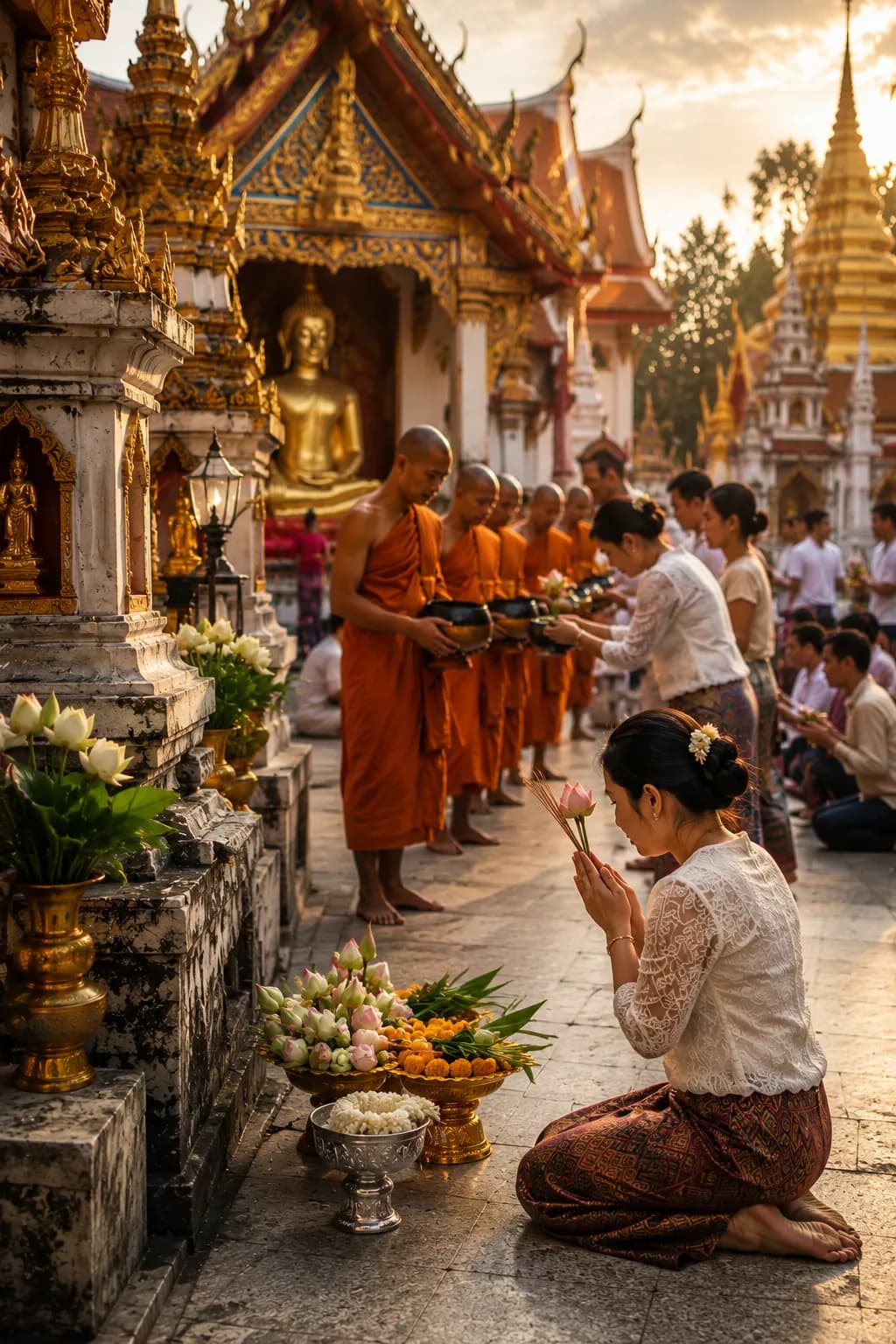
Thailand is often described as friendly, relaxed and easygoing. That's not wrong. But underneath the smiles and informality sits a social culture with very clear ideas about respect, hierarchy, embarrassment, politeness and how people should behave toward one another.
Visitors don't need to memorise hundreds of rules, and most Thai people don't expect foreigners to behave exactly like Thais. But understanding a few key ideas prevents awkward moments and makes everyday interactions much easier. The core principles are simple: show respect, avoid unnecessary confrontation, pay attention to age and status, don't embarrass people publicly, and when you're unsure, calm politeness works remarkably well.
The Wai
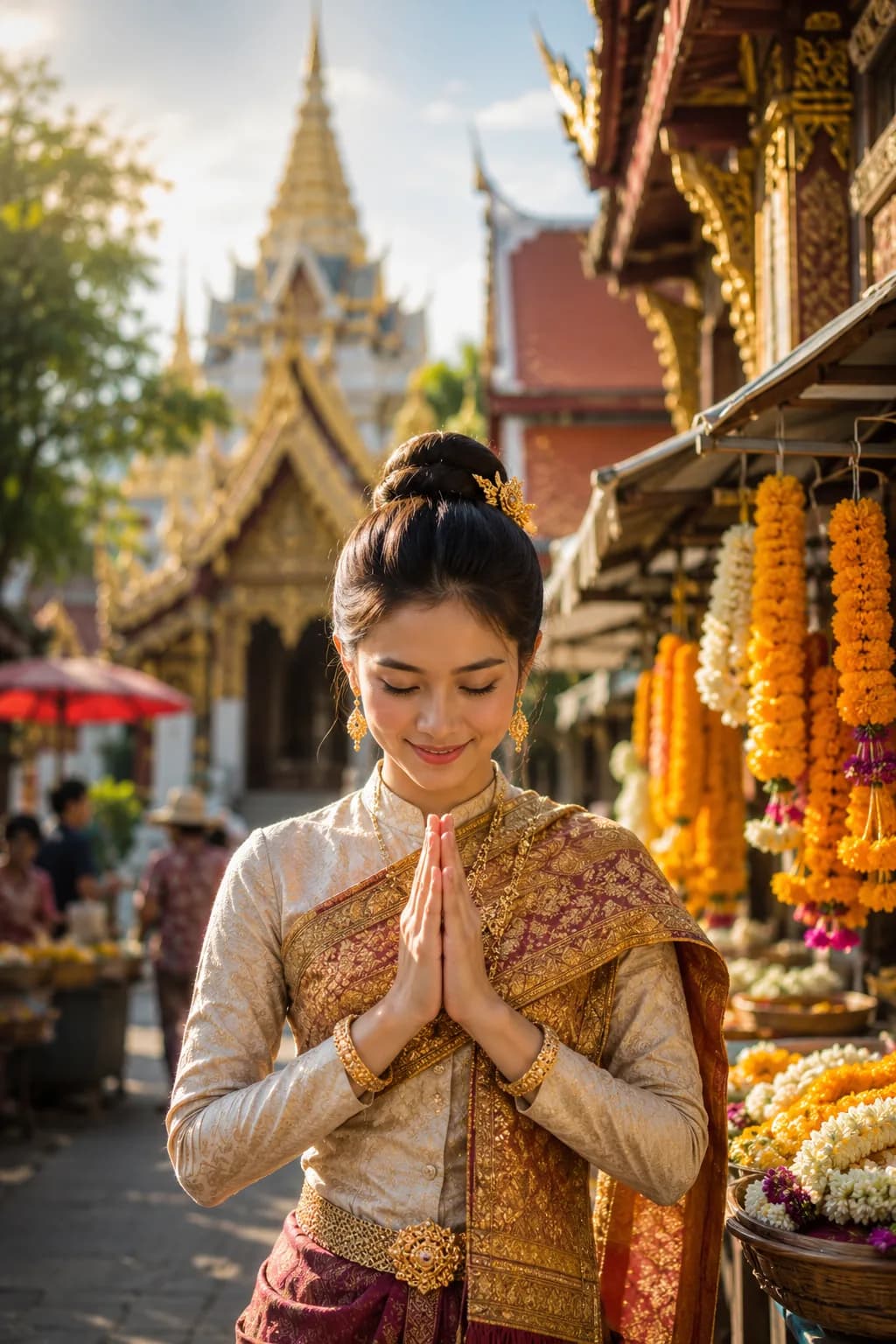
The wai is one of Thailand's most recognisable gestures, performed by pressing the palms together with fingers pointing upward and giving a slight bow. It's more than a greeting — it can communicate respect, thanks, apology, acknowledgement and social position, and the exact height of the hands and depth of the bow traditionally change depending on who's being greeted.
Start with your palms together in front of the centre of your chest, fingers pointing up, elbows staying naturally close to the body rather than out to the sides. From there, a simplified guide: for an ordinary polite wai, palms together at chest level with a small bow of the head is enough. For an older person, a parent or someone highly respected, raise the hands while bowing so the thumbs come toward the tip of the nose. For a Buddhist monk, raise it higher still, thumbs toward the area between the eyebrows, with a deeper bow. The general principle is simple: the higher the wai and the deeper the bow, the greater the respect being shown.
Traditionally, the younger or more junior person initiates the wai toward the older or more senior one — children wai parents, students wai teachers, monks receive especially respectful versions of the gesture. Tourists sometimes start wai-ing everyone in sight, which isn't necessary; you generally don't need to initiate a formal wai toward every waiter, shop assistant or taxi driver. A smile and a polite thank you are usually enough, and if someone gives you a wai, returning it politely is normally appropriate.
If you forget everything else, use this version: palms together at chest level, elbows close to your body, a small nod or bow, and a smile. Don't overdo it — that looks far more natural than dramatically raising your hands to your forehead every time somebody says hello. A wai should feel respectful, not theatrical.
Face
One of the most useful ideas for understanding Thai social behaviour is what English speakers usually call "face" — connected to dignity, reputation and social standing. Thailand isn't the only society where this matters; nobody enjoys being humiliated anywhere. But avoiding public embarrassment can be especially important here, and it affects how people disagree, criticise, apologise and solve problems. A person may know perfectly well they made a mistake — publicly proving it in front of everyone else usually just makes things worse.
Someone can lose face through public criticism, aggressive confrontation, being mocked in front of others, shouted at, or forced to admit failure publicly. The original problem may be small; the loss of face can become much bigger, which is why a calm, private conversation usually works better than making a scene. The opposite exists too — you can help someone save or gain face by thanking them publicly, showing respect to an older person, giving credit, or correcting something quietly rather than humiliating them. A visitor doesn't need to get calculating about it. The basic rule is simply: don't embarrass people unless there's a very good reason.
Imagine a hotel has lost your booking. It's midnight, you're tired, and you know you're right. The temptation is to raise your voice and demand someone admit the mistake — that might work in some cultures, but in Thailand it can easily make the interaction harder. A calmer approach tends to work better: explain the problem clearly, show your booking confirmation, ask what can be done, and give the employee room to solve it without being publicly humiliated. You still get to insist on a solution. Being polite doesn't mean accepting bad service — it means separating the problem from the person.
Jai Yen, the Smile, and Reading Between the Lines
The Thai expression "jai yen" literally relates to having a cool heart, commonly used to describe calmness and emotional control — you'll also hear "jai yen yen", roughly meaning calm down, keep cool, take it easy. The opposite image is a hot heart: anger, impatience, escalation. Thai people obviously get angry like anyone else, but openly losing control is often viewed negatively, and someone who stays calm under pressure tends to preserve their dignity.
Thailand's reputation as the Land of Smiles causes endless misunderstandings, because a smile doesn't always mean happiness — it can equally express friendliness, embarrassment, nervousness, apology, discomfort, uncertainty, or simply an attempt to keep a situation pleasant. This matters most during disagreements: a foreign visitor may get angry because somebody is smiling while something has gone wrong, when the Thai person may not find the situation funny at all — the smile may be helping them manage the tension. Reading it correctly takes time.
Thai communication can also be less direct than many Northern Europeans are used to. A blunt "no" may be softened into "maybe difficult", "not sure", "later", "can try", or just hesitation and a smile — the exact wording depends on the situation, but maintaining harmony can matter as much as delivering the answer with maximum directness. This doesn't mean Thai people never say no; it means visitors should listen to context, not just individual words. The same goes for "yes" — it may simply signal "I understand what you said" rather than a guarantee everything requested will happen exactly as asked. Whenever something is important — transport times, hotel bookings, medical appointments, business arrangements — confirm the practical details clearly and politely, and don't assume a friendly nod is a binding contract.
None of this means Thai people are passive. Thai society contains intense political debate, business competition, family arguments and every other form of disagreement found anywhere else. Politeness isn't weakness, indirect communication doesn't mean people lack strong opinions, and a smile doesn't mean somebody agrees with you. Understanding Thai culture means getting better at reading the form communication takes, not assuming there's nothing underneath it.
Hierarchy, Titles and Names
Thai society is often more openly hierarchical than many Western societies — age, seniority, job title, family position, religious status, and sometimes wealth or social position can all matter. That doesn't mean every Thai person obsesses over rank, but people often understand social relationships through a clear sense of who's senior and who's junior. Two words reveal this particularly well: "phi" for someone older, "nong" for someone younger, used far beyond literal siblings — by friends, coworkers, couples, even people who've only just met. In cultures where asking someone's age can feel impolite, this might seem surprising; in Thailand, knowing who's older helps determine language and relationship.
Titles are common too. "Khun" is a widely used polite title placed before a first name, useful in almost any situation for foreigners, and professional titles are also used for teachers, doctors, monks and senior people according to their role. Thai names can run long, which is part of why nicknames are so common in everyday life — almost every Thai person has one, often used far more than their official name, and you may meet people called Bank, Beer, Ice, Golf, Apple, Ploy, Mint or Boss. Don't assume an English-sounding nickname is a joke; it may have been their everyday name since childhood.
The Body: Head, Feet and Personal Space
Traditional Thai etiquette treats the head as the highest and most symbolically respected part of the body, and the feet as the lowest — both physically and symbolically. Avoid touching someone's head casually, especially someone you don't know well; a playful pat that might seem harmless elsewhere can read as disrespectful. Avoid pointing your feet directly at people, Buddha images or sacred objects, and avoid putting your feet on tables or chairs where that would look disrespectful. If you're sitting on the floor in a temple, position your legs so your soles don't point toward the Buddha image. Stepping over someone sitting or lying on the floor is best avoided too, since it feels disrespectful to pass your feet over another person's body — walk around instead. Nobody expects tourists to achieve perfect Thai posture; basic awareness is enough.
Shoes are frequently removed before entering homes, and often before temples, some guesthouses, massage shops and small businesses too. The easiest way to know is to look at the entrance — a row of shoes usually answers the question, and if you're unsure, ask or copy what local people are doing. Temples deserve extra care generally, since they're active religious spaces rather than theme parks: cover shoulders and knees, remove shoes where required, keep your voice down, don't climb on sacred structures, and don't interrupt people praying for a photograph.
The Monarchy and National Symbols
The Thai monarchy occupies a unique and highly sensitive position in national life. Visitors should treat royal images, ceremonies and symbols respectfully, and Thailand has strict laws concerning insults or threats toward the monarchy. The practical advice is simple: don't joke about the royal family, don't damage or mistreat royal images, and don't assume political discussion around the monarchy works the way it might at home. There's no travel benefit in testing the boundaries.
Thai banknotes and coins carry royal imagery, so treating money disrespectfully can carry an extra layer of offence — one classic tourist mistake is stopping a rolling coin or escaping banknote by stamping on it with a foot, which seems practical but combines the foot with a royal image, a bad mix. Use your hand instead. You may also occasionally encounter the national anthem being played in public places such as railway stations, where people stop and stand — if that happens, the easiest approach is to do what everyone else is doing; you don't need to perform patriotism, just avoid pushing loudly through a stationary crowd. Flags, royal portraits and Buddhist images appear widely in businesses and public institutions, and you don't need to share the emotional significance attached to them, but mocking them is unnecessary and can create serious problems.
Public Behaviour
Thailand's international image can mislead — nightlife districts can look sexually open, but everyday social behaviour is generally more restrained. Holding hands and casual affection are normal; heavy kissing or overtly sexual behaviour in public can feel inappropriate. Younger urban Thais are becoming more internationally influenced, but local context still matters — Walking Street at midnight and a provincial temple fair at lunchtime are not the same social environment.
Thailand is hot, and nobody expects visitors to dress for a diplomatic reception — but context matters. Beachwear belongs at the beach and pool; a bikini in a convenience store several streets from the sea attracts less admiration than the wearer might imagine, and temples and official settings call for more conservative clothing. Thai social interactions often run at a lower confrontational volume than some visitors are used to — the country itself can be loud, but shouting at an individual in anger is different, and if the person behind a hotel desk gets quieter while you get louder, that's probably not a sign you're winning. Pointing directly at people with one finger can feel impolite, with an open hand generally softer, and pointing with the feet is considerably worse; in relaxed tourist settings minor mistakes are usually ignored, and the goal is avoiding unnecessarily aggressive body language, not perfection. Giving and receiving important objects — a gift, a business card, something from an older or respected person — often benefits from a little extra care, such as using both hands, even if buying water at 7-Eleven doesn't need to become a ceremony.
At the Table
Thai meals are usually shared, with several dishes ordered for the table and individuals taking smaller portions as they eat. Use the serving spoon when one is provided rather than digging repeatedly into a shared dish with your personal spoon, and expect rice to sit at the centre of most meals. For many central Thai dishes, the spoon is the main utensil, with the fork used to push food onto it — you rarely need a knife, since much Thai food arrives in bite-sized pieces. Chopsticks show up mainly with noodle dishes and Chinese-influenced food, while sticky rice in Isaan and the north is often eaten with the fingers. One of the classic beginner assumptions is that all Asian food calls for chopsticks; Thailand quickly disproves that. Food etiquette varies regionally and by situation, so watching the group usually beats memorising rules.
Getting It Wrong, and Why It's Fine
Learning etiquette can accidentally create another problem: treating every Thai person like a character in a cultural instruction manual. Real people are more complicated — a 20-year-old university student in Bangkok may behave very differently from her grandmother in a rural village, and a nightclub employee may communicate differently from a monk. Culture provides patterns; it doesn't erase individuality.
Thai people generally know foreigners didn't grow up learning Thai etiquette, which gives visitors considerable room for mistakes. An awkward wai will normally be forgiven, bad pronunciation may produce a smile, and nobody sensible expects perfection. What causes bigger problems is arrogance — acting like local customs are stupid, shouting because things aren't done the way they are at home, treating service staff as inferior, mocking religion, or refusing to adapt at all. Good intentions are usually obvious.
If all the etiquette starts to feel complicated, it reduces to one principle: don't make other people unnecessarily uncomfortable. That covers an extraordinary amount — don't humiliate people, don't shout at them, don't put your feet in their face, don't disrespect their religion or national symbols, don't force intimacy, and don't assume your own cultural habits are universal. Be calm, be polite, pay attention, and that gets you most of the way there.
You'll still make mistakes — forgetting to remove your shoes, performing a ridiculous wai, mispronouncing a word so badly it means something completely different. The solution is rarely complicated: smile, correct it, say sorry if necessary, and move on. Turning a tiny cultural slip into a five-minute panic is usually more awkward than the original mistake.
Good etiquette isn't about pretending to be Thai — it's about making travel easier. Once you understand the basic social signals, interactions become less mysterious: the hotel employee who won't say "no" directly makes more sense, the younger person wai-ing an older relative makes more sense, the calm tone during a disagreement makes more sense. Much of Thai politeness isn't a collection of random rules. It revolves around respect, social harmony, and letting people keep their dignity — and you're allowed to be foreign, ask questions, and misunderstand things along the way. Many Thai people genuinely enjoy explaining customs to someone who shows real interest. The goal isn't to become an etiquette expert before you land. It's to arrive with enough awareness to notice what's happening around you, and learn as you go.