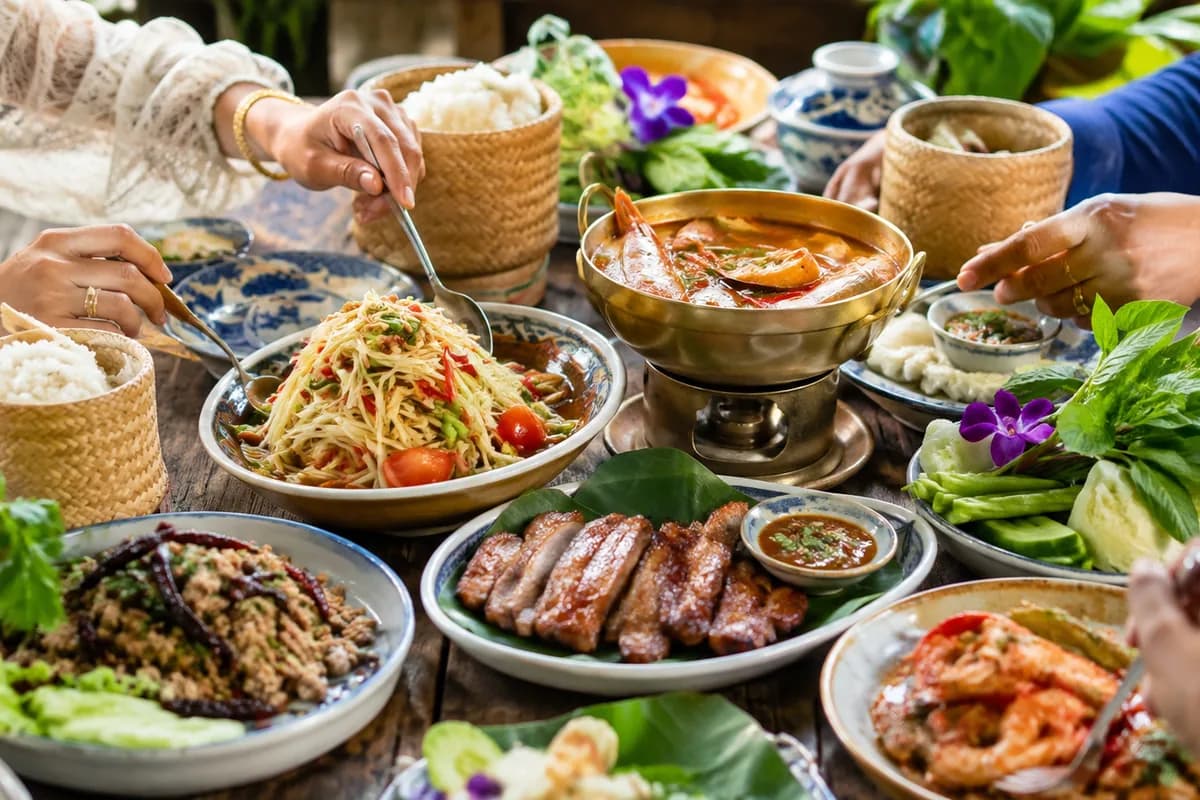
More Than Pad Thai
Most visitors arrive expecting Thai food to mean pad Thai, green curry and tom yum. Those dishes are real, and they're worth trying — but they're a small slice of a much bigger picture. Thai food changes by region, family, religion, season and migration history: the food of Chiang Mai has little in common with the food of Isaan, southern cooking can feel like an entirely different cuisine from central Thai food, and Chinese and Muslim culinary traditions run through the whole country. Royal kitchens developed their own refined style, and street food grew into a culture of its own. Perhaps most importantly, Thai food isn't only about what's on the plate — it's about how people eat together.
Rice Is the Centre, Not a Side Dish
The easiest way into a Thai meal is to start with rice. For much of Thailand, rice isn't simply an accompaniment; it's the organising centre of the meal. The expression kap khao, literally "with rice," refers to everything eaten alongside it — which flips the usual Western framing. Instead of "curry with rice," a Thai meal is closer to "rice, with several things to go with it." It sounds like a small difference. Culturally, it isn't.
Regional rice traditions differ sharply. Fragrant jasmine rice dominates central Thailand and much of the country, while in Isaan and parts of the north, sticky rice — khao niao — is essential, commonly eaten by hand: a small piece rolled into a ball and used to scoop up grilled meat, dips or salads. For many people in the northeast, this is simply everyday food, not a novelty.
Sharing the Table
One of the clearest differences between Thai and many Western dining habits is how dishes are ordered. Rather than one main course per person, a Thai group often orders several dishes — a curry, a stir-fry, a soup, a salad, some vegetables — for everyone to share, taking small portions as the meal continues. The goal is variety and contrast across the whole table rather than everyone eating an identical plate in isolation.
That said, not everything is shared. Thailand has countless one-plate meals built for a quick lunch or eating alone: fried rice, pad kra pao, noodle soups, rice topped with curry or roast pork. Recognising the difference between shared dishes and individual meals makes ordering considerably easier for a first-time visitor.
Utensils follow their own logic too. Despite a common assumption, most rice-based Thai meals are eaten with a spoon and fork rather than chopsticks — the fork pushes food onto the spoon, and the spoon does the actual work, since food is usually cut into manageable pieces during preparation. Chopsticks appear mainly with Chinese-influenced noodle dishes. And eating with your hands has its own legitimate place: sticky rice in northeastern and northern food is commonly eaten that way, simply because it's the most practical method for that particular food, not because it's somehow less refined. At a shared table, communal dishes typically come with their own serving spoon — use it, rather than digging back in with the spoon that's already been in your mouth.
Balance, and the Reality of "Spicy"
Thai cuisine is famous for balancing sweet, sour, salty, spicy and bitter flavours, but that balance doesn't necessarily happen within a single dish. It often plays out across the whole meal: a rich coconut curry sitting beside a sharp salad, fresh herbs cutting through something fried, a mild soup contrasting with grilled meat.
The country's reputation for extreme heat is only partly true. Some dishes are genuinely fierce; plenty of others — mild soups, grilled meats, fried rice, omelettes — carry little or no chilli at all, and even a traditionally spicy dish varies enormously depending on the cook, the region and the specific chillies used. If you want less heat, "mai phet" (not spicy) or "phet nit noi" (a little spicy) are useful phrases, though results vary — touristed restaurants tend to adjust readily, while a curry paste already built into a dish at a local spot may not be removable. Ask before ordering if chilli tolerance is a genuine concern, not after the plate arrives.
Table condiments do a lot of the fine-tuning work. Phrik nam pla — fish sauce with chopped chillies — sits on many tables as a way to adjust saltiness, heat and acidity to taste, and noodle shops typically offer a small set of sugar, fish sauce, chilli flakes and vinegared chillies so diners can adjust their own bowl. The advice that actually matters: taste first, then adjust. Fish sauce (nam pla) itself is one of the foundational seasonings of Thai cooking, and in Isaan, the fermented fish sauce pla ra plays a similarly central, if more polarising, role — its smell can be a genuine hurdle for newcomers, while for many people who grew up with it, it simply tastes like home.
A Country of Regional Cuisines
There is no single Thai cuisine — there are several, loosely gathered under one national label.
Isaan food, bold, sour, fermented and often grilled, built around sticky rice, som tam, larb and grilled chicken, has spread across the country largely because millions of northeasterners migrated to Bangkok and other cities for work and brought their food with them. (For a much deeper look at the region behind this food, see our dedicated guide to Isaan.)
Northern Thai food reflects the old Lanna region's distinct history: khao soi, a rich curry noodle soup, has become internationally famous, alongside dishes like sai ua (aromatic sausage) and nam phrik noom (roasted green chilli dip). It tends to be deeply flavoured without relying on the same chilli intensity found in the northeast or south.
Southern Thai food can be genuinely intense — turmeric, coconut, abundant seafood and strong Muslim-Malay influence combine into curries like gaeng som that test even confident chilli-eaters. Massaman curry is one of the clearest examples of this outside influence becoming distinctly Thai over time: a flavour profile rooted in Persian, Indian and Muslim culinary traditions that Thailand absorbed, adapted and made its own.
Central Thai food — green curry, tom yum, pad Thai, coconut-milk curries — is what most visitors first identify as "Thai food," partly because Bangkok became the meeting point where regional cuisines and migrant traditions mixed most visibly.
Running through all of them is Chinese influence: noodle culture, wok cooking, soy-based seasoning and roast meats are so deeply embedded in everyday Thai eating — kuay tiew noodle soup being the clearest example — that many visitors never register them as an external influence at all. Muslim culinary traditions, especially strong in the south, extend well beyond massaman curry into roti, biryani-style rice and halal street food. And royal Thai cuisine, developed in palace kitchens where presentation and technique became highly refined, shaped wider ideas of elegant Thai cooking without ever describing how most people actually eat day to day.
Street Food, Markets and the Rhythm of Eating
Street food isn't a tourist invention — it's deeply embedded in Thai urban life, from morning commuters grabbing breakfast to office workers eating lunch at a stall to night markets functioning as genuine social spaces. Much of its quality comes from specialisation: a stall that has sold one dish, and only that dish, for years or decades tends to be very good at it.
Breakfast doesn't follow the Western script either. Rice porridge (jok), noodle soup, or grilled pork skewers with sticky rice are all completely normal ways to start the day, and the boundary between "breakfast food" and "any other meal" is far looser than many visitors expect. Markets — wet markets in particular — remain central to how Thai food culture actually works, offering a view of ingredients before they become restaurant dishes, while night markets combine eating, shopping and social life in a way that rewards a slow pace: buy one thing, share it, walk, buy something else, rather than trying to sample everything in the first twenty minutes.
Thailand's tropical fruit deserves its own exploration — mango, mangosteen, rambutan, dragon fruit and durian among many others, with availability shifting by season. Durian remains the country's most divisive fruit, loved intensely by some and avoided by others for its smell; if you want to try it, a small portion from a vendor is a lower-commitment way in than buying a whole fruit, and it's worth checking hotel rules, since many ban it from rooms.
Eating Well, Safely and Thoughtfully
Vegetarian and vegan travellers can eat very well in Thailand, but language matters: a dish with no visible meat can still contain fish sauce, oyster sauce, shrimp paste or dried shrimp, so simply pointing at vegetables isn't always enough. During the Vegetarian Festival, look for the yellow flags marking "jay" food, a specific Chinese-influenced religious vegetarian tradition that excludes meat and animal products (and, traditionally, certain strongly scented vegetables) — useful for plant-based travellers even outside the festival period, where jay restaurants exist year-round in many cities. Halal food is widely available in Bangkok and even more so in the south, given the size of the country's Muslim population.
Serious food allergies require real caution: peanuts, shellfish, fish sauce, shrimp paste, soy and gluten-based sauces appear constantly across Thai kitchens, and cross-contact is a real risk in small kitchens and street stalls. Simply asking for something to be left out is different from communicating that a trace amount could cause a serious reaction — for severe allergies, a clearly translated allergy card and a choice of establishment that can genuinely understand the request are worth the extra effort.
On hygiene, millions of people eat street food safely every day, but not every stall is equal. High turnover, food cooked fresh and hot, and a queue of local regulars are reasonable positive signals — Thai diners have their own favourite stalls and are just as selective as anyone else, so a busy stall next to an empty one is often telling you something.
Prices vary enormously by context rather than by any single "Thai food price" — a plate of street food and an island seafood dinner exist on completely different scales, and tourist areas generally cost more than local neighbourhood spots. Tipping isn't traditionally expected at street stalls and inexpensive local restaurants, though a modest tip for good service is common at nicer restaurants and hotels; check the bill first, since some venues already include a service charge.
Food as Identity
Ask a Thai person living in Bangkok what food they miss and you often learn where home really is — a northern sausage, a particular chilli dip, pla ra from a specific province. Recipes travel through families, relatives bring regional ingredients when they visit, and food becomes one of the clearest ways regional identity survives migration to the capital. Offering food is also one of the simplest expressions of Thai hospitality: more will keep arriving even after you insist you're full, and accepting a little is often warmer than refusing repeatedly.
For a first-time visitor, the best strategy isn't a checklist of "ten Thai dishes to try." Eat one famous dish, then order something you can't pronounce. Eat at a market, a food court, a family restaurant. Try a regional meal you didn't expect. Taste before reaching for the condiments, and ask people what they'd recommend. You'll learn far more about Thailand at the table than almost anywhere else — because food here isn't just one attraction alongside beaches, temples and nightlife. It's one of the places where nearly all of Thailand meets at once.