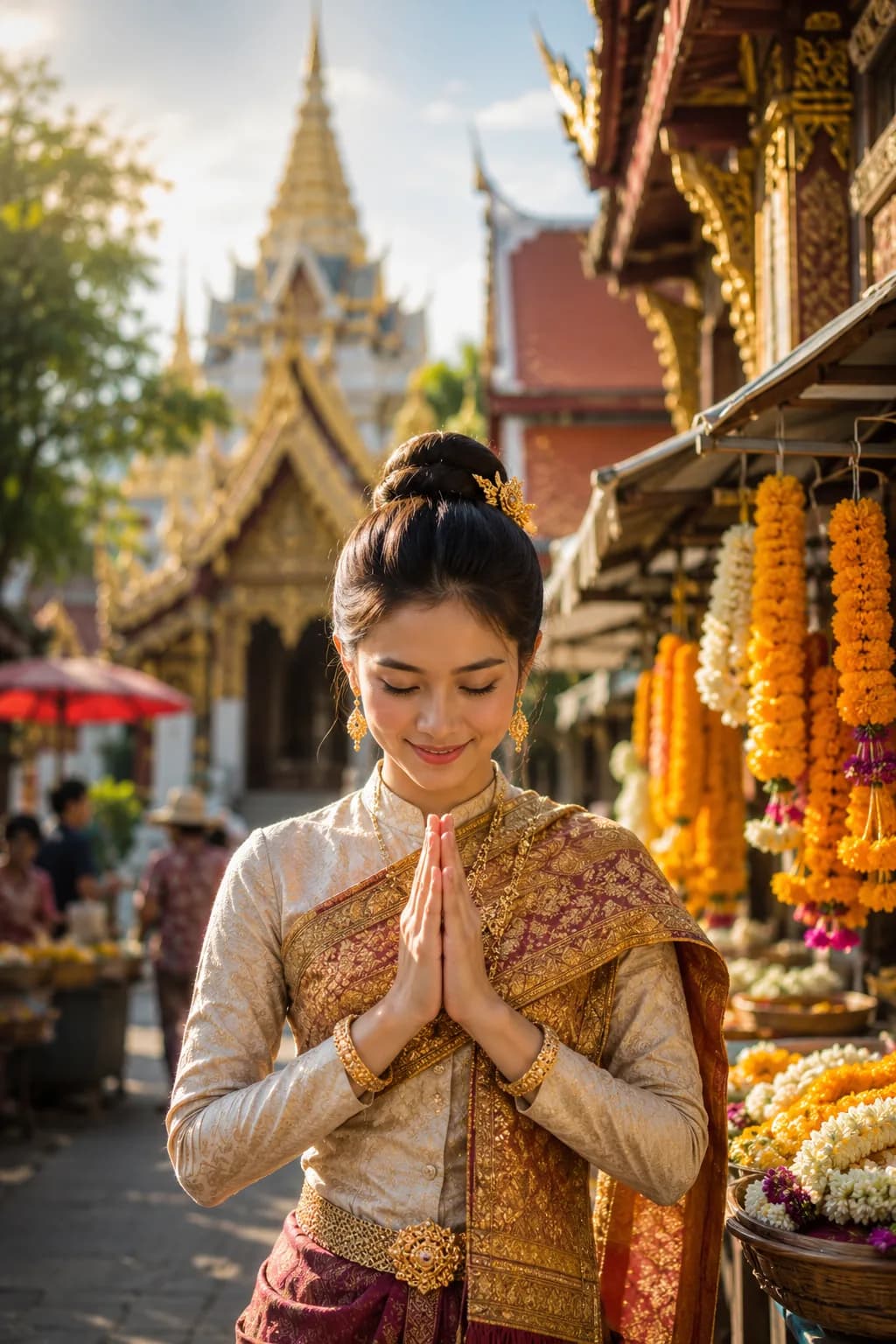
You don't need to spend long in Thailand before Buddhism becomes visible. Golden Buddha images look down from temple halls. Saffron-robed monks walk through neighbourhoods in the early morning. Small offerings appear beside shrines. Drivers keep amulets in their cars, and even people who aren't especially religious take part in customs with Buddhist roots.
Buddhism in Thailand isn't confined to temples. It's woven into language, family life, festivals, ideas about generosity, attitudes toward death, social respect and the way many people think about good and bad actions. Understanding a little of this background makes the country much easier to read — and you don't need to become a Buddhist to appreciate it.
Theravada Buddhism
The dominant tradition in Thailand is Theravada Buddhism, also the main Buddhist tradition in Sri Lanka, Myanmar, Laos and Cambodia. The word is usually translated as "Teaching of the Elders", and its traditions are closely connected to the Pali Canon, a large collection of teachings preserved in the Pali language.
At the centre of it all are the teachings attributed to Siddhartha Gautama, the historical Buddha, who lived in South Asia more than two thousand years ago. Buddhism doesn't begin with a creator god — it begins by looking at human experience directly. Why do people suffer? Why are we dissatisfied even when things seem to be going well? Why do we cling to things that inevitably change? And is there a way to live that reduces suffering rather than creating more of it?
The Four Noble Truths and Karma
One of the most basic summaries of Buddhist teaching is the Four Noble Truths: that life contains suffering and dissatisfaction; that this suffering has causes, particularly craving, attachment and ignorance; that it's possible for suffering to cease; and that there's a path of practice leading toward that cessation. That path is commonly described through the Noble Eightfold Path — covering understanding, intention, speech, action, livelihood, effort, mindfulness and concentration. It's a vast philosophical tradition that no travel article can explain in full, but one idea is especially useful for everyday Thai life: actions matter. What you do, why you do it, and how you treat other beings all have consequences.
The word "karma" gets used casually in English, often to mean something like cosmic revenge — a poor description. In Buddhism, karma is closely tied to intentional action: good intentions and wholesome actions have consequences, as do harmful ones. It isn't a supernatural scoreboard where someone who cuts you off in traffic gets instant punishment from the universe. Karma operates within a much larger understanding of cause and effect, moral development and rebirth — which helps explain a concept you'll encounter constantly in Thailand: merit.
Making Merit — Tham Boon
The Thai expression "tham boon" means making merit, and it's one of the most visible parts of everyday Thai Buddhism. Merit can be cultivated through generosity, ethical conduct and mental development. Visitors may see it in people giving food to monks, donating to a temple, supporting charitable causes, observing precepts, listening to teachings or joining ceremonies. The important point is that merit isn't meant to be a purely financial transaction — giving is one expression of generosity, and the intention behind it matters. People make merit on birthdays, during festivals, after a death in the family, at the start of a new stage of life, or simply as part of ordinary practice. Someone might say they're going to the temple to "make merit" without needing to explain any more than that — for many Thai Buddhists, everybody already understands.
Morning Alms — Tak Bat
One of the most striking Buddhist traditions a traveller may encounter happens early in the morning, when monks leave their temples carrying alms bowls and laypeople offer food — a practice commonly called "tak bat". The relationship runs both ways: monks depend on lay communities for material support, and laypeople gain an opportunity to practise generosity and make merit. It isn't simply "giving food to poor monks" — it's part of the relationship between the monastic community and lay Buddhist society. If you want to take part, treat it as a religious practice first and a photo opportunity second. Follow local behaviour, offer food respectfully, and don't block the monks for pictures.
Monks and the Sangha
The Buddhist monastic community is known as the Sangha. Thai monks are immediately recognisable by their shaved heads and robes, ranging from orange to dark saffron or brown, and follow rules considerably stricter than those expected of ordinary lay Buddhists — their lives may involve study, meditation, teaching, chanting and community duties. Temples have long functioned as community institutions too, serving historically as centres of education, art and organisation as well as religion, a role that remains visible today.
Visitors sometimes swing between two odd extremes — treating monks as mysterious, almost supernatural figures, or forgetting that monastic rules exist at all. A monk may use a smartphone, ride a bus, laugh, study at university — none of that makes him less of a monk. At the same time, the robes represent a genuine religious commitment and deserve respect: don't grab a monk for a selfie, and don't treat the robes as a costume.
One convention matters especially for visitors: Theravada monastic rules restrict physical contact between monks and women. A woman should generally avoid touching a monk directly, and if she needs to hand something to one, local practice may involve placing the object on a cloth or tray rather than passing it hand to hand. If you're unsure, leave a little space and watch what Thai people around you do.
Becoming a monk in Thailand doesn't necessarily mean becoming one for life. Thai men may ordain temporarily, for anywhere from days to months, and temporary ordination has traditionally been seen as a meaningful way to study Buddhist teachings, practise discipline and make merit — for some families, a son's ordination is a major event. That's why you might meet someone working in an office, bar or restaurant who casually mentions he was once a monk; there's no contradiction there. You'll also see boys and young men in robes as novice monks, known in Pali as samanera, who follow fewer rules and often enter monastic life for education or personal reasons — temples historically played a major role in educating boys from poorer or rural families, and monastic education still exists alongside Thailand's modern national school system.
What Is a Wat?
The Thai word for a Buddhist temple complex is "wat". Foreign visitors often use "temple" to describe one impressive building, but a wat is usually much more — depending on the site, the compound may include several religious structures, monks' living quarters, chedis or stupas, shrines, courtyards, schools and cremation facilities. That's why two very different-looking sites can both be called a wat: an internationally famous architectural monument and a quiet neighbourhood temple serving local families are both functioning religious spaces.
Among the key buildings, the ubosot, or ordination hall, is where important monastic ceremonies take place and can often be identified by boundary stones called sema positioned around it. The viharn, or assembly hall, typically holds Buddha images and is used for prayer, chanting and sermons — often where visitors spend most of their time at major temples, so give worshippers space if people are praying. The tall bell-shaped or tower-like structures seen throughout the country are usually chedis, the Thai form of the Buddhist stupa, associated with sacred relics and remembrance; their shapes vary considerably by period and region, and once you start recognising them, you begin seeing the history of Thailand in the architecture itself.
Buddha Images and Offerings
Thailand contains countless Buddha images — standing, sitting, reclining, walking, huge and tiny, made from bronze, stone, stucco or gold. To a visitor they may initially look like decorative statues; to Buddhists they're religious representations connected to the Buddha and his teachings, and that difference matters. Climbing onto one, sitting disrespectfully against one, or treating sacred imagery as a joke can cause real offence — which is also why you'll sometimes see signs asking foreigners not to use Buddha imagery as casual decoration, particularly on tattoos. You don't need to share the religious belief, but treating the imagery respectfully is an easy courtesy.
Flowers, incense and candles are common offerings, with lotus flowers especially associated with Buddhist symbolism. People may kneel before a Buddha image, light incense, place flowers, bow and pray, or simply reflect quietly — different temples and traditions have their own patterns, and you're not required to participate. Watching respectfully is perfectly acceptable; if you do join in, follow local instructions rather than copying a ritual as a joke. Thai Buddhists may also perform three prostrations before a Buddha image, traditionally linked to the Triple Gem: the Buddha, the Dhamma (the teachings) and the Sangha (the monastic community) — not a random gesture, but a reference to three central objects of Buddhist refuge.
The Five Precepts and Meditation
Lay Buddhists are commonly encouraged to observe five basic ethical precepts, generally expressed as commitments to refrain from killing living beings, taking what isn't given, sexual misconduct, false or harmful speech, and intoxicants that lead to heedlessness. These are training principles rather than commandments from a creator god, and not every Buddhist follows them perfectly — the precept against intoxication obviously doesn't mean nobody in Thailand drinks. Religious ideals and everyday behaviour aren't the same thing in any society, but the Five Precepts still provide an important ethical framework.
Meditation is central to Buddhist practice, though the forms and intensity vary enormously — some people meditate daily, others rarely, and some attend retreats at monasteries or dedicated centres. Thailand has long attracted international visitors interested in Buddhist meditation, and some monasteries offer instruction to foreigners. Anyone considering a serious retreat should research the centre carefully; it's not necessarily a relaxing wellness holiday, and traditional practice can involve long periods of silence and many hours of meditation.
Holy Days and Festivals
Thailand observes several important Buddhist days, many following the lunar calendar, so their dates shift from year to year. Among the best known are Makha Bucha, Visakha Bucha and Asalha Bucha — Visakha Bucha commemorates major events in the Buddha's life and is one of the most important observances, while Asalha Bucha is associated with his first sermon. Alcohol sales may be restricted by law on certain major religious holidays, something travellers sometimes discover only when a bar or convenience store won't sell them a beer.
Asalha Bucha leads into Khao Phansa, the start of a roughly three-month period commonly called Buddhist Lent or the rains retreat, when monks traditionally remain based at a particular monastery rather than travelling widely. The period is associated with intensified religious practice — laypeople may make merit, donate candles and necessities, and sometimes make personal commitments such as giving up alcohol. Its end is followed by Kathina, an annual period when lay communities offer robes and other necessities to monks, often as major community events involving families, businesses and local groups, sometimes with music and processions. That mix of solemn religion, community participation and celebration is very Thai — a religious event doesn't have to feel silent or austere to be taken seriously.
Foreign visitors often know Songkran as the world's biggest water fight, but that's only one layer of it. Songkran is the traditional Thai New Year and carries real Buddhist and family significance — people visit temples, make merit, offer food to monks, and Buddha images may be ceremonially washed with water. Younger people may respectfully pour water over the hands of elders and ask for blessings. The giant street water battles grew out of a much older symbolic use of water tied to cleansing, renewal and respect — knowing that changes how the festival looks.
Funerals and Everyday Life
Buddhist ideas also shape how many Thai families approach death. Funeral ceremonies commonly take place at temples, with monks chanting and families making merit dedicated to the deceased, and cremation is common. But Thai funeral traditions aren't purely Buddhist — as with much of Thai religious life, Buddhist teaching coexists with older beliefs involving spirits and ancestors, a mixture explored further in Thailand4U's article on spirit houses and everyday beliefs.
Not every Thai person meditates, visits a temple weekly, or makes every decision according to Buddhist doctrine — Thailand is a modern society with religious people, loosely religious people, sceptics and followers of other faiths. But Buddhism stays culturally visible even where formal practice doesn't: it shows up in language, in calendar holidays, in temples occupying central spaces in towns and villages, and in monks participating in ceremonies around birth, ordination, marriage, new homes and death. Someone may describe themselves as not particularly religious while still taking their parents to a temple, making merit on a birthday and keeping an amulet in the car. Religion and culture are hard to separate cleanly here.
It's also worth remembering that Buddhism isn't the whole story. Thai religious life often blends Theravada Buddhism with Brahmanic-Hindu traditions, local spirit beliefs, ancestor traditions and astrology, and a spirit house outside a Bangkok office tower isn't easily explained by Buddhist scripture alone. That mixture deserves its own article — Buddhism sits at the centre of the picture, but it isn't the only thing in the frame.
Visiting a Temple
You don't need to be nervous about entering a Thai temple — most that receive visitors are well used to tourists, and a few basic habits are enough. Dress respectfully, with shoulders and knees covered as a safe rule for important temples; remove your shoes where required; avoid pointing your feet toward Buddha images when sitting on the floor; don't climb on sacred structures; keep your voice down inside active worship spaces; and give monks and worshippers room. Follow photography signs, and remember a wat isn't an abandoned historical attraction just because tourists are allowed inside — people may be praying, studying or grieving there.
You're not required to bow or copy any religious gesture. You can walk through many temple spaces, look around quietly and appreciate the architecture without pretending to practise a religion you don't follow. If you do choose to bow or take part in a ritual, do it respectfully; if you're not sure what's happening, observing usually beats copying randomly.
Why So Many Temples?
Travel through Thailand and the sheer number of temples can seem extraordinary. The answer is partly historical and partly social — temples have long been central institutions in Thai communities, and building, restoring or supporting one is traditionally associated with merit-making. Powerful rulers sponsored magnificent temples, local communities built their own, and generations repaired what earlier ones created. The result is a religious landscape stretching from tiny village wats to some of the country's greatest monuments. Wat Phra Kaew in Bangkok and a small neighbourhood temple in Isaan may differ enormously in wealth and fame, but both belong to the same wider Buddhist landscape — and for travellers, temples offer one of the easiest ways to see Thai history physically, since architecture, Buddha styles and murals all shift from Sukhothai to Ayutthaya to Lanna to Bangkok's royal temples. You can study Thai history in a book, or take off your shoes and walk into it.
Beyond the Postcard Image
A common visitor fantasy is to imagine Thailand as a peaceful Buddhist country where everybody is calm, detached from money and permanently smiling — then Bangkok traffic happens, or politics, or business, or nightlife, and the fantasy collapses. That's because Thailand is a country of human beings, not a Buddhist theme park. A society can be deeply influenced by Buddhist ideas while still containing ambition, anger, inequality, consumerism and contradiction. Religious teachings describe ideals and practices; they don't erase human nature. Understanding that makes Thai Buddhism more interesting, not less.
You don't need to understand Buddhist philosophy before visiting Thailand, but a few ideas unlock a surprising amount of what you'll see: generosity matters, intentions matter, merit matters, monks and temples occupy respected social roles, and Buddhist traditions coexist with older beliefs rather than replacing them entirely. Once you know that, ordinary scenes look different — the woman placing rice into a monk's bowl isn't simply giving away breakfast, the family carrying orange robes into a temple isn't just making a donation, and the young man with a shaved head may be spending a few weeks ordained before returning to ordinary life. The ancient temple you came to photograph is still part of a living religious tradition. Buddhism in Thailand isn't only something preserved from the past — it's happening around you.