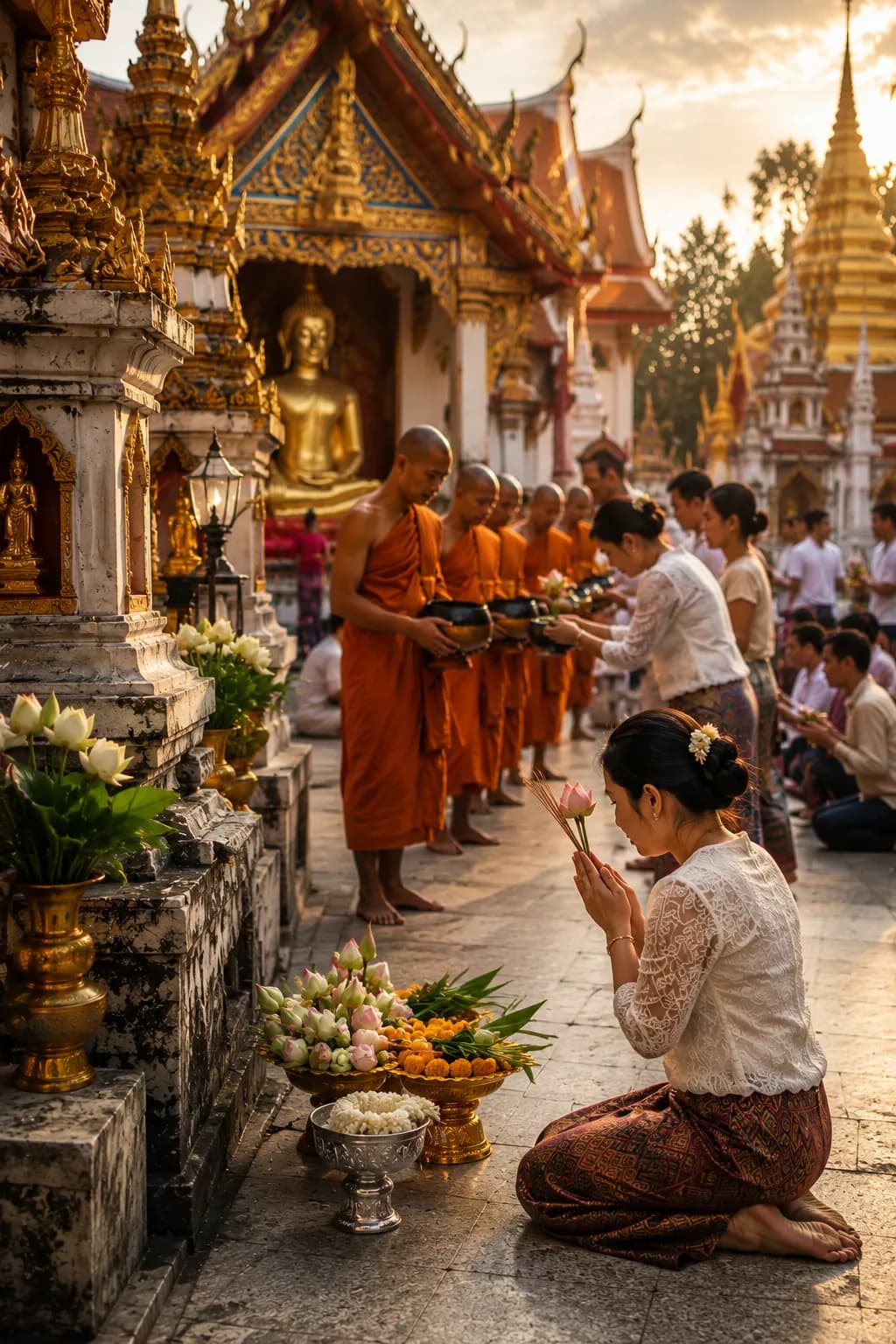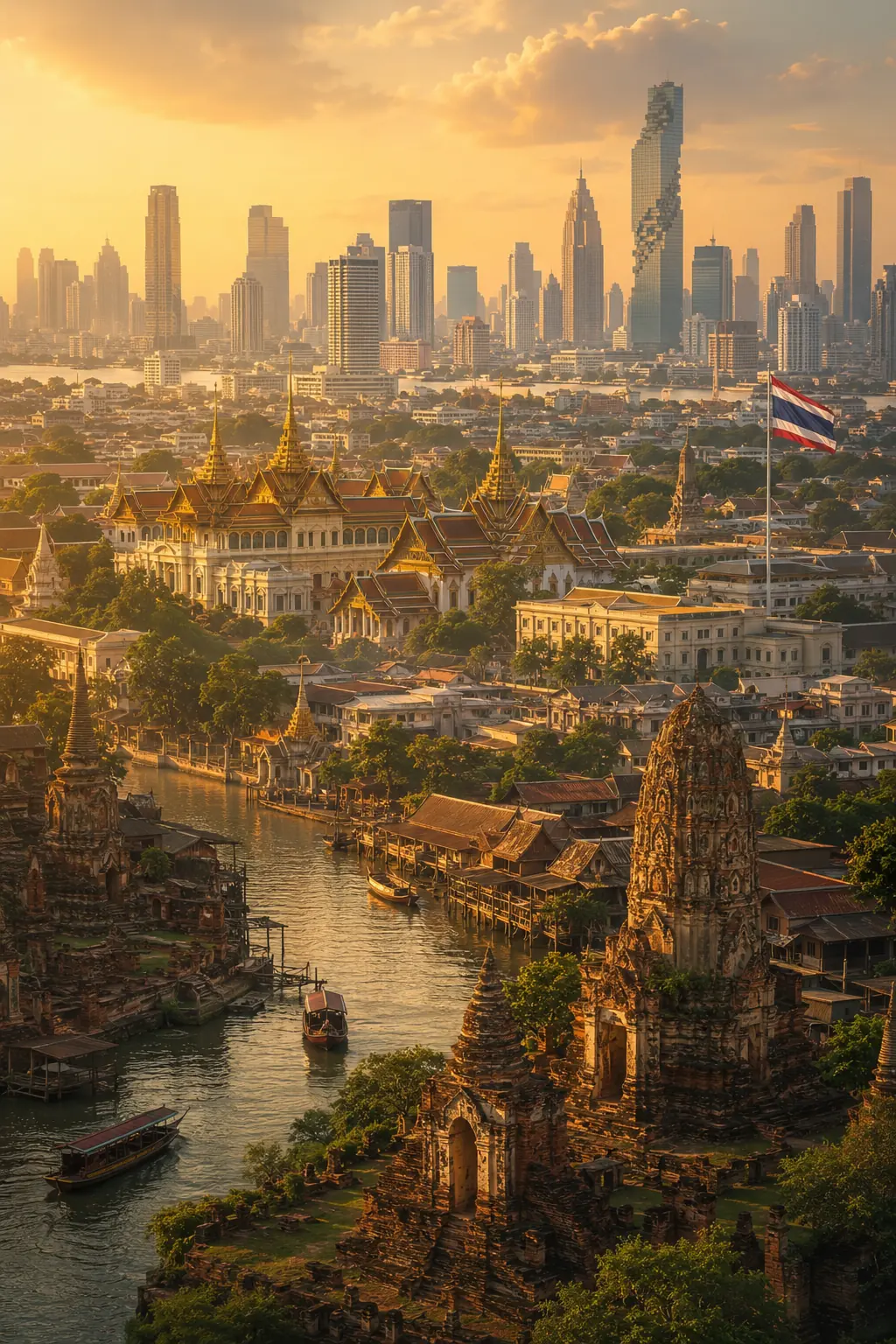
Thailand is usually described as a Buddhist country. That's true — but it isn't the whole story. Walk through Bangkok and you might see a tiny shrine outside a skyscraper, a taxi driver touching an amulet before starting the engine, a shop owner leaving red Fanta and fruit beside a spirit house, or a family visiting a Buddhist temple in the morning and consulting an astrologer that same afternoon. None of this necessarily feels contradictory here.
Thai spirituality has grown through several overlapping traditions. Theravada Buddhism is dominant, but older animistic beliefs, Brahmanic-Hindu traditions, Chinese religious practice and local customs have all shaped how many people understand luck, protection, spirits and the unseen world. For a visitor, this mixture can be one of the most fascinating parts of the country — you just have to stop looking for neat boxes.
Buddhism Is the Centre, Not the Whole Picture
Buddhism has shaped Thailand for centuries, and temples, monks, merit-making and Buddhist festivals remain deeply important. But many everyday beliefs don't come directly from Buddhist teaching. Spirit worship predates Buddhism's arrival in the region. Brahmanic-Hindu traditions influenced royal ceremonies, sacred symbols and ideas about deities. Chinese communities brought their own religious practices, ancestor traditions and forms of astrology. Over time these traditions didn't replace one another — they blended, which is why a person can identify comfortably as Buddhist while also believing a place has a guardian spirit, wearing a protective amulet, and choosing an auspicious date for an important event. Thai spirituality often works through addition rather than exclusion.
What Is Animism?
Animism is a broad term for beliefs in which places, objects, natural forces or living things may hold spirits or spiritual power — beliefs that existed in Southeast Asia long before Buddhism became dominant. In Thailand, spirits are commonly called "phi", often translated as "ghost". That's useful but incomplete: a phi might be the spirit of someone deceased, but the word can equally mean a guardian spirit, a spirit tied to a place or natural force, and many other supernatural beings — some feared, some respected, some protective, some mischievous, some connected to ancestors. The spirit world in Thai culture is considerably larger than the horror-movie idea of a ghost suggests.
Spirit Houses
One of the easiest examples to spot is the spirit house — small raised structures resembling miniature houses or temples, found outside homes, hotels, offices, shopping centres, factories and restaurants. To a visitor they can look decorative; they're not simply garden ornaments. The basic idea is that spirits associated with a piece of land should be acknowledged and given an appropriate space. When a new building occupies land, the spirit house provides a respected place for the guardian spirit rather than simply ignoring the presence believed to be associated with the site, and offerings are made there. Beliefs and practices vary, and not every household keeps one, but their presence in ultra-modern settings is a perfect example of old belief continuing alongside contemporary life.
Some properties have more than one shrine, and they're not necessarily duplicates — two commonly distinguished forms serve different spiritual roles. A taller, more temple-like shrine, often called a san phra phum, is usually connected to the guardian spirit of the land, while a lower shrine shaped more like a traditional Thai house is commonly associated with the household or earlier occupants. Exact terminology and local practice vary, but the lesson for a traveller is simple: a cluster of shrines outside a building may represent different spiritual relationships rather than several versions of the same thing.
A spirit house isn't normally placed wherever there happens to be an empty corner, either. Its position may be chosen carefully, involving ideas about direction, shadow and auspicious placement, and specialists are sometimes consulted during installation — which is why a tiny shrine outside an enormous hotel can occupy what looks, architecturally, like a strangely specific spot. Spiritually, it may be exactly where it's meant to be.
Offerings vary enormously — flowers, incense, candles, fruit, rice, sweets, water, tea, soft drinks, small cooked meals, sometimes tiny figurines representing dancers or servants. The offering is a sign of respect, gratitude, or a request for goodwill; some people offer regularly, others when asking for help or giving thanks after success. If you see food sitting untouched beside a shrine, don't assume somebody forgot their lunch.
One detail fascinates visitors more than almost anything else: why so much bright red strawberry-flavoured soda at Thai shrines? There's no single explanation everyone agrees on. Modern soft drinks became convenient substitutes for older sweet or coloured offerings, and red itself carries strong associations with vitality and auspiciousness in parts of regional spiritual practice — though it's easy to over-explain the bottle as if every person offering it has the same theological reason. For many people today, red soda is simply a familiar, culturally recognised offering. Traditions evolve; apparently spirits can move with the times too.
The Erawan Shrine
One of Bangkok's most famous religious sites isn't a Buddhist temple at all. The Erawan Shrine, beside one of the busiest intersections in central Bangkok, is dedicated to Phra Phrom, the Thai representation of the Hindu deity Brahma. People come to pray and make offerings, and traditional dancers may perform when worshippers fulfil vows — all surrounded by hotels, shopping centres, elevated trains and constant traffic. It's hard to find a better illustration of Thai religious layering: a predominantly Buddhist city with an intensely popular Brahmanic-Hindu shrine sitting in the middle of one of its most modern commercial districts, and to most Thai visitors, nothing strange about it whatsoever.
Indian religious and cultural influence reached Southeast Asia centuries before the modern Thai state existed, and elements from Hinduism and Brahmanic tradition became embedded in royal ritual, language, mythology, art and ceremony — visible in names, statues, sacred imagery and royal traditions. The Thai version of the Ramayana, the Ramakien, is one of the clearest examples, as are the giant guardian figures seen around major temples. This doesn't mean Thailand practises Hinduism alongside Buddhism; the traditions have been adapted into distinctively Thai forms over centuries. Hindu-derived deities remain visible throughout the country — Phra Phrom is widely worshipped, and Ganesha, associated with wisdom, success and the arts, is extremely popular too, with shrines drawing students, artists and businesspeople seeking help with particular goals. A Thai Buddhist can take part without feeling they've changed religions; Western assumptions that belief systems must be mutually exclusive often don't apply here.
Phi: The Spirit World
Thai folklore contains an enormous variety of phi — some regional, some known nationally, some ancient, others surviving mainly in stories, television and horror films. Thailand has a very strong horror-film tradition, and many Thais enjoy ghost stories enormously, but these stories draw on beliefs that historically carried far more than entertainment value: spirits could explain danger, illness, strange behaviour, death, or events otherwise hard to understand. Even in a modern, scientific society, those older ideas remain culturally powerful.
Probably the most famous Thai ghost is Mae Nak Phra Khanong, a story retold in films, television, plays and books for generations. In the best-known version, Nak is a young woman whose husband leaves for military service while she's pregnant; she dies during childbirth, but when he returns he finds what appears to be his wife and child waiting for him. The terrible truth is that Nak is already dead, and her spirit remains through love and attachment. Details change between tellings, but what makes the story fascinating is that Nak isn't merely a monster — she's frightening, tragic and deeply human. A shrine associated with her can still be visited at Wat Mahabut in Bangkok's Phra Khanong area, where people continue to leave offerings, making the line between folklore and living belief surprisingly thin.
Not all phi are frightening. Many traditional beliefs involve protective spirits tied to homes, communities, fields, forests or particular places, respected because they're thought to protect the people nearby — a reciprocal relationship where people offer respect and the spirit offers protection or goodwill. Animistic tradition also connects closely to the natural environment: large old trees may be regarded with particular respect, and caves, forests, mountains and rivers can carry spiritual significance. Colourful cloth tied around an old tree doesn't automatically mean it's a Buddhist object — it may simply indicate respect for a spirit believed to inhabit or protect it, and a tree believed to hold a powerful spirit can end up considerably less likely to be cut down.
Rice carries its own spiritual weight too. Historically the foundation of the economy and everyday survival, it inspired traditions built around Mae Phosop, commonly understood as a female spirit or goddess of rice — rituals that reflect a world where a successful harvest could determine whether a family or community survived comfortably. Modern supermarkets can make these traditions feel distant, but in rural Thailand the connection between agriculture, nature and spiritual belief runs deep.
Respect for deceased ancestors also appears throughout Thai religious life, though practices differ significantly between families, regions and ethnic communities — Thai-Chinese families may observe Chinese ancestor traditions, while southern practices such as Sart Duen Sip include merit-making connected to deceased relatives. The underlying idea that relationships don't necessarily end completely at death shows up in many forms; the dead can remain part of the moral and spiritual world of the living.
Amulets and Sak Yant
Amulets are everywhere in Thailand — hanging from taxi mirrors, worn around necks, traded by collectors, sold in dedicated markets. Some are inexpensive; others become extremely valuable. Buddha amulets may depict the Buddha or respected monks, while other talismans draw on symbols and forms from animistic or Brahmanic tradition, and depending on the object and belief, an amulet may be associated with protection, luck, safety, charisma or wealth. The important detail is that an object isn't automatically powerful just because it looks religious — its history, maker, blessing and ritual context all shape how believers understand it. Thailand's amulet culture is a world of its own, where collectors study temples, monks, materials and authenticity, certain historic pieces command extraordinary prices, and markets house specialists examining tiny details — part religion, part collecting, part history, part investment, though for many owners the personal meaning matters more than market value.
Sak yant are sacred tattoos built around yantra designs, script and symbolic imagery, associated with ritual traditions influenced by Buddhism, Brahmanism-Hinduism and older magical beliefs. Different designs are linked to different qualities — protection, authority, charm, fortune, strength — and the tattoo itself is only one part of the tradition; traditional sak yant may be applied or blessed by a monk or a qualified ajarn, a ritual master or teacher. Visitors who approach sak yant purely as exotic body art are missing much of the cultural meaning: a sacred tattoo isn't simply an attractive pattern copied from Instagram.
Luck, Astrology and Fortune Telling
Numbers can carry strong associations with luck, and people may choose phone numbers, licence plates, wedding dates or business-opening dates partly because certain numbers are considered auspicious. Lottery culture intensifies this enormously — before draws, stories circulate about unusual numbers drawn from a strange event, a dream, a tree, a news story, even the age of a famous person, as people search for patterns. It creates a wonderful intersection between modern bureaucracy and ancient belief: a nationally administered lottery generating an entire ecosystem of supernatural number hunting.
Important events may also be scheduled according to auspicious dates or times — weddings, housewarmings, business openings, ceremonies, moving house — with astrologers, monks or ritual specialists consulted depending on the family and tradition. That doesn't mean nobody signs a contract on a Tuesday; modern Thai life runs on schedules like everywhere else. But when an event carries real meaning, choosing the right moment can still matter.
Astrology has a long history here, drawing on Indian systems as well as Chinese astrology, which is highly influential through Thailand's large Thai-Chinese population. Horoscopes appear in the media, and people consult astrologers about relationships, careers, business decisions and auspicious timing — even sceptics often know their zodiac sign and get surprisingly interested once an astrologer starts talking about them, a phenomenon probably not unique to Thailand. Chinese religious and cultural tradition runs deep too, given one of the world's largest overseas Chinese communities: Chinese temples are common, festivals like Chinese New Year are widely visible, and ancestor worship, deities and zodiac beliefs appear far beyond communities that identify strongly as Chinese. The idea of pi chong, an inauspicious or clashing zodiac year, is a good example — some people visit Chinese temples to perform rituals reducing the associated bad luck, a belief from Chinese tradition that sits comfortably beside Buddhist practice in modern Thailand.
Fortune telling is another visible part of everyday spirituality, found near temples, markets and shrines, using methods ranging from astrology and cards to palm reading, birth dates, Chinese systems and numerology. For some customers it's serious guidance; for others, entertainment; for many, something in between. A person can be highly educated and technologically sophisticated and still decide that checking the stars before opening a business wouldn't hurt. Dreams can carry meaning too — a vivid dream involving a deceased relative, an animal or an unusual event may be read as a sign, sometimes leading to spiritual concern, sometimes to a lottery number. There's no single Thai rulebook for interpreting dreams, but the idea that they might contain information beyond ordinary psychology remains culturally familiar.
Belief and Modern Life
It's tempting to imagine supernatural belief fading as education and technology increase. Thailand is a useful reminder that culture doesn't necessarily work that way — a person can use artificial intelligence at work, pay with a smartphone, drive an electric car, and still slow down near a place believed to be haunted. Belief and modernity aren't opposites; humans are capable of holding several ways of understanding the world at once, and Thailand simply makes that coexistence unusually visible.
That's also why Thai horror movies work so well across Asia — audiences already recognise the underlying ideas. A spirit tied to a place, a violent death with supernatural consequences, unresolved attachment preventing a spirit from moving on, monks or sacred objects offering protection, merit-making helping the deceased: the films exaggerate these ideas for entertainment, but the cultural vocabulary underneath is familiar, and watching Thai horror after learning a little about phi makes the genre far more interesting.
None of this means every Thai person is superstitious. Thailand contains sceptics, atheists, strict Buddhists, casual believers, Christians, Muslims, Hindus and people who simply don't think much about religion — even two people who both call themselves Buddhist may hold completely different attitudes toward spirits or astrology. One may consult a fortune teller before every major decision; another may think that's nonsense; a third may say it's nonsense and quietly choose the lucky licence plate anyway. That's ordinary human inconsistency, not a stereotype to lean on.
Whether any given practice counts as "real" Buddhism depends on the practice. Merit-making at a temple is clearly Buddhist. A shrine to Brahma has Brahmanic-Hindu roots. A guardian spirit of a piece of land reflects animistic tradition. Chinese zodiac rituals come from Chinese religious culture. An amulet may combine several influences at once. Thai religious life has absorbed and adapted traditions over centuries, and trying to force every practice into one pure category usually tells you less than simply observing how people actually use it.
What Should a Visitor Do?
Mostly, leave it alone. You don't need to bow to every shrine, make an offering, or understand the spirit believed to be associated with it — just treat it as something that may be religiously important to other people. Don't sit on it, move offerings for a better photo, take figurines as souvenirs, joke around by pretending to drink the offerings, or use it as a convenient shelf for your bag. Basic respect solves almost everything.
If a shrine is open to visitors and you understand what you're doing, making an offering is usually fine — at well-known public shrines, vendors often sell flowers or incense for exactly this purpose. Watch local practice, follow posted instructions, and don't feel you need to perform an elaborate ritual you don't understand. A sincere, simple offering beats theatrical imitation.
Whether Thai people "really" believe all this is almost impossible to answer with a simple yes or no. Does someone believe with total certainty that a guardian spirit lives beside their office, or make the offering because their parents always did, because it would feel disrespectful not to, because something good happened last time they asked, or because everyone else in the business participates? Religion and custom rarely fit neatly into surveys. The more useful observation is that these practices remain culturally alive — people keep performing them, which makes them real social facts regardless of how each individual explains the supernatural part.
Tourists first notice Thailand through what they can photograph: beaches, food, temples, markets, motorbikes. But another Thailand exists underneath the visible one, where a tree can have a spirit, a date can be lucky, an amulet can offer protection, and a new building may need a spirit house — all without stopping the same person from using online banking or watching Netflix that evening. That mixture isn't a contradiction to be solved. It's part of Thailand, and understanding it helps explain a surprising amount of what a visitor might otherwise misread: why somebody makes an offering before opening a shop, why a taxi dashboard is full of sacred objects, why a family chooses a strangely precise time for a ceremony. Thailand is often described as a place where old and new sit side by side. Spiritually, something even more interesting is happening — old and new don't just sit beside each other. They constantly mix.