Thailand is famous for being easy to visit. People smile, food is everywhere, shops stay open late, transport is cheap, and tourist areas are so used to foreigners that even a first-time visitor can get through a day without understanding much Thai at all.
That ease can create an illusion. Thailand may be simple to travel through, but Thai social culture isn't always easy to read. A conversation that sounds friendly may carry several layers of politeness. A disagreement may hide behind a smile. A person may avoid saying "no" directly. Age, status, family, seniority and social position can matter more than a visitor first realises.
None of this means every Thai person behaves the same way — Thailand is a modern, diverse country of more than 70 million people, and a Bangkok office worker, a student in Chiang Mai, a farmer in Isaan and an island tourism worker may live very different lives. Still, there are cultural patterns that show up often enough to be genuinely useful. You don't need to memorise a rulebook. You just need to notice what's happening underneath the surface.
Respect Is Everywhere
One of the strongest threads running through Thai social life is respect. Age matters. Seniority matters. Professional position, family position and religious status can all matter too. Thai society is often more visibly hierarchical than societies where people are encouraged to act as if everyone occupies roughly the same social level.
That hierarchy doesn't mean every interaction feels formal — Thailand can be extremely relaxed and playful. But beneath the informality, people are usually very aware of who is older, who is senior, and what behaviour fits the situation. That's part of why language changes depending on who's speaking to whom, why titles are common, and why younger people often show extra deference to older relatives, teachers, monks or senior colleagues. For a visitor, the safest approach is simple: be polite, don't assume informality means disrespect is fine, and when in doubt, a little extra courtesy rarely hurts.
The Wai
The wai is one of Thailand's most recognisable gestures — hands pressed together in front of the body with a slight bow of the head. It can express greeting, thanks, respect, apology or acknowledgement, and it isn't simply the Thai version of a handshake. Visitors don't need to worry about getting it exactly right: in most everyday tourist interactions, nobody expects a foreigner to know the full etiquette, and you generally don't need to wai every shop assistant, waiter or taxi driver who helps you. If someone offers you a wai, returning it politely is appreciated. For the details of how and when to use it, see our full guide to the wai and Thai social etiquette.
Khrap and Kha
Two small words can make a foreigner's Thai sound noticeably more polite. Men commonly end polite sentences with "khrap"; women commonly use "kha". You'll hear them constantly — sawasdee khrap, sawasdee kha, khob khun khrap, khob khun kha — often described as polite particles that soften speech and signal courtesy. A traveller doesn't need fluent Thai to benefit from them. Even a basic "thank you" with the right polite ending usually lands better than a memorised phrase with no social context. Politeness often matters more than perfect pronunciation.
Face
One of the most useful concepts for understanding Thai social behaviour is often translated as "face" — dignity, reputation and social standing. It isn't uniquely Thai, but avoiding unnecessary public embarrassment can matter especially much here, and forcing a confrontation or proving someone wrong in front of others often creates a bigger problem than the original issue. That's why a calm, private conversation usually works better than getting loud, especially when something goes wrong at a hotel or restaurant counter. Our guide to Thai social etiquette goes deeper into how face works, and how to give and save it in practice.
The Thai Smile
Thailand's reputation as the "Land of Smiles" is famous, and the trouble starts when foreigners assume every smile means the same thing. It doesn't — a smile may express happiness or friendliness, but it can equally appear when someone feels embarrassed, nervous or unsure what to say, or simply wants to keep an awkward interaction socially smooth. Learning not to read every Thai smile through your own cultural expectations, especially during a disagreement, makes a lot of interactions easier to understand.
Jai Yen — A Cool Heart
"Jai yen" relates literally to having a cool heart, and describes staying calm rather than becoming hot-headed. Losing your temper dramatically in public is rarely a good look in Thailand, and a traveller who stays calm during a misunderstanding is usually making things easier for everyone involved. There's even a phrase for it: "jai yen yen" — cool your heart, take it easy — used often enough to say a lot about the cultural preference.
Sanuk and Sabai Sabai
Two more words come up constantly in explanations of Thai culture. "Sanuk" roughly means fun or enjoyment, but direct translation misses some of the feeling — sanuk can apply to situations foreigners might think of as entirely separate from entertainment. Work can have sanuk. A meal can have sanuk. A long journey can have sanuk. It doesn't mean Thai life is an endless party; it means enjoyment and atmosphere are often treated as a real part of doing something, not an optional extra. Visitors often notice this in workplaces — people joke, food appears, someone starts teasing someone else, and things still get done.
"Sabai" relates to comfort, ease or feeling good, and "sabai sabai" conveys a relaxed, easygoing feeling. Tourists sometimes misread this as meaning Thai people don't care about schedules or responsibility — that's too simplistic. Bangkok during rush hour is not a national meditation retreat, and Thai businesses can be highly competitive. But there's a real cultural appreciation for making life comfortable where possible and avoiding unnecessary tension. Sanuk and sabai aren't commandments; they're clues to what people tend to value in everyday life.
Mai Pen Rai
Few Thai expressions are more famous among foreigners than "mai pen rai" — depending on context, it can mean it's okay, never mind, don't worry, no problem, or forget it. The phrase is sometimes romanticised into a whole philosophy of Thai life, which goes too far — people in Thailand absolutely care when something important goes wrong. Still, "mai pen rai" captures something real about a preference for not turning every small inconvenience into a major confrontation. Someone bumps into you — mai pen rai. A tiny mistake happens — mai pen rai. It's a way of letting social life move forward without squeezing every minor problem for maximum drama.
Family Matters
Family remains enormously important in Thailand, and for many people, family obligations extend well beyond parents and children living as one isolated household. Grandparents, aunts, uncles, cousins and other relatives can play major roles in everyday life. Adult children may contribute financially to their parents, grandparents may help raise children while parents work elsewhere, and someone working in Bangkok, Phuket or Pattaya may regularly send money back to relatives in another province. Migration for work is common, especially from rural regions toward Bangkok and the tourism centres, which creates family networks spread across the country. When a Thai person talks about going "home", they may not mean the apartment where they currently live — they may mean the province or village their family comes from.
This hierarchy of age even shows up in everyday language, through words like "phi" (older) and "nong" (younger) used well beyond literal siblings, and in the near-universal Thai habit of using nicknames — often something like Beer, Bank, Ice or Golf — rather than formal given names.
The Head and the Feet
Traditional Thai etiquette treats the head as the most respected part of the body and the feet as the lowest — so touching someone's head casually, or pointing your feet at people, Buddha images or sacred objects, can come across as disrespectful. Nobody expects a visitor to move with perfect Thai posture; basic awareness is enough.
Temples and Monks
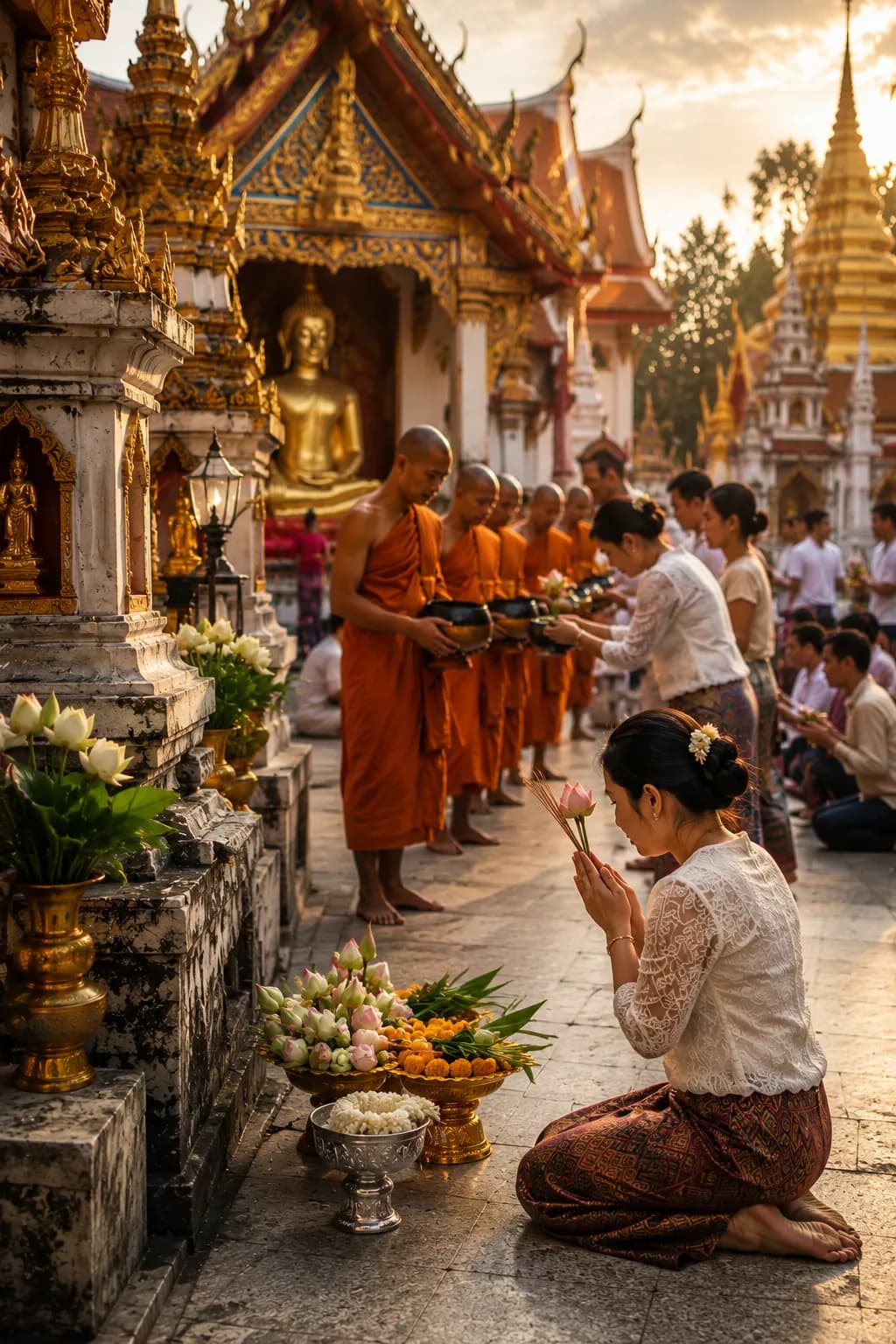
Thailand's temples are active religious places, not just tourist attractions, even when a temple is also one of the biggest sights in the city. Covering shoulders and knees is a safe general approach at important temples, shoes are normally removed before entering certain buildings, and it's worth watching what local people are doing rather than guessing. Don't climb onto sacred structures for photographs, and remember that the people praying beside you may be there for reasons far more important than an Instagram shot.
Buddhist monks occupy a distinct and respected position in society. You'll see them collecting alms in the morning, riding public transport, studying and using smartphones — monks are not museum exhibits, and normal courtesy applies. One specific convention matters for visitors: women should generally avoid directly touching monks or handing objects straight into their hands. If you're unsure in a temple or religious setting, simply observe what Thai people around you are doing.
Public Affection
Thailand can look sexually liberal to outsiders because of its nightlife, beach culture and tourism industry, but everyday social norms are more restrained — heavy public displays of affection can feel out of place outside those specific contexts. It's another good reminder that Thailand shouldn't be read entirely through the areas built around international tourism.
Shoes and Food
Shoes are frequently removed before entering homes, temples and some small businesses — look for a row of shoes by the entrance as your cue.
Thai eating culture deserves its own article, but one point matters enormously for understanding social life: meals are usually shared. Instead of everyone ordering a separate main dish, groups typically order several dishes for the table and take portions as they eat, alongside rice — which explains why a Thai group may seem to order an extraordinary amount of food. Variety is part of the point. Food is also woven deeply into social interaction: people ask whether you've eaten, bring snacks, share food at meetings, and many of the best social moments in Thailand happen around a table rather than at a formal event.
Time
Foreign visitors sometimes talk about "Thai time", usually after someone arrives later than expected. Be careful with the stereotype — Thailand has airlines, hospitals, factories, financial markets and multinational companies that would collapse fairly quickly if nobody cared what time it was. Attitudes toward punctuality do vary by setting, though: a business meeting and an informal dinner with friends aren't the same thing, and neither are Bangkok and a relaxed island. The useful lesson isn't "Thai people are late" — it's that expectations around time are partly social and contextual. Make important transport connections on time, give yourself margins, and don't build a cultural theory out of one taxi driver showing up ten minutes late.
Yes Doesn't Always Mean Yes
Indirect communication can cause some of the biggest misunderstandings between Thai people and foreigners. A direct "no" can feel unnecessarily confrontational, so people may soften it into "maybe", hesitation or a smile instead — and a polite "yes" may simply mean "I understand", not a guarantee. This isn't passivity or dishonesty; it's a communication style where maintaining harmony can matter as much as stating a position directly. Our etiquette guide goes deeper into reading these signals, alongside the Thai smile and hierarchy in practice.
Beyond the Foreigner Bubble
It's entirely possible to spend two weeks in Thailand without interacting very deeply with Thai society — staying in an international hotel, eating at tourist restaurants, visiting famous attractions and flying home. There's nothing wrong with that; it's a holiday. But it's worth recognising that the Thailand experienced by tourists is only one layer of the country. Pattaya Walking Street is Thailand. So is a village temple festival in Isaan. A rooftop bar in Bangkok is Thailand, and so is a grandmother selling grilled chicken beside a road in Khon Kaen. The more of those layers you notice, the more interesting the country becomes.
Every foreign visitor eventually gets something wrong — mispronouncing a word, forgetting to remove your shoes, misreading a smile, returning a wai awkwardly. Nobody reasonable expects a tourist to arrive with a doctorate in Thai etiquette. What matters far more is attitude: be respectful, watch what people around you are doing, learn a few polite words, stay calm when small things go wrong, and be willing to laugh at yourself. That combination takes you surprisingly far.
Many people visit Thailand once and think they understand it, then return and realise they understood almost nothing. That's part of the attraction. At first you notice the obvious things — temples, food, beaches, traffic, nightlife, smiles. Later you start noticing relationships: who speaks first, who pours the drinks, who pays, how people disagree, when somebody smiles and when they don't. Thai culture isn't a puzzle a foreign visitor eventually solves. It's simply a society shaped by its own history, religion and family structures. You don't need to become Thai to enjoy Thailand — but understanding a little of what's happening around you can transform the experience.