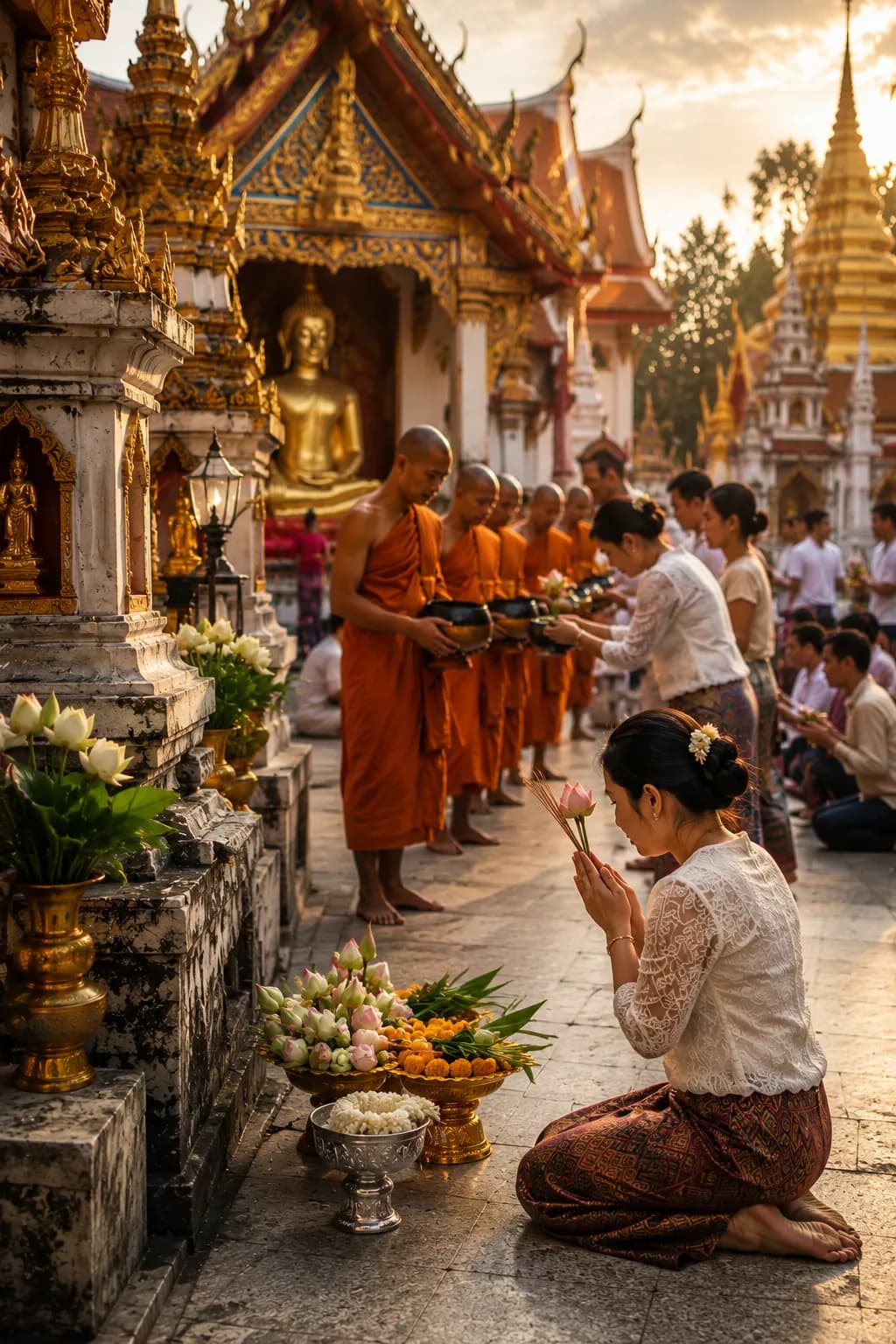
The phrase Thai Forest Tradition sounds timeless. A monk walks alone through jungle, meditates beneath a tree and lives far from society. That image contains some truth. It also hides a much more interesting history. The modern Thai Forest Tradition emerged strongly in the late nineteenth and early twentieth centuries, particularly in Northeast Thailand. Its monks emphasised meditation, disciplined observance of the Vinaya, simplicity and direct practice. Figures such as Ajahn Sao Kantasilo, Ajahn Mun Bhuridatta and later Ajahn Chah became enormously influential. Their tradition helped change Thai Buddhism. Over time, that local monastic movement also became international.
What “Forest” Means
Buddhist monks have used forests and remote places for practice since ancient times. The modern Thai Forest Tradition drew on that ideal. Monks sought environments away from the social comfort and institutional routine of established temples. A forest offered both solitude and deliberate discomfort. Heat, insects, illness, uncertainty and fear became part of practice rather than problems to be completely eliminated. The point was not to become a nature enthusiast. The environment stripped away distractions and forced attention back onto mind and body.
The tradition became especially associated with Isaan, Thailand’s Northeast. At the time the movement developed, large parts of the region were rural and forested. Infrastructure was limited, and monks could travel between villages and remote areas in ways almost impossible to imagine in modern Thailand. The Northeast was also undergoing political, social and religious change as the Thai state expanded administrative control. Forest practice developed inside that historical world. The movement also developed inside a changing political and social landscape.
Ajahn Sao Kantasilo
Ajahn Sao Kantasilo is remembered as an important early teacher in the modern forest lineage. He is often associated with disciplined meditation and simplicity. His most famous student was Ajahn Mun. Because Ajahn Mun later became such a towering figure, Ajahn Sao can disappear from simplified histories. That can obscure how religious movements actually develop: teachers have teachers, and lineages grow through relationships rather than one charismatic figure appearing from nowhere. Ajahn Mun Bhuridatta became the central figure in the consolidation of the modern Thai Forest Tradition.
He spent years practising and wandering through different regions. Stories about his life often emphasise intense discipline, meditation and remote forest environments. His reputation attracted students who later became respected teachers themselves, spreading the tradition through networks of monasteries. Ajahn Mun’s influence rests as much on the lineage that grew around him as on his own practice. It lies in the lineage that grew around him.
Tudong
Forest monks are often associated with tudong, a Thai term connected with ascetic wandering practices. A monk might travel on foot, carrying very little, staying in forests or simple shelters. The wandering life reduced possessions and dependence on familiar surroundings. It also created direct contact with uncertainty. Questions about food, shelter and fear at night became part of the training rather than inconveniences to be removed. Those questions become religious practice when the goal is to observe attachment and fear rather than immediately solve them with comfort.
Modern readers should be careful not to romanticise the setting. Tropical forests contain snakes, insects and disease; villages can be poor, and travel can be physically exhausting. A beautiful photograph of a monk under a tree does not communicate the hardship involved. Forest practice deliberately used difficult conditions. That makes the tradition more impressive, not less. The monks were not escaping civilisation for a wellness retreat. They were training under conditions designed to expose the mind.
Vinaya Discipline
The Forest Tradition places strong emphasis on monastic discipline. The Vinaya regulates the life of Buddhist monks. Forest teachers often treated careful observance not as bureaucratic rule-following but as part of meditation itself. Fewer possessions create fewer attachments. Clear boundaries simplify choices, dependence on alms reinforces the relationship with lay supporters, and discipline gives shape to the day. The rules therefore become a training environment. Freedom, from this perspective, is not produced by having no rules. It comes from understanding the mind that reacts to them.
Meditation is central to forest practice. Sitting and walking meditation can occupy substantial parts of the day. Teachers emphasise direct observation rather than merely collecting intellectual knowledge. Study still matters; the warning is against mistaking intellectual knowledge for transformation. The tradition often warns against confusing knowledge about Buddhism with the transformation Buddhism is intended to produce. You can read about impermanence for years. Watching your own mind refuse to accept change is a different education. The forest becomes a laboratory for that difference.
Dhammayuttika Connections
The early Forest Tradition had important historical connections with Dhammayuttika Nikaya, the reform fraternity associated with nineteenth-century Thai monastic reform. Ajahn Mun ordained within that institutional world. This connection helped shape the movement. Yet it would be misleading to say forest practice belongs only to Dhammayuttika. Important forest lineages also exist within Maha Nikaya. Ajahn Chah is the clearest example.
Meditation movements do not always respect the neat categories preferred by institutional summaries. Ajahn Chah became one of Thailand’s most internationally influential Buddhist teachers. He was a Maha Nikaya monk whose teaching style emphasised direct practice, simplicity and close observation of the mind. Ajahn Chah became known for using ordinary experiences as teaching tools. Monastic discipline, discomfort, food, boredom and relationships within the community all became material for practice. His approach attracted both Thai and foreign students. That changed the future of the tradition.
Foreign Disciples
From the mid-twentieth century onward, increasing numbers of Westerners came to Thailand seeking Buddhist teaching. Ajahn Chah accepted foreign students. One of the best-known developments was the establishment of Wat Pah Nanachat, an international forest monastery in Northeast Thailand where monastic training could be conducted in ways accessible to foreigners. The experiment proved influential because forest monasticism was no longer something Western practitioners could only read about. They could ordain inside the tradition.
Ajahn Chah’s disciples later established monasteries in Europe, North America, Australia and elsewhere. This created a remarkable reversal. A movement shaped by rural Northeast Thailand became one of the most visible forms of Theravada Buddhism in the English-speaking world. The forests and climate changed, while the monastic discipline and teaching lineage travelled with the community. A Buddhist monastery in England may therefore have an institutional and spiritual family tree leading back to an Isaan forest wat. Religious globalisation can take unexpected routes.
What Happened to the Forests?
Modern Thailand is not the country Ajahn Mun wandered through. Roads expanded, forests disappeared, villages became towns and mobile phones arrived. The conditions that produced early forest wandering changed dramatically. Modern forest monasteries cannot recreate the early twentieth century, even when they preserve its ideals. Some preserve large forested areas. Others operate as established institutions with buildings, electricity and international visitors. The tradition survives by adapting its environment while trying to preserve the purpose behind the practices.
A modern forest monastery can still be remarkably simple. Monks live in individual huts or kutis spread through wooded grounds. Walking meditation paths connect the spaces. The schedule may emphasise alms, communal meals, meditation and work. Silence can play an important role. Yet no two monasteries are identical. Some monasteries welcome lay visitors, others remain more secluded, and a few have large international communities. The label “forest monastery” describes an orientation, not an architectural standard.
Arahant Stories
Devotees sometimes describe revered forest teachers as arahants, fully awakened beings. Such claims belong to religious faith and lineage tradition. A historical article should treat them accordingly. It is possible to describe the extraordinary respect surrounding Ajahn Mun or other teachers without declaring their spiritual attainment as an objective fact. This distinction protects both religious sensitivity and factual accuracy. Their historical influence can be described without settling claims about spiritual attainment.
The Thai Forest Tradition reshaped modern Buddhism in several ways. It renewed emphasis on meditation and discipline. It created influential teacher lineages. It offered a model of monastic life that appealed to people dissatisfied with purely ceremonial religion. And through teachers such as Ajahn Chah, it became one of Thailand’s most successful religious exports. Its influence is now larger than the forests where it began.
The Forest as a Teacher
Forest monks often speak as if the environment itself teaches. Not because trees deliver sermons. Because the forest removes excuses. Fear appears, the body becomes uncomfortable, boredom sets in, plans fail and the illusion of control weakens. Those conditions reveal exactly the mental habits Buddhism asks practitioners to examine. The modern world can reproduce the robes, texts and meditation techniques of the Forest Tradition. Reproducing that confrontation with uncertainty is harder. That may be why the forest still holds such power in the Buddhist imagination.