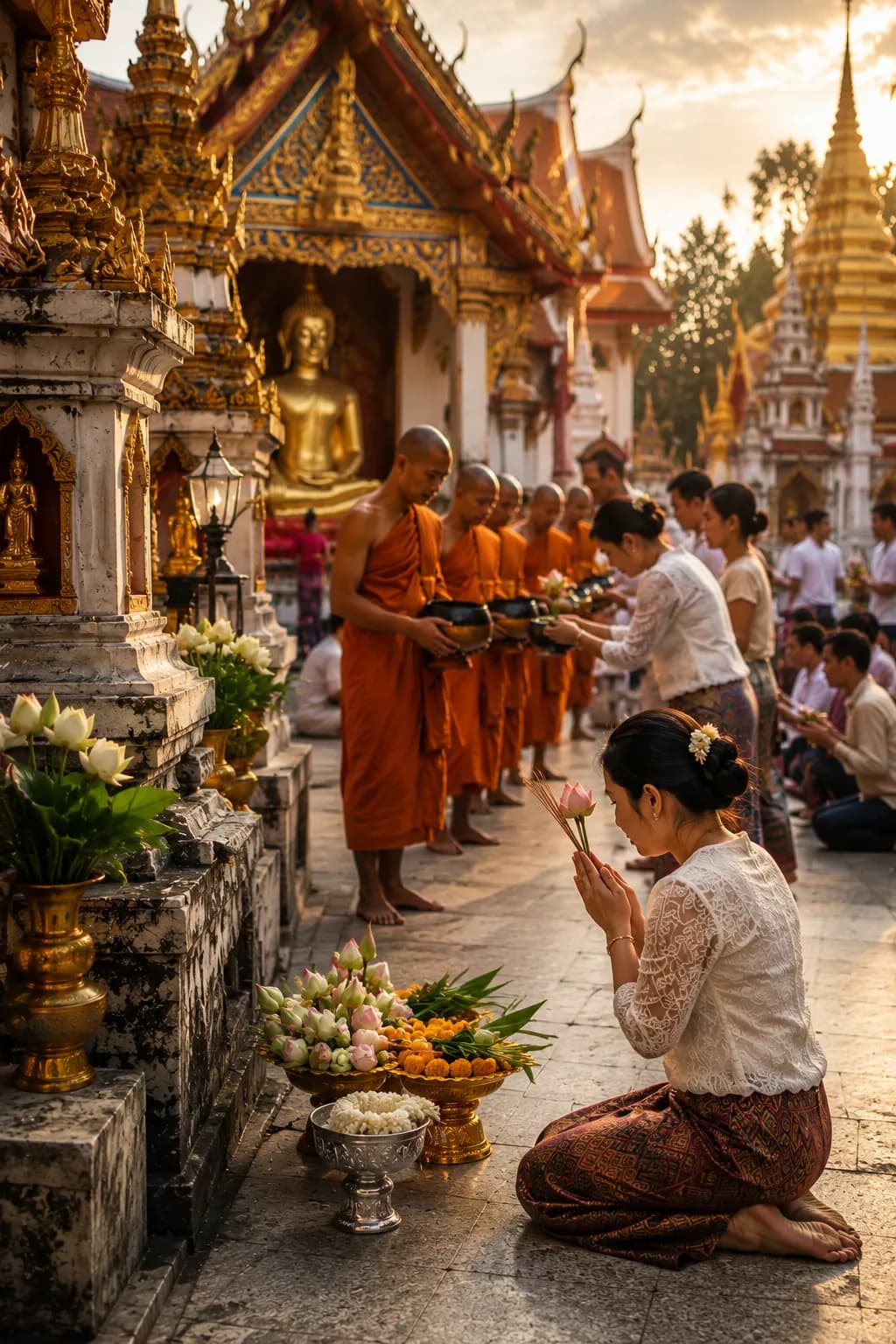
The image is familiar even to first-time visitors: saffron or ochre robes, shaved heads, an alms bowl held close to the body and a quiet walk through the early-morning streets. Thai Buddhist monks are highly visible. Understanding what they actually do is less straightforward. Monastic schedules vary considerably across Thailand. A monk in a forest monastery devoted to meditation may live very differently from a monk studying at a large Bangkok temple. A village wat can have different responsibilities again. What unites them is not one daily routine but participation in the Theravada monastic tradition and its disciplinary framework, the Vinaya. From there, daily life depends heavily on the monastery, teacher, lineage and individual monk.
Monastic Life Is Not One Job
Visitors sometimes ask what monks “do” as if monkhood were an occupation. It is better understood as a religious way of life. A monk takes on a discipline designed to reduce ordinary attachments and create conditions for Buddhist practice. That includes rules concerning possessions, food, money, relationships, behaviour and interaction with laypeople. Within that framework, monks may meditate, study, teach, chant, conduct ceremonies or help maintain temple life. Some become renowned scholars.
Others are known as meditation teachers. Some spend decades in quiet local monasteries without becoming publicly famous at all. The robe tells you that a man is ordained. It does not tell you his entire daily schedule. Many monasteries begin the day well before most tourists have found coffee. Morning chanting and meditation are common, although exact schedules vary. In some temples, monks then leave for an alms round.
The Thai word often used for this is binthabat. Monks walk through the surrounding community carrying alms bowls while laypeople offer food. The atmosphere can be remarkably quiet even in busy neighbourhoods. This is not designed as a performance for visitors. It is part of the traditional relationship between monastics and lay supporters.
The Alms Round
Theravada monks traditionally depend on laypeople for food rather than maintaining ordinary household economies. That dependence is deliberate. The monk practises simplicity and receives what is offered. The layperson has an opportunity to practise generosity and make merit. Calling the alms round “begging” therefore gives the wrong impression. A monk does not normally solicit customers or negotiate for food. The relationship is religious, not commercial.
In modern Thailand, practices vary. Some temples receive much of their food directly at the monastery. Others continue highly visible morning rounds. The principle behind both is the same: the monastic community is materially supported by the lay community. One monastic rule that often surprises visitors concerns food. Under Theravada discipline, fully ordained monks generally do not eat solid food after noon.
Breakfast and the main late-morning meal can therefore carry particular importance in the monastic day. The detailed Vinaya rules are more complicated than the simple sentence “monks cannot consume anything after midday.” Certain permitted items and medicines are treated differently. For a visitor, the useful point is that monastery meal times do not follow an ordinary three-meal household schedule. If you see monks eating before noon and then no evening meal appearing later, that is part of monastic discipline rather than an unusual Thai diet.
Study
Thailand has a long tradition of monastic education. Monks may study Buddhist doctrine, Pali, chanting, monastic law and other subjects. Large urban temples can function as important educational centres. Historically, temples also played a broader role in education before modern state schooling expanded. Today, some monks pursue formal Buddhist qualifications while others focus less on academic study. The balance depends on the temple and the monk. This is another reason the stereotype of monks spending the whole day meditating does not work.
Study can be as central to one monastery as meditation is to another. Meditation remains an important part of Thai monastic life, but the emphasis varies enormously. Some monasteries are strongly associated with meditation practice. Forest traditions in particular developed reputations for disciplined meditation, simplicity and ascetic practice. Other temples place more emphasis on study, ceremonies or serving the surrounding community. Individual monks also differ. One may spend long periods in intensive meditation. Another becomes a respected teacher or scholar. Monastic Buddhism has room for more than one kind of religious specialisation.
Chanting and Ceremonies
Monks are involved in many ceremonies that connect temples with the lay community. They chant at funerals. They participate in house blessings. They conduct religious observances during Buddhist holidays. They are central to ordination ceremonies and merit-making events. From a traveller’s perspective, this is one of the most visible roles of monks. A family may have little day-to-day involvement with a monastery and still invite monks into the most important moments of life.
Birthdays, funerals, new homes, ordinations and memorial events can all bring laypeople and monks together. Some monks teach formally through sermons or classes. Others provide less formal guidance to individual visitors. A respected monk may become an important moral or spiritual figure for a community. That role should not be translated too quickly into Western religious categories. A monk is not exactly a priest, pastor or minister.
Monks do not perform the same theological role as clergy in every other religion. Their authority derives from monastic discipline, teaching, seniority, reputation and religious practice in ways specific to Buddhism. The comparison can be useful as a starting point, but it breaks down quickly.
Temple Responsibilities
A working temple requires practical organisation. Buildings need maintenance. Ceremonies must be prepared. Lay visitors arrive with questions and offerings. Festivals can bring large crowds. Depending on the monastery, monks may be involved in different aspects of that activity, often alongside lay staff and volunteers. Senior monks can carry substantial administrative responsibilities. This practical side of temple life is easy to miss when a wat is visited only as a tourist attraction. Behind the architecture is an institution that has to function every day.
The discipline governing Buddhist monks is known as the Vinaya. For fully ordained Theravada monks, it contains a large body of rules covering many aspects of life. Some concern major ethical violations. Others govern everyday behaviour: robes, food, possessions, relationships and interactions with the lay community. Visitors do not need to memorise monastic law. What matters is understanding that the rules are not random Thai customs. They are part of a religious disciplinary system much older than modern Thailand. Local interpretation and practice can vary, but the Vinaya provides the framework.
Money and Monks
Money can be a confusing area for visitors because monastic discipline places restrictions on handling money. In modern Thailand, practical arrangements differ between monasteries and situations. Lay attendants, temple committees or institutional systems may handle financial matters. That complexity is another reason visitors should avoid making confident assumptions based on one encounter. If a temple has an established donation system, use it. Visitors are better off using the temple’s established donation arrangements than improvising a personal financial exchange with a monk.
Respecting the local arrangement is simpler than trying to become an expert in Vinaya during a ten-minute visit. Theravada monastic discipline also regulates physical contact between monks and women. In Thailand, women generally avoid touching monks directly. When an object needs to be passed, local practices allow it to be placed down or transferred without physical contact. The rule is about monastic discipline rather than a judgement about women. Visitors sometimes take it personally or interpret it as ordinary social rudeness. That is the wrong framework. A monk following discipline is maintaining a religious boundary that applies to his ordained life.
Urban Monks and Forest Monks
The contrast between urban and forest monasteries is useful, although reality is not divided perfectly in two. An urban monastery may have large educational programmes, frequent ceremonies and a constant flow of visitors. A forest monastery may emphasise meditation, simplicity and a quieter environment. But urban monks meditate, and forest monasteries still have administration, lay supporters and ceremonies. The categories describe tendencies rather than two separate religions. Thai monastic life contains many variations between them. Not every man in Thai robes intends to remain a monk for life.
Temporary ordination has long been an important part of Thai Buddhist culture. Some men ordain for a limited period before returning to lay life. Others remain monks for decades. This affects monastery life because the Sangha includes people at very different stages of commitment and experience. A newly ordained monk learning basic routines and a senior teacher with fifty years of monastic life may stand beside each other at the same ceremony. The robe creates a shared institution without erasing those differences.
A Monk Is Still a Person
Visitors sometimes turn monks into symbols rather than human beings. They are expected to be permanently serene, detached, wise and immune to irritation. Real monks are real people. Monastic discipline aims at training behaviour and mind precisely because human beings are not automatically perfect when they put on robes. Thailand also has public debates and scandals involving monks, just as other religious institutions have problems. Recognising human fallibility does not undermine Buddhism.
It prevents religious romanticism from replacing reality. Most travellers encounter only a small part of monastic life. You may see monks on an alms round, sitting at the front of a bus, chanting in a temple or walking through a shopping centre. You might encounter young novices at a provincial wat or an elderly monk receiving local visitors. Those glimpses can be meaningful if you remember they are pieces of a much larger life.
Behind them are discipline, relationships with lay supporters, study, ritual obligations, meditation and the practical demands of living in a religious community. Thai monks are one of the clearest visible signs that Buddhism remains part of everyday Thailand. But the orange robe is only the surface. Monastic life is a disciplined attempt to organise everyday existence around Buddhist practice. In one monastery that may look heavily meditative. In another it may involve education, ceremonies and community responsibilities. The details vary. The underlying commitment—to live within the monastic discipline and the Buddhist path—is what connects them.