An Institution You Cannot Miss
Thailand's monarchy is one of the most visible institutions in the country. Royal portraits appear in government offices, businesses and private homes. Ceremonies are broadcast nationally. Palaces and royal temples rank among the country's most important landmarks, and the names of past kings are attached to roads, bridges, universities and hospitals across Thailand. For visitors from countries where monarchy, if it exists at all, is largely ceremonial background, this can feel unfamiliar. In Thailand, the institution has played a far more central role in the story the country tells about itself — and understanding why means looking at history, religion and state-building together, rather than at any one of them alone.
Kingship Before Modern Thailand
The idea of kingship in this region long predates the modern Thai state. Early Southeast Asian rulers drew legitimacy from several overlapping sources at once: military power, control of land and trade, religious patronage, Brahmanic-Hindu court tradition, and Buddhist ideas about righteous rule. These influences mixed differently across different kingdoms, and there was never one single, unchanging model of "Thai monarchy" from the start — the institution evolved considerably over centuries.
One especially important ideal was the righteous Buddhist ruler, a king expected to support Buddhism, protect the realm and govern by moral principle — which didn't mean historical kings always behaved accordingly; succession struggles and war were as much a part of the story as piety. But Buddhist kingship gave rulers a moral language for legitimate authority, and supporting temples and monks became a core part of royal duty and public image. Older Khmer and Indian court traditions layered in additional ideas of sacred kingship, sometimes described through the concept of devaraja, linking royal authority to divine or cosmic order. Thai kingdoms didn't simply copy Khmer models, but Brahmanic ritual and Hindu imagery became deeply embedded in royal culture regardless — a mixture still visible in ceremony today, in a country that is overwhelmingly Buddhist but whose royal rituals carry unmistakably Brahmanic roots.
Thai national history often presents the Sukhothai kingdom, and King Ramkhamhaeng in particular, as an early model of Thai kingship — associated with political expansion, Theravada Buddhism and the development of Thai writing, with the famous Ramkhamhaeng inscription presenting an image of a ruler close to his people. Historians continue to debate details of early Sukhothai history, but for understanding national identity, what matters most is how the kingdom became a powerful founding symbol regardless. Ayutthaya, which followed, developed a far more elaborate royal court, with kings at the centre of a complex hierarchy reinforced by court language and ceremony, growing into a major regional power and trading centre that shaped Siamese political culture for more than four centuries.
From Ayutthaya's Fall to the Chakri Dynasty
When Burmese forces destroyed Ayutthaya in 1767, the royal capital collapsed — but the idea of Siamese kingship survived it. Taksin reunified much of the former kingdom and established a new capital at Thonburi; after his reign ended, the Chakri dynasty was founded in 1782, and the capital moved across the Chao Phraya River to Bangkok, creating the royal order that became the foundation of the Bangkok era. Rather than a clean break with the past, this was in many ways a restoration project: the early Rattanakosin period saw temples rebuilt, texts and artworks recreated, and the Grand Palace — home to Wat Phra Kaew, the Temple of the Emerald Buddha — established from 1782 onward as both official royal residence and centre of state ceremony. Placing palace and temple physically beside each other at the heart of the new capital was itself a statement: royal authority and Buddhist legitimacy, standing together. The Emerald Buddha image itself, despite its English name, is carved from green stone rather than emerald, and has a long, complicated history moving between several kingdoms and cities before reaching Bangkok; the monarch traditionally presides over the ceremonial changing of its seasonal robes, one small ritual that captures how closely monarchy, Buddhism and national tradition intertwine.
Surviving the Colonial Era
The 19th century transformed the monarchy again, as European colonial powers expanded across Southeast Asia — Britain into Burma and Malaya, France through Indochina — putting Siam under real pressure and making royal leadership central to the kingdom's strategy for survival. King Mongkut (Rama IV), who had spent many years as a Buddhist monk before taking the throne, is associated with growing diplomatic engagement and adjustment to a new international order that could no longer be treated as a distant problem. His successor, King Chulalongkorn (Rama V), oversaw some of the most significant reforms in Thai history: reorganised government administration, the gradual abolition of old systems of labour obligation and slavery, expanded education and infrastructure, and new railways, all of which strengthened Siam considerably at a moment when colonial powers were carving up much of the surrounding region.
Thailand is often celebrated as the only Southeast Asian country never formally colonised by a European power — a genuine and lasting source of national pride, though independence came at a real cost. Siam made territorial concessions to Britain and France, and areas once linked to Bangkok politically or through tribute became parts of modern Laos, Cambodia and Malaysia. Royal diplomacy and reform helped preserve the core of the kingdom, and national memory has strongly connected that survival with the monarchy ever since. Building the modern Thai state was a genuine, deliberate project during this period — expanding ministries, reorganising provincial administration, defining borders more clearly, teaching a national language and identity in schools — and the monarchy played a major role throughout, which is one reason royal and national history remain so difficult to separate even today.
1932 and the Constitutional Era
For centuries, Siam was governed under forms of monarchy in which the king held enormous direct political authority. That changed in 1932, when the People's Party carried out a revolution ending absolute monarchy and establishing Siam as a constitutional monarchy — one of the largest political shifts in Thai history. The monarchy itself remained, but formal political power moved into a new framework of constitutions, governments and representative institutions.
It would be easy, but wrong, to read that as the whole story: absolute monarchy ended in 1932, the king became purely ceremonial, and Thai politics simply moved on from there. The reality was considerably more complicated. The institution's public role and importance shifted repeatedly over the following decades, shaped by different governments, military leaders and social movements, and by the second half of the 20th century, monarchy had again become highly visible in Thai public life.
The Long Reign of King Bhumibol
King Bhumibol Adulyadej (Rama IX) reigned from 1946 to 2016 — seven decades that overlapped with post-war reconstruction, the Cold War, military governments, rapid economic development, urbanisation, mass tourism and globalisation. For generations of Thais, he was the only king they had ever known. Royal development projects addressing water management, agriculture and rural development became a major part of his public image, with heavily documented visits to provincial and rural areas building an idea of a monarch personally engaged with the wellbeing of ordinary people — an image that carried, and for many still carries, deep emotional significance. He's also associated with the "Sufficiency Economy" philosophy, emphasising moderation and resilience over unlimited growth, which became genuinely influential in Thai public policy and education even as scholars and critics have debated how it should be applied in practice.
Royal connections appear across everyday Thai geography as a result — dams, hospitals, schools, roads and public parks either initiated through royal foundations or named in honour of the royal family — so travellers encounter royal symbolism far beyond any palace. That symbolism sits inside a genuinely complicated modern political landscape: Thailand has experienced numerous military coups since 1932, and the relationship between monarchy, the military and elected governments is historically important, politically sensitive, and resistant to any simple slogan.
Nation, Religion, King
One of the most useful phrases for understanding modern Thai identity is the triad Nation, Religion, King — three pillars long used in state and civic narratives, with the nation representing collective belonging, religion referring historically and primarily to Buddhism (even as the state formally recognises religious diversity), and the monarchy representing continuity and unity. These ideas became deeply embedded in education, public symbols and ceremony. Thailand's flag — red, white and blue horizontal bands, adopted under Rama VI in 1917 — is commonly explained through this same framework, with red linked to nation and people, white to religion, and blue to monarchy, though as with most national symbols the explanations have shifted somewhat over time.
Visitors will also notice specific colours tied to royal occasions, since Thai tradition links days of the week with particular colours, and a monarch's birthday becomes associated with the colour of the day they were born — yellow, for instance, became strongly linked to King Bhumibol because he was born on a Monday. These displays can carry political weight or simply express respect and celebration, depending on context. Royal portraits themselves, appearing in government offices, shops, hotels and private homes, are part of a public culture where monarchy has long been tied to loyalty and national identity, worth treating as more than ordinary decoration. Thai even carries a distinct royal register, rachasap, used specifically when referring to the monarchy — vocabulary most foreign visitors will never need, but whose existence shows how deeply hierarchy runs through the language itself.
Some of Thailand's most elaborate state ceremonies — coronations, royal cremations, the historic Royal Barge Procession along the Chao Phraya — combine Buddhist, Brahmanic and state tradition into events that are visually extraordinary, blending golden architecture and centuries-old ritual with modern television broadcast. The 2017 cremation of King Bhumibol, held at a purpose-built ceremonial complex near the Grand Palace, drew millions of Thais into mourning activities nationwide; travellers in Thailand during that period saw first-hand the scale of the emotional connection many citizens felt toward the late king.
Different Thais, Different Views
This point matters enormously: there is no single Thai opinion about the monarchy. Across a population of more than seventy million people, generations, political views and personal experiences differ considerably. Some feel profound personal devotion. Others engage with the institution mainly through tradition and civic identity. Others hold critical views or actively favour political reform. A responsible account neither pretends every Thai person feels the same way nor dismisses the genuine attachment many people hold toward the institution — both realities exist at once, and younger Thais in particular, with far greater access to online discussion than earlier generations had through television or school curricula alone, have brought debates once confined to narrower circles into much wider public view. It's worth resisting the temptation to assume "all young Thais think this" or "all older Thais think that" — generations are diverse too.
A Genuinely Sensitive Subject
Discussion of the monarchy can be highly sensitive in Thailand, for reasons that are cultural, political and legal all at once. Thailand has laws protecting the monarchy from certain forms of insult, defamation or threat, and the legal environment around royal discussion is considerably stricter than many visitors from Western countries are used to. For travellers, the practical guidance is straightforward: treat the subject respectfully, don't assume political humour that's normal at home is automatically safe here, don't push strangers into sensitive political conversations for entertainment, and don't treat legal boundaries as something to test.
None of this requires adopting a particular political opinion. Showing respect isn't the same as agreeing with everything the institution represents, and you don't need to become a monarchist, or a scholar of Thai constitutional law, to travel here comfortably — you simply need to recognise that you're visiting a society where this institution carries genuine historical, emotional and legal weight, which is ordinary travel intelligence rather than a political statement.
A few everyday etiquette points follow directly from this. Thai banknotes and coins carry royal imagery, so standing on a note or coin to stop it blowing away — a natural instinct anywhere else — can read as disrespectful, since the foot is traditionally considered the lowest part of the body; use your hand instead. Older travel guides sometimes describe audiences standing for a royal anthem before films in Thai cinemas; public practices around royal symbolism have shifted over time and vary by venue, so the safer approach is simply to watch what people around you are doing and follow their lead rather than relying on an outdated blog post.
Monarchy, Buddhism and Religious Diversity
The Thai monarch has historically been closely tied to Buddhism, sponsoring temples and participating in major religious ceremonies, though the role isn't that of a Buddhist pope — Thailand has its own monastic institutions and religious hierarchy, and royal patronage has functioned alongside them rather than above them. Thailand isn't entirely Buddhist either: the country includes substantial Muslim, Christian, Hindu, Sikh and Chinese-religious communities, and modern kingship has also been presented as connected to protection of religion more broadly — a framing that matters particularly in regions like the deep south, where Buddhism isn't the dominant faith.
Kings Remembered
A handful of historical kings occupy a particularly strong place in national memory. King Naresuan of Ayutthaya is remembered as a great warrior king, celebrated for restoring the kingdom's independence from Burmese domination in the late 16th century, with statues commemorating him across the country. King Taksin, who reunified much of the former kingdom after Ayutthaya's destruction and established Thonburi as capital, occupies a similarly outsized place given how short his reign actually was — without his recovery effort, there may have been no straightforward path from Ayutthaya to Bangkok-era Siam, and shrines to him remain important in several parts of the country. King Chulalongkorn (Rama V) remains especially respected more than a century after his reign, his portrait still found in homes and businesses, his association with modernisation and the abolition of slavery giving him a lasting place in national memory, marked annually on Chulalongkorn Day.
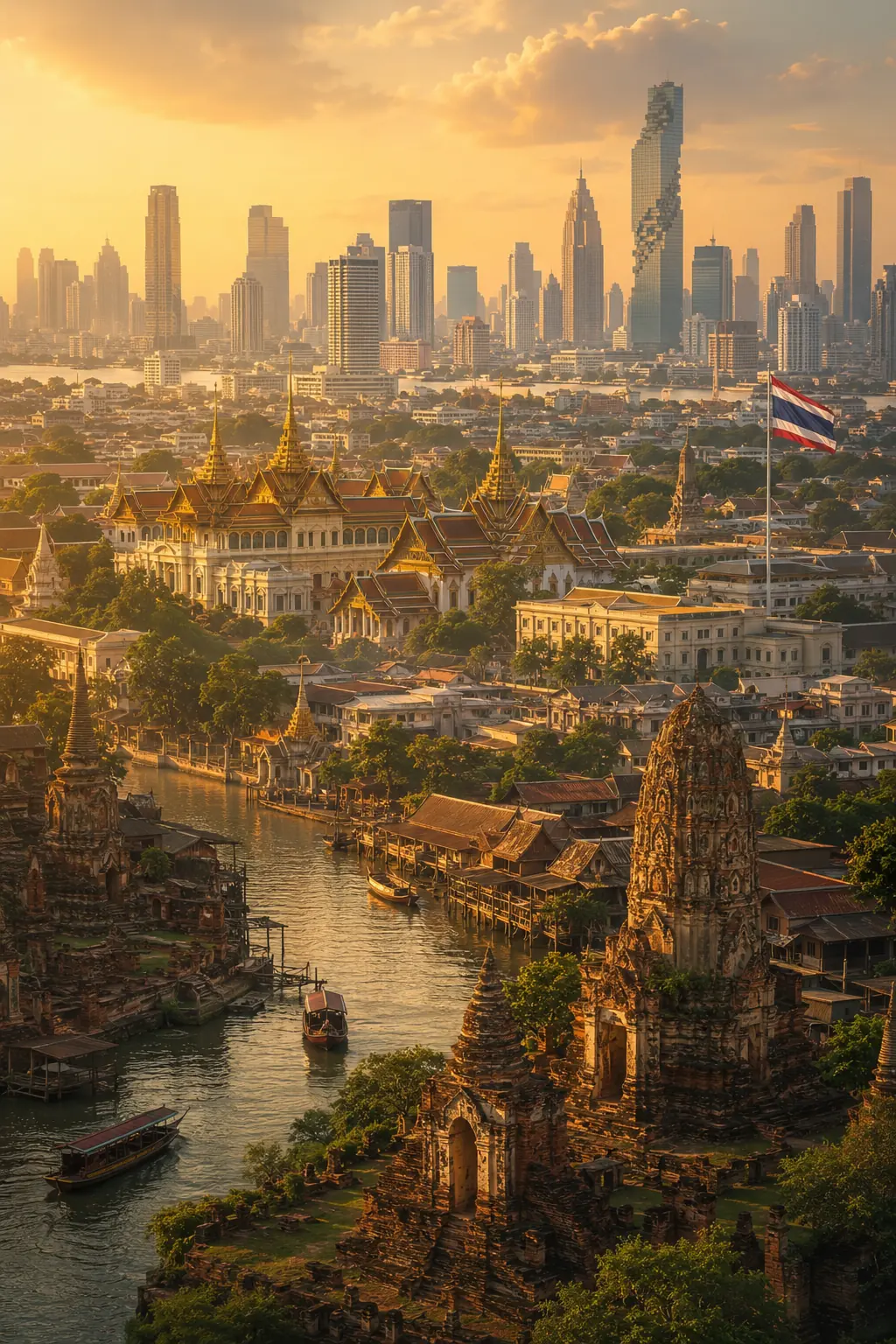
Bangkok itself functions as a kind of physical map of this history. Several of the city's most important temples — Wat Phra Kaew, Wat Pho, Wat Arun, Wat Benchamabophit among them — exist because of royal patronage, and the old Rattanakosin district, with its palace, temples, ceremonial avenues and river frontage, is essentially a record of how Siamese power reorganised itself after the losses at Ayutthaya and Thonburi. Understanding the monarchy changes how that architecture reads.
Thailand's Political System Today
Thailand today is constitutionally organised as a democratic system with the King as Head of State, though the precise operation of Thai politics has changed repeatedly through new constitutions, elections, court decisions and military interventions since 1932 — reflecting cycles of political upheaval that the monarchy has endured across, which is part of why the institution has often been presented as a symbol of stability inside a political system that keeps changing around it. For a traveller, the useful distinction is simpler than the full political history: the monarchy remains a constitutional institution and national symbol, while day-to-day government runs through parliament, cabinet, courts and the broader state bureaucracy — even if Thai political reality has often proven more complicated than any constitutional diagram suggests.
Seeing It as a Traveller
Tourists interact with royal history constantly, often without fully realising it — the Grand Palace, royal temples, historic districts, museums, bridges, parks and national holidays all carry it. Understanding the institution simply gives these places more context: the palace stops being a collection of glittering buildings and becomes part of a much longer story about power, religion and state-building. Dress codes at royal and major religious sites tend to be stricter than at ordinary attractions, so it's worth following posted requirements, speaking respectfully, avoiding restricted structures, and complying immediately with any security instructions — these are functioning symbolic spaces, not simply scenic backdrops for a photo.
The most useful approach for a foreign visitor is curiosity without provocation: read more than one perspective, understand why many Thais feel deep respect for the monarchy, and understand that political criticism and reform debates exist too, without reducing the country to either extreme. National identity in Thailand is bigger than any one institution — language, Buddhism, regional cultures, food, family and popular culture all contribute just as much — but try telling the history of Bangkok without kings, or explaining Thailand's survival through the colonial era without royal diplomacy, or making sense of the country's major temples and ceremonies without the monarchy, and the gaps become obvious fast. Perhaps the institution's strongest symbolic power comes simply from continuity: Ayutthaya fell, the capital moved twice, absolute monarchy ended, governments changed, coups occurred, Bangkok became a megacity — and royal institutions remained part of the national landscape through all of it, a kind of historical weight that's genuinely difficult for a short-term visitor to fully appreciate, but worth trying to. Understanding it doesn't require picking a side in Thai politics. It simply helps explain the country actually standing in front of you.