Beyond the Photograph
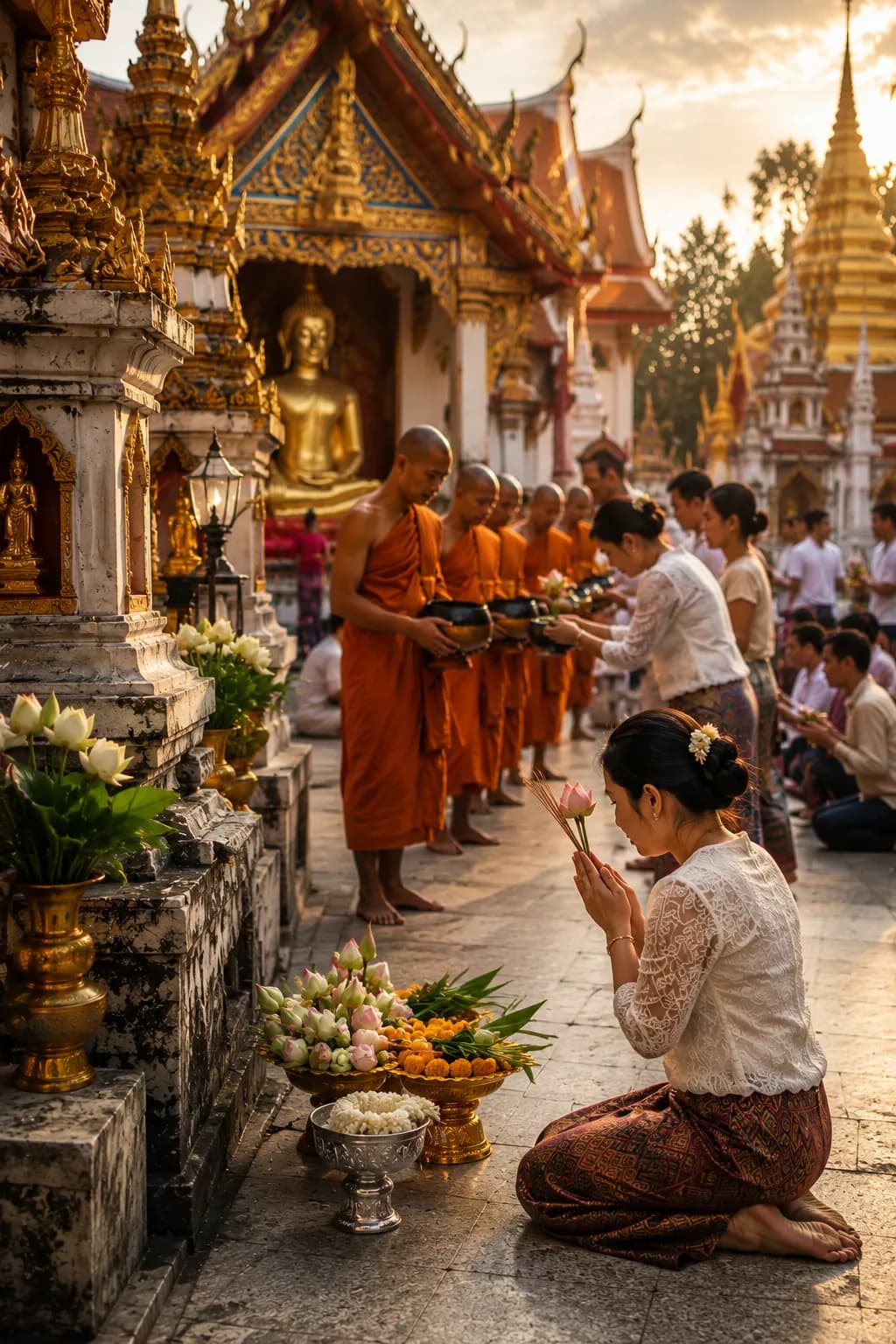
For many visitors, Thai Buddhism begins with a photograph: a golden Buddha, an orange-robed monk, curling incense smoke, a temple roof cutting against a blue sky. Those images are entirely real, and worth seeing. But Buddhism in Thailand isn't only something to look at from the outside. It's woven directly into ordinary life — people visit temples before work, families make merit around birthdays, monks walk quiet neighbourhood routes each morning collecting food, funerals take place at temples, young men ordain temporarily, communities donate robes together, businesses invite monks to bless new premises. The temple, in other words, is not simply a tourist attraction. It's part religious institution, part community centre, part school of tradition, part social memory — and understanding Thailand well means understanding a little of what happens there once the tourists have moved on to the next stop.
Theravada Buddhism
Thailand's dominant Buddhist tradition is Theravada Buddhism, also widespread across Sri Lanka, Myanmar, Laos and Cambodia. Theravada places strong emphasis on the teachings preserved in the Pali Canon, monastic discipline, ethical conduct, meditation and the pursuit of liberation from suffering — and Thai Buddhism has developed its own distinctive institutions and cultural forms over many centuries, existing alongside Brahmanic, animist and Chinese religious traditions rather than in isolation from them. (Our guide to Thai superstitions, lucky numbers and amulets explores that wider layer of everyday belief in more depth.) Practice traditionally centres on the Three Jewels — the Buddha, the awakened teacher; the Dhamma, his teaching; and the Sangha, referring both to the ordained monastic community and, more broadly, the wider Buddhist community itself. Respect for these three foundations runs through nearly every corner of Thai religious life.
Inside a Wat
The Thai word for a Buddhist temple complex is "wat," and a wat is usually far more than a single building. Depending on its size and importance, it may contain an ordination hall, one or more assembly halls, chedis, Buddha images, monks' living quarters, a crematorium, school buildings, a library, gardens and general community space — visitors often refer to the whole complex simply as "the temple," which flattens a considerably more layered structure underneath.
The ubosot, the ordination hall, ranks among the most sacred buildings on any temple site, since formal monastic ceremonies including ordination itself take place there, with boundary stones called bai sema traditionally marking the consecrated ground around it. A viharn, or wihan, functions as an assembly hall, commonly holding the temple's principal Buddha image and used for worship and religious gatherings — in some temples visitors actually spend more time inside the viharn than the ubosot, since arrangements vary considerably from one temple to the next. A chedi is a monument typically associated with sacred relics, commemorative remains or broader religious symbolism, varying dramatically in shape from bell-shaped forms to tall spires depending on Sri Lankan, Khmer, Mon, Lanna or other architectural influences on a given temple. A prang is a different tower form again, its origins strongly connected to Khmer architectural tradition, with Wat Arun's enormous central prang standing as perhaps the single best-known example anywhere in the country. (Our guide to the rise and fall of Ayutthaya and our guide to the history of Bangkok both explore this architectural inheritance in more depth.) Monks themselves live within the temple grounds in residences called kuti, ranging from simple individual rooms to considerably larger structures — and it's worth remembering that a wat is genuinely someone's home, not every building inside it is open to visitors, whatever a guidebook might imply.
This is perhaps the single most important thing to understand about any Thai temple: it's alive. Wat Pho is unquestionably a major tourist attraction, and it's simultaneously an active religious site. A small village wat, by contrast, may see no international visitors at all and still function as the absolute centre of local life — monks live there, families visit, funerals happen, children learn, festivals get organised, people make merit continuously. The temple was never built or maintained as a preserved historical stage set for visitors to walk through.
Who Are Thai Monks, Really?
Thai Buddhist monks are members of the monastic Sangha, following a disciplined religious life built around Buddhist monastic rules, though their daily routines vary meaningfully by monastery — meditation, chanting, study, teaching, receiving alms, temple duties, community ceremonies and religious education can all form part of a given monk's day, with some temples focused heavily on meditation, others deeply embedded in community life, and still others functioning as genuinely major scholarly institutions. There is, in short, no single monk lifestyle to generalise from.
A few common visitor assumptions are worth correcting directly. Robe colour varies considerably — saffron, ochre, brown, orange and darker shades all appear depending on monastery and tradition, and the robe identifies the monastic role far more than any precise shade does. Shaving the head is part of Buddhist monastic renunciation, reducing emphasis on personal appearance and symbolising a deliberate departure from ordinary worldly life, alongside simple robes and traditionally limited personal belongings; the underlying ideal throughout is simplicity, even as modern monasteries obviously exist within a thoroughly modern society around them. Monastic discipline, known as the Vinaya, governs a large body of rules covering behaviour, possessions, food, interaction and community life — visitors don't need to learn the code itself, but knowing that monks operate under considerably stricter rules than ordinary lay Buddhists helps explain a great deal of what you'll observe. Traditional discipline also restricts how monks handle money directly, and modern practical arrangements around donations and temple finances vary by temple; visitors should generally use official donation boxes or follow a given temple's normal system rather than pressing cash directly into a monk's hand without understanding the local setting.
One particular etiquette point matters more than most: Theravada monks traditionally avoid direct physical contact with women, so a woman should not touch a monk casually, and when giving something to a monk directly, the item is typically placed down, passed through an appropriate intermediary, or handled according to the specific local arrangement rather than handed over directly. This isn't a judgment about women in any sense; it's connected purely to monastic discipline. On public transport, some seating in Bangkok is specifically intended for monks and other priority passengers, and giving monks appropriate space in waiting areas and religious settings generally is a simple courtesy. And no, you don't need to wai every monk you happen to see — foreign visitors sometimes overdo this after first learning about the gesture. A small, respectful wai fits direct interaction; there's no need to stop and perform an elaborate greeting every time an orange robe enters your field of vision. Follow the social context rather than turning etiquette into a performance.
It's worth stating something that sounds obvious but is genuinely easy to forget: monks are people. Young, old, serious, funny, quiet, academic, rural, urban, interested in technology, deeply focused on meditation — human personalities don't disappear at ordination. The robe represents a religious role rather than a personality template, and treating every monk as an identical, silent archetype misses the actual diversity of who's wearing it.
The Morning Exchange
One of the most visible Buddhist practices anywhere in Thailand is the morning alms round, known in Thai as tak bat. Monks leave the monastery carrying alms bowls, and laypeople offer food — an exchange that can happen early in the morning across villages, towns and city neighbourhoods alike. It's worth being precise about what this actually represents: the alms round isn't begging in any ordinary sense. Within the Buddhist system, laypeople provide material support to monks, monks preserve, practise and teach the Dhamma in return, and the exchange connects the monastic and lay communities directly — the donor, in turn, receives a genuine opportunity to practise generosity and make merit of their own.
People may offer rice, prepared dishes, fruit, packaged food, drinks or other appropriate items, and the exact practice varies by place — in some communities monks walk past individual homes, elsewhere people gather at a known location, and tourist areas sometimes organise more formalised alms experiences specifically for visitors. The genuine practice, though, exists entirely independently of tourism and continues whether or not anyone is watching. If you encounter a morning alms round as a visitor, don't block it for photographs, keep noise down, avoid intrusive close-up photography, and if you want to actually participate, it's far better to learn the local practice from a temple, your accommodation, or a knowledgeable Thai person than to simply improvise. The ritual belongs to the community first, and to any visitor's curiosity second.
What Merit Actually Means
The Thai phrase "tham boon" means making merit, one of the most fundamental concepts running through Thai Buddhist life. The Thailand Foundation describes merit-making as encompassing generosity, observing moral precepts and mental development together — which matters, because merit is considerably broader than simply giving money to a temple, and connects instead to cultivating genuinely wholesome action more generally.
Giving, or dana, is the most visible form: food for monks, donations to temples, support for community activities, general charity and everyday help to others. Its spiritual value connects not merely to the object given but to the intention behind giving it. Moral conduct, sila, connects merit to ethical behaviour more broadly, commonly referenced through the Five Precepts — avoiding killing, stealing, sexual misconduct, false speech and intoxicants that lead to heedlessness — with people observing these ideals to widely differing degrees, exactly as in any religious tradition where teaching and daily behaviour don't always align perfectly. Mental development, bhavana, covers meditation and the deliberate cultivation of mind through mindfulness, concentration and reflection; Thailand has monasteries specialising specifically in meditation retreats, some welcoming foreign practitioners and others serving mainly Thai communities.
It's worth resisting one particular misreading that visitors sometimes fall into: treating merit as a kind of religious points system, give 100 baht, receive 100 units of karma in return. That isn't a useful way to understand the underlying teaching. Intention matters, ethical behaviour matters, mental cultivation matters — merit-making is better understood as cultivating wholesome qualities over time than as purchasing supernatural credit in a transaction.
Monks traditionally depend on lay support because they don't normally engage in ordinary employment, so laypeople providing food and daily necessities is both a practical and a religious act at once — a given monastery survives specifically because the surrounding community actively supports it. Sanghadana refers to offerings made for the Sangha broadly rather than as a personal gift to one chosen monk, and pre-packed offering sets, commonly sold near temples and in shops, often contain practical items like toiletries, medicine or everyday necessities; not every commercial offering basket is equally useful, since temples can end up receiving enormous quantities of identical products, and if you genuinely want to support a monastery, asking what's actually needed can matter more than buying the largest, shiniest bucket available. Temples commonly accept money donations too, supporting everything from electricity and repairs to education, funerals, construction and general community activities — larger temples can have genuinely complex finances, and smaller village temples may depend heavily on local giving; as with institutions anywhere, transparency and administration vary from place to place. Supporting the construction or restoration of a temple has traditionally been considered a particularly significant meritorious act, and donor names frequently appear on plaques or commemorative structures as a result — meaning the built landscape of Thai Buddhism, quite literally, reflects generations of accumulated community giving.
Not Always Quiet
Temples aren't always solemn. A temple fair can include food, music, games, rides, markets, performances and religious ceremony all at once, alongside the families who come specifically for that combination — a mix that genuinely surprises visitors who expect religion and entertainment to occupy strictly separate worlds. In Thailand, the temple often sits comfortably at the centre of community celebration rather than apart from it. (Our guide to Thai festivals explores temple fairs and the wider festival calendar in more depth.)
Funerals sit at the more solemn end of this same institution. Many wat contain their own crematoria, and families gather there for chanting and ceremony that can continue across several evenings before the actual cremation — food is served, relatives travel home from elsewhere, monks chant, friends and colleagues attend, and the temple becomes the place where a community collectively responds to death together. Merit can be dedicated specifically to deceased relatives too, with families donating, offering food to monks or performing religious acts with the explicit intention of sharing merit with someone who has died — connecting remembrance directly to Buddhist practice, so that the dead remain part of family life through ongoing ritual memory rather than fading from it. Birthdays involve merit-making of their own, sometimes including morning alms-giving, a temple visit, a donation or an invitation for monks to give a blessing — a modern birthday cake and an ancient religious practice sit together on the same day without any tension between them. Songkran, Thailand's most famous festival, carries a similar dual identity: temple visits and offerings alongside water ceremonies honouring both Buddha images and elders, with the giant nationwide water fight familiar to tourists sitting directly on top of these older religious and family traditions rather than replacing them. (Our guide to Thai festivals covers Songkran's full dual identity.)
Becoming a Monk, Even Briefly
Ordination ranks among the most significant Buddhist events a Thai family can experience together. A son entering monkhood becomes a genuine source of pride and religious meaning for many families, and while some men remain monks for life, temporary ordination has long been an established and widely respected Thai tradition of its own. Foreign visitors are often genuinely surprised that monkhood doesn't always mean a lifelong commitment — a Thai man may ordain for several days, several weeks, several months or considerably longer, depending entirely on personal circumstances and family tradition, and temporary ordination can be connected to family obligation, merit-making, personal reflection or straightforward religious commitment, in any combination.
Traditional belief often associates a son's ordination with significant merit specifically for his parents, particularly his mother, which is one reason families can place such real importance on the event — an ordination becomes both deeply religious and genuinely, warmly celebratory at once. Before full ordination, a male candidate is commonly called a nak, and ordination ceremonies can involve processions, family gatherings, music and ritual, sometimes genuinely lively and colourful depending on the community — solemn religion and open celebration aren't necessarily opposites here. Boys and young men may also enter monastic life more briefly as novices, following a smaller set of precepts than a fully ordained monk, with temporary novice programmes sometimes running during school holidays specifically to provide religious education and discipline for a limited period. Reasons for ordaining vary as widely as reasons for anything else people do: religious conviction, family tradition, merit-making, honouring parents, personal reflection, a deliberate period of discipline, or a response to some major life event. It's worth not assuming every man in robes carries the same story.
Temples as Schools and Living Memory
Monasteries historically functioned as important centres of education — before modern public schooling expanded, temples often provided literacy and general learning, with monks preserving texts and teaching boys directly, an educational role that helped make the wat genuinely central to community life well beyond religion alone. That tradition continues in a different, more formal shape today: Thailand has modern Buddhist universities and structured monastic education systems, where monks study Buddhist doctrine, Pali, Thai and various other academic subjects, and some monasteries function as genuinely major intellectual centres — the popular image of a monk as someone who only meditates in silence is, at best, a very incomplete one.
Pali, the canonical language of Theravada Buddhism, is studied and chanted by Thai monks, and many Thai religious terms derive from Pali or Sanskrit; a layperson may hear a chant without fully understanding every individual word, and the sound itself still carries genuine ritual familiarity regardless. Chanting sits at the centre of morning and evening prayers, funerals, blessings, holy days, ordinations and home ceremonies alike, its rhythm capable of feeling almost hypnotic to a visitor, while for participants the chants belong to a religious tradition learned and repeated across many generations. "Wai phra" refers broadly to paying respect to a Buddha image or sacred object, typically through kneeling, pressed palms and a bow, and at temples you'll frequently see worshippers perform three deliberate bows expressing reverence toward the Buddha, the Dhamma and the Sangha in turn — a specific devotional practice, not simply Thai social etiquette transplanted into a religious setting.
Temples also function as one of Thailand's most important repositories of physical history — art, architecture, inscriptions, murals, Buddha images, local records and funerary monuments all accumulate there over time, often forming the longest continuously surviving physical record a community has, since wooden homes disappear, businesses close and roads change while the wat, more often than not, remains. Temple murals in particular can preserve genuine historical detail worth looking beyond the central religious scenes for — artists frequently included ordinary people, foreigners, markets, animals and everyday humour alongside the formal religious narrative, turning a mural into something close to a historical document of daily life at the time it was painted. Jataka tales, describing the Buddha's previous lives, teach moral qualities through storytelling, and the Vessantara Jataka — centred on extraordinary generosity, and known in Thai as the Mahachat, the Great Birth — remains one of the most culturally important, with its ceremonial recitation, Thet Mahachat, forming an important merit-making tradition in many Thai communities, particularly in regional festival contexts. Buddhist teaching, in other words, has always reached people through storytelling as much as through formal doctrine.
The Two Biggest Mistakes a Visitor Can Make
The first mistake is treating a temple purely as architecture — admiring a beautiful roof, an impressive Buddha image, photogenic murals, while missing where the actual meaning comes from: someone prays here, someone ordained here, someone's parent was cremated here, someone donated the roof itself, someone learned to read within these walls. The building carries real lives, not just aesthetic value.
The second mistake is assuming every Thai person is deeply religious in an identical way. Thailand is thoroughly modern and genuinely diverse, and levels of belief vary enormously from person to person — some visit temples regularly, some participate mainly around family events, some meditate seriously, some believe strongly in spirits while holding looser views on formal doctrine, and some are fully secular. Culture remains genuinely influential even as individual belief shifts considerably from person to person; a person may participate in Buddhist tradition — funerals, ordinations, Songkran merit-making, temple fairs, blessings — largely because these are Thai family traditions as much as because of formal theology, which makes it difficult, and often not especially useful, to try separating religion and culture cleanly here at all.
A Simple Guide for Visiting
You don't need twenty separate rules to visit a Thai temple respectfully. Dress modestly, remove your shoes where required, keep your feet away from sacred images, don't touch monks casually, remember that women should specifically avoid direct physical contact with monks, follow whatever photography rules are posted, don't climb on sacred structures, keep your voice reasonable, observe before participating in anything unfamiliar, and treat Buddha images as genuinely sacred rather than as photogenic props. That short list will carry you comfortably through the great majority of temple visits.
The Exchange at Dawn
If a single image explains Thai Buddhism better than a hundred photographed golden statues, it's probably the morning alms round. A monk walks quietly through a neighbourhood. A layperson waits with food already prepared. The food passes from one hand to another — no ticket, no performance staged for tourists, no dramatic architecture required at all. One side offers material support; the other represents a religious tradition stretching back many centuries. The exchange has repeated, essentially unchanged, across generations, and it tells you more about Thai Buddhism in thirty quiet seconds than an entire afternoon spent photographing temple rooftops ever could.
The tourist eventually walks out through the gate, shoes go back on, the camera disappears back into a bag — and the wat simply continues on exactly as before. Monks chant. A funeral begins somewhere on the grounds. Children arrive for lessons. Someone makes a quiet donation. A family starts preparing for an upcoming ordination. A temple dog moves into the shade to sleep through the heat of the day. Tomorrow morning, without fail, someone will offer rice again. That continuity, more than any single building or ceremony, is why Thai temples matter so much. They aren't relics of a historical Buddhism preserved for visitors to admire. They're places where Buddhism is still, quite genuinely, happening.