Contradictions That Look Completely Normal
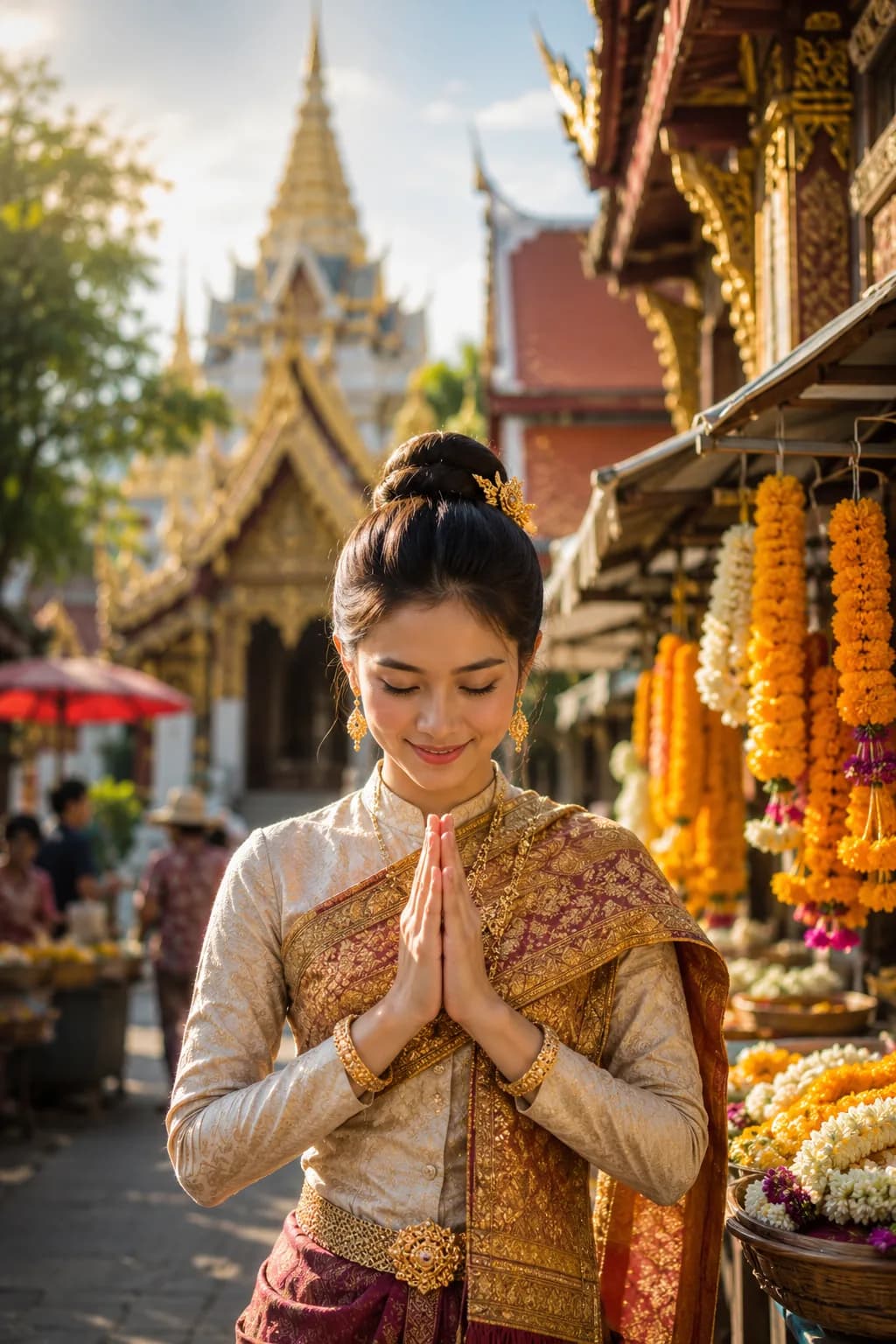
Thailand is very good at making contradictions look ordinary. A monk checks a smartphone between chants. A spirit house stands outside a glass office tower. A teenager films a TikTok video beside a temple built centuries earlier. A food-delivery rider waits outside a shrine while someone else steps inside to light incense. A grandmother watches a Buddhist ceremony on television while her grandchildren order dinner through an app in the next room. A family consults an astrologer about an auspicious date before launching a business promoted entirely through social media. None of this feels especially strange within Thailand itself. Modernisation hasn't simply replaced tradition here. The two have learned, over a remarkably short period, to live comfortably together.
The Thailand Visitors Expect, and the One That Actually Exists
Visitors often arrive carrying an imaginary Thailand assembled from temples, tuk-tuks, street food, rice fields, monks, beaches, markets and traditional dance. All of that genuinely exists. It simply exists alongside electric trains, digital payments, high-rise condominiums, streaming culture, influencers, e-commerce, international universities, K-pop fandom, competitive gaming and a thriving startup scene. Thailand isn't trapped somewhere between old and new, waiting to fully arrive at modernity. It's actively using both at once, and has been for some time.
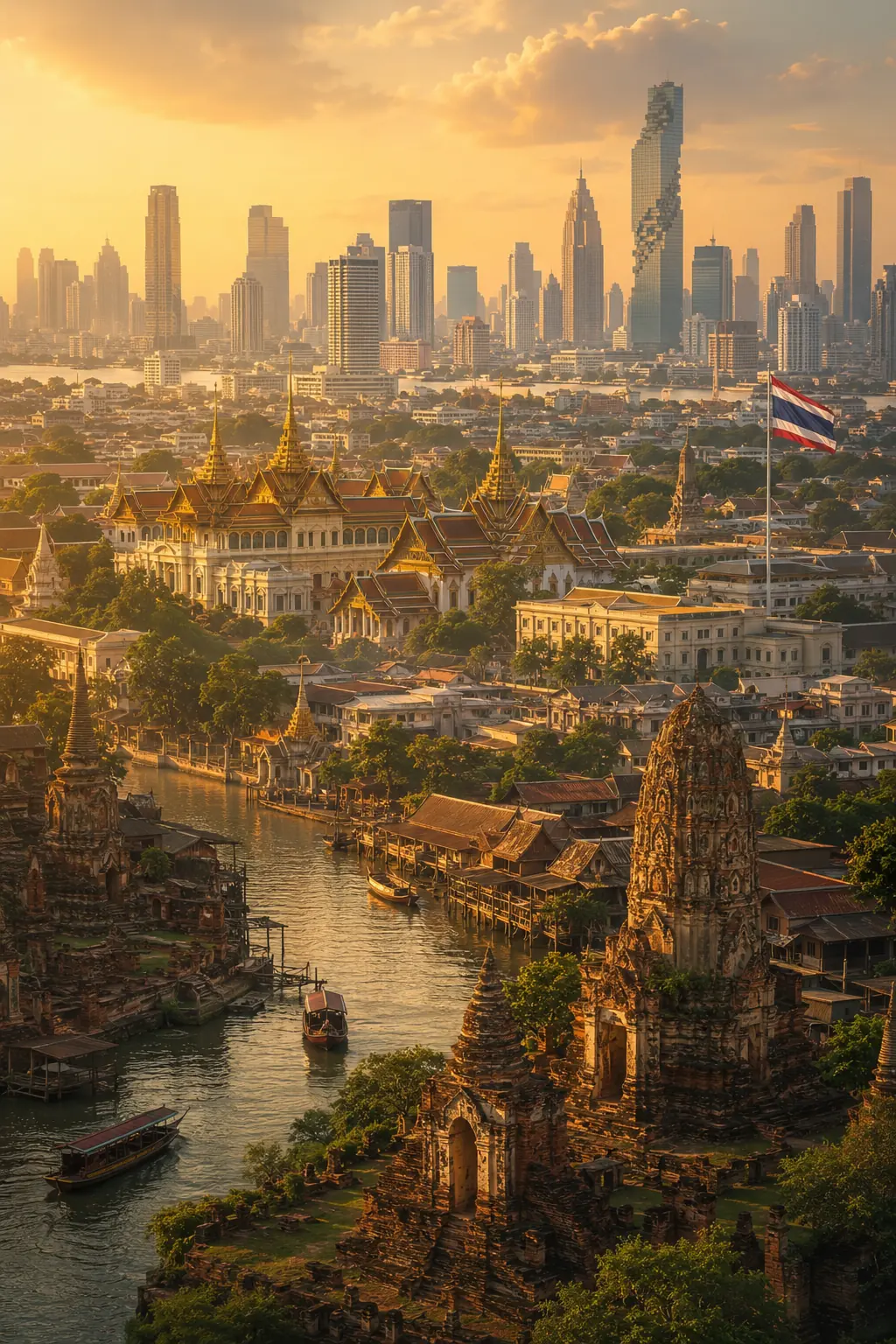
Nowhere is that contrast more visible than in Bangkok, where walking a few hundred metres can mean passing a flower-covered shrine, a global luxury boutique, a 7-Eleven, a street-food cart, a Buddhist monk, a digital advertising screen, a century-old shophouse, a brand-new condominium tower, a motorcycle delivery rider and a fortune teller, all within the same short block. Bangkok doesn't sort these things into separate historical zones the way a museum might. They simply coexist on the same pavement, because that's genuinely how the city works. (Our guide to the history of Bangkok explores how that layered urban pattern actually developed over time.)
Life on the Phone
Smartphones transformed daily life in Thailand much as they did everywhere else, though the specific shape of that transformation is worth noting. Communication moved into apps, shopping moved largely online, food could be ordered instantly, banking went digital, and ride-hailing changed how people move through cities. Social media became deeply woven into commerce, dating, politics, entertainment and family life all at once. For younger Thais especially, the smartphone functions less like an accessory and more like basic infrastructure.
LINE became one of the most important communication platforms in the country — friends, families, businesses, workplaces and customers all use it, and official accounts routinely send promotions and information directly through it, in a way that visitors from Europe, more used to WhatsApp or Messenger, sometimes find unfamiliar at first. Facebook has played an enormous role in Thai social life more broadly: businesses built entire customer bases around simple pages, local communities formed active groups, families shared photos, news circulated, political discussion moved online, and a tiny shop with no formal website could still reach a large audience purely through a Facebook page. Instagram reshaped tourism and urban culture in its own way — cafés became visually designed around the platform, hotels started actively considering photo opportunities, restaurants cared newly about presentation, and viewpoints became destinations in their own right, with people travelling specifically to photograph places they'd already seen online. Tourism had always sold images, in Thailand as everywhere; Instagram simply made the customer part of the advertising system itself.
Then TikTok accelerated all of it further still. A food stall can become nationally famous overnight. A small café in a provincial town can suddenly draw visitors from across the country. A song can become inescapable background music within days. A slang expression can spread nationwide before most people even learn where it came from. Young creators can build audiences considerably larger than traditional media personalities once commanded, and Thailand's cultural trends now genuinely move at the speed of a phone screen. This creates a distinctly modern phenomenon: a restaurant operates quietly for years, someone uploads a short video, millions watch, a queue appears, more creators arrive specifically because there's now a queue to film, and the queue itself becomes content in its own right. Old-fashioned word-of-mouth food culture hasn't disappeared. It's simply become algorithmic.
A Café Economy, and a Market That Learned to Post
Thailand's modern café culture has grown into something genuinely enormous. Bangkok and Chiang Mai remain the obvious centres, but beautifully designed cafés now appear throughout provincial Thailand too, where coffee is really only part of the actual product — architecture, gardens, views, desserts, photogenic presentation, air conditioning and social space all matter just as much, and a single café can function simultaneously as restaurant, informal office, meeting place and content studio. Traditional markets have entered this same economy from the opposite direction: a place that once served mainly local residents can become genuinely famous simply because it photographs well, drawing visitors, new signage, expanded parking and vendors who adapt their offerings accordingly, sometimes changing prices along the way. The market becomes, almost overnight, both local infrastructure and tourism content at the same time.
The same digital shift reaches rural Thailand more thoroughly than outside stereotypes usually assume. Rural life is often photographed as though technology stops abruptly at the edge of the rice field; the reality looks considerably different. Farmers use smartphones, weather apps, Facebook groups, online marketplaces, modern machinery, digital banking and YouTube tutorials as a matter of course, and small producers across the country increasingly sell directly online — food, clothing, crafts, plants, beauty products, local specialties — reducing dependence on a physical storefront and letting a family business in a small provincial town reach customers nationwide. Livestream selling has become a genuinely major form of commerce in its own right: sellers demonstrate products live, customers comment in real time, orders appear as the stream continues, and entertainment and shopping merge almost completely. The market stall hasn't disappeared here either. It's simply learned to livestream.
Digital tools have also strengthened regional pride rather than eroding it. People increasingly promote their hometown food, local dialect, provincial festivals, regional fashion and small businesses online, and what might once have been dismissed as merely provincial can become genuinely fashionable precisely because it's local. Isaan culture offers one of the clearest examples: food, mor lam, luk thung, dialect, regional fashion, homegrown celebrities and northeastern humour have all become increasingly visible in mainstream national culture. Migration first brought Isaan physically into Bangkok decades ago; digital culture has more recently allowed Isaan to speak back on its own terms, to a national and international audience it never previously had direct access to. (Our guide to Isaan explores this same shift from the region's own perspective.)
Global Culture, Told Through a Thai Lens
Korean popular culture has had an enormous influence across contemporary Thailand — music, fashion, beauty, television, dance and organised fan culture have all been shaped by it, and Thai performers have increasingly become prominent within the Korean entertainment industry itself, strengthening the connection from both directions at once. Lisa of BLACKPINK, originally from Buriram province, became one of the most internationally recognised Thai entertainers of her generation, and her success demonstrated something genuinely significant about modern Thai identity: it no longer requires choosing between local origin and global culture. A single biography can comfortably include both Buriram and international pop stardom.
This connects to a broader idea Thailand increasingly discusses explicitly: cultural "soft power" — food, music, film, fashion, Muay Thai, festivals, design and television as sources of international influence and genuine economic value, without requiring traditional political power to achieve it. Thailand has, in practice, been doing this informally for decades already; Thai food alone may be one of the country's single greatest international ambassadors, quietly doing more for how the country is perceived abroad than most formal diplomacy ever could. Thai television and streaming productions increasingly reach international audiences too, spanning romance, drama, comedy, horror and, especially, BL (boys' love) and GL (girls' love) series — genres that began as relatively niche entertainment categories and developed genuinely large fan bases across Asia and well beyond, with actors becoming international celebrities in their own right and fan meetings drawing real international travel. Modern tourism, as a result, can now begin with a television series just as easily as with a beach photograph. Muay Thai has followed a similar path in an entirely different direction — ancient in its cultural roots and thoroughly modern in its global reach, with foreigners travelling specifically to train, major events streamed internationally, and Thai fighters building substantial social-media audiences of their own. Traditional ritual remains fully visible even inside this global framing: wai khru and ram muay honour teachers and lineage before a fight begins, and sacred headpieces and traditional music sit comfortably beside modern sponsorship logos in the very same arena. (Our guide to Thai superstitions, lucky numbers and amulets explores wai khru and these sacred pre-fight rituals in more depth.)
Old Buildings, New Purpose
Everyday commerce has adapted just as thoroughly as entertainment has. QR-code payments appear at markets, cafés and small shops throughout the country, and a vendor selling food from a genuinely basic stall may accept a bank transfer as instantly as any modern retailer — visitors sometimes expect a "traditional" market to be cash-only, when in practice the person selling mangoes may be considerably more digitally integrated than the tourist buying them. Thailand's PromptPay system helped normalise easy account-to-account payments using simple identifiers and QR codes, and its widespread adoption illustrates just how quickly financial technology can become entirely ordinary infrastructure. There's something genuinely modern about buying a twenty-baht snack from a street vendor and paying for it through a smartphone: the stall itself may look almost unchanged from decades earlier, while the payment system running underneath it belongs entirely to the digital economy. Modernisation, in Thailand, doesn't always require replacing the physical environment at all.
Shopping malls deserve to be taken seriously as genuine social institutions rather than simple retail space, especially in Bangkok — restaurants, cinemas, supermarkets, banks, clinics, beauty services, schools, coworking spaces, transit connections and reliable air conditioning all sit under one roof, and families, teenagers, office workers and heat-escaping tourists all spend real time there as a result. The mall and the market aren't really enemies competing for the same customer, whatever that framing might suggest — a single person can shop at a wet market in the morning and a luxury mall that same afternoon without feeling any particular tension between the two, and Thai consumers generally move between both without much thought. Convenience stores fit into this same pattern at an even smaller scale: 7-Eleven branches are genuinely everywhere, selling ready meals, drinks, snacks, SIM-related services, household basics, hot food and payment services, functioning as part of everyday urban infrastructure for residents even as visitors experience them mainly as convenient novelty — the humble toasted sandwich sold at the counter has, somewhat improbably, become an actual object of online tourist fascination in its own right.
Old buildings have found new economic life through much the same process. Historic districts in places like Phuket, Songkhla and various smaller provincial centres have gained renewed attention as old Chinese-Thai shophouses become cafés, galleries, hostels, design stores or restaurants — heritage becoming economically valuable in a way that lets preservation and gentrification happen simultaneously, sometimes within the very same building. A structure survives specifically because someone finds it a genuinely new economic purpose; purists may reasonably complain about the transformation, but outright demolition, the more likely alternative, would preserve considerably less. Modern night markets and festivals follow a similar pattern of deliberate reinvention, layering lighting design, curated food zones, photo installations, social-media promotion, LED lighting, livestreaming and drone photography on top of genuinely old ritual and market culture — the core tradition surviving comfortably inside an event that's been thoroughly redesigned for a modern audience. A television drama can even revive interest in a specific historical period almost overnight: the historical series "Love Destiny" became a genuine cultural phenomenon that stimulated renewed domestic interest in Ayutthaya-era history and traditional dress specifically, with visitors renting historical-style outfits to photograph themselves at heritage sites afterward — a single television drama turning centuries-old history into an entirely contemporary form of tourism behaviour. (Our guide to the rise and fall of Ayutthaya covers that same history from a more traditional angle.)
Language, Family and a Generation Growing Up Differently
Digital communication has changed the Thai language itself, at least in casual use — abbreviations, English words, romanised Thai, memes, emoji, fresh slang and proudly used regional dialect all circulate constantly online, and young people frequently write quite differently in casual chat than they do in formal Thai at school or work. One small, genuinely useful piece of Thai internet culture travels easily to foreign visitors: the Thai word for five is "ha," so "555" reads phonetically as "ha ha ha," with more fives simply meaning more laughter — quite possibly the easiest Thai-language internet joke any visitor will ever pick up. English loanwords appear constantly too, especially in business, technology, fashion and youth culture, sometimes adapted into distinctly Thai pronunciation patterns through natural code-switching — a sign of a language actively borrowing and evolving, not one quietly disappearing. Foreigners sometimes label Thai-influenced English "Thainglish," a term that can be genuinely playful but easily turns patronising when used simply to mock accent or grammar; it's worth remembering that English is a second or third language for many Thai speakers, and someone communicating imperfectly in your language may well speak several more languages than you do yourself.
Family remains extremely important throughout all of this technological change. Young adults may live independently while staying financially or emotionally connected to parents; adult children frequently support family members directly; parents often hold strong opinions about relationships, careers and marriage; and while modern individualism clearly exists in contemporary Thailand, family obligation remains genuinely powerful alongside it. Living with parents into adulthood isn't necessarily viewed through the same lens it might carry in some Western societies — housing costs, family structure, cultural expectation, caregiving responsibility and simple practical convenience all play a role, and multi-generational households remain common as a result; independence here doesn't always require geographical separation the way it might elsewhere. Thailand's declining birth rates and generally smaller families are gradually reshaping older family structures too, with fewer children potentially carrying greater responsibility for ageing parents, even as urban migration separates families physically and smartphones keep them constantly, easily connected regardless of distance. Modernisation, in other words, tends to change family obligation rather than simply remove it.
Marriage itself increasingly mixes old and new in a single event. A modern couple may meet through a dating app, choose each other independently, hire a professional wedding photographer, and then still organise ceremonies involving elders, monks, carefully chosen auspicious timing and various traditional elements — a wedding that's simultaneously globally modern and unmistakably Thai. Sin sod, often translated as bride price or dowry, can still form part of Thai marriage tradition, though its meaning and amount vary enormously by family and specific context, involving symbolism, status and family negotiation in different proportions each time; foreign internet discussions often reduce it to a simplistic, universal rule that doesn't reflect how the tradition actually works in practice. Dating apps have transformed how relationships begin more broadly, with Thai people using the same global platforms found elsewhere alongside regionally popular local services — relationships that once depended almost entirely on work, school or social introduction can now begin online just as easily, and the old geography of farang-Thai meetings, once centred heavily on bars and tourist areas, has expanded onto smartphones as thoroughly as everything else. (Our guide to Thailand and the farang explores this same relationship history from a different angle.) Technology may increasingly shape the introduction; family culture, more often than not, still shapes what happens next once things get serious.
Visibility, Representation and What Still Needs Work
Thailand has long featured visible gender and sexual diversity in both popular culture and everyday life, and modern media, entertainment and social platforms have only increased that visibility further; the country also became internationally known for LGBTQ+ tourism and entertainment specifically. It's worth being precise here: social acceptance, formal legal rights and everyday lived experience aren't identical questions, and attitudes continue to vary meaningfully by individual family and community. The Thai term kathoey is often translated imperfectly into English and may be used in contexts involving transgender women or feminine gender expression, though identity terms and personal preference genuinely vary from person to person — foreigners should avoid treating kathoey as a tourist curiosity, since Thai gender diversity belongs to real people living real lives, not to entertainment folklore built around them. Transgender performers and celebrities have been visible in Thai media for many years now, and that visibility genuinely creates familiarity over time, though it doesn't automatically remove discrimination on its own — as in most places, representation and formal equality don't always advance at exactly the same pace.
Faith, Technology and the Feeling of "Just In Case"
Buddhism has adapted to all of this digital change too. Temples livestream ceremonies, monks teach through online platforms, QR codes appear beside physical donation boxes, meditation apps reach younger audiences directly, and people watch Dhamma talks on their phones during an ordinary commute. The religion itself is genuinely ancient; its delivery system clearly doesn't have to be. A temple can maintain an active Facebook page, post ceremony schedules, share photographs, collect donations digitally and stay connected with supporters living far away — technology letting religious communities remain connected across real distance in a way that simply wasn't possible before. Astrology and fortune telling have moved online in much the same way, with birth information submitted digitally, readings conducted over video call or messaging, and numerology businesses advertising openly through social media; lottery-number culture has adapted just as smoothly, with dreams, unusual animals, licence plates and mysterious markings turning into genuinely viral number stories that can spread nationwide before lunchtime, where they once might have spread only around a single village. (Our guide to Thai superstitions, lucky numbers and amulets covers this same belief system in far more depth, from its older roots through to its newest digital form.)
Royal tradition remains highly visible throughout Thai public life as well, even as the way younger people actually encounter national institutions has shifted considerably, with information now moving through social media alongside more traditional education and television coverage. Political discussion has become considerably more visible through social media too — hashtags, livestreams, online campaigns and memes have all changed how younger voters in particular encounter political information, and Thailand's political culture remains genuinely complex and sensitive in its own right. The point worth emphasising here is mainly technological rather than political: public conversation in Thailand is no longer shaped only by television, newspapers and official institutions the way it once was almost entirely. (Our guide to the monarchy and Thai national identity addresses that institution's own history and role directly and in far more depth.)
The Country Behind the Feed
None of this technological change means daily Thai life has become one continuous highlight reel. Most people commute, pay bills, go to school, complain about work, shop for groceries, watch television, sit in traffic, visit relatives and clean the house, exactly as people do everywhere else in the world — that ordinary Thailand rarely goes viral, and it's also where the overwhelming majority of actual Thai life happens, day in and day out. If Thailand looks from the outside like nonstop festivals, spectacular food, beaches and nightlife, that's mainly because those are the specific parts tourism, and social-media algorithms built to reward spectacle, choose to show you. Algorithms reward beautiful beaches, extreme food, luxury hotels, nightlife and amusing cultural misunderstandings far more readily than they reward ordinary life; the underlying technology changes which filter gets applied, not the simple fact that some filter is always being applied. Residents experience Monday morning too, and understanding a country well genuinely means leaving conscious room for its ordinary, unglamorous days alongside its more photogenic ones.
There is a real cost worth naming honestly when everything risks becoming content: a funeral is not content, a monk is not a prop, a sacred ritual is not a costume backdrop, and a local community is not simply an aesthetic to be captured and moved on from. Modern travel increasingly demands a new, fairly basic form of etiquette that didn't need to exist quite so explicitly before smartphones: simply knowing when not to film. The genuinely positive side of this same technological shift is considerable, though. Thai creators can now explain their own culture directly to global audiences — food, language, history, comedy, travel, religion, regional identity — without needing outside writers to filter and translate it for them first. For generations, English-language travel writing filtered Thailand almost entirely through outsiders' eyes; today a Thai student holding nothing more than a phone can reach a larger audience than an older guidebook author ever managed. That represents a genuinely major cultural shift. Thailand, increasingly, narrates itself.
An Old Skill, Applied to a New Tool
Thailand has spent centuries absorbing outside influences and steadily making them its own — Indian religion, Khmer court culture, Chinese migration, Persian trade, European technology, American popular culture, Japanese investment, Korean entertainment, and now global digital platforms. The country rarely absorbs any of these influences unchanged. It adapts them, mixes them with what already existed, gives the result local meaning, and moves on to whatever comes next. TikTok is new. This particular process of cultural adaptation is not — smartphones have simply accelerated a pattern Thailand has practised for a very long time already.
"Tradition meets TikTok" sounds, at first glance, almost like a joke of a title. It's actually a genuinely useful description of what's happening. Traditional Thailand didn't disappear the moment smartphones arrived everywhere. It logged in instead. The shrine received a QR code for donations. The festival received its own hashtag. A grandmother joined LINE to stay in touch with her grandchildren. A regional singer went viral nationally. A neighbourhood market got its own Facebook page. A temple started livestreaming its ceremonies. And the country, through all of it, kept changing steadily without ever quite becoming anyone else's country in the process. The most useful way to actually see modern Thailand is to stop looking for a clean boundary between tradition and modernity in the first place — because, more often than not, there simply isn't one to find. Look instead for the overlap. That overlap, messy and constantly shifting as it is, is where modern Thailand genuinely lives.