Koh Lipe was not discovered by tourists. It was discovered by tourism.
That distinction matters, because it is easy to tell this story the wrong way. Long before the first backpacker stepped off a boat onto its white sand, Koh Lipe was already home to the Urak Lawoi, a sea-oriented community whose way of life had been built around these waters for generations. Fishermen already knew its reefs. Families already knew its beaches and its seasons. What changed, over the following decades, was not that the island was found — it was that the wider tourism world finally learned where it was, and began arriving in numbers nobody on Lipe could have predicted.
The Urak Lawoi Were Already Here
Official Thai cultural and environmental records identify Koh Lipe as a long-standing Urak Lawoi community, and research from the Department of Cultural Promotion includes the island in its wider study of Urak Lawoi life, adaptation and cultural change. The community's way of life has historically centred on the sea: fishing, boats, coastal gathering and ritual practices that continue to this day. Satun's provincial cultural material still recognises the Urak Lawoi boat-floating tradition as part of Koh Lipe's living identity, not as a historical curiosity but as something the community continues to practise.
It is worth being precise about what this means for the story that follows. Koh Lipe was never uninhabited, never empty, never simply waiting to be found. The Urak Lawoi are not a colourful backdrop to a tourism story — they are part of the island's history and its present, and any honest account of how Koh Lipe changed has to begin by acknowledging that it changed around a community that was already there.
This is a distinction the rest of the article keeps returning to, because it shapes how every later stage of the story should be read. A backpacker arriving in the 1990s or 2000s was not walking onto empty sand — they were arriving somewhere with an existing rhythm of life, existing relationships to the reefs and the seasons, and an existing community whose presence long predated any interest from the outside tourism world.
Small, Remote and Very Far South
Part of what kept Koh Lipe out of the mainstream tourism map for so long was simply its location. The island sits in Satun Province, in the far southern Andaman Sea, close to the maritime border with Malaysia — about as far from Thailand's more famous islands as it is possible to get while still being part of the country's western coastline. The Tourism Authority of Thailand highlights Lipe as one of Satun's principal island destinations today, but for a long time it was a genuinely peripheral place on the country's tourism map. Access has always been by boat, primarily from Pak Bara on the mainland, and the island has neither an airport nor a road bridge connecting it to anywhere else. That remoteness was not an accident of underdevelopment — it was simply geography, and it shaped everything about how slowly, and how late, mass tourism arrived.
Part of the Tarutao Archipelago
Koh Lipe does not sit in isolation. It belongs to the wider Tarutao archipelago, a cluster of islands that the Tourism Authority of Thailand describes as home to Tarutao National Park, Thailand's first marine national park. Current tourism material places Koh Lipe within this broader Tarutao island landscape, alongside the nearby Adang-Rawi islands, whose coral reefs contribute significantly to the whole area's appeal. The governance of the archipelago is not entirely straightforward, however, and it would be a mistake to assume that every part of the now-developed island of Koh Lipe is administered in exactly the same way as an ordinary stretch of national-park territory. What can be said with confidence is that Lipe sits within, and depends heavily upon, a protected marine landscape that extends well beyond its own small shoreline.
Reefs and Beaches Were the Original Draw
Before any of the infrastructure that defines modern Koh Lipe existed, its appeal rested entirely on the natural environment. The Tourism Authority of Thailand promotes the island for its clear water, coral reefs, snorkelling and general island scenery, and its geography made that appeal easy to experience. Despite its small size, Lipe has three principal beach areas — Pattaya Beach, Sunrise Beach and Sunset Beach — meaning a visitor could sample several distinct sides of the island within a short stay. The surrounding marine environment, rich with reefs and neighbouring islands worth exploring by boat, created natural demand for snorkelling, diving and island-hopping long before Lipe had any of the resort infrastructure it has today. This was the foundation the entire tourism story was built on: not marketing, not investment, but water clear enough and reefs healthy enough to be worth the journey.
The Backpacker Years
The exact chronology of Koh Lipe's earliest tourism businesses is not well documented, and no single source can identify a first resort or a first foreign visitor with any confidence. What historical and secondary accounts agree on is the broader pattern: Lipe developed first as a small-scale, independent-travel destination, circulating mainly through backpacker and independent-travel networks long before its popularity accelerated into anything resembling mass tourism. Academic and cultural research points to a period of genuinely rapid change beginning around the 2000s and continuing into the early 2010s, a shift from a niche stop on the backpacker trail to something with a very different scale and character.
Pak Bara Makes the Island Reachable
None of that growth would have been possible without a reliable way to actually get there. The Tourism Authority of Thailand identifies Pak Bara pier, on the Satun mainland, as the principal gateway to Koh Lipe, and over time, improved road transfers to Satun combined with more regular speedboat and ferry services turned what had once been a difficult and irregular journey into something closer to routine scheduled transport. The precise date any particular ferry route began matters less than the broader transition it represents: access to Koh Lipe shifted from something that required real effort and planning to something a visitor could simply book. Remoteness remained part of the island's character and appeal, but it stopped being a serious practical barrier to getting there.
That shift, gradual as it was, is really the hinge on which the rest of Koh Lipe's story turns. An island that once demanded genuine commitment to reach became, over time, a realistic option for a much wider range of travellers — not only the most determined backpackers willing to chase down irregular boats, but increasingly ordinary holidaymakers planning a trip with a fixed departure date and a return ferry already booked.
An International Gateway Through Langkawi
More recently, Koh Lipe's position near the Thailand-Malaysia maritime border has become an asset in its own right rather than simply a marker of remoteness. Current Thai government tourism policy actively promotes stronger tourism links between Satun, Koh Lipe and Malaysia, and seasonal ferry connections with Langkawi have helped place Lipe inside a cross-border Andaman travel circuit that extends well beyond Thailand's own mainland. A 2026 government tourism source describes joint efforts by the Tourism Authority of Thailand and Satun provincial authorities to promote these Thailand-Malaysia routes specifically connecting Langkawi and Koh Lipe. The detail matters less as a transport guide than as evidence of how far the island's tourism geography has expanded — from a destination once reached only with difficulty from the Thai mainland, to a stop on an international circuit spanning two countries.
From Niche Island to Mainstream Destination
The pace of change on Koh Lipe over the past two decades has been genuinely rapid, and recent academic work describes the island in exactly those terms — a place transformed by accelerated tourism development in a relatively short span of time. A 2023 study of sustainable tourism competitiveness on the island identifies infrastructure development, public services and tourism promotion as major current policy priorities, while also flagging waste management and coordination challenges that have come with growth. A 2025 academic thesis, meanwhile, documents significant tourism-driven social and cultural change affecting the Urak Lawoi community specifically. There is no reliable precise growth curve to cite here, no clean statistic that captures the scale of change, but the broad shape of the story is consistent across the research: Koh Lipe moved from backpacker niche to mainstream destination, and the pace of physical and social change accelerated sharply as it did.
Pattaya Beach and the New Tourism Geography
Much of that change is visible today around Pattaya Beach, which developed into one of the island's principal accommodation and arrival areas and now anchors a concentration of tourism infrastructure around the main beach zones and the island's central commercial spine. It is worth noting, given the name, that this is an entirely different place from the city of Pattaya in Chonburi Province on the mainland — a coincidence of naming rather than any connection between the two. What matters for Koh Lipe's story is geography rather than any particular hotel or business: Pattaya Beach became the island's front door, the place most visitors arrive to and base themselves around.
Sunrise Beach and a Living Community
Sunrise Beach tells a different, more layered story. Official cultural and environmental material identifies Koh Lipe as home to a living Urak Lawoi settlement, and parts of that community remain strongly associated with the Sunrise Beach area and the island's interior village. This creates a contrast worth sitting with: one of Koh Lipe's most photographed and most visited beaches is also, simultaneously, part of a community landscape that existed long before any of the visitors arrived. Tourism and local life on this side of the island do not occupy neatly separate zones — they overlap, and that overlap is part of what makes Koh Lipe distinctive rather than simply another pretty beach.
Walking Street as the Symbol of the New Island
If Pattaya Beach is where most visitors arrive, Walking Street is where they spend their evenings. This central pedestrian and commercial strip links the island's main visitor zones and concentrates restaurants, shops, bars, travel agencies and dive operators along a single route that has become, in effect, the symbol of modern Koh Lipe. Its precise origins and development are not well enough documented to assign an exact date or chronology, so it is best understood as a modern end-state rather than a historical milestone — the physical expression of everything the island's tourism economy has grown into, condensed into one narrow street that barely existed as a commercial hub a generation ago.
A Market That Broadened Rather Than Replaced
What is striking about Koh Lipe's growth is that it did not abandon its backpacker roots so much as build outward from them. The Tourism Authority of Thailand now presents the island as a mainstream Thai and international destination, and modern Lipe genuinely serves all of the categories that description implies: backpackers still pass through, alongside couples, divers, snorkellers, families and guests staying in considerably higher-end resorts than anything the island's early visitors would have found. The physical island stayed exactly the same tiny size it always was. What grew, dramatically, was the market surrounding it.
The Urak Lawoi Experience the Change Directly
For the community that called Koh Lipe home long before any of this began, rapid tourism growth has not been a distant or abstract phenomenon — it has been lived directly. Department of Cultural Promotion research explicitly studies Urak Lawoi adaptation and cultural change under tourism, and more recent academic work documents ongoing concerns around cultural visibility, how the community is represented to visitors, and its participation in decisions about the island's development. Thailand's Ministry of Natural Resources and Environment continues to address land disputes and quality-of-life issues that involve the Urak Lawoi directly.
None of this should be read as a story of passive victimhood, and the research itself does not support that framing. Alongside the genuine pressures, more recent work also describes real agency: economic opportunities that have opened up through tourism, and the ongoing transmission of cultural knowledge and practice within the community. The honest picture is more complicated than either a straightforward success story or a simple loss — a community navigating rapid change on its own island, with both the difficulties and the openings that change has brought.
Land Becomes One of the Island's Biggest Questions
Rapid development on a genuinely tiny island inevitably drives up the value, and the pressure, surrounding every available piece of land. Current Thai government work includes ongoing investigation into land-rights disputes, questions over public access, and coordination on utilities, waste, healthcare and cultural protection across Koh Lipe. This is worth understanding as evidence that the island's tourism transformation reached well beyond hotels and beaches into some of the most fundamental questions a small community can face — who has rights to what land, and how those competing claims get resolved. These remain sensitive, unresolved issues, best described in neutral terms rather than as a settled dispute with clear sides.
The Limits of a Small Island
Land is not the only constraint growth has run up against. A 2023 study on sustainable tourism competitiveness identified waste management and the coordination of public services and infrastructure as major issues facing Koh Lipe, and a more recent 2026 peer-reviewed study examines marine-resource management and community-based ecotourism as responses to the pressure tourism has placed on the island. Thailand's Ministry of Natural Resources and Environment likewise lists electricity, water, waste and healthcare among the quality-of-life issues requiring coordinated attention on the island. This is, in essence, the small-island paradox at the heart of Koh Lipe's modern story: tourism has proven capable of growing considerably faster than the land, water supply and infrastructure of a very small place can realistically expand to match.
A Tradition That Belongs to the Community First
Amid all of this change, one thread of continuity stands out. Satun's provincial government and the Koh Sarai local administration continue to support the Urak Lawoi boat-floating festival on Koh Lipe, a tradition that includes ancestor ritual, traditional boat-making and launching, and wider community cultural practice. It would be a mistake to read this festival as something staged for visitors — it belongs to the community first, and tourism today is better understood as an observer of a tradition that predates it by a considerable margin, rather than as its author.
A Tropical Icon
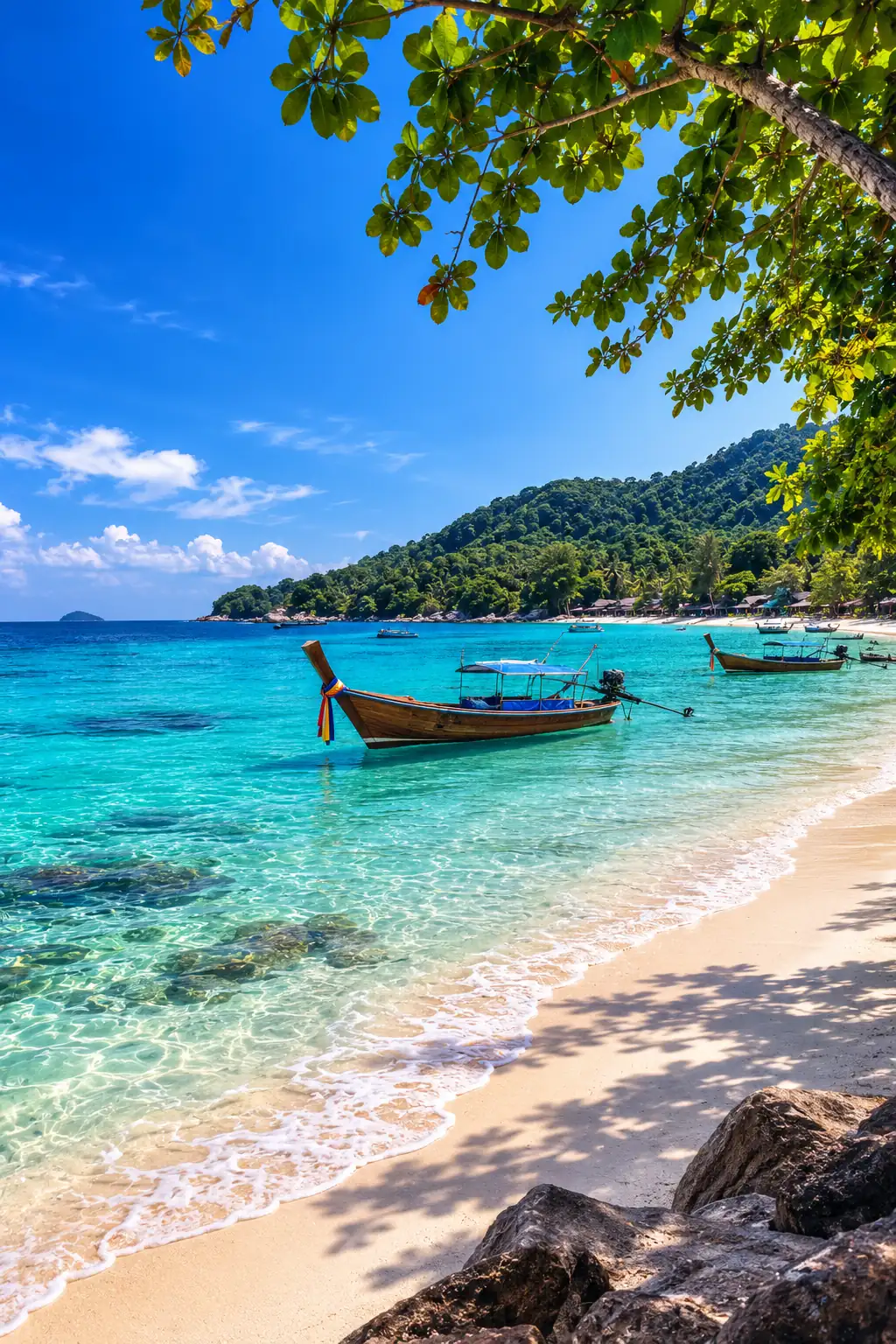
The Tourism Authority of Thailand now lists Koh Lipe among the best-known island destinations in southern Thailand, and the image most visitors carry away is a straightforward one: clear water, coral reefs, small white beaches, long-tail boats drawn up on the sand, and a compact walking street humming with activity in the evening. What actually changed over the decades covered by this story was never the island's physical size — it remained as small as it always was. What changed was visibility. A tiny island close to the Malaysian border became recognisable far beyond Satun, far beyond Thailand's usual island shortlist, and far beyond anything its earliest visitors could likely have imagined.
Not Phi Phi, Not Lanta, Not Samui
Set alongside Thailand's other well-known island transformations, Koh Lipe's path stands apart. Phi Phi's story runs through backpacker fame, a Hollywood film, a devastating tsunami and the conservation management that followed. Koh Lanta developed more slowly and unevenly, shaped by its plural communities rather than any single defining event. Koh Samui moved from a coconut economy through backpacker tourism to global resort status once an airport transformed its accessibility. Koh Lipe followed none of these routes exactly: a remote island with a long-standing Urak Lawoi presence, discovered gradually by backpackers, made reachable by a boat-access boom, and now navigating life as a tropical icon under real small-island and community pressure. None of these islands' stories should be ranked against one another — they simply demonstrate how differently Thailand's coastline has responded to the same broad forces of tourism growth. What sets Lipe apart is the particular combination it carries: tiny physical scale, no airport, genuine border-region remoteness, exceptional marine appeal, and a living community whose history long predates any of it.
A Place That Already Had a History
Koh Lipe was not discovered when the first backpacker stepped ashore. The Urak Lawoi already knew the island intimately. Fishermen already knew its reefs, and families already knew its beaches and its seasons long before any guidebook mentioned its name. What changed was that the tourism world eventually learned where Lipe was. Guidebooks spread the name from traveller to traveller. Scheduled boats shortened what had once felt like a genuinely serious distance. Resorts and restaurants multiplied along shorelines that had previously supported little more than fishing boats and a handful of simple bungalows. Walking Street appeared as the commercial spine of an island that had never needed one before. And gradually, Koh Lipe became part of international travel circuits stretching from mainland Thailand across the maritime border into Malaysia and beyond.
Koh Lipe's modern story, then, is not really the discovery of an island at all. It is the discovery, by mass tourism, of a place that already had a history — and the ongoing challenge of making sure that history is not lost beneath the success of the destination that has been built around it.