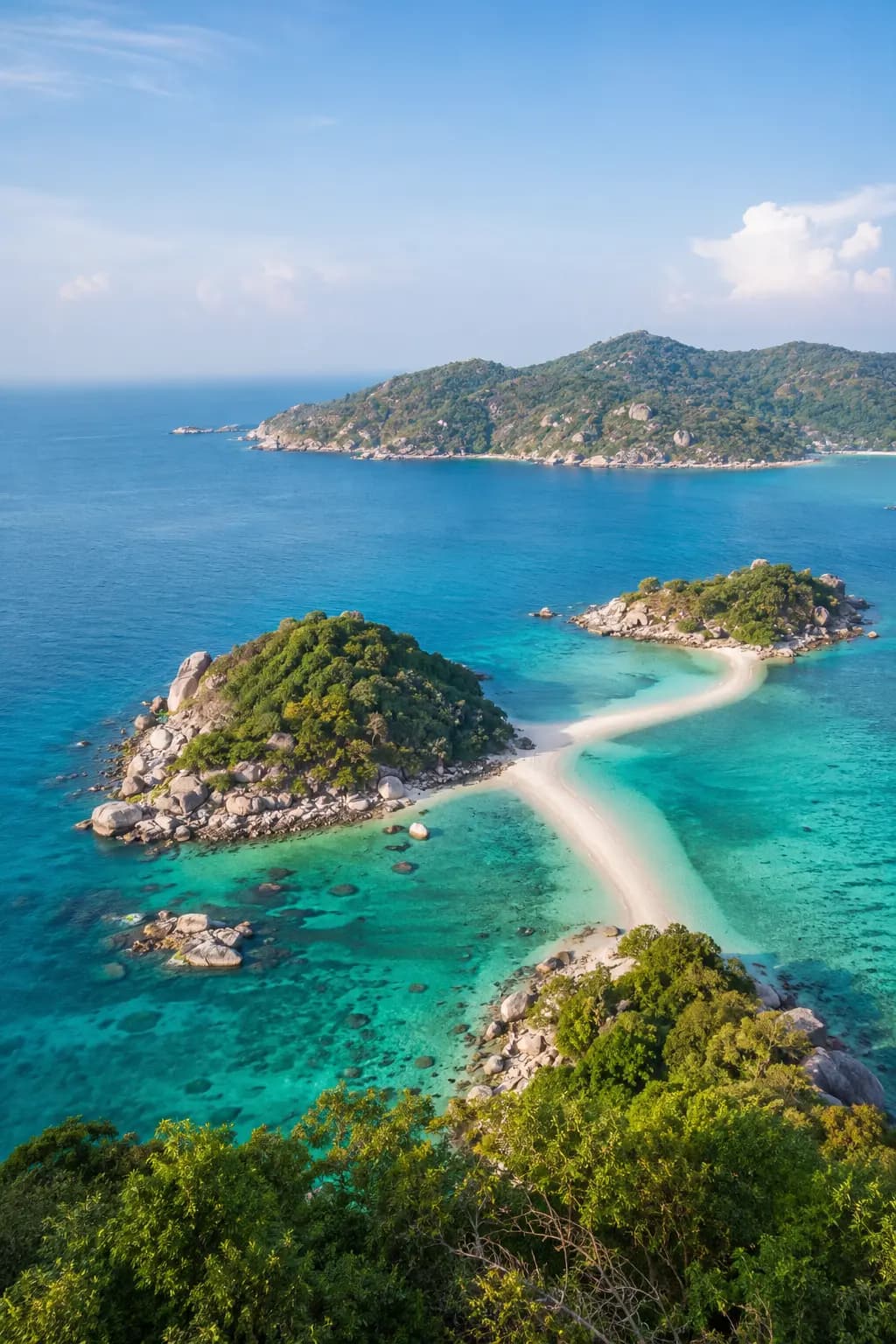
The most famous part of Koh Tao has never been the beach. It is what lies just beyond it, a few metres beneath the surface, where the island's real reputation was built. Ask most travellers what they remember about Koh Tao and the answer rarely starts with a hotel or a sunset. It starts with a dive — the first breath taken underwater, the first coral wall, the first time the whole island suddenly made sense from below rather than above.
That underwater identity did not arrive overnight, and it did not arrive by accident. Koh Tao's transformation from a tiny, barely reachable island into one of Southeast Asia's best-known scuba-diving centres is a story about isolation, about reefs nobody had yet learned to value, and about a small community that built an entire economy around teaching strangers to breathe underwater.
A Very Small and Isolated Island
Long before diving had anything to do with Koh Tao, the island was simply remote. Peer-reviewed tourism-planning research describes it as a small, isolated Gulf island, cut off from the mainland and, for a period, used as a political-prison site. Settlement followed in the 1940s, when fishing and farming families from neighbouring Koh Phangan and Koh Samui made their way across and began building a life there. The Koh Tao Tourism Association's own account of the island's history follows broadly the same sequence — prison use in the 1940s, then families settling afterwards to fish, grow coconuts and farm on a small scale.
None of this needs dwelling on at length; it is background rather than the heart of the story. What matters is the shape of the island in the years that followed: a tiny population, an economy built entirely around fishing and the land, and no obvious reason for anyone outside that small community to think of Koh Tao as a destination at all.
Compared with its larger neighbours, Koh Tao in this period was barely a footnote on any map a traveller might have consulted. Koh Samui and Koh Phangan, close by, already had their own slowly developing identities. Koh Tao, smaller and harder to reach, simply carried on as it had for generations — a place people lived and worked, not a place people visited.
The First Adventurous Visitors
That began to change in the 1970s, when, according to the Koh Tao Tourism Association, the first tourists started making their way to the island. There were no commercial passenger ferries running at the time, so visitors who wanted to reach Koh Tao often had to find a place on a fishing boat headed that way. It is a detail worth sitting with, because it captures just how inaccessible the island still was at that point. The vessels bringing the earliest travellers ashore were not tour boats or dive boats — they were working boats, going about their ordinary business, with a handful of curious outsiders aboard almost as an afterthought.
No single first tourist or first bungalow can be credited with starting Koh Tao's tourism story, and none of the sources behind this account try to name one. What can be said is that a trickle of visitors, adventurous enough to hitch a ride on a fishing boat to a barely known island, had begun to arrive — and that trickle would, within a couple of decades, turn into something far larger.
The Late 1980s: Koh Tao Becomes a Resort Destination
The real hinge point in Koh Tao's story arrives in the late 1980s. Research published in EnvironmentAsia describes the island emerging as a resort destination during this period, built on two assets that were there long before anyone thought to market them: unspoiled beaches, and a significant offshore resource of coral reefs. It would be easy to treat the reefs as simply one more attractive feature alongside the sand and the sea, but that undersells what actually happened. The reefs did not merely decorate Koh Tao's tourism offer — they created the foundation for the activity that would go on to define the island completely.
Diving Becomes the Difference
On many Thai islands, diving exists as one activity among several — a day trip, an optional add-on to a beach holiday. Koh Tao took a different path entirely. The Tourism Authority of Thailand now describes it as one of the country's top scuba-diving destinations, and academic research has gone further, identifying it as one of the busiest scuba-diving centres anywhere in Southeast Asia. A study published in ScienceDirect found the local economy to be strongly dependent on the dive-tourism sector specifically, not simply on tourism in general. Diving on Koh Tao did not remain a side activity for holidaymakers who happened to be staying nearby. It became structurally central to the island's accommodation, its restaurants, its transport and its employment — the organising principle around which almost everything else on Koh Tao was eventually built.
People did not come to Koh Tao simply to lie on a beach that happened to be near good diving. Increasingly, they came specifically because of what was beneath the water, and everything else on the island grew up around that single fact.
That distinction shaped the island in ways that went well beyond marketing language. Restaurants adjusted their hours around dive-boat schedules. Accommodation clustered near dive centres rather than simply near the best stretch of sand. Even the island's social life, for many visitors, revolved around dive courses — the shared experience of learning something together, in a group, over several days, created a different kind of traveller community than the more transient, beach-hopping crowd found on many other Thai islands.
Why the Island Worked So Well for Divers
Several features of Koh Tao made it particularly well suited to this kind of transformation. The offshore coral reefs offered multiple dive sites within easy reach, and the island's small overall scale meant that dive centres, accommodation and piers all sat close together rather than being spread across long distances. Nearby marine sites, including the well-known formation at Koh Nang Yuan, added further variety close at hand. Together, these features allowed Koh Tao to become internationally known for accessible, high-volume dive training and certification — a place where learning to dive was genuinely straightforward to arrange, rather than requiring a long journey out to a single remote site.
Three Settlements, One Island Economy
Modern tourism on Koh Tao did not grow up around a single resort compound. EnvironmentAsia's research identifies development as having centred on the island's original settlements: Sairee and Mae Haad in the west, and Chalok Ban Kao in the south. Each took on a distinct role as tourism expanded. Mae Haad developed into the island's main arrival point and pier zone, the place most visitors first set foot on Koh Tao. Sairee grew into the largest beach-tourism and social area, the long stretch of sand most associated with the island's public image today. Chalok Ban Kao, further south, built up its own cluster of accommodation and dive businesses, developing a somewhat quieter character than its northern counterparts.
This pattern matters for understanding Koh Tao's shape today. Rather than consolidating around one dominant development, the island's tourism economy grew outward from several already-existing settlement nodes, each retaining something of its own character even as all three became increasingly tied together by the same underlying dive economy.
A visitor arriving today can still sense the difference between these three areas within a short walk or taxi ride of each other. Sairee's long beach carries the busiest, most social atmosphere, lined with restaurants and dive shops standing almost shoulder to shoulder. Mae Haad, still functioning as the main arrival point, feels more transactional — piers, transport links, the practical business of getting on and off the island. Chalok Ban Kao, further south, keeps a noticeably quieter pace, its own dive operators and guesthouses spread more loosely along the coastline. None of the three ever fully absorbed the others, and that patchwork quality remains one of Koh Tao's more distinctive features.
Ferries, Dive Shops and the Mid-1990s Turning Point
By the mid-1990s, according to the Koh Tao Tourism Association, the island had gained passenger ferries, its first scuba-diving shops and a growing range of basic services. This represents a genuine infrastructure transition — from an island reachable only by hitching a ride on a working fishing boat to one with scheduled transport bringing visitors in specifically to dive. By the turn of the century, Koh Tao was firmly established on both the backpacker trail and the scuba-diving circuit, no longer a barely known outpost but a recognised stop for travellers moving through the region with diving specifically in mind.
How Fast the Numbers Changed
The scale of that transformation is visible in the historical visitor figures EnvironmentAsia's research cites: approximately 30,462 visitors in 1993, rising to around 180,000 by 2004. These are historical research figures rather than current totals, and they should be read that way — as a snapshot of a particular period rather than an ongoing count. But even as a snapshot, the increase across little more than a decade is striking. An island that had been reachable only by fishing boat within living memory of many of its residents was, within roughly ten years, drawing visitor numbers roughly six times what it had seen at the start of the 1990s.
Infrastructure Struggling to Keep Pace
Growth on that scale inevitably outran the systems originally built for a much smaller population. Academic research on Koh Tao repeatedly notes that rapid tourism development created real challenges around planning, waste, water, electricity and land use. EnvironmentAsia's study found substantial urban development between 1995 and 2007, alongside pressure on, and in places encroachment into, conservation areas. This is not a story of development being simply bad for the island — it is a more specific and more useful point: Koh Tao's tourism economy grew considerably faster than the infrastructure and planning systems that had originally been designed for a small fishing community, and that gap between growth and capacity became one of the defining challenges of the island's development. It is, in many ways, a classic small-island problem, one that recurs across destinations of Koh Tao's size wherever popularity accelerates faster than the systems built to support it.
The Night the Lights Stayed On
Few details capture just how recently Koh Tao's basic infrastructure caught up with its tourism growth better than its electricity supply. A technical paper published by the Provincial Electricity Authority states plainly that Koh Tao has had 24-hour diesel-generated electricity only since 2005. The Koh Tao Tourism Association's own account likewise places round-the-clock power as part of the island's later modernisation, arriving well after diving had already established itself as the island's defining activity.
Even after 2005, the system remained a genuinely difficult one to run. Because generation took place locally using diesel, power on Koh Tao stayed expensive by comparison with mainland supply, and a later PEA paper from 2010 documents the rising demand and the mounting challenge of supplying an island whose tourism numbers were continuing to grow quickly. It is a small but telling marker of how recently Koh Tao completed its journey from backpacker outpost to a fully functioning, if still logistically demanding, resort economy — dive shops and ferries had been running for the best part of a decade before the island could guarantee its own lights would stay on through the night.
From Basic Bungalows to a Broader Market
The accommodation on offer across Koh Tao changed accordingly. The Tourism Authority of Thailand notes that the island's lodging historically ranged from the most basic thatched bungalows through to considerably more boutique options, and the Koh Tao Tourism Association describes a similar later shift toward more varied and upmarket accommodation as the island matured. Divers remained the core of the island's identity throughout, but Koh Tao increasingly drew non-divers too — couples, travellers drawn by its nightlife, freedivers, hikers and others who came for reasons that had nothing directly to do with scuba certification. The tourism market on Koh Tao broadened considerably over the decades, even as diving itself never stopped being the island's defining brand.
A Reef-Dependent Economy Under Pressure
An economy built this closely around a natural resource carries an obvious vulnerability, and Koh Tao's coral reefs are no exception. Academic studies of the island's dive industry document real pressure from high visitor numbers, coastal development and the wider challenges of governing a resource shared by so many overlapping interests. It would be a mistake, though, to lay all of this pressure at the feet of divers alone — coral systems worldwide also face climate-driven bleaching and other environmental stresses that have nothing to do with tourism at all. The more accurate framing is this: because Koh Tao's economy depends so heavily on healthy reefs, environmental management on the island became an economic necessity as much as a conservation concern. Protecting the reefs was never only about protecting nature for its own sake on Koh Tao — it was, and remains, about protecting the very foundation the island's economy was built on.
Conservation Becomes Part of the Culture
That necessity has, over time, become woven into how Koh Tao's dive industry describes itself. The Tourism Authority of Thailand presents the island as a centre for environmentally friendly diving practices, including coral-restoration work and turtle-related conservation initiatives, and local tourism and management bodies publish marine zoning, coastal-management and tourism-development plans of their own. None of this means the island's environmental challenges have been solved — they clearly have not, and no source behind this story suggests otherwise. What has changed is the relationship between conservation and tourism on Koh Tao. Where the two might once have been treated as separate concerns, conservation has increasingly become part of how the dive industry talks about its own future, rather than an afterthought bolted onto a purely commercial operation.
Different From Samui and Phangan
Set alongside its closest neighbours, Koh Tao's path stands out for how narrowly focused its identity became. Koh Samui moved from a coconut economy through backpacker tourism to become a global resort island once an airport transformed its accessibility. Koh Phangan built its international fame around a single recurring nightlife event, the Full Moon Party, that turned one beach into a household name. Koh Tao took a third route again: small-island isolation, followed by backpackers, followed by dive schools, culminating in recognition as a genuine international scuba centre. None of these three transformations should be ranked against the others — they are simply different answers to broadly similar starting conditions. What sets Koh Tao apart most clearly is how unusually concentrated its global identity became around a single activity. Travellers do not typically arrive on Koh Tao already unsure what they plan to do there. Overwhelmingly, they come to learn to dive, or to keep diving somewhere new.
Still a Small Island
Despite everything that has changed, Koh Tao has not grown physically large in the way some of its neighbours have. The Tourism Authority of Thailand continues to emphasise the island's small scale, its beaches and its generally laid-back atmosphere, and that description holds up. Koh Tao has no airport and no large, mainland-style urban centre; arrival remains by sea, exactly as it always has been, even if the boats involved have changed considerably since the days of hitching a lift on a fishing vessel. Its main tourism centres — Mae Haad, Sairee, Chalok Ban Kao — remain relatively compact, close enough together that the whole island can still feel, in places, like the small fishing and farming community it once was.
That continuity gives Koh Tao's story its most useful final contrast: the island became internationally famous without ever becoming physically large. Its reputation grew far beyond its shoreline while the shoreline itself stayed much the same size it always was.
Below the Waterline
Koh Tao's transformation did not begin with a runway, a landmark resort or a film that put it on the map overnight. It began with people making the difficult journey out to a small, isolated island and discovering that the most important landscape there was not the one they could see from the beach. Fishing boats carried the first travellers across, because nothing else was running yet. Passenger ferries eventually made the crossing straightforward rather than improvised. Dive shops turned the reefs offshore into an entirely new kind of economy, one built on teaching people a skill rather than simply selling them a view. Electricity and basic services caught up slowly, arriving properly only in 2005, long after diving had already given the island its defining purpose. And conservation became essential not as an abstract ideal but because the natural asset driving the whole economy was, and remains, alive and genuinely vulnerable.
Few islands in Thailand have had their identity reshaped so completely by what lies beneath the surface around them. Koh Tao became internationally known not because visitors came to look at it from the shore, but because generations of them were taught, for the first time, to look down.