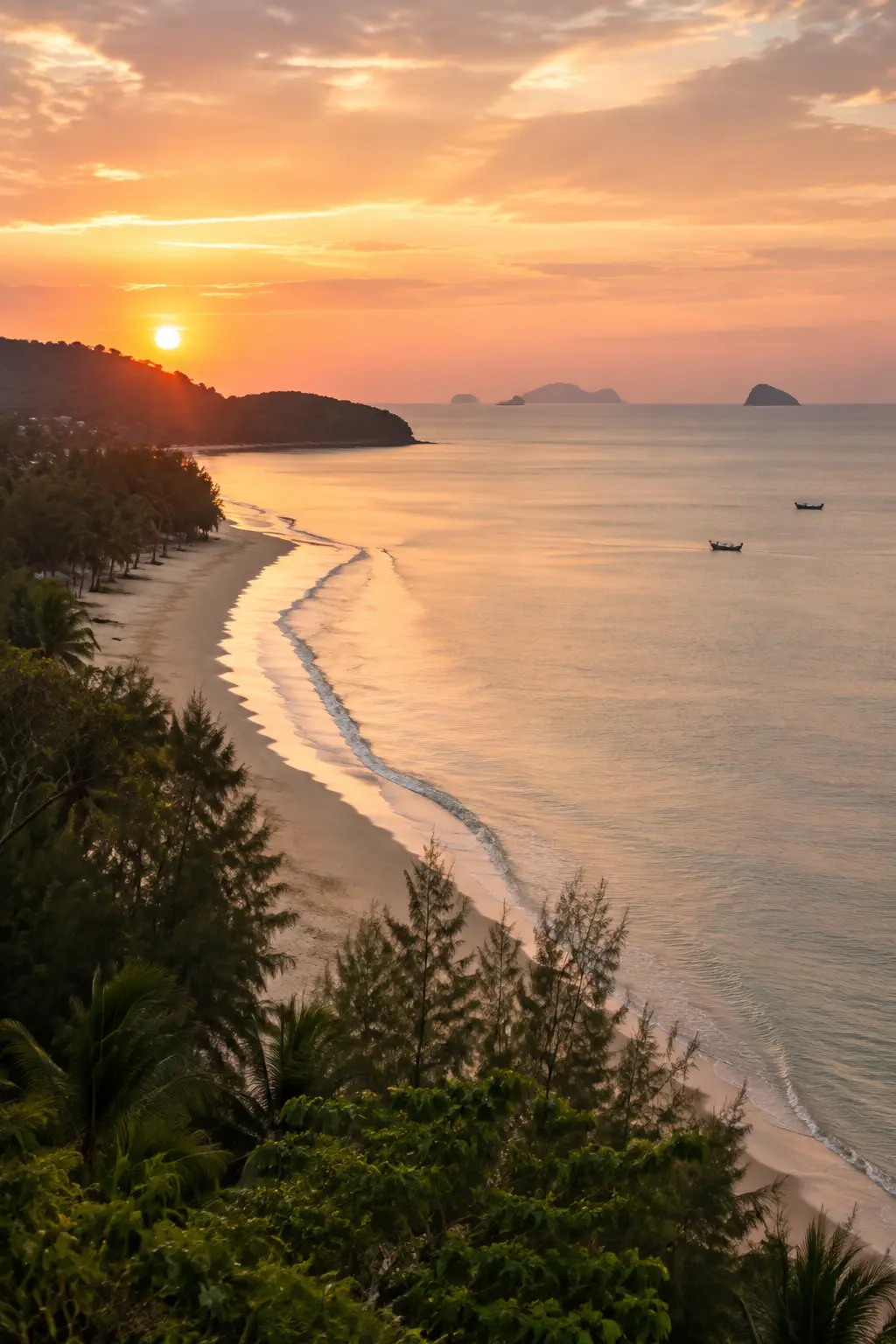
Arrive on Koh Lanta after time spent on Phuket or Koh Phi Phi, and something feels different almost immediately. There is no single strip of high-rise resorts, no one obvious centre of gravity. Instead there are long beaches strung along the west coast, an old wooden trading town on the other side of the island, mangrove-fringed communities inland, and a national park protecting the southern tip. Development clearly happened here — Koh Lanta is not an undiscovered secret — but it happened unevenly, gradually, and across a landscape too varied and too divided to ever be swallowed by one dominant tourism zone.
That unevenness is really the whole story. Koh Lanta never held a single formal meeting at which it decided to become a "slow tourism" island; no such decree exists in the record. What the island did instead was absorb tourism piece by piece, shaped by its geography, its plural communities, its protected landscapes and its own particular pace of change — and the cumulative result came to look, from the outside, remarkably like a deliberate choice.
It would be a mistake, though, to read any of this as a story of an island that resisted tourism or refused development, as though Koh Lanta had somehow held itself apart from the forces reshaping the rest of Thailand's Andaman coast. It did not. Development happened here just as it happened elsewhere. What differs is the shape it took, and the pace at which it unfolded, both of which owe a great deal to the island's own unusual geography and history.
An Island That Was Never One Community
Long before tourism arrived, Koh Lanta was a plural place. Academic research on the island describes a mix of Thai Muslim, Thai-Chinese and sea-people communities, including the Urak Lawoi, each with distinct cultural, religious and economic traditions. Livelihoods here were historically built around fishing, small-scale agriculture and maritime trade rather than any single dominant industry. This diversity matters because it explains why Koh Lanta never developed around one unifying identity in the way some destinations do. There was no single "real Lanta" waiting to be either preserved or displaced by tourism — there were, and still are, several overlapping Lantas, each with its own religious traditions, its own economic history and its own relationship to the sea and the land. A visitor moving across the island today, from a fishing village to an old trading settlement to a beach resort, is really moving between several different long-standing communities rather than through a single homogeneous culture that tourism later divided up.
Old Town: A Trading History Before the Beach Era
On the island's east coast sits Lanta Old Town, described by Thailand's official government sources as a community dating back more than a century, with roots connected to the era of Chinese-junk trade. Long before west-coast beaches drew independent travellers, this waterfront settlement of wooden shophouses functioned as a genuine commercial centre, tied into maritime trading routes that predate any notion of Koh Lanta as a holiday destination.
Old Town remains today as a visible, tangible reminder that the island had its own trading and community life long before resorts appeared. It is not a recreation or a museum piece built for visitors; it is simply what remains of an economic centre that mattered in its own right, well before tourism gave the island a new reason to be known. Its wooden waterfront buildings, some raised on stilts above the tidal flats, speak to a different economic era altogether — one oriented toward trade routes and maritime commerce rather than toward beach holidays and dive shops.
The Urak Lawoi and the Island's Sea-Oriented Layer
Alongside the island's Muslim and Chinese-descended communities, Koh Lanta is also home to the Urak Lawoi, sometimes referred to by outsiders as sea people, though that label alone does not do justice to their distinct community identity. Thailand's Department of Cultural Promotion has published research into Urak Lawoi life and the changes brought by tourism and post-tsunami development, documenting effects on land use, livelihoods and cultural continuity. This is a layer of the island's story that deserves care rather than romanticism — the Urak Lawoi are not a static or untouched community frozen against a backdrop of change, but a living community that has had to navigate real pressures on land and livelihood as the island around them has developed.
Tourism Begins to Take Shape
Koh Lanta's tourism industry began developing in a more organised way from around the late 1970s and through the 1980s. A 2023 historical study identifies 1979 as the starting point for the period of tourism-industry development it examines, while other accounts of the island's history place the emergence of an early backpacker scene in the 1980s. There is no single, mythologised "first bungalow" moment worth dwelling on here; the safest and most accurate account is simply that Koh Lanta's tourism industry took shape gradually across these two decades, building from a small, independent-traveller base rather than arriving as a fully formed resort economy. Compared with destinations that experienced sudden, investment-driven booms, Koh Lanta's early tourism years look more like an extension of the island's existing pattern of small-scale, family-run enterprise than like a wholesale economic transformation imposed from outside.
Why Lanta Grew More Slowly
Geography did much of the shaping. For decades, Koh Lanta depended on boats and vehicle ferries to connect it to the mainland, a fact the Tourism Authority of Thailand explicitly credits with helping the island retain a laid-back atmosphere even as resort development gradually took hold. This is not to say remoteness prevented development outright — it plainly did not — but it shaped the pace and the form that development took. Rather than concentrating in one dense urban core, as happened elsewhere, tourism businesses spread across multiple beaches and settlements, producing growth that was gradual and spatially dispersed rather than sudden and centralised.
The West Coast Becomes the Beach-Tourism Side
Koh Lanta Yai's west coast holds the long beaches most closely associated with the island's modern tourist image. The Tourism Authority of Thailand describes nine major beaches strung along an island more than thirty kilometres long, with accommodation and services developing progressively along this stretch over time. Crucially, different beaches took on different characters and different scales rather than merging into a single continuous resort strip — a pattern that reinforced the island's fragmented, dispersed geography rather than working against it. Some stretches grew busier and more built-up over the years, while others retained a quieter, more modest feel, and the distance between them, both physical and atmospheric, helped preserve a sense of variety that a single unbroken tourism corridor would have flattened out.
Saladan Becomes the Modern Gateway
At the northern tip of Koh Lanta Yai, Ban Saladan emerged as the island's main arrival and commercial hub, according to the Tourism Authority of Thailand, home to the highest concentration of banks, dive shops, markets, clinics and rental services. This represents a genuine shift in the island's economic centre of gravity — away from the older maritime trading centres of the east coast and toward a modern, north-facing tourism economy built around convenience and access. Where Old Town preserves the island's earlier trading-era layer, Saladan represents the newer visitor-facing gateway that grew up alongside it, rather than replacing it outright.
A National Park Protects the South
In 1990, Mu Ko Lanta National Park was established, protecting the southern portion of Koh Lanta Yai along with surrounding smaller islands and marine areas. The Tourism Authority of Thailand presents the park headquarters and the southern lighthouse and cape as part of the island's natural identity today. The park's existence helps explain why large stretches at the island's southern end never became continuous resort development, though it would be an overstatement to credit park status alone for Koh Lanta's slower overall tourism model — it is one factor among several rather than the whole explanation.
An Outcome, Not a Decree
It bears repeating clearly: there is no evidence that Koh Lanta ever formally adopted an island-wide "slow tourism" policy. The label fits the island because of what accumulated over time — remoteness, beaches spread across a long coastline, protected land at the southern end, continuity among established local communities, grassroots community-based tourism initiatives, and a visitor market that came, over the years, to value quieter stays. Koh Lanta is better described as an island that came to embody slow tourism through the accumulation of these factors than as one that consciously decreed it from the outset.
Thung Yee Pheng and Community-Based Tourism
Some of the island's most interesting tourism development did not come from hotels or resort chains at all, but from local communities themselves. Academic research documents community-based ecotourism at Thung Yee Pheng, where local people organised tourism activity around the surrounding mangroves, drawing on local knowledge, conservation practice and community participation. A 2018 study found that the community used tourism management as a genuine tool for local development, with a strong emphasis on self-reliance, resource protection and the fair distribution of benefits among residents. Later research has continued to describe the resulting enterprise as locally owned, with a focus spanning tourism, forest management and community involvement.
This matters because it shows that Koh Lanta's tourism story is not simply one of hotels arriving to fill empty beaches. In at least some parts of the island, tourism was built from the ground up, by the communities who lived there, on their own terms — a markedly different model from investor-led resort development, and one that gave residents a genuine stake in shaping their own local economy and environment.
Community Management as Part of the Island's Character
More broadly, sustainable tourism researchers have repeatedly studied community management and responsible tourism practices on Koh Lanta. This does not mean every tourism business on the island operates sustainably or under community ownership — that would overstate the case considerably. But it is fair to say that community-based tourism has become a visible, researched, and genuinely significant part of how the island has developed, standing alongside the more conventional resort economy rather than being incidental to it.
A Bridge Changes Internal Movement
In June 2016, the Siri Lanta Bridge opened, connecting Koh Lanta Noi and Koh Lanta Yai and officially inaugurated, according to Thailand's Ministry of Transport, on 11 June that year. Local government records from Saladan municipality confirm the same timeline and describe the bridge's role in linking the island's two main landmasses. Before the bridge, travellers and residents relied on a vehicle ferry to cross between Lanta Noi and Lanta Yai; its replacement by a fixed crossing made everyday movement considerably easier for both visitors and residents alike.
It is worth being precise about what this bridge did and did not do: it connected the two main parts of Koh Lanta to each other, not the island as a whole to the Thai mainland. Reaching Koh Lanta from the mainland still requires a separate connection.
The Next Development Pressure
That mainland connection remains an active question rather than a settled fact. Thailand's government has continued to plan a bridge linking the mainland to Koh Lanta Noi, and a 2026 announcement from the Royal Thai Government approved financing arrangements for what is referred to as the Lanta Bridge Project. This shows that questions of accessibility are far from closed on Koh Lanta; if anything, they represent the next chapter in an ongoing story of gradual, incremental change, one that has not yet reached its conclusion.
Beyond Backpackers
Koh Lanta's tourism market has broadened considerably since its early backpacker days. The Tourism Authority of Thailand today describes an island serving families, couples, backpackers and scuba divers, with accommodation ranging from simple guesthouses up to high-end beach resorts. "Slow" tourism, in other words, has never meant cheap or undeveloped tourism. Koh Lanta learned to host several different kinds of visitor at once while retaining a form that remains, spatially and atmospherically, less intensely urbanised than several of Thailand's larger and more famous resort islands.
Why Koh Lanta Feels Different
Set alongside its Andaman neighbours, Koh Lanta's distinctiveness becomes clearer still. Phuket developed as a road, bridge and aviation-connected mass resort island with substantial urban centres of its own. Koh Phi Phi built a compact, highly concentrated tourism identity that gained global fame through cinema. Koh Lanta, by contrast, is a long island made up of multiple communities, reached by a mix of road and ferry, with beaches dispersed across its length, a national park protecting its south, active community-based tourism initiatives, and a pattern of development that simply unfolded more slowly than elsewhere. None of these islands is better or worse for having taken a different path; they are simply different stories, worth telling on their own terms.
Development Still Carries Costs
None of this should be read as suggesting Koh Lanta's development has been without cost or pressure. Research into Urak Lawoi communities documents genuine cultural and land pressures tied to rapid tourism growth in parts of the island, and more recent studies have examined waste-management and carrying-capacity challenges facing Koh Lanta today. These issues deserve acknowledgement in measured terms: slow tourism has not meant impact-free tourism, and the island's ongoing development continues to raise real questions about sustainability and capacity that have not been fully resolved.
Old Town and Saladan: Two Ends of the Same Story
If a single visual pairing captures Koh Lanta's arc, it is the contrast between Old Town and Saladan. One is a historic east-coast trading community, its wooden shopfronts a legacy of the Chinese-junk era. The other is a modern north-end hub of banks, dive shops and rental services, built to serve the needs of contemporary visitors. Together they show how the island's economic centre has shifted over time without ever fully erasing what came before — a pattern that, in miniature, tells the same story as the island as a whole. A visitor who spends a morning in Old Town's quiet lanes and an afternoon among Saladan's dive shops and rental counters has, in effect, walked through the entire arc of Koh Lanta's economic history in the space of a single day.
Why "Slow" Should Not Be Mistaken for "Static"
It is worth being careful, throughout any account of Koh Lanta, not to let the word "slow" slide into something it does not mean. Slow tourism, in this island's case, has never meant an absence of change. Roads have been paved and widened. Ferries have given way, in part, to a fixed bridge. Beaches once served by a handful of family-run bungalows now sit alongside considerably larger and more polished resort operations. What has stayed comparatively constant is not the amount of development but its distribution — spread thinly and unevenly across a long island rather than concentrated into one dominant tourist zone. That distinction, between the pace of change and its geography, is really what "slow tourism" is describing when applied honestly to Koh Lanta.
An Island Shaped by Accumulation
Koh Lanta did not stay low-key because nothing happened there. Tourism arrived, roads improved, resorts opened, a bridge linked its two main islands, and steadily more visitors came each year. But all of this development spread across a long island already divided by beaches, forests, villages, mangroves, old trading communities and protected land — a landscape that resisted, simply through its own shape, the kind of single-centre concentration that produced very different outcomes elsewhere in Thailand.
There was never one moment when Koh Lanta chose slow tourism. The island became slow by accumulation: through geography, through the persistence of its plural communities, through the pace of its physical access, and through the particular, uneven way its development unfolded over four decades.
Even the island's ongoing infrastructure projects reflect this same pattern of incremental, rather than sweeping, change. A single bridge reshaped movement between two halves of the island; a mainland connection remains, even now, a matter of planning and financing rather than a completed fact. Koh Lanta's story has never been one of dramatic before-and-after moments. It has been a story of gradual accumulation, one beach, one bridge, one community initiative at a time — and that, more than any single decision, is what finally gives the island its distinctive, unhurried character. Koh Lanta's real distinctiveness lies not in having avoided tourism altogether, but in having absorbed it without ever letting one single tourism centre become the whole island.