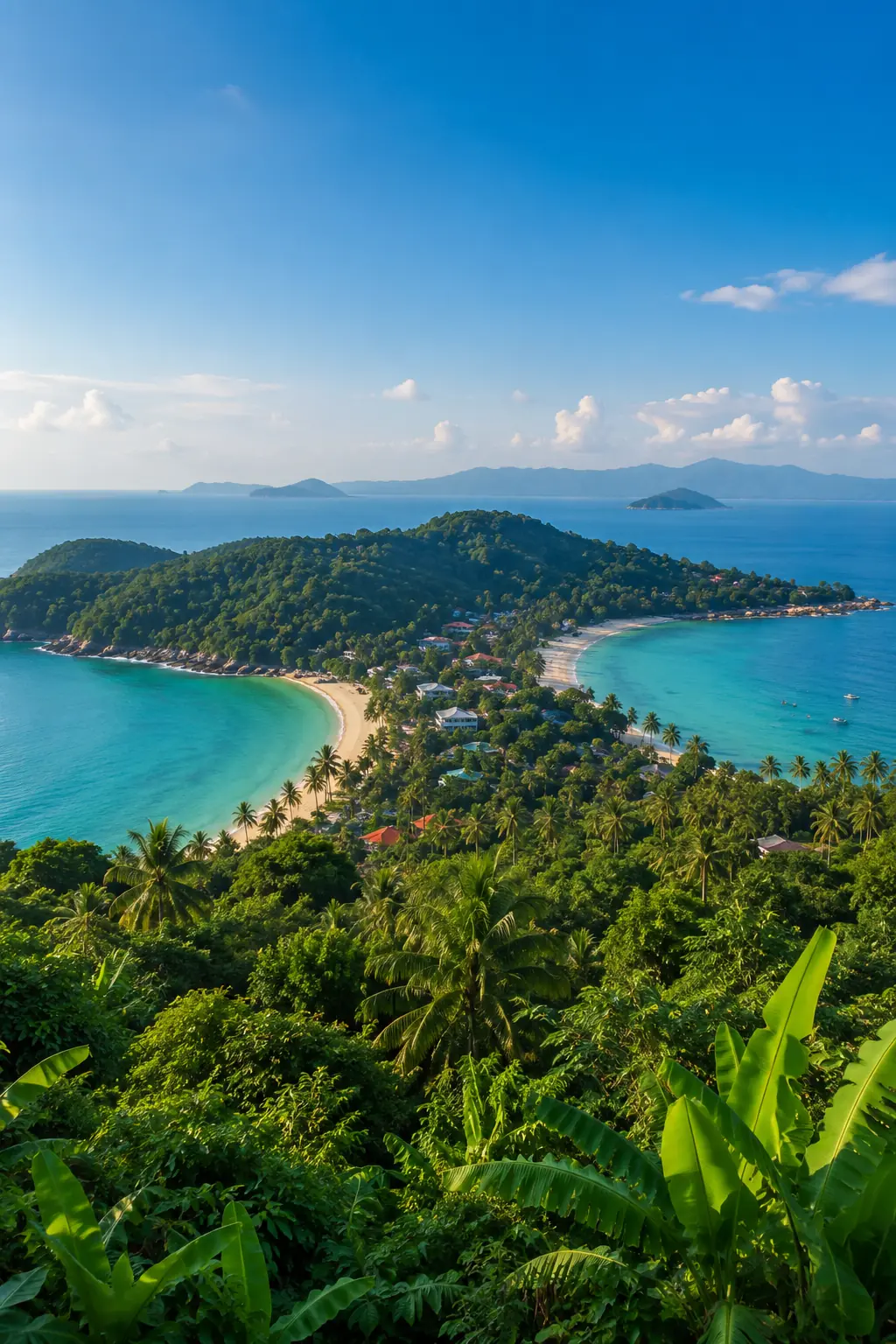
On an ordinary afternoon, Haad Rin looks like most other beaches in the Gulf of Thailand. The sand is pale, the water is calm, and a handful of travellers doze under umbrellas or wander down to the water's edge to cool off. There is little to suggest that, once a month, this same stretch of coastline becomes one of the most talked-about party locations on the planet. When the full moon rises, the beach fills with music, fire, coloured paint and tens of thousands of people, and for one night the quiet island town becomes something else entirely.
That contrast is the whole story of Koh Phangan. A place that grew up on fishing and coconuts became, almost by accident, one of the most recognisable names in world tourism — not because it built an airport or a landmark resort, but because travellers kept coming back to the same beach on the same kind of night. To understand how that happened, it helps to start with the island before anyone had heard of the Full Moon Party at all.
An Island Before the Party
Koh Phangan sits in Surat Thani Province, in the Gulf of Thailand, within reach of its better-known neighbours Koh Samui and Koh Tao. Long before backpackers arrived, the island supported itself the way many Gulf islands did: through fishing, coconut cultivation and small-scale local trade. Village life revolved around the sea and the land, not around visitors. It is worth being clear about this, because the Full Moon Party's fame can make it easy to imagine Koh Phangan as having appeared from nowhere in the 1980s. It did not. It was an established island community long before it became an internationally recognised tourist destination, and that older identity never entirely disappeared — it simply moved out of the international spotlight once one beach began attracting all the attention.
The transformation that Koh Phangan is known for today is really a story about tourism and reputation, not ancient history. It begins not with the island's founding but with the arrival of a very particular kind of traveller.
Backpackers Find the Gulf Islands
Koh Phangan's modern tourism story is closely tied to the independent traveller. Long before package holidays or direct flights made Thailand's islands easy to reach, the Gulf islands were the preserve of backpackers moving slowly through Southeast Asia, chasing word-of-mouth recommendations from one beach to the next. Access to Koh Phangan was by boat only, which kept the pace of development relatively slow at first and gave the island a reputation as somewhere a little further off the beaten track than its neighbours.
There was no single first tourist, no single first bungalow that can be credited with starting it all — the shift happened gradually, one arrival at a time, as travellers passed word along the same informal networks that carried news of cheap guesthouses, good beaches and friendly boat operators from one stop on the map to the next. What made the Gulf islands appealing to this crowd was precisely what made them harder to reach: nothing was mass-produced, nothing was pre-booked from home, and finding a place to stay usually meant asking someone who had been there the month before.
By the 1980s, certain beaches on Koh Phangan had begun to earn a name for themselves within backpacker circles, and one in particular was starting to stand out.
Haad Rin Becomes the Place Everyone Was Talking About
At the southern tip of the island lies Haad Rin, a beach that would eventually become shorthand for the whole of Koh Phangan in the minds of travellers who had never set foot anywhere else on it. Official Thai tourism material identifies Haad Rin as the island's most famous Full Moon Party location, with the event itself taking place on its east-facing, sunrise side. What makes Haad Rin's story so striking is how completely a single beach came to represent an entire island. Koh Phangan is a large, varied place with dozens of other bays and villages, and yet for many people around the world, the name of the island and the name of one beach effectively became interchangeable. A local tourism node turned into a global brand, and it happened almost entirely by word of mouth.
The Full Moon Party's Disputed Beginning
Ask exactly how the Full Moon Party started and you will get several different answers, none of which can be proven beyond doubt. There is no single authoritative record establishing one definitive first party, one exact date or one named founder. What specialist histories of the event tend to agree on is a rough timeframe: somewhere around the mid-1980s, at Haad Rin, often associated with the long-running Paradise Bungalows. Beyond that, the details blur into legend. Some accounts describe a birthday party among travellers; others recall a farewell gathering, a thank-you celebration, or simply an informal night on the beach that happened to coincide with a full moon and got out of hand in the best possible way.
None of these stories can be treated as settled fact, and that is worth stating plainly rather than smoothing over. The most honest way to put it is this: around the mid-1980s, a small full-moon beach gathering began at Haad Rin, and exactly who started it, and why, remains part of the legend. What is far more certain is what happened next.
Why a Simple Idea Spread
The concept behind the Full Moon Party was almost absurdly simple: a beach, a full moon, music and a crowd of travellers with nowhere in particular to be. That simplicity was its strength. Word travelled through the backpacker circuit and the guidebook culture of the era, and a single gathering on a specific beach gradually became a recurring fixture that travellers began building their island-hopping itineraries around. The lunar calendar did much of the marketing on its own — a full moon happens on a predictable schedule, which meant that anyone moving through the region could simply look up when the next one fell and plan to be in Haad Rin for it. No single guidebook or publication can be credited with the party's growth; it spread the way most good travellers' tales do, through repetition, recommendation and the simple appeal of being told about something you didn't want to miss.
From Dozens to Thousands
The earliest full-moon gatherings at Haad Rin were, by most specialist accounts, modest affairs — small groups of travellers numbering only in the dozens. What happened across the 1990s and into the 2000s was a shift in scale that turned a local curiosity into a monthly international event. Precise attendance figures vary considerably depending on the season and the source, and there is no reliable way to pin the growth to an exact number, but the broad shape of the story is not in doubt: a gathering that once involved a few dozen travellers grew into a beach party drawing crowds numbering in the thousands. Few, if any, informal beach traditions anywhere in the world have scaled up quite so dramatically, or quite so quickly.
A Town Built Around One Night
Growth on that scale does not happen without consequences for the place hosting it. A monthly influx of visitors creates demand for accommodation, food, bars, transport, security and clean-up, and Haad Rin absorbed all of it. Rather than simply being an existing resort town that happened to host a popular event, Haad Rin developed its shape and rhythm around the party itself. Guesthouses, bars and services multiplied to serve the monthly surge, and the town became noticeably denser and more tourism-oriented than most of the rest of the island. Thai tourism authorities today still identify Haad Rin as one of Koh Phangan's most popular visitor areas, a status that owes a great deal to decades of monthly crowds shaping the built environment around them.
Access played its part in that story too. Koh Phangan has no airport, and every visitor arrives by sea, commonly connecting through Surat Thani, Donsak or Koh Samui. The monthly party created especially intense peaks in arrivals and departures, with ferries absorbing surges of travellers timed to a lunar calendar rather than a conventional holiday season. It is a useful point of contrast with neighbouring Koh Samui, where the arrival of an airport reshaped the entire island's development. Koh Phangan's fame grew while it remained accessible only by boat — proof that international recognition does not always require the infrastructure normally associated with it.
That is, in some ways, the most unusual feature of the whole story. Most destinations that reach this level of international recognition do so alongside major infrastructure investment: a new airport, a landmark hotel, a government-backed marketing campaign. Koh Phangan built its global reputation with none of that. The island simply kept doing what it had always done — running boats, filling guesthouses, opening bars along the beach — while the party itself did the work of drawing people back, month after month, for decades.
One Beach, One Global Reputation
By any measure, the Full Moon Party succeeded as place branding on an extraordinary scale. Official Thai tourism sources describe Koh Phangan as globally renowned for the event, drawing visitors from around the world specifically because of it. For a great many people, the name "Koh Phangan" was first encountered through the Full Moon Party rather than through geography, history or any other feature of the island. That is a remarkable outcome for something that began as an informal gathering with no marketing budget, no government campaign and no single organiser steering its direction. It grew because people kept telling other people about it, month after month, for decades.
As the original event's fame solidified, it also generated an ecosystem around itself. Half Moon parties, jungle events and other recurring nights developed elsewhere on the island, broadening what had started as a single monthly gathering into a wider party-season economy. This wider nightlife scene matters mainly as context: it shows how one successful event created space for others to follow, rather than existing as the whole story in itself. The heart of Koh Phangan's global reputation remains the original party on Haad Rin beach.
But Koh Phangan Never Became Only Haad Rin
Here is where the popular image of Koh Phangan and the reality of the island start to diverge. Thai tourism material highlights a string of other beaches well beyond Haad Rin — Yao Beach, Mae Haad, Salad Beach and Thong Nai Pan among them — and several are explicitly described as quieter, less crowded and better suited to snorkelling and simply relaxing than anything happening at the southern tip of the island. This matters enormously in correcting the popular caricature of Koh Phangan as nothing but a party island. The island's global reputation is concentrated on one beach far more than the island itself is. Travel a short distance from Haad Rin on any night of the month, full moon or otherwise, and you find a version of Koh Phangan that has very little to do with the image most people carry in their heads.
That gap between reputation and reality has, over time, allowed a second identity to grow alongside the first.
Wellness, Long Stays and a Second Modern Identity
Away from Haad Rin, Koh Phangan has increasingly built a parallel reputation as a destination for yoga, wellness retreats and longer, slower stays. This side of the island developed gradually rather than through any single defining moment, but it is now a genuine and substantial part of Koh Phangan's modern character, distinct from — and in some ways almost a mirror image of — the nightlife the island is best known for internationally. It would be inaccurate to suggest that wellness tourism somehow replaced or displaced the party scene; the two exist side by side, drawing different kinds of travellers to different parts of the same island, sometimes within a few kilometres of each other.
That layering is, in many ways, what makes Koh Phangan unusual among Thailand's islands. Haad Rin transforms dramatically around the full moon, filling and emptying on a monthly rhythm that has little equivalent elsewhere. Other parts of the island keep an entirely different, much slower pace, largely undisturbed by whatever is happening at the southern end. Effectively, one island runs several tourism models simultaneously: a party island in one place, a beach island in another, and something closer to a wellness retreat somewhere else again. Few destinations manage to hold such different identities within a single, relatively small landmass.
A visitor's experience of Koh Phangan, then, depends almost entirely on where — and when — they choose to be. Arrive by ferry away from the full moon and the island can feel like any number of quieter Gulf destinations: a coastal road heading south, coconut groves giving way to guesthouses, an ordinary afternoon on an ordinary beach. Time a visit around the full moon instead, and the same island reveals an entirely different rhythm, one that builds through the evening and peaks somewhere around sunrise before the clean-up crews arrive and the beach, by mid-morning, has largely returned to itself. Both experiences are genuinely Koh Phangan. Neither is the whole picture on its own.
An Event Too Big to Stay Informal
Success on this scale inevitably brings its own demands. Large, recurring crowds create genuine practical needs around waste, safety, transport and crowd management, and the modern Full Moon Party reflects that reality. What began as an unplanned gathering among travellers now involves organised entrance management, security and structured clean-up operations once the crowds disperse. The party did not stop being popular because it grew formal — it grew formal because it had become too large to be managed any other way. That evolution is best understood as a natural consequence of decades of growth rather than as evidence that something has been lost.
The event's importance to the local economy became especially visible during the COVID-19 pandemic, when international tourism to Thailand came to a standstill and the Full Moon Party stopped along with it. Its return once Thailand reopened underlined just how embedded the event had become in local livelihoods across Haad Rin — a brief but telling illustration of how much of the town's economy had come to depend on a tradition that began as nothing more than a night on the beach.
Why the Uncertain Origin Still Matters
There is something genuinely revealing in the fact that nobody can agree on exactly how the Full Moon Party began. It was never a planned tourism campaign, a government branding exercise or a corporate marketing idea. It grew organically, through repetition, through the informal networks travellers built as they moved between islands, and through the everyday decisions of small local businesses responding to demand as it appeared. That organic, almost accidental quality is part of what makes its eventual scale so remarkable. Few destinations become globally famous through something that started too small and too informally for anyone to bother writing down exactly how it happened.
Three Islands, Three Different Stories
Koh Phangan's transformation makes the most sense when set alongside its closest neighbours, each of which followed a strikingly different path despite sitting within sight of one another in the same stretch of the Gulf. Koh Samui moved from a coconut economy through backpacker tourism to become a global resort island once an airport arrived. Koh Tao, more isolated still, built its identity around backpackers and dive schools to become Thailand's dive capital. Koh Phangan took a third route entirely: a quiet Gulf island that became a backpacker beach, then home to a full-moon legend, and eventually carried a global party identity that the rest of the island never quite matched. None of the three is better or worse than the others — they are simply three distinct answers to the same starting conditions, three different tourism transformations that happened to unfold within sight of each other.
The Island Behind the Reputation
Koh Phangan's story is one of the more unusual examples of tourism branding to come out of Thailand. An entire island became globally famous because of a recurring party that began small enough that nobody involved thought to record exactly how it started. A small gathering became a tradition. The tradition became a fixed date on the lunar calendar. The calendar date became an international event, spoken about in guidebooks, travel forums and, eventually, well beyond the backpacker world that first embraced it. And the event became the island's global identity, carried by word of mouth long before any tourism board thought to claim credit for it.
And yet the strange, easily overlooked part of the story is that most of Koh Phangan never became Haad Rin at all. Beyond the reach of the monthly crowds, the island still keeps its quieter beaches, its fishing villages, its temples and its slower rhythms — a version of Koh Phangan that existed before the first full moon gathering and has simply continued alongside it ever since. The island became famous because of one beach, on one kind of night, month after month for decades. But the island itself was always far larger than the reputation that beach created for it.