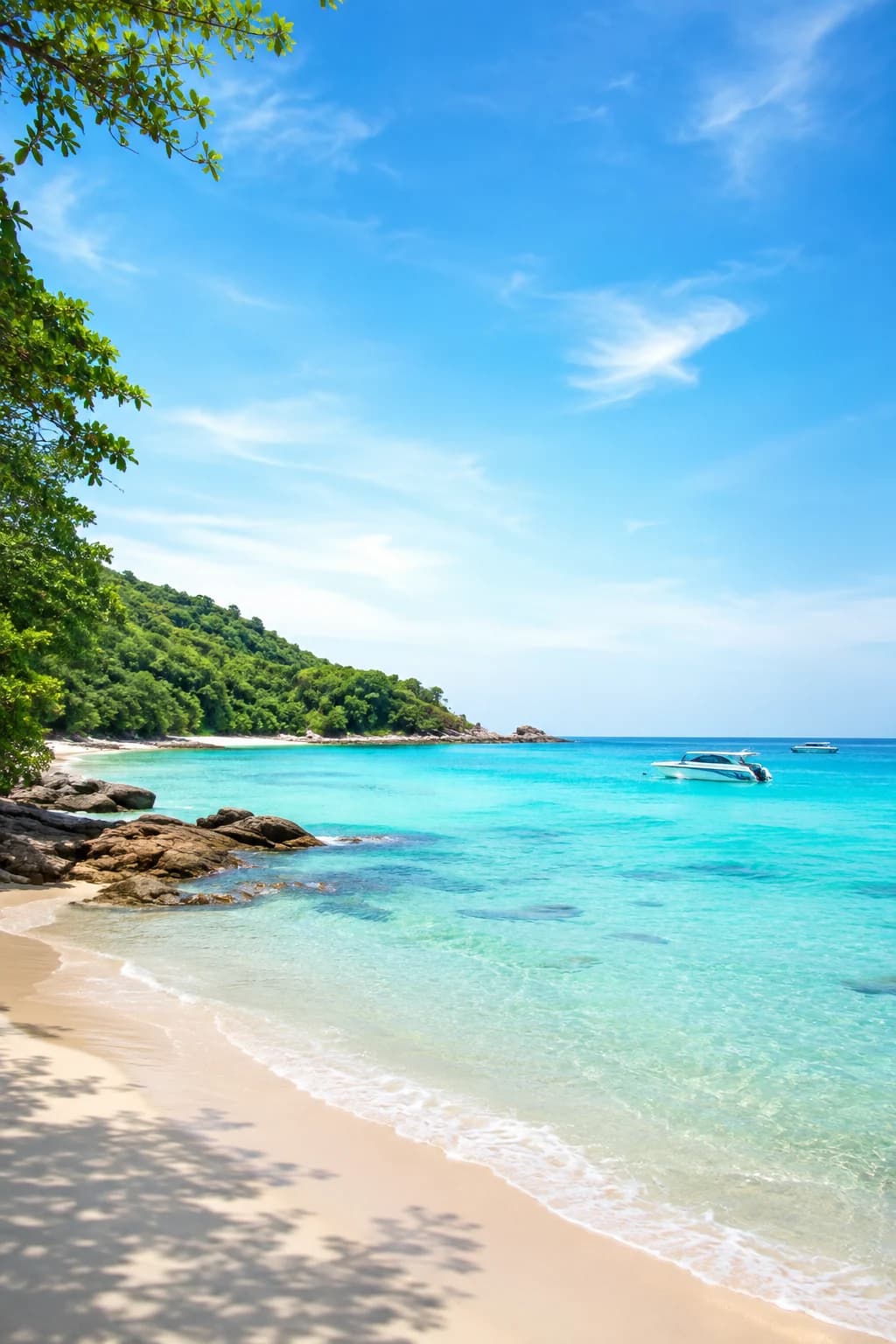
On a Monday morning, Koh Samet is quiet. The beaches are half-empty, the restaurants have space to spare, and the island settles into the unhurried pace of a small community going about its week. By Friday evening, the same beaches look entirely different — busier, louder, filling with visitors who left Bangkok that afternoon and are already thinking about how little of the weekend is left. Come Sunday night, the island exhales again. Few places in Thailand wear such a visible weekly rhythm, and understanding why requires looking not at what makes Koh Samet remote, but at what makes it reachable.
Before the Weekend-Island Identity
Koh Samet is a small island off the coast of Rayong, administratively part of Rayong Province, in the Gulf of Thailand. Long before it became known as a short break from the capital, it existed as a local island community in its own right — not empty, not undiscovered, simply a smaller and quieter place than the resort island it would eventually become. Its detailed early history is not well documented in the sources this story draws on, so it is best left at that: an island with its own community life, waiting for nothing in particular, before tourism arrived and reshaped it into something else.
What makes Koh Samet worth telling as a story at all is not any single dramatic turning point, but the accumulation of ordinary, practical factors — a national park designation, a stretch of improving coastal road, a growing number of Bangkok residents looking for somewhere close enough to reach on a Friday afternoon. None of these things sound especially remarkable in isolation. Together, they produced one of the most distinctive tourism identities of any island in Thailand.
1981: A National Park Around a Future Resort Island
The single most important fact in Koh Samet's story might be one that sounds, at first, like a footnote. In 1981, the area was designated Khao Laem Ya-Mu Ko Samet National Park, Thailand's 34th national park according to TAT Newsroom. The protected area covers roughly 131 square kilometres of land and sea, taking in Koh Samet itself alongside Khao Laem Ya, Mae Ramphueng Beach and several smaller islands nearby.
This is the central paradox running through everything that follows: Koh Samet became one of Thailand's most heavily visited weekend islands while remaining, on paper, inside a national park the entire time. National-park status did not mean the island stayed undeveloped — resorts, restaurants and bars spread across its beaches over the following decades regardless of the protective designation surrounding them. The tension between those two realities, conservation framework and resort development, runs through the rest of Samet's history and never entirely resolves.
Tourism Takes Hold in the 1980s
Multiple historical travel sources place the growth of backpacker tourism on Koh Samet in the 1980s, in the years immediately following the national park's creation. A Swedish travel feature from 2004 recalled that foreign tourists began discovering the island during that decade, while Thai visitors — weekend travellers from Bangkok especially — remained a major part of the market throughout. At least one long-running bungalow resort is identified in travel-guide material as having opened in the early 1980s, one of the first pieces of accommodation infrastructure on an island that had very little of it before.
These are secondary accounts rather than official historical records, and no single exact year marks the moment tourism "started" on Koh Samet. What can be said with reasonable confidence is broader and, in a way, more useful: by the 1980s, Koh Samet was becoming established among backpackers and Thai weekend travellers alike, a dual identity that would go on to define the island for decades.
Why Bangkok Changes Everything
Here is the fact that anchors the entire story. The Tourism Authority of Thailand explicitly describes Koh Samet as a popular weekend getaway for Thais and for foreigners living in Bangkok — and that single detail sets Samet apart from nearly every other island destination in the country. Phuket, Samui and Phi Phi built their modern identities largely around longer international holidays. Koh Samet's identity, by contrast, is tied specifically to short trips from the capital: a journey overland toward Rayong and Ban Phe, followed by a boat crossing to the island itself.
It would be a mistake to pin down a precise historical travel time between Bangkok and the island, since roads, traffic conditions and transport options have all changed considerably over the decades this story spans. The more accurate way to frame it is this: as transport along Thailand's eastern seaboard gradually improved, Koh Samet became increasingly practical as a two- or three-day escape — close enough to fit around a working week, far enough to genuinely feel like leaving the city behind.
A Weekly Rhythm Built Into the Island
The Tourism Authority of Thailand describes Koh Samet in terms unusually explicit for a destination profile: quiet and relaxing on weekdays, considerably livelier on weekends. That rhythm is not incidental to the island's identity — it is close to the whole point of it. Bangkok residents do not need to take an extended holiday or book a domestic flight to reach Samet, which means the island absorbs a pattern of frequent, short, repeated visits rather than the longer, once-a-year international holidays that shape many of Thailand's other islands.
The effect is something close to a living tide, timed to the working week rather than the seasons. On a Friday afternoon, the island's character visibly shifts as boats bring in a wave of weekend arrivals; by Sunday evening, as the same visitors head back toward Bangkok, Samet settles back into something closer to its weekday self. It is a pattern worth describing plainly rather than dismissively — not a lesser or more commercial version of island tourism, simply a different one, built around domestic rhythms rather than international holiday calendars.
That distinction is worth dwelling on, because it separates Koh Samet from almost every other well-known Thai island in a fundamental way. Where Phuket, Samui or Phi Phi built their reputations largely around visitors arriving from the other side of the world for a single, longer holiday, Samet's core audience has always included people who might visit a dozen times a year, each stay lasting only a couple of days. That kind of repeat, high-frequency relationship with a destination produces a very different island — one shaped as much by regulars as by first-time visitors.
Hat Sai Kaew and the Developed East Coast
Not every part of Koh Samet absorbed this weekend surge equally. The Tourism Authority of Thailand notes that the island's more developed beaches sit mainly along the east coast, and Hat Sai Kaew — the best known and liveliest of them — became, in effect, the public face of the island. Its white sand, dense accommodation, restaurants and nightlife made it the image most visitors associate with Koh Samet, and its position on the island's northern and eastern arrival side meant it absorbed a disproportionate share of the island's overall visitor traffic. Nearby beaches such as Ao Phai developed a broadly similar character, becoming known for restaurants, bars and the kind of social, backpacker-friendly tourism that had helped establish the island in the first place.
This unevenness matters for understanding Koh Samet today. Development spread across many separate coves rather than consolidating into one continuous high-rise resort strip, which is part of why a visitor can experience genuinely different versions of the island within a fairly small area — busy and commercial in one cove, considerably quieter just a short walk or boat ride away. The northern and eastern arrival side of the island, closest to the boats coming in from Ban Phe, naturally absorbed the bulk of that early development, while corners further south saw comparatively little of it for years.
The West Coast Tells a Different Story
Where the east coast built its reputation on volume and energy, Koh Samet's west coast developed along different lines entirely. The Tourism Authority of Thailand contrasts the busier, more developed eastern beaches with quieter, generally more upscale resorts on the western side of the island, and Ao Phrao stands as the clearest current example of that difference. This diversification matters because it complicates any simple idea of Samet as a purely budget, backpacker-only destination. "Weekend island" does not mean the same thing as "cheap island" — modern Koh Samet serves backpackers, Bangkok couples, families, larger groups and considerably higher-end resort guests, often within a short distance of one another.
A Small Island With No Water of Its Own
One physical fact does more than almost any other to explain why Koh Samet's popularity has always come with real limits attached: the island has no natural freshwater source. Water has to be brought in from the mainland or collected from rainfall, a constraint that shapes everything from hotel capacity to daily life for anyone living there. It is one of the clearest physical explanations for why carrying capacity became such a persistent concern on Samet — a small island can absorb large weekend crowds in terms of beach space and bar seating far more easily than it can expand a water supply that was never designed for that scale of demand in the first place.
Planners Were Already Worried by the 1990s
Concerns about Koh Samet's capacity to absorb its own popularity are not a recent development. A 1997 planning thesis from Chulalongkorn University studied the island specifically to develop physical-planning guidelines for tourism that would respect its underlying carrying capacity, and its findings were not encouraging. The research identified three major categories of problems: environmental deterioration, difficulties managing resources and land, and shortages across basic infrastructure. It went further, arguing for controls on tourist numbers, improvements to infrastructure and clearer land-use management — recommendations that suggest planners were grappling with real strain on the island's resources as early as the mid-1990s, barely a decade or two after mass tourism first took hold.
None of this amounts to proof that tourism on Koh Samet has been simply harmful. What it demonstrates, more precisely, is how quickly popularity created genuine management challenges on an island of Samet's size — challenges that planners were already documenting and trying to address well before the island reached anything like its current level of development.
A National Park and a Resort Island, Coexisting Uneasily
The tension identified back in 1981 — a national park that also became a resort destination — never fully went away. Later research from NIDA documents ongoing land-use conflicts on Koh Samet involving tourism development, settlements, agriculture and protected forest, complicated further by overlapping jurisdictions and inconsistent enforcement of land management rules. This is best understood as a long-running, largely unresolved tension rather than a settled dispute with a clear resolution: Koh Samet's modern form developed inside a protected area from the very beginning, which means tourism growth and conservation management have always been forced to coexist on the same small piece of land, sometimes uncomfortably.
More recent academic research has continued to study the island through this lens. Work examining visitation frequency and willingness to pay for conservation at Khao Laem Ya-Mu Ko Samet National Park points to an island where repeat visitation remains genuinely important to how the park is managed and funded — consistent, in its own way, with everything the rest of Samet's story suggests about its identity as a place people return to again and again rather than visit only once.
Ban Phe: The Unseen Half of the Journey
No account of how Koh Samet became reachable from Bangkok is complete without Ban Phe, the small town on the Rayong mainland that functions as the island's principal gateway. TAT's own material on Rayong identifies Ban Phe as a local seafood and market centre in its own right, with Koh Samet standing as the province's signature island attraction just offshore. Ban Phe does not need — and does not really support — a story of its own; its role here is simply to illustrate the transport chain that makes Samet's relationship with Bangkok work at all: road travel to Rayong and Ban Phe, followed by a boat crossing to the island. Remove either half of that chain and the "weekend island" identity built around Bangkok's proximity would not exist in anything like its current form.
Why the Missing Airport Matters
Koh Samet has no airport, and arrival still requires a sea crossing regardless of how developed the mainland road connections have become. That single fact keeps the island genuinely an island, both physically and psychologically, even as its relative closeness to the capital might otherwise suggest an easy, almost suburban getaway. The road can carry a traveller most of the way there, but the boat is what completes the sense of having actually left the city behind. It is a useful point of contrast with Koh Samui, where the arrival of an airport transformed access, and with it the whole shape of the island's tourism development, on a far larger scale than anything Koh Samet experienced. Samet's development took a different path specifically because that particular shortcut was never available to it.
Modern Samet: Several Islands in One
Put all of this together and modern Koh Samet emerges as a genuinely layered place rather than a single, uniform resort strip. Weekdays remain quiet and relaxed; weekends turn lively and crowded, exactly as the Tourism Authority of Thailand's own description suggests. The developed, busy beaches of the east coast coexist with the quieter, more upscale resorts of the west. Dozens of individual resorts, bars and restaurants are spread across numerous separate beaches rather than concentrated into one dominant development, meaning the island never fully committed to being only one kind of destination. That, in the end, may be Samet's real achievement: not becoming Thailand's biggest or most famous resort island, but finding a way to be several different islands at once, each accessible within a short walk or boat ride of the others.
Different From Phuket, Samui and Phi Phi
Set alongside Thailand's other major island transformations, Koh Samet's path is distinctive for reasons that have little to do with size or fame. Phuket's story runs through tin mining and trade toward full international resort transformation. Samui moved from a coconut economy through backpacker tourism to global resort status once an airport reshaped its accessibility. Phi Phi went from backpacker island to cinema location to mass global icon almost overnight. Koh Samet followed none of these routes: a protected small island that combined backpacker tourism with Thai domestic short breaks to become, specifically, Bangkok's weekend beach escape. None of these transformations should be ranked against the others — they simply reflect how differently Thailand's various islands responded to broadly similar tourism pressures. What sets Samet apart, more than anything else, is its domestic and metropolitan relationship: an island defined less by international fame than by its place in the weekly rhythm of Bangkok life.
Conservation Remains Part of the Story
Koh Samet's future, much like its past, continues to be shaped by the tension between popularity and the limits of a small protected island. A 2014 study into Thai tourists' willingness to pay for beach improvement on Koh Samet found that cleanliness and water quality ranked among the management attributes visitors valued most, and more recent research conducted at Khao Laem Ya-Mu Ko Samet National Park continues to examine visitor willingness to pay for conservation and park improvement more broadly. None of this amounts to a policy report, and it would be wrong to end the story there — but it is worth noting that the questions raised by planners back in the 1990s have not disappeared. They have simply become part of the island's ongoing, unfinished relationship with its own popularity.
Friday Evening, Sunday Evening
Koh Samet never needed to become Thailand's biggest resort island, and it never really tried to. Its advantage was always distance, carefully balanced: close enough to Bangkok for a weekend, far enough away to require a boat, developed enough over the decades to make short trips genuinely easy, and still fragmented enough across its many separate coves for quiet corners to exist well beyond the busiest beaches. That particular combination created a tourism rhythm unlike anything found on Thailand's larger, more internationally famous islands.
Koh Samet became Bangkok's beach escape not because it was the most remote island in Thailand, but because it was almost the opposite — the island that was just reachable enough to become part of the capital's weekly life, quiet on a Tuesday and transformed again by the following Friday night.