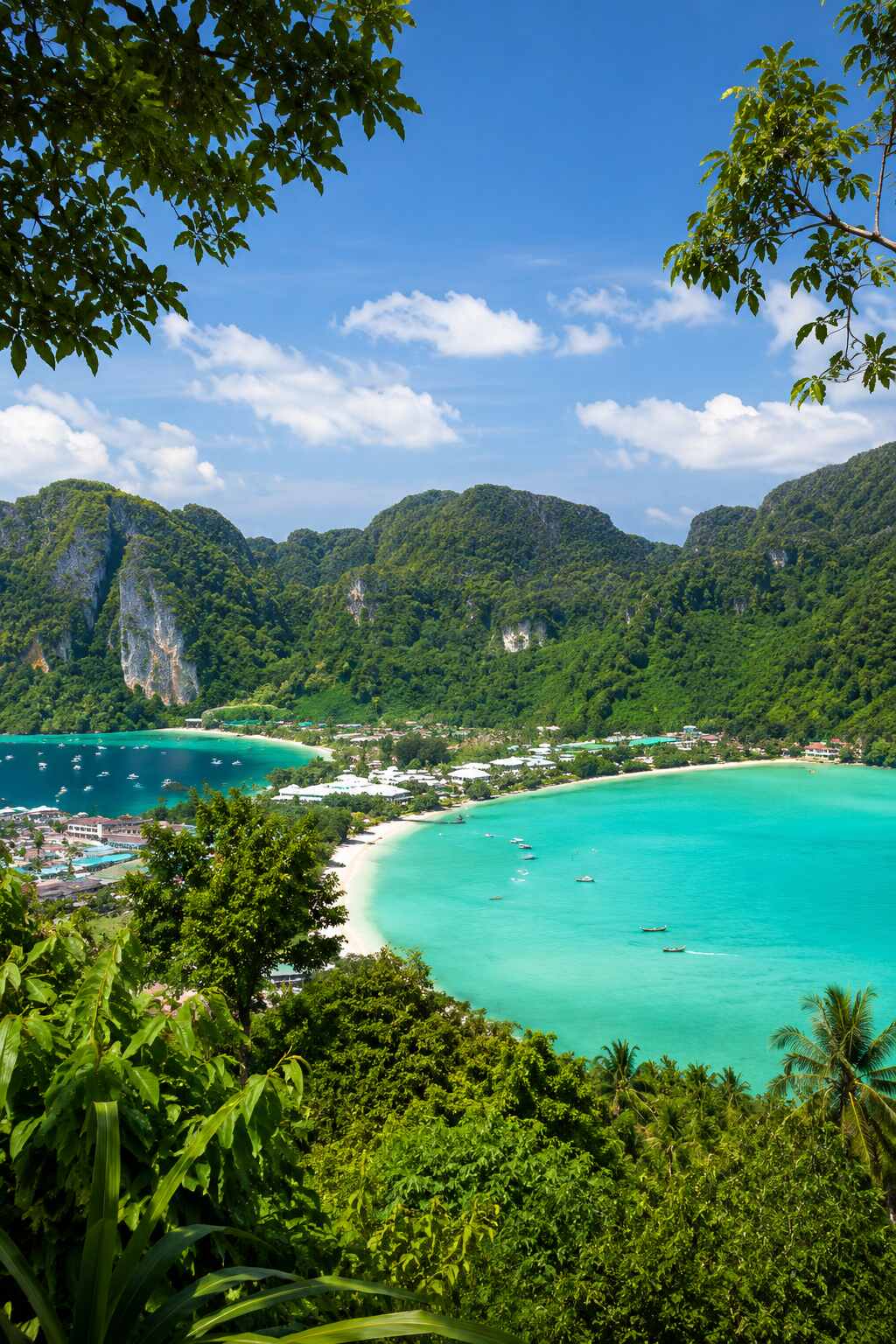
Ask most people to picture Thailand's most famous island view, and there is a strong chance they will describe the same scene without ever having set foot there: a turquoise bay closed in on three sides by sheer limestone cliffs, a crescent of white sand, longtail boats bobbing at anchor. That image is Maya Bay, and it belongs to Koh Phi Phi Le, one half of an island group whose modern history is really a story about visibility — how a place moves from being known to a small circle of independent travellers to being recognised, almost instantly, by people who have never left home.
Phi Phi's story is not a simple rise-and-fall narrative, and it should not be read as one. Cinema transformed its fame overnight, mass tourism followed, the 2004 tsunami struck with devastating force, and reconstruction brought the island back — but at each stage, Phi Phi has had to learn something new about the consequences of being seen by so many people at once.
This is also not a story that begins and ends with a single Hollywood film, tempting as it is to tell it that way. Phi Phi had already built a considerable reputation among independent travellers long before any camera crew arrived, and it has continued to evolve, through disaster, recovery and increasingly careful environmental management, long after that film's premiere faded from the headlines.
One Destination, Two Islands
Before going any further, it is worth being precise about geography, because Phi Phi is routinely misunderstood as a single island. The Tourism Authority of Thailand describes the Phi Phi group as part of Hat Noppharat Thara–Mu Ko Phi Phi National Park, comprising two major islands — Phi Phi Don and Phi Phi Le — along with several smaller islands nearby. Phi Phi Don is the principal inhabited island, home to accommodation, restaurants and the island's tourism economy. Phi Phi Le is uninhabited, and it is here, not on Phi Phi Don, that Maya Bay is found. This distinction matters throughout the island's history, and confusing the two obscures rather than clarifies the story. Phi Phi Don carries the weight of settlement, commerce and daily life; Phi Phi Le, by contrast, exists largely as a place people visit rather than live, its fame resting almost entirely on a single, extraordinary bay.
Working Communities Before Global Fame
Long before Phi Phi became an international name, its islands supported fishing and small island communities, much like many other parts of the Andaman coast. There is no need to invent a precise settlement date or detailed history here; the essential point is simply that these were lived-in, working communities well before Phi Phi became an international tourism brand. The islands' modern global fame is a relatively recent chapter layered on top of a much older, quieter existence, one built around the sea rather than around the visitors the sea would eventually bring.
Backpackers Arrive First
Phi Phi's international reputation was built by backpackers long before mass package tourism discovered it. Academic tourism literature on the island describes its development from a relatively small island tourism economy into a heavily visited destination in the years before the 2004 tsunami, with early accommodation concentrated in a smaller-scale form around Phi Phi Don, particularly in the Tonsai area. There is no reliably documented "first bungalow" moment to anchor this history to a precise year, but by the 1980s and into the 1990s, Phi Phi had become well established on the wider Southeast Asian backpacker circuit — a place travellers heard about from other travellers long before any film brought it to a global audience. That word-of-mouth reputation, built up over more than a decade of independent travel, gave Phi Phi a genuine tourism identity of its own well before global cinema ever became part of the story.
It is worth noting how typical, in some respects, this early phase was of a wider pattern across Southeast Asia's coastal destinations during those decades. Backpackers of that era often prized exactly the qualities Phi Phi could offer: dramatic scenery, a laid-back pace, and accommodation cheap and simple enough to suit a traveller moving from island to island on a modest budget. What distinguished Phi Phi from many of its regional counterparts was less the nature of this early growth than what would happen to it afterwards.
Tonsai Becomes the Island's Heart
Tonsai Bay and Tonsai Village grew into the main arrival point, accommodation hub and commercial centre of Phi Phi Don. The Tourism Authority of Thailand today describes Tonsai as containing numerous bars, restaurants and shops, while smaller beaches elsewhere on the island offer quieter accommodation for those seeking a different pace. Much of this settlement sits on a low-lying isthmus stretched between Tonsai Bay and Loh Dalum Bay — a distinctive piece of geography that gave the island its urban centre, and one that would later prove tragically significant. The very feature that made Tonsai so practical in ordinary times, a narrow strip of flat land linking two sheltered bays and offering easy access to boats on either side, was also the feature that would leave it exposed when the sea itself became the threat.
Growing Up Inside a Protected Area
In 1983, Hat Noppharat Thara–Mu Ko Phi Phi National Park was established, encompassing the archipelago's major marine and island landscapes. This detail is worth dwelling on, because it means Phi Phi's tourism growth and its conservation status developed alongside one another, rather than one following cleanly after the other. National park designation did not prevent tourism development from taking place around it. Instead, it created a long-running tension between public access and conservation that has shaped much of Phi Phi's more recent history, right through to the management decisions of the present day. That tension is worth keeping in mind as the island's story unfolds, because it resurfaces again and again — in the pressures that built up around Maya Bay in particular, and in the eventual decisions authorities made to manage, rather than simply permit, public access to the island's most celebrated natural sites.
The Landscape Behind the Fame
What makes Phi Phi so visually distinctive is well documented by the Tourism Authority of Thailand: aquamarine water, dramatic limestone cliffs, beaches, rich marine life and excellent diving conditions. Maya Bay itself sits enclosed by towering limestone walls on Phi Phi Le. The wider archipelago shares visual DNA with the limestone landscapes of nearby Krabi, but over time Phi Phi carved out its own, entirely distinct tourism identity, separate from its geological cousin along the coast.
A Film Changes Everything
The single event that did more than any other to make Phi Phi a household name arrived in 2000, when Maya Bay served as a filming location for the Hollywood film The Beach, starring Leonardo DiCaprio. The Tourism Authority of Thailand explicitly confirms this connection between the film and the site. It is worth being clear about what the film did and did not do: it did not discover Phi Phi, which already had an established tourism history stretching back decades. What it did was take an image already known to a relatively narrow circle of travellers and amplify it to a genuinely global audience, almost overnight. There is no reliable figure for exactly how much visitor numbers rose as a result, but the qualitative shift in the island's international profile was immediate and lasting.
Maya Bay Becomes the Postcard
In the years that followed, Maya Bay solidified its position as one of the most instantly recognisable images of tropical Thailand anywhere in the world. Day trips from Phi Phi Don, from Phuket and from Krabi made the bay increasingly accessible to ever larger numbers of visitors, and its visual formula — turquoise water, white sand, sheer limestone walls rising on every side — became one of the most reproduced tourism images the country has ever produced. There is a real irony worth noting here without cynicism: the bay was often marketed as a secluded escape even as it grew, year on year, into one of the busiest single sites in the region. This was not a failure of any one party so much as the predictable outcome of extraordinary and sustained global demand meeting a single, small, physically enclosed bay. A location whose entire appeal rested on a sense of isolation and quiet was, almost by definition, poorly suited to absorbing an ever-growing stream of day-trip boats without that same sense of isolation beginning to erode.
It is also worth remembering that Maya Bay's fame did not develop in isolation from the rest of the archipelago. Phi Phi Don's own hotels, boat operators and tour companies grew alongside the bay's reputation, since so much of the demand to see Maya Bay was, and remains, channelled through day trips organised from the main island, from Phuket, and from Krabi. The bay's fame therefore became bound up with the wider tourism economy of the whole region, not just with Phi Phi Le itself.
26 December 2004
On 26 December 2004, the Indian Ocean tsunami struck Phi Phi Don. Academic research identifies the island as among the Thai tourist areas most severely affected by the disaster, with the low-lying, densely built isthmus between Tonsai and Loh Dalum proving extremely vulnerable to the wave. Studies of the event document widespread destruction to tourism buildings and infrastructure across the settled part of the island. As with any account of this disaster, human loss must be treated with restraint rather than detail for its own sake; reported casualty figures for the wider affected region vary considerably, and rather than repeat an uncertain number, it is enough to acknowledge that the loss experienced on Phi Phi that day was severe, and that it deserves to be remembered with the seriousness it warrants.
Why Tonsai Was So Exposed
The same narrow, low-lying isthmus that made Tonsai such a convenient site for a concentrated tourism settlement also left it exposed to the sea from both sides at once. Studies of the island's post-tsunami reconstruction point to dense tourism development and building layout as factors relevant to the scale of the damage sustained. This is not an assignment of blame to the businesses or residents who built there; the geography that made Tonsai practical for daily commerce and accommodation was, under the extraordinary force of a tsunami, the very same geography that left it so vulnerable. Density and convenience, in ordinary times, are assets for any tourism settlement; on 26 December 2004, on this particular strip of low-lying land, they became liabilities instead.
Rebuilding and Return
Reconstruction on Phi Phi is described in academic research on Thailand's tourist-coast recovery as having proceeded rapidly, driven by the central economic importance of tourism to island livelihoods and by strong pressure to reopen businesses and restore visitor confidence. As elsewhere along the affected coast, post-tsunami debate considered whether reconstruction could be used to make development safer and more sustainable going forward; some studies concluded that, in practice, recovery priorities often favoured the rapid restoration of tourism over deeper structural reform. Rebuilt accommodation, restaurants, boat services and diving operators gradually restored the island's visitor economy in the years that followed. The disaster was catastrophic, but it did not end Phi Phi's role in international tourism — the island returned, even as questions about vulnerability and sustainable development continued alongside that recovery. What makes this recovery notable is not that it happened, since tourism-dependent communities across the region shared much the same imperative to rebuild quickly, but that it happened on an island whose fame, thanks to a single film released only a few years earlier, meant the world was watching its progress more closely than it might otherwise have done.
From Backpacker Island to Multi-Market Resort
Modern Phi Phi reflects just how far its visitor base has broadened since its early independent-traveller days. Today's island combines backpacker accommodation and nightlife with diving operators, mid-range hotels and high-end resorts side by side. The Tourism Authority of Thailand presents Tonsai as the island's lively centre, while its smaller, quieter beaches serve honeymoon, family, budget and luxury markets alike. Backpackers have not disappeared from this picture; they remain part of a much wider mix than existed in the island's earlier decades.
Success Creates a New Problem
By the 2010s, Maya Bay's popularity had become its own form of pressure. Ever-increasing numbers of day-trip boats and visitors were converging on a single, small, enclosed natural site, and in 2018 Thai authorities took the significant step of closing Maya Bay to tourists altogether, to allow for ecological recovery. This closure became one of the most visible examples in the world of a famous natural attraction being deliberately withdrawn from the tourism market for the sake of rehabilitation. It should not be read as suggesting that tourists alone caused every form of environmental damage recorded there — impacts of this kind typically have multiple contributing causes — but intense visitor and boat pressure was clearly among the management concerns that prompted the intervention.
Reopening Under New Rules
Maya Bay has since reopened, but under a markedly different management model than existed before its closure. Modern rules have introduced controlled access, including use of a rear-side route via Loh Samah rather than boats landing directly on Maya Bay's beach, limits on the flow of visitors, and restrictions on swimming within the bay itself. Thailand's Department of National Parks continues to close Maya Bay and other nearby sites on a seasonal basis for natural-resource recovery and safety reasons, and the precise details of current access rules are liable to change over time. What matters for the island's broader story is the underlying shift this represents: Maya Bay's modern tourism experience is now a deliberately and actively managed one, rather than a site of simple, unrestricted open access. Where the bay's early fame rested on the idea of a hidden, undiscovered paradise, its present-day management rests on the opposite premise — that a site this famous can no longer be treated as hidden at all, and must instead be actively protected from the scale of its own popularity.
Conservation Becomes Part of the Story
Phi Phi's modern identity now extends beyond beaches and nightlife to include visible efforts at visitor management and ecological rehabilitation. The shift from essentially open access to a controlled system at Maya Bay illustrates how tourism policy on the island has changed over time. This should not be framed as some belated national reckoning with the idea that tourism itself was harmful; the more accurate account is that a globally famous natural attraction required a genuinely different management model once visitor pressure reached a scale the site could no longer comfortably absorb.
Distinct From the Rest of Krabi
Phi Phi is administratively part of Krabi Province, yet its story stands apart from the wider region. Krabi's broader identity is shaped by its dramatic limestone landscape and the destinations built around it, such as Ao Nang and Railay, along with the rock-climbing culture those cliffs have attracted. Phi Phi's identity, by contrast, rests on island tourism, backpacker fame, cinema, the 2004 tsunami, reconstruction and a very particular story of visitor-management transformation at Maya Bay. Phi Phi deserves to be understood on its own terms, rather than folded into a broader account of Krabi's geology. Where Krabi's story is fundamentally about a landscape and the activities it makes possible, Phi Phi's is fundamentally about visibility itself — about what happens to a place once the rest of the world decides, for one reason or another, that it wants to see it too.
Fame Itself Becomes the Challenge
Phi Phi changed because more and more of the world learned, in successive waves, to see it. Backpackers first carried its reputation outward by word of mouth. Cinema then transformed Maya Bay into a genuinely global image, recognised by people who could not have named the wider island group it belonged to. The 2004 tsunami revealed, in the most severe way possible, just how vulnerable the island's tourism settlement really was. Reconstruction restored the visitor economy that followed. And eventually, sheer popularity forced an entirely new kind of question: how do you keep showing the world a place without steadily destroying the very qualities that made everyone want to see it in the first place?
Koh Phi Phi's modern history offers no tidy conclusion. It is, instead, a continuing story of increasing visibility — and of an island that has had to learn, more than once, how to live with the consequences of being one of Thailand's most recognisable and most photographed places.