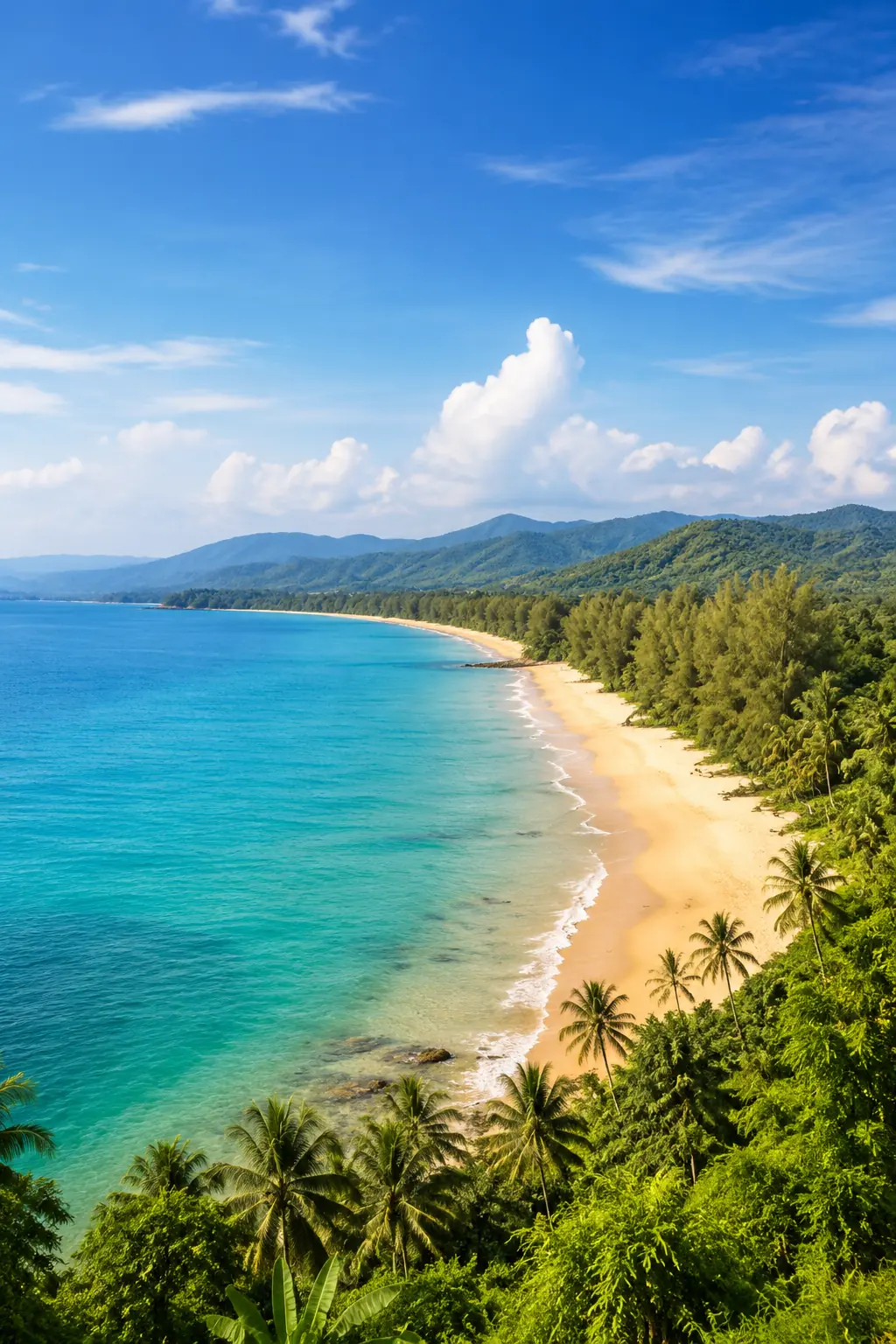
Walk along a beach in Khao Lak today and you may pass, within the same short stretch, a family settling in for a morning swim and a yellow evacuation route sign pointing calmly inland. Further back from the shore, incongruous against the palm trees and beach bars, sits a police patrol boat — not moored at any harbour, but resting on dry land almost two kilometres from the sea. These two images, the holiday coast and the remembered coast, exist side by side in Khao Lak in a way that few other destinations in the world quite manage. Understanding why requires understanding both what this coast was before tourism, and what happened to it on a single morning in December 2004.
Khao Lak's story is, at its heart, a story told in two halves — a young, fast-growing destination on one side of a single catastrophic event, and a rebuilt, more resilient one on the other. Neither half makes sense without the other, and neither should be told in a way that overshadows or diminishes what the other represents.
A Working Coast Before Tourism
Long before Khao Lak became an international name, the area was home to sparsely populated coastal villages, their livelihoods built around rubber and fruit plantations alongside subsistence and small-scale fishing, according to academic field research on the region. This is worth stating plainly, because it is easy to imagine a resort coastline as a blank or undiscovered stretch of sand simply waiting to be developed. Khao Lak was nothing of the sort. It was a working agricultural and fishing landscape, home to communities who had made their lives there long before any visitor arrived looking for a quiet stretch of Andaman coast. The tranquil tropical setting that international marketing would later sell to European holidaymakers was, in its earlier life, simply home — a place of daily labour on plantations and in small fishing boats, not a backdrop awaiting discovery.
Small Beginnings in 1988
Khao Lak's tourism industry began modestly. Peer-reviewed research by Calgaro and Lloyd places the start of tourism development at 1988, a finding echoed by the Stockholm Environment Institute's detailed vulnerability assessment of the area, which locates the very first small-scale development at Nang Thong Beach that same year — a single, very small bungalow operation. There was no master plan and no large-scale investment at the outset. Khao Lak began as a tiny, independent-tourism destination, built one small guesthouse at a time, in much the same modest, incremental way that many of the region's now-famous beach destinations began before international attention and capital arrived in force.
How "Khao Lak" Became a Destination Name
One of the more unexpected details in Khao Lak's history concerns the name itself. According to the Stockholm Environment Institute's report, "Khao Lak" was not originally the name used for the broader stretch of coast that carries it today. The name was drawn from the mountain overlooking the area and was picked up during the 1990s as international tourism marketing — helped along by a successful early resort and European tour operators — turned what had been a locally known coastal area into an internationally recognised destination brand. In other words, the "Khao Lak" that visitors know today is partly a geographic place and partly a tourism identity, assembled gradually across a number of neighbouring beach communities under a single, marketable name. This is a subtle but important point for understanding the destination as it exists now: when people speak of Khao Lak, they are usually referring to a whole coastal identity built up out of several distinct beaches and communities, unified less by administrative boundary than by a shared brand that international tourism itself helped to create.
European Visitors Fuel Rapid Growth
Academic research describes Khao Lak becoming especially popular with European travellers seeking a quieter alternative to the busier resorts of Phuket, with German and Scandinavian markets particularly significant in the years before 2004. The destination's image leaned heavily on nature, relaxation and a lower-intensity style of beach tourism than its larger neighbour offered. It would be wrong to suggest that European visitors somehow created Khao Lak on their own; local businesses, workers and investors were central to its growth throughout. What can fairly be said is that international demand and local entrepreneurship reinforced one another, each feeding the other's expansion. As word spread through European travel circles that a quieter, more nature-focused alternative to Phuket existed only a few hours up the coast, local operators responded by expanding what they offered, and that expansion in turn attracted still more visitors seeking exactly that kind of calmer experience.
From a Hundred Rooms to Over Five Thousand
The scale of that expansion is striking when set out in numbers. Calgaro and Lloyd's research records that Khao Lak grew from roughly 100 tourist rooms in 1996 to 5,315 rooms by December 2004 — an extraordinary rate of growth achieved in under a decade. The same research notes that larger four- and five-star resort developments appeared mainly after 2000, meaning that Khao Lak was still, in relative terms, a very young tourism destination by the time it faced the greatest test of its short existence.
A Coast That Grew Northward
As Khao Lak's reputation spread, its tourism footprint expanded well beyond its original beach. Development extended from Khao Lak Beach itself north through Nang Thong and Bang Niang, reaching toward Laem Pakarang, also known as Coral Cape, and further beaches beyond. The Tourism Authority of Thailand today describes the Khao Lak coast as a long stretch running from the area near Ban Nam Khem down toward Khao Lak–Lam Ru National Park. This is important context: Khao Lak was never a single compact town in the way many destinations are. It grew, and remains, a long coastal tourism zone made up of multiple beach communities strung along the shore, each with its own accommodation, restaurants and character, connected more by a shared coastal road and a shared name than by any single urban centre.
The Destination on the Eve of Disaster
By late 2004, Khao Lak's tourism economy combined a base of small and medium local businesses — accommodation, restaurants, souvenir shops, tailoring, spas, taxis, guiding services and scuba-diving operators, according to academic research — with newer, larger resorts and some international investment. Its image remained calmer and more nature-oriented than Phuket's. This is worth holding onto, because it explains just how economically dependent this fast-growing but still young destination had become on a tourism system that had expanded at extraordinary speed in only a handful of years.
26 December 2004
On 26 December 2004, the Indian Ocean tsunami struck Thailand's Andaman coast. Among the coastlines affected, Khao Lak was hit with exceptional severity, identified in research comparing Thailand's major tourist coasts as the worst affected of them all. Peer-reviewed studies document extremely severe destruction to resorts and coastal infrastructure along this stretch of shore. The scale of human loss on that day was significant, and reported totals for the wider region vary because the affected population included residents, tourists and migrant workers alike; rather than offering an uncertain figure, it is enough to say plainly that lives were lost, and that the loss experienced by Khao Lak's communities that morning deserves to be acknowledged with the seriousness and restraint it is due.
For a coast that had, only a few years earlier, been expanding at a pace few destinations anywhere could match, the scale of the reversal on that single morning is difficult to overstate. A destination that had grown from roughly a hundred rooms to more than five thousand in under a decade suddenly faced the task of working out what, if anything, of that rapid growth could be salvaged, and what would need to be rebuilt almost from nothing.
Why Khao Lak Was So Exposed
Khao Lak's tourism development had grown along a relatively open, low-lying stretch of Andaman coastline, and research has found that the most severe damage occurred where hotels and other buildings stood close to the beach. One engineering study reported that the tsunami's inundation reached as far as approximately 1.5 kilometres inland in parts of Khao Lak. This is not a matter of assigning blame to the choices made by local businesses or developers; it reflects, instead, a straightforward combination of flat coastal terrain, beachfront development, and the extraordinary force of a wave that few coastlines anywhere in the world could have withstood without severe damage. The very features that had made this stretch of coast so appealing to visitors in the first place — open beaches, easy access to the water, low-rise buildings set close to the shoreline for the sake of the view — were, under these singular and extreme circumstances, the same features that left it so exposed.
A Disaster Experienced Differently Along the Coast
Comparative research makes clear that Khao Lak suffered considerably more severe damage to its tourism infrastructure than Phuket did in the same event. One study found that more than 90 per cent of surveyed hotel rooms in Khao Lak were largely destroyed or rendered unusable in the tsunami's immediate aftermath, while Phuket's broader tourism infrastructure recovered much more quickly. This comparison is worth noting not as any kind of contest over suffering, but because it explains why Khao Lak's identity in the years that followed became so closely and lastingly tied to the process of reconstruction, in a way that set it apart even from other badly affected parts of the Thai coast.
Rebuilding Begins
Because tourism was so central to local livelihoods, reconstruction along the Khao Lak coast began relatively quickly after the disaster. Even so, academic research describes recovery here as slower than in Phuket, a direct reflection of how much more severe the physical destruction had been. Resorts, restaurants, roads and visitor businesses reopened gradually rather than all at once, and recovery was uneven — larger operators typically had greater resources to rebuild than smaller, independent businesses did. This was not a story of instant restoration but of patient, uneven, hard-won reconstruction stretched across years, in which the fortunes of individual businesses often depended as much on access to capital and insurance as on the severity of the damage each had suffered.
Rebuilding Raised Questions of Its Own
The process of rebuilding also opened up genuine debate about what kind of coast should emerge from the reconstruction. Post-tsunami research examined whether recovery could be used as an opportunity to reduce future vulnerability and improve planning, or whether reconstruction would simply reproduce the same pre-tsunami development pattern along the same exposed coastline. These are questions that matter, though they need not dominate a story focused on Khao Lak's broader recovery; the essential point is that the coast's return was never treated purely as a matter of restoring what had existed before, without any reflection on what had gone wrong.
The Police Boat That Became a Memorial
Among Khao Lak's most striking physical reminders of that day is police patrol boat T.813. Academic disaster-preparedness research documents that the tsunami carried the boat inland, across the main coastal road, to a resting point roughly two kilometres from the sea. Rather than being moved back to the water, the boat was deliberately preserved where it came to rest, as a memorial, with exhibition and interpretation facilities later developed around it. It stands today as a quiet, powerful marker of the tsunami's scale — one that communicates memory rather than spectacle, and asks for reflection rather than shock.
Ban Nam Khem and Formal Remembrance
Further along the coast, the Tourism Authority of Thailand includes Ban Nam Khem Tsunami Memorial Park within its official itineraries for the region. Ban Nam Khem, situated north of the main Khao Lak resort zone, was itself one of the communities most severely affected by the tsunami. The memorial park gives this wider coastal region a formal, lasting place for remembrance — a sign that recovery here has always included space for memory, not simply a return to business as usual.
Preparedness Becomes Part of Daily Life
In the years since, preparedness has become a visible and permanent feature of the Khao Lak landscape. Later research documents tsunami warning sirens, evacuation towers, clearly marked evacuation routes and other measures now built into the area, and a long-term recovery study covering the twenty years since 2004 found that these "soft" preparedness measures were prominent along the coast, even though large-scale seawalls were generally absent. This represents a genuine transformation in how the destination presents itself: modern Khao Lak does not pretend that 2004 never happened. Preparedness is woven visibly into daily life along the coast, without eliminating all future risk, but reducing it, and reassuring residents and visitors alike that the lessons of that day have not been forgotten. Signage of this kind has become so ordinary a part of the coastal landscape that many visitors likely walk past it without a second thought — which is, in its own quiet way, exactly the point: preparedness that has become routine is preparedness that is far more likely to be followed if it is ever needed.
Twenty Years Later, a Busy Coast Again
A recent study by the Japan Association for Earthquake Engineering, drawing on seven field surveys and satellite imagery over two decades, examined the long recovery process along this coastline in detail. It found that, twenty years after the tsunami, the Khao Lak resort area was once again busy with foreign tourists, and contained significantly more hotels and buildings than it had before. The Tourism Authority of Thailand today describes Khao Lak as offering both luxury and budget accommodation, and states plainly that the coast, devastated in 2004, has since been rebuilt. Together, these findings provide clear, evidence-based confirmation of just how far the destination has travelled since that December morning.
A Coast That Did Not Become a Copy of Phuket
Even after large-scale reconstruction, Khao Lak has not become a smaller version of Phuket. Its tourism identity remains tied to a long, quieter mainland coastline, to national parks, to easy access for diving trips, and to a generally nature-oriented style of visit. The Tourism Authority of Thailand presents Phang Nga's Andaman coast, including Khao Lak alongside the Similan and Surin islands, as a nature-rich alternative within the wider region. This is not a claim that one destination is superior to the other; it is simply a recognition that Khao Lak rebuilt while retaining a distinct character of its own, rather than reconstructing itself in another destination's image.
What "Started Again" Really Means
It would be a mistake to read this title as implying Khao Lak began from nothing after 2004. Families, communities, businesses and memories all remained, even amid devastation. What had to be rebuilt, and rebuilt on an extraordinary scale, was the physical tourism infrastructure — and what had to be regained, slowly and unevenly, was the confidence of a visitor economy that had been so severely disrupted. "Started again" refers to the rebuilding of a functioning coast, not to any erasure of what had happened there. The two things are entirely different, and Khao Lak's modern identity depends on holding that distinction clearly in view.
Living With Both Histories at Once
What makes Khao Lak unusual, even among other places that have experienced natural disaster, is how openly it holds both of its histories in view at the same time. There is no attempt here to tuck the memorials away out of sight of the beach resorts, nor any attempt to let the tragedy overshadow the ordinary business of a functioning holiday destination. The sirens and evacuation signage sit within easy view of hotel pools and beachfront restaurants, not as a jarring intrusion but as a quiet, accepted part of the landscape — evidence that the destination has made its peace with carrying both stories forward together, rather than choosing between them.
Two Coasts in One
Khao Lak today is unusual in that it holds two versions of itself visible at once. There is the holiday coast: long beaches, resorts, restaurants, dive trips, and families arriving each year for winter sun. And there is the remembered coast: a police boat resting far inland, quiet memorials, evacuation arrows along the roadside, and warning towers standing among the palm trees. Neither of these two coasts cancels the other out. The destination rebuilt because people lived and worked here, and because their livelihoods depended on its recovery — not because anyone wished to forget what had happened.
Khao Lak's story after 2004 is not one of a destroyed resort simply springing back to life. It is the story of a young tourism destination, hit harder than almost anywhere else on Thailand's coastline, that rebuilt itself while learning, deliberately and visibly, to carry the memory of what happened as part of the place it has become.