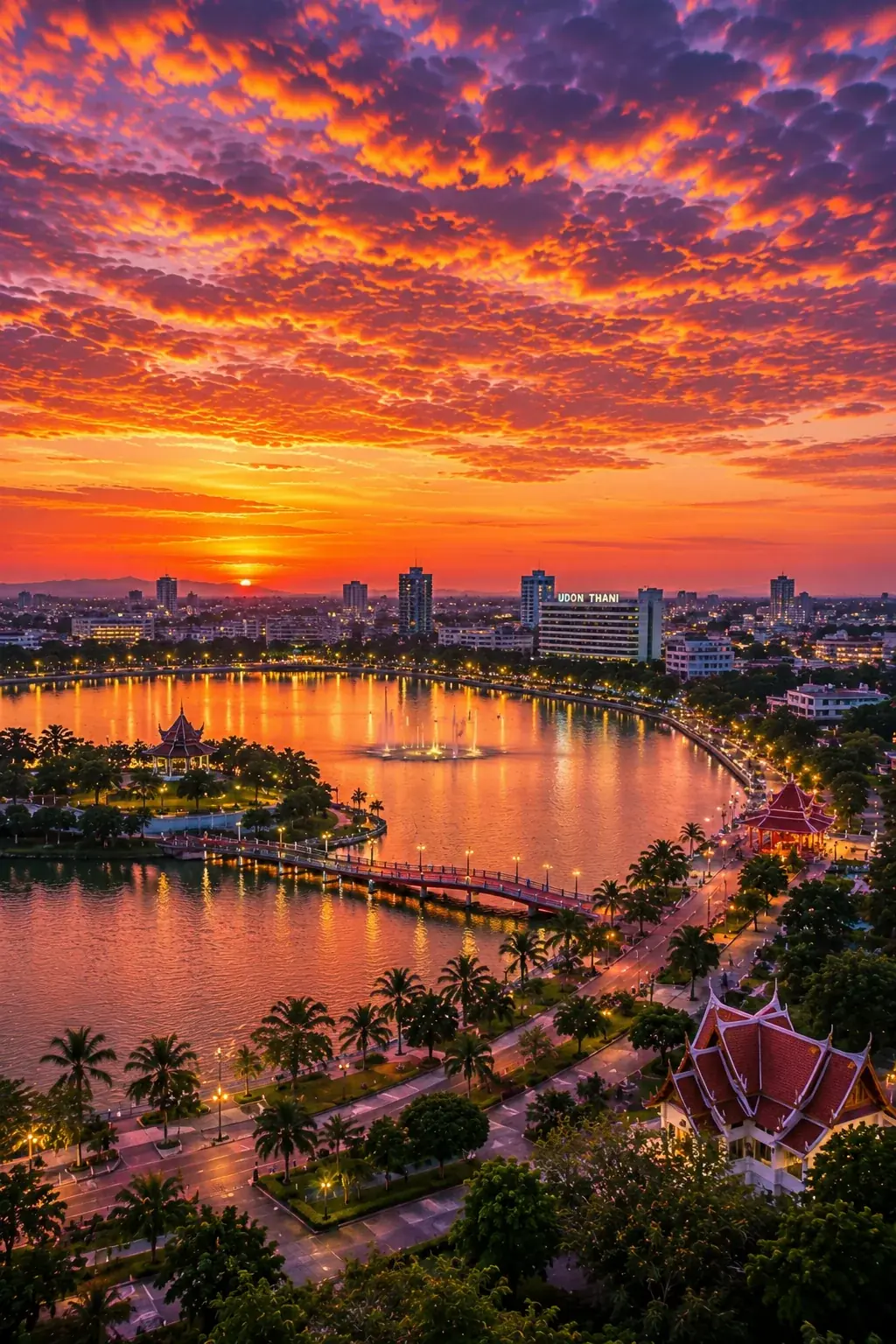
Fly into Udon Thani today and you land at a perfectly ordinary-looking international airport: check-in counters, a handful of domestic and regional routes, arrivals hall, taxi rank. What is less obvious to most passengers is that the airport sits within the military area of Royal Thai Air Force Wing 23 — a civilian facility administered by Thailand's Department of Airports, but physically embedded in an active air force installation. It is a small, easily overlooked detail, and yet it is also a direct, tangible link to the period that did more than any other to shape the modern city surrounding it.
Udon Thani's story is not a story about a war creating a city out of nothing. It is the story of a provincial Isaan administrative centre, already more than seventy years old by the time the first American aircraft arrived, whose scale, economy and connectivity were permanently accelerated by a period of intense international military activity — and which kept growing, commercially and structurally, long after that activity ended.
A City That Predates the Cold War
Modern Udon Thani traces its establishment as an administrative centre to 1893. According to the Udon Thani Provincial Administrative Organization, the city's founding is connected to Prince Prachaksinlapakhom, who moved his headquarters south from Nong Khai to Ban Mak Khaeng following the Franco-Siamese crisis and the restrictions it placed on Siamese military presence close to the Mekong. The provincial administration commemorates 18 January 1893 as the city's founding date, and the Tourism Authority of Thailand identifies Nong Prachak Park, one of the city's well-known green spaces today, as named in honour of that same prince, credited as the founder of Udon Thani town.
This opening chapter matters because it establishes something easy to overlook once the story turns to aircraft and military bases: Udon Thani was already a functioning regional administrative centre for decades before the Cold War gave it a new and unexpected kind of significance. Whatever came later was built on top of an existing city, not conjured from empty ground.
Why Upper Isaan Became Strategically Important
Udon Thani sits in upper northeastern Thailand, relatively close to Laos and the wider Mekong region. During the Cold War, this positioning took on a significance that would have been hard to predict in earlier decades. Conflicts in Laos and Vietnam, combined with concerns about communist insurgency across the region, turned Thailand's Northeast into a genuinely important strategic zone. There is no need here to trace the full geopolitical history of the Vietnam War; the relevant point for Udon Thani's story is simpler and more human in scale. A provincial city that had spent the better part of a century quietly administering its corner of Isaan suddenly found itself close to one of the most consequential military theatres in all of Southeast Asia.
American Air Operations Arrive
That new significance became concrete in 1964. Official United States Air Force historical material records American personnel and aircraft beginning operations at Udorn that year, with an official USAF history noting that forty-one airmen and four aircraft opened activity there in April 1964. It is worth being precise about what this moment did and did not represent. The Americans did not build an airfield from scratch in Udon Thani; aviation infrastructure already existed at the site before this larger deployment began. What happened in 1964 was the start of a rapid expansion and militarisation of an existing aviation location — the beginning of a transformation in scale and purpose, not the creation of an airport where none had stood before.
Udorn Becomes a Major USAF Base
What began with forty-one airmen grew, over the following years, into a substantial and long-running military presence. Records held by the Air Force Historical Research Agency show the 432nd Tactical Reconnaissance Wing and its associated units based at Udorn from 1966 through the mid-1970s, with the 432nd Combat Support Group stationed there from 18 September 1966 until 15 March 1976. The 555th Tactical Fighter Squadron also operated from Udorn during significant periods of the war. There is little value in cataloguing every squadron or aircraft type that passed through the base over more than a decade; the point that matters for Udon Thani's civilian story is one of scale and duration. This was not a brief or temporary detachment passing through a provincial airfield. Udon Thani hosted a major international military installation, continuously, for the better part of ten years.
The Base Changed the Local Economy
It is difficult to overstate how significant a shift this represented for a city of Udon Thani's size and character. Academic research on the city's urbanisation states plainly that Udon Thani's economy grew continually once the U.S. military settled at the air force base in the mid-1960s. Other academic work on northeastern Thailand more broadly notes that American bases and troops boosted local businesses across a range of sectors, including restaurants, bars, travel companies and rental housing. Logically, this kind of demand would also have extended into transport, retail, construction and maintenance services, though the strongest documented evidence points specifically to hospitality, travel and housing.
The clearest way to understand what happened is this: a large population of salaried foreign personnel, arriving with disposable income and everyday needs, suddenly created an entirely new kind of urban consumer market inside a provincial Isaan city that had never previously experienced anything of comparable scale. This was not a case of every single business sector in Udon Thani owing its existence to the base — that would overstate matters considerably — but the direction and speed of the city's economic growth from this period onward are well documented.
Housing, Restaurants and a New Urban Scale
Meeting the everyday needs of military personnel and the wider workforce that supported the base's operations required housing and services well beyond the base's perimeter. Rental accommodation expanded to house personnel and associated workers living off-site. Restaurants, transport services and entertainment businesses grew to meet a demand that had simply not existed at this scale before. Taken together, these changes pushed Udon Thani toward a more commercial urban economy and increased the overall scale of the city in ways that outlasted any single squadron's tour of duty.
It would be easy, and inaccurate, to turn this chapter into a detailed inventory of wartime hotels, bars and rental houses; no reliable count of that kind exists in the historical record, and inventing one would misrepresent the sources. What can be said with confidence is the direction of change: Udon Thani's economy accelerated and diversified during this period, moving toward a broader commercial base than its earlier decades as a purely administrative centre had required.
Roads and Connectivity Mattered Too
Udon Thani's wartime transformation did not happen in isolation. It formed part of a wider Cold War-era push to improve transport and strategic infrastructure across northeastern Thailand as a whole. It would be inaccurate to attribute every road built in or around Udon Thani directly to the American military presence; the more accurate and better-supported framing is that military priorities and national development goals reinforced one another during this period, strengthening the region's road and aviation connectivity and tying cities such as Udon Thani more tightly to Bangkok and to other centres across the Northeast. Crucially, this improved connectivity did not disappear once the war ended. It became part of the underlying infrastructure that allowed Udon Thani's growth to continue long after the immediate military demand had gone.
The Airport as a Physical Survival of the Military Era
Few features of the modern city illustrate this layered history more clearly than Udon Thani International Airport itself. Thailand's Department of Airports states that today's civilian airport is located within the military area of Royal Thai Air Force Wing 23, administered for civilian use even as the site remains physically connected to the air force. This arrangement did not begin with the Vietnam War. Department of Airports records show that Udon Thani was declared a customs airport as early as 12 October 1954, confirming that aviation activity at the site predates the large-scale American deployment by a full decade.
This is a useful piece of nuance to hold onto. The Cold War did not create aviation in Udon Thani; what it did was dramatically expand the strategic importance of an airfield that already existed, and it left behind an airport whose physical setting, shared with an active military wing, still tells that story to any passenger who takes the time to notice it. Every civilian flight in or out of Udon Thani today lands within a landscape first shaped for very different purposes more than half a century ago.
A City of Unusual International Contact
Beyond infrastructure and commerce, the base exposed Udon Thani to a level of direct contact with foreigners that would have been highly unusual for an inland Isaan city during the 1960s and 1970s. Academic studies of communities across the Northeast describe local people having direct, everyday contact with American servicemen throughout this period — a level of international exposure that most provincial Thai cities of the era simply did not experience. This contact left its mark on business practice, on language exposure, on consumption patterns, and more broadly on the outward-looking character the city developed during these years. There is no need to romanticise this period, nor to condemn it; the more useful observation is simply how unusual this degree of sustained international contact was for a provincial city of this size and setting at that particular moment in history.
A Brief Note on the Laos Connection
Udon Thani's strategic importance during this period extended beyond its own city limits. Academic research into the Cold War in this region identifies Udon Thani as an important base for American activity connected to operations across the border in Laos, and notes that Air America, the airline associated with those operations, maintained a headquarters presence in the city. This detail is worth including briefly, because it illustrates just how strategically connected Udon Thani had become to events unfolding across an international border, at a scale that a purely domestic account of the city's development would miss. It does not need, and does not deserve, further elaboration here; the covert dimensions of this period are not the subject of this story, and speculation about them adds nothing reliable to an account grounded in documented fact.
The Military Period Winds Down
American combat involvement in the region wound down in the years following the Vietnam War, and the intensive base era at Udorn came to a defined close during the mid-1970s. Records from the Air Force Historical Research Agency show that major American support units at Udorn remained in place until March 1976, giving the story of the base's most active period a fairly clean historical endpoint. This should not be read as suggesting that every American connection to the city, or every trace of international contact, vanished on a single day in 1976. By that point, however, the city had already changed structurally in ways that would prove considerably more durable than the military presence that had set those changes in motion.
Udon Thani Does Not Return to Its Old Scale
This is the point at which Udon Thani's story departs from what might have been a fairly ordinary narrative of wartime boom followed by peacetime bust. The strongest and best-documented long-term finding is that Udon Thani continued developing after the American withdrawal, rather than reverting to its earlier, smaller scale. A 2014 peer-reviewed study of the city's urbanisation describes Udon Thani as a rapidly growing city, identifying continued commercial expansion well beyond the years of American military presence. The same study explicitly links this continuous economic growth back to the period beginning with the arrival of the U.S. air base in the mid-1960s, treating that period not as an isolated wartime anomaly but as the starting point of a longer growth trajectory. Satellite analysis covering the years from 1989 to 2014 documented substantial urban expansion across both the municipality and its surrounding suburban areas, confirming that this growth was not a brief post-war plateau but a sustained, decades-long process.
The clearest way to state the thesis at the heart of this chapter is this: the wartime boom in Udon Thani functioned as a catalyst for long-term urban and economic development, not as a temporary bubble that simply vanished along with the departing troops.
From Military City to Commercial Regional Hub
In the decades since, Udon Thani has increasingly developed around commerce, retail, transport, services and regional connectivity rather than around any residual military significance. Modern urbanisation research describes the city as strategically positioned within the wider Indochina and Mekong region, and notes government ambitions to strengthen its role as a logistics centre for the surrounding area. The Tourism Authority of Thailand's current material on Udon Thani presents it, quite reasonably, as an ordinary modern regional destination, with its own accommodation, transport links and provincial attractions, much like any other established Thai regional centre. The transformation this represents is significant in its own right: a city whose accelerated growth began with strategic military importance has settled, over the following decades, into a rather different but no less substantial role as a civilian regional hub.
The Laos Connection After the War
Part of what allows Udon Thani to occupy this modern role is the same geography that made it strategically significant during the Cold War. Nong Khai and the Lao border lie to the city's north, and Udon Thani continues to function as a major staging point for travellers and commerce moving in that direction, toward Nong Khai and on to Vientiane. This is best understood as the civilian echo of a geographic fact that mattered enormously during the Cold War for entirely different reasons. Udon Thani today stands as one of upper Isaan's principal regional service and transport centres, oriented in part toward the wider Mekong region — a modern, commercial version of a strategic position first defined by very different circumstances several decades earlier.
A Different Kind of Isaan Story
Set alongside other prominent examples of modern development in Isaan, Udon Thani's path stands out clearly as its own. Nakhon Ratchasima, or Korat, built its modern identity as a transport gateway opening the wider Northeast to the rest of the country. Khon Kaen's growth has been driven by universities, medicine and knowledge-based development. Udon Thani's defining chapter is different again: a Cold War-era air base that accelerated commerce, services and urban expansion at a pace the city would likely not have experienced on its own timeline. None of these three stories outranks the others. Together, they simply illustrate three genuinely different routes by which modern cities across Isaan arrived at their present-day significance.
What a Visitor Can Still Read in the City
A visitor moving through Udon Thani today encounters a place where this layered history remains visible, if not always obvious. There is the airport itself, sitting within the active military area of Wing 23, a daily, ordinary reminder of the city's Cold War chapter for anyone who knows to look for it. There is the city's broad, commercial centre, its retail and service economy testament to decades of growth that trace back to the mid-1960s. There is Nong Prachak Park, its name a quieter link back to the city's nineteenth-century founding and to Prince Prachak himself. And there is the road heading north, toward Nong Khai and the Lao border, carrying the same essential geographic logic that once made this stretch of upper Isaan so strategically significant to a much larger and more distant conflict. None of this needs to be dressed up as a lost world of wartime nightlife to be worth noticing; the more honest and more interesting story is written into the ordinary infrastructure of the city itself.
Temporary War, Permanent Transformation
The Vietnam War did not create Udon Thani. The city had already existed for more than seventy years, functioning as a regional administrative centre, before the first American aircraft began operating from Udorn in 1964. What the base changed was the speed and scale of the city's development. Military operations brought personnel. Personnel created demand. Demand expanded housing, food, transport and services well beyond anything the city had previously required. Infrastructure and connectivity strengthened alongside all of this, tying Udon Thani more closely into the wider networks of northeastern Thailand.
When the Americans eventually left in the mid-1970s, those urban networks did not simply disappear along with them. The war itself was temporary. The larger, more commercially developed city it helped bring into being was not. Udon Thani's modern role as a regional hub stands today as one of the clearest surviving civilian legacies of a period when a provincial Isaan administrative centre suddenly found itself connected, however briefly, to one of the defining conflicts of the twentieth century — and grew, in lasting and largely unexpected ways, because of it.