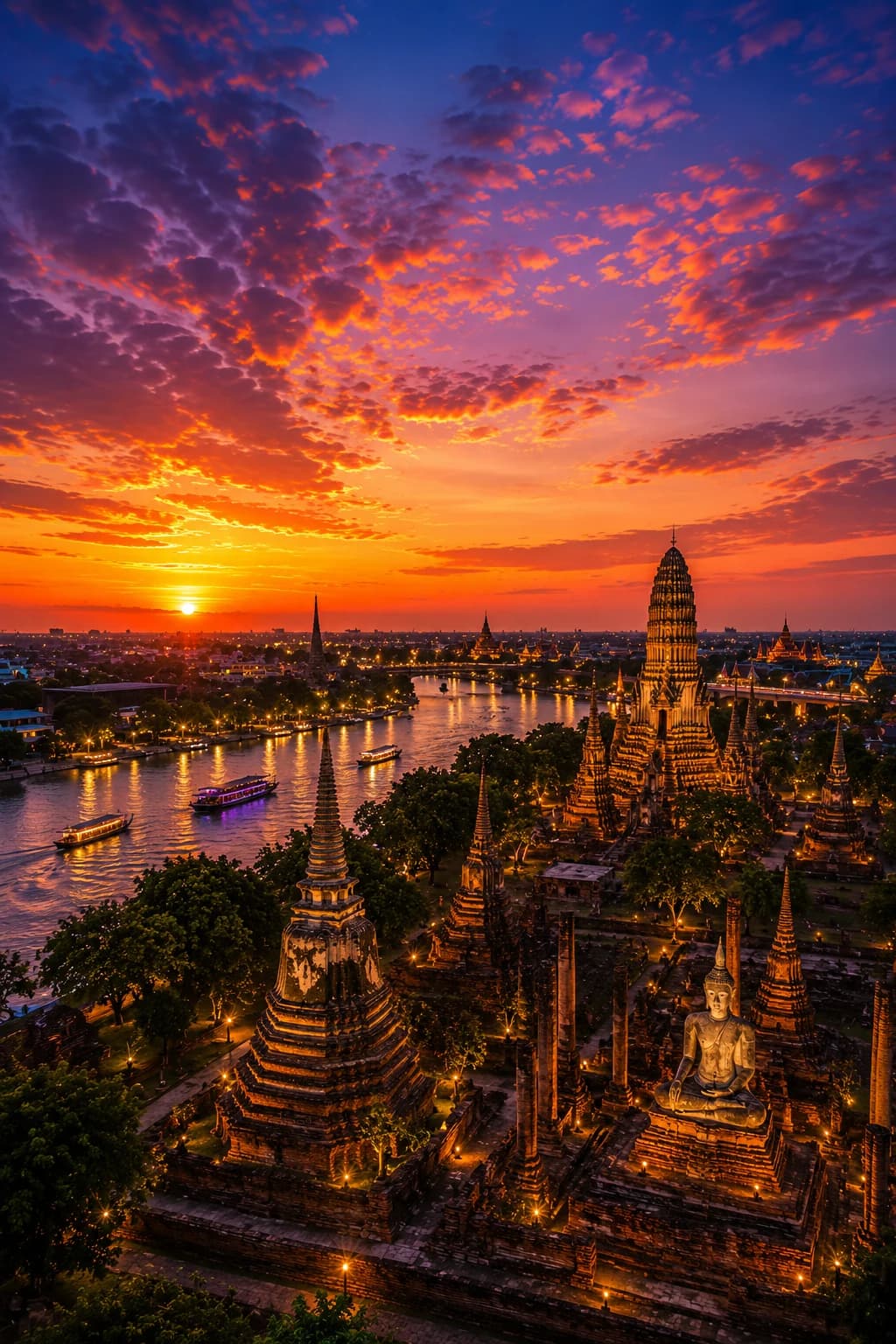
Walk through Ayutthaya today and the loudest thing you will encounter is silence. Brick towers stand in open fields. Headless Buddha images sit half-swallowed by tree roots. Rows of columns hold up nothing at all. It is a landscape built for quiet contemplation, and most visitors experience it exactly that way — as a place to reflect on what was lost.
But the ruins tell only half the story, and arguably not the more interesting half.
Before it fell silent, Ayutthaya was one of the busiest, noisiest, most linguistically varied cities in Asia. UNESCO describes it, at its height, as one of the world's largest and most cosmopolitan urban areas, and a centre of global diplomacy and commerce. The temples that dominate today's postcards belonged to a city that was also full of merchants, sailors, translators, diplomats, missionaries and entire foreign communities living along its riverbanks.
This is a story about that city — the trading capital that made Ayutthaya matter to the rest of the world, long before it became a place people visited to look at ruins.
Why Build a Capital Here? The Three Rivers and Access to the Gulf
Ayutthaya was founded around 1350, becoming the second great Siamese capital after Sukhothai. Its location was not an accident of convenience. The city occupied an island formed where the Chao Phraya, Lopburi and Pa Sak river systems meet — a position UNESCO describes as strategically chosen for exactly this reason.
That island setting solved two problems at once. It gave the capital direct access to the sea, since the Chao Phraya system connected all the way down to the Gulf of Siam, allowing goods and ships to move between the royal city and the wider maritime world. At the same time, sitting inland and above the tidal bore of the gulf as it existed then offered a measure of protection — both from seasonal flooding and from the kind of direct assault a coastal capital might face from the sea.
The rivers, in other words, were never simply scenery around the palace. They were roads for people and goods, defensive buffers against seaborne threats, and the connective tissue linking a Siamese royal capital to ports and trading partners far beyond its own borders. Everything that made Ayutthaya an international city in the centuries that followed depended, first, on this piece of geography.
Between India and China
Geography gave Ayutthaya more than defensible walls and a river highway. It placed the city, as UNESCO notes, near the head of the Gulf of Siam — broadly between the trading worlds of India and China.
That position mattered enormously. Rather than functioning simply as an exporter of one or two Siamese products, Ayutthaya was well placed to act as an intermediary between much larger trading systems. Goods could arrive from inland Siam, the Malay Peninsula, China, Japan, India and lands farther west, and be exchanged again through merchant networks connected to the capital. It would be an overstatement to say all world trade passed through Ayutthaya. The more accurate and, frankly, more impressive point is that it became a major node within the early-modern trading networks that connected East and Southeast Asia — a city where different commercial worlds met and did business with one another.
A Cosmopolitan Capital Emerges
As trade grew, so did the city's population and its variety. UNESCO's description of Ayutthaya as one of the world's largest and most cosmopolitan urban areas during its fourteenth-to-eighteenth-century flourishing is worth taking seriously rather than treating as promotional language.
Foreign traders and missionaries were permitted to live in communities associated with their own national, linguistic or religious backgrounds, typically in enclaves downstream from the Royal Palace. Contemporary European maps of the period show a highly organised capital — roads, canals, temples, royal zones and distinct foreign settlements all mapped out with real precision, evidence of a city that understood exactly how it was organised even if outsiders were seeing it for the first time.
Historical population estimates for Ayutthaya vary considerably, and it is worth resisting the temptation of a single precise number. What matters more than any figure is the texture such numbers point toward: boats and warehouses lining the riverbanks, several languages spoken within a short walk of each other, and religious buildings from different traditions standing not far apart, all connected by the same network of waterways that ran through the heart of the city.
Portugal Arrives
Portugal was the first Western European power to establish formal relations with Ayutthaya, beginning in 1511 — decades before the diplomatic exchanges with France that many visitors associate with the city's international history today.
Portuguese merchants, soldiers, shipbuilders and missionaries became a significant community within Ayutthaya, settled south of the city island along the river, opposite the area where the Japanese community would later establish itself. Historical accounts of the site describe multiple Roman Catholic churches built within the Portuguese settlement, reflecting a community substantial enough to sustain its own religious institutions. Some secondary histories put the community's peak population at several thousand, though exact figures remain uncertain and are not essential to the point.
What matters is the sequence this establishes: Western presence in Ayutthaya did not begin with the famous embassies of the later seventeenth century. It began generations earlier, with Portuguese traders and craftsmen building a life on the riverbank south of the royal city.
Japanese Village and the Japan Trade
A short distance from the Portuguese settlement, another substantial foreign community grew up along the Chao Phraya: a Japanese quarter that provincial tourism material describes as home to merchants, ronin serving in military roles, and Japanese Christians.
Estimates of the community's peak population differ across sources, commonly cited somewhere in the range of one thousand to fifteen hundred people, sometimes higher — again, a detail worth noting in passing rather than treating as fixed fact. Trade between Siam and Japan moved substantial goods in both directions: deer hides, sappanwood, lead and tin flowed one way, while Japanese silver moved through the wider trading system that connected Ayutthaya to East Asia.
One figure from this community is often mentioned in histories of the period: Yamada Nagamasa, who rose to high rank in Ayutthaya's service. His career is a useful illustration of a broader pattern rather than the centre of the story in its own right — it shows how a foreigner could become genuinely embedded in Ayutthaya's political and military world, not merely trade at its edges.
The Dutch VOC: Ayutthaya Inside a Global Company Network
Dutch merchants from the Vereenigde Oostindische Compagnie, the VOC, first arrived in Ayutthaya in 1604. Within a few years, King Ekathotsarot had granted the company permission to establish a trading post, in 1608, and by the 1630s the Dutch had built a more substantial lodge, or factory, south of the city.
The site of that old VOC settlement is now home to Baan Hollanda, an information centre on Dutch-Thai relations, which describes the Dutch as major Western traders operating in Siam during this period. The goods moving through Dutch hands were wide-ranging: tin, deerskins, rayskins, sappanwood, rice, imported textiles and Japanese silver all passed through VOC trading activity connected to the city.
The Dutch presence is particularly valuable to historians today for a practical reason — VOC employees kept detailed records and produced maps of Ayutthaya as part of the company's own administrative habits. Those records help demonstrate something important about the city's place in the world: Ayutthaya was not operating in isolation. It was connected into the same global company network that linked Batavia, Japan, India and Europe, a genuine node within one of the earliest truly international trading systems.
Persian and Muslim Connections
Ayutthaya's cosmopolitan character was never simply a story of Europeans on one side and Chinese or Japanese communities on the other. Persian and other Muslim merchants and officials played an important role within Siam's broader trade connections to the Indian Ocean world.
Historical material from Thailand's Central Islamic Council identifies Sheikh Ahmad, a Persian merchant who entered royal service in the early seventeenth century, as the first known named holder of the Chularatchamontri office and head of the Department of the Right Harbor. His career is a striking example of how thoroughly a foreign commercial community could become woven into Ayutthaya's own administration, rather than remaining separate from it. It is worth being careful with terminology here: Ayutthaya's Muslim connections were broader than any single national community, part of a wider set of relationships with Muslim trading networks across the Indian Ocean world, of which Persian merchants like Sheikh Ahmad were one significant part.
China and the Asian Networks That Underpinned the City
If any single trading relationship deserves to be called fundamental to Ayutthaya's economy, it is the relationship with China. Chinese merchants and goods circulated through the capital throughout much of its history, connecting Siam to the vast commercial networks of East Asia, and UNESCO explicitly notes diplomatic exchange between Ayutthaya and imperial China as part of the city's international standing.
It is worth resisting a common distortion in how this history gets told. Because European archives from this period are more accessible today, accounts of Ayutthaya's trade can end up weighted toward Portuguese, Dutch and French sources. But China, along with the wider regional networks connecting Siam to East and Southeast Asia, was every bit as fundamental to the city's success as its European relationships — arguably more so, given how long-standing and persistent the trade with China proved to be.
When Trade Became Diplomacy
Ayutthaya's international reach extended well beyond the activities of private merchants. UNESCO records royal diplomatic exchanges between the Siamese court and the French court at Versailles, the Mughal court in Delhi, and the imperial courts of Japan and China, among other powers.
These embassies were never purely ceremonial. They were commercial as well as political, aimed at securing access, privileges and stable relationships that mattered directly to trade. Foreigners, in turn, served the Siamese government in various capacities — not merely as merchants operating alongside the court, but as officials working within it, as Sheikh Ahmad's career already demonstrates.
King Narai's seventeenth-century reign is often the period people think of first when European diplomacy in Ayutthaya comes up, and it is fair to treat this as the era when that diplomacy became especially visible and well documented. But it is worth being clear that international trade did not begin with Narai. By the time his famous embassies to European courts took place, Ayutthaya had already been a genuinely international trading capital for well over a century.
The Goods and Boats Moving Through the River System
It helps to picture, concretely, what was actually moving through Ayutthaya's waterways during these centuries. Deer hides and other animal skins travelled in significant volume, particularly in trade with Japan. Sappanwood, valued for the dye it produced, was a recurring export. Tin and lead moved through regional networks, alongside rice and other agricultural goods and a range of forest products drawn from Siam's interior.
Beyond what Siam itself produced, Ayutthaya also handled goods passing through from elsewhere: ceramics and silk carried along Chinese trading networks, Indian textiles, and Japanese silver and copper moving through the wider commercial system that connected the region.
This points to an important nuance about why Ayutthaya mattered as much as it did. The city was not simply exporting Siamese products to the world. A large part of its importance came from redistribution and brokerage — goods arriving through one trading network could be exchanged into another, with Ayutthaya itself acting as the meeting point. That role as an intermediary, more than any single export, is what made the capital indispensable to so many different trading partners at once.
The Foreign Quarters Beyond the Royal Island
Much of this trading activity had a very specific address. Many foreign communities were located downstream from the main royal island, rather than inside the palace core itself, and the Portuguese, Japanese, Dutch and other settlements occupied riverfront sites well suited to warehouses, moored ships and the daily business of trade.
These were not isolated or self-contained enclaves cut off from the rest of the city — they were trading, residential and diplomatic communities operating within the structure of the Siamese capital, connected to it by the same rivers that connected everything else. Religious buildings reflected this diversity in physical form: Catholic churches, Muslim places of worship and institutions tied to particular communities all found their place within, or just beyond, the royal city's boundaries.
For a modern visitor, this is one of the most rewarding ways to see beyond Ayutthaya's famous temple circuit. Sites such as the Japanese Village, the archaeological remains of the Portuguese Settlement, and Baan Hollanda on the old VOC lodge site allow a traveller to step outside the monuments most associated with the city and see, instead, its international geography laid out on the ground.
Why Ayutthaya Worked as a Trading City
Pulling these threads together, Ayutthaya's success as a trading capital rested on several reinforcing factors rather than any single cause.
Geography came first: a river island with access to the Chao Phraya system and, through it, the sea. Political power mattered just as much — Ayutthaya was the capital of a kingdom strong enough to protect and regulate commerce operating within its territory. Its location between major Indian Ocean and East Asian trading systems gave it a natural role as an intermediary. Its openness to foreign merchants, who were permitted to establish their own settlements and trading operations, allowed international communities to take root and thrive. And its diplomacy — a royal court that actively maintained relationships across Asia and, in time, with European powers as well — gave the city reach that went beyond what trade alone could achieve.
No single king, and no single foreign nation, built this success on their own. It emerged from the combination of all five factors working together over centuries.
It is worth stressing, too, that these five factors reinforced one another rather than operating separately. Political stability made foreign merchants more willing to invest in permanent settlements along the river. Those settlements, in turn, deepened the trading relationships that gave the court reason to invest in diplomacy. And diplomacy secured the kind of access and privileges that made further trade possible. Ayutthaya's success was less a single achievement than a self-reinforcing cycle, sustained across roughly four centuries of the city's history.
1767: The Commercial City Disappears
That long, layered story of trade and diplomacy came to an abrupt end in 1767, when Ayutthaya was attacked and destroyed by Burmese forces. UNESCO notes that the city was never rebuilt on the same site as the royal capital, and what remains today is the archaeological landscape now familiar to visitors. The foreign settlements that had lined the riverbanks for centuries were destroyed or abandoned along with the rest of the city.
This is not the centre of Ayutthaya's story, and it does not need to be dwelt on at length here — the fall of the city is covered elsewhere. What matters for this account is the contrast it creates: where a crowded, multilingual, internationally connected city once stood, a modern visitor now finds ruins and open spaces.
What Today's Ruins Hide
Temple ruins naturally dominate the visual experience of Ayutthaya today, and it is easy to see why — they are the most visible, most photogenic, most immediately legible remains of the old capital. But UNESCO's own statement of the site's significance explicitly includes commerce, diplomacy, urban planning and foreign influence alongside its religious and royal monuments.
Surviving maps and archaeological sites help reconstruct a considerably fuller picture of the city than the temples alone can offer. Behind the quiet brick towers, it is worth imagining the docks and warehouses that once lined the riverbanks, the communities that lived and worshipped along them, the embassies that arrived and departed, and the constant river traffic that connected all of it. Ayutthaya's international districts, quiet and half-empty today, would once have been among the busiest places anywhere in the kingdom.
A City Speaking Many Languages
Ayutthaya became one of Asia's great trading cities because geography gave it access, political power gave it security, and diplomacy gave it reach.
The capital sat inland, and yet it was connected directly to the sea. It was thoroughly Siamese, and yet deeply international, home to Portuguese churches, a Japanese quarter, a Dutch trading lodge, Persian officials in royal service, and enduring, fundamental ties to China — all alongside its Buddhist temples and royal compounds. Its monuments were monumental, certainly, but some of the most revealing sites for understanding what Ayutthaya actually was lie beyond the famous temple circuit, in the old foreign quarters downstream from the palace.
The ruins tell us how powerful Ayutthaya was. The trading settlements tell us how connected it was. A visitor who sees only the temples is seeing the capital after its world fell silent. To understand the living city — the one that made Ayutthaya matter far beyond the borders of Siam — you have to imagine the river full of boats, and a capital speaking in many languages at once.