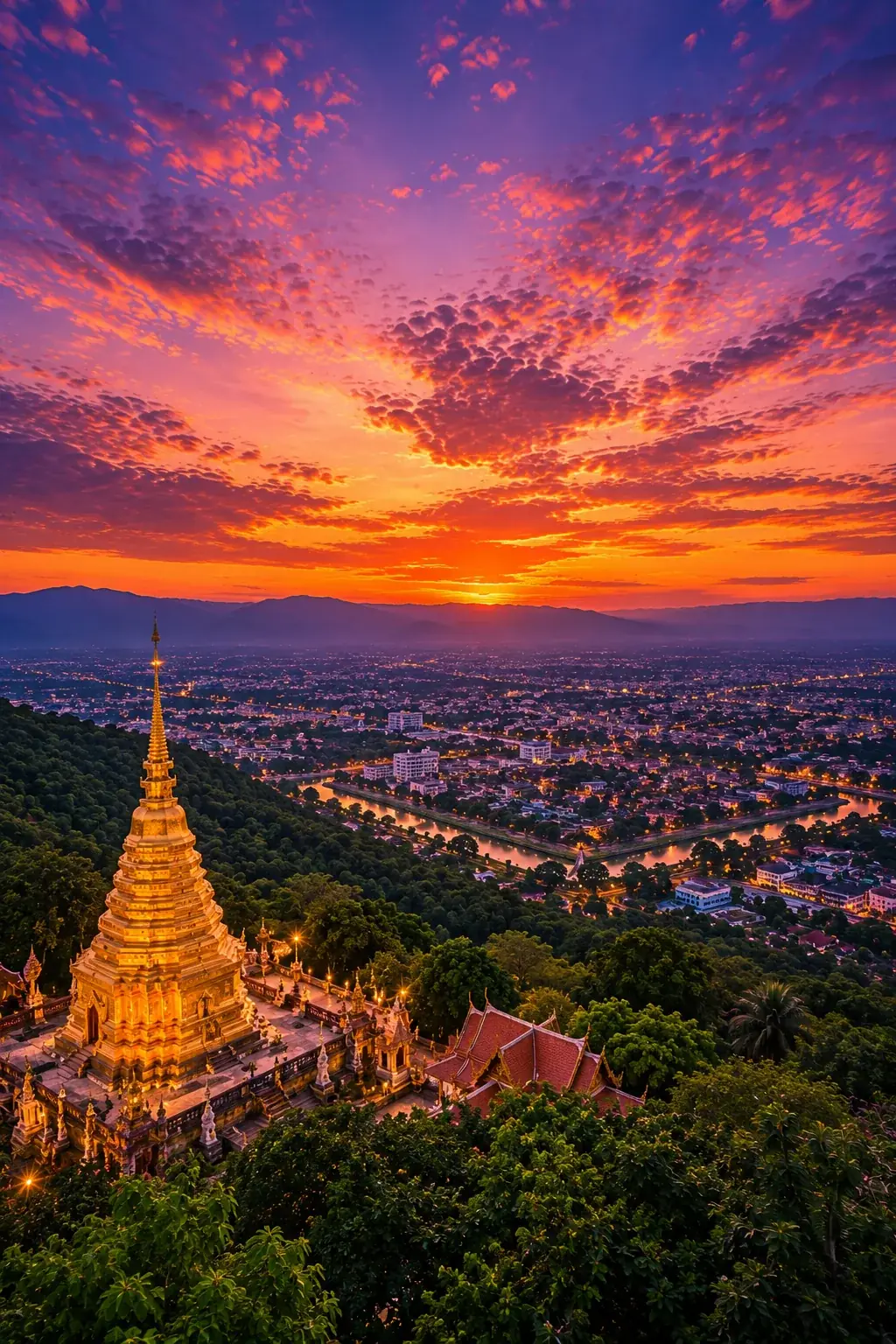
Stand at one of the old moat corners in the early evening and Chiang Mai shows you two cities at once.
On one side, the water traces a line that has separated an inner city from the world outside for more than seven centuries. Brick fragments of the old wall still rise from the grass at intervals. Temple roofs catch the last light behind them. On the other side of that same water, traffic moves, songthaews turn corners, café lights switch on, and a city of galleries, guesthouses, universities and creative studios carries on with its evening.
Neither side is more "real" than the other. They are the same city, built in layers.
Chiang Mai's story is not one of a historic place that modern life eventually reached. It is the story of a city that has reinvented itself several times over — and has kept recognisably becoming Chiang Mai each time it did.
The New City
Chiang Mai began, quite literally, as a plan.
In 1296, King Mangrai founded the city as the capital of the Lanna Kingdom. It was not an accidental settlement that later grew into significance. UNESCO's World Heritage Tentative List describes it as a capital deliberately created to serve the political, economic, social and cultural functions of Mangrai's expanding kingdom. The name itself makes the intention plain: Chiang Mai means "new city."
It was not Mangrai's first attempt at a capital. He had already used other centres, including Wiang Kum Kam, to the south of the site that would become the walled city most visitors recognise today. Chiang Mai was chosen with real care, its position considered in relation to the surrounding landscape — Doi Suthep rising to the west, the waterways threading through the site, and the wider Ping River valley beyond.
That is worth pausing on, because it changes how the old city should be read today. The moat, the surviving sections of wall and the historic temples inside them are not decorative leftovers arranged for tourist photographs. They are physical evidence of a capital that was designed on purpose, for a purpose. Wat Chiang Man, identified in UNESCO's material as the first temple built during Mangrai's reign in 1296, still stands inside those walls as one of the oldest markers of that founding moment.
Chiang Mai's Lanna monuments and cultural landscape appear on Thailand's UNESCO World Heritage Tentative List — an important step of international recognition, though the city has not yet been formally inscribed on the World Heritage List itself. The city's significance does not depend on that formal status. It is written into the streets regardless.
It is worth sitting with the deliberateness of the original design for a moment, because it is easy for a modern visitor to assume the old city simply accumulated over time, the way many historic centres do. Chiang Mai did not. Its square shape, its moat, its gates facing the cardinal directions, and its relationship to the mountain and the river were choices made at the outset by a founder building a capital to last. Everything that has happened to the city since — conquest, revival, modernisation, tourism, creative reinvention — has happened to a place that began with that kind of intention behind it.
A Capital Built on Culture and Craft
Chiang Mai was never simply a fortified administrative centre. It was the heart of a living regional civilisation.
Lanna's reach extended well beyond the modern municipal boundary, into a cultural and political world with connections stretching into what is now northern Thailand, Myanmar, Laos and southern China. Within that world, Lanna culture developed distinctive forms of Buddhist architecture, art, language, literature, craft, music and ritual knowledge — a regional identity with its own character, not simply a northern variation on a capital elsewhere.
Trade underpinned much of this from the very beginning. UNESCO's Creative Cities profile of Chiang Mai links the city's historic prosperity directly to its position near the Ping River and the trading routes that passed through it. Goods, ideas and skilled people moved along those routes, and the city grew as a place where such exchange could happen.
Craftspeople were central to Chiang Mai's early reputation. Long-lived traditions in pottery, silverwork, wood carving, silk embroidery and lacquerware took root in and around the city, connected to its courts, temples, households and trading life. Each of these crafts served a purpose within Lanna life rather than existing as decoration for outsiders — silverwork and lacquerware for ceremonial and household use, textiles woven for temples and families, pottery and woodcarving feeding both everyday needs and religious life. This matters for understanding modern Chiang Mai, because the "creative city" identity so often mentioned today is not a recent invention. It has roots that reach back to the earliest centuries of the Lanna capital.
The City That Had to Begin Again
No city's history moves in a straight line upward, and Chiang Mai's certainly did not.
In 1558, Chiang Mai came under Burmese control. UNESCO's Tentative List describes roughly two centuries of Burmese administration, followed by a period of warfare and fragmentation as regional power shifted. By the later part of the eighteenth century, conflict had left Chiang Mai severely depopulated — for a time, the city came close to being deserted altogether.
What happened next is one of the most important turning points in Chiang Mai's story, and one that is easy to overlook. By 1796, Prince Kawila, with support from Bangkok, had revived Chiang Mai as the centre of Lanna once again. He resettled people from the surrounding region, restored important buildings and temples, and reestablished the Lanna ceremonies, music, dance, language, literature and craftsmanship that had sustained the city before.
This is worth stating plainly: Chiang Mai is not a city that simply survived, unchanged, for seven hundred years. It is a city that was, at one low point, close to empty — and that had to be deliberately repopulated and rebuilt. Its continuity is a product of revival as much as endurance.
Becoming Part of Modern Thailand
Following Kawila's revival, Chiang Mai functioned as a tributary polity connected to Bangkok while retaining significant local institutions of its own.
That relationship changed again during the reign of King Chulalongkorn, Rama V, when the administration of the northern region was progressively reorganised and integrated more directly into the Siamese state. Fine Arts Department archival material documents this reform of northern administration and the gradual transition away from older local governing structures.
It is a chapter best understood as one more shift in Chiang Mai's long political life, rather than a moment of loss. The city's formal role within the wider state changed. Its local cultural identity — the temples, the language, the craft traditions, the sense of being a Lanna place — continued alongside that change, carried forward into the next chapters of the city's story.
This pattern is worth naming clearly, because it repeats throughout Chiang Mai's history. Political structures around the city shifted more than once — from independent Lanna capital, to a period under Burmese administration, to a tributary polity linked to Bangkok, to a province integrated into the modern Thai state. Each shift changed how Chiang Mai was governed. None of them, on their own, changed what Chiang Mai culturally was.
Rails and Wings
If Chiang Mai's founding was about geography and its revival was about people, its next transformation was about distance.
For centuries, reaching Chiang Mai from the Thai capital meant a long and difficult overland journey. That began to change with the railway, which reached Chiang Mai in 1921 — a development that research on domestic tourism in northern Thailand identifies as a significant shift in the city's accessibility. In the years that followed, the railway also enabled organised travel to Chiang Mai, including early tourism trips that brought visitors north in a way that would previously have been impractical.
Air travel added a second layer of connection. According to Airports of Thailand, Chiang Mai Airport began operations in 1934.
Neither the railway nor the airport single-handedly created the Chiang Mai that exists today — that would be too simple a claim for what was a gradual process. But together, they steadily reduced the distance between Chiang Mai and Bangkok, and made it far easier for visitors, students, officials, goods and ideas to move in and out of the city. A place that had once felt remote from the centre of the country became, decade by decade, much easier to reach.
The University Changes the City
If any single modern institution reshaped Chiang Mai's character, it is Chiang Mai University.
The Thai Cabinet approved the establishment of a university in Chiang Mai in 1960, with teaching due to begin a few years later. Chiang Mai University opened its doors and began teaching on 18 June 1964. The university describes itself as Thailand's first regional university, established to serve as a centre for higher academic and professional education for the northern region.
The significance of that reaches well beyond the campus itself. A major university does not simply educate students within its walls — it draws in lecturers and researchers, supports hospitals and clinics, generates cultural and academic activity, and brings a continual flow of younger people into a city's daily life.
It is fair to say that Chiang Mai University helped Chiang Mai become something in addition to its historic role as northern Thailand's cultural centre: a centre of learning and ideas in its own right, with a younger, more international population moving through it year after year.
That role sits comfortably alongside the older one rather than replacing it. A city that had been the seat of Lanna kings and the home of centuries of craft and religious learning became, in the second half of the twentieth century, a city with lecture halls, research departments and a large student population as well. Chiang Mai's identity as "a centre" — of a kingdom, of a culture, and later of higher education — turns out to be one of the more consistent threads running through the entire story.
When Visitors Arrived in Numbers
Tourism, like almost everything else in Chiang Mai's history, did not arrive as a single event. It grew gradually, over decades, around the city's existing culture and improving accessibility.
Academic research on northern Thai tourism describes Chiang Mai being promoted with increasing purpose as a domestic tourism destination through the 1960s and 1970s. The Tourism Authority of Thailand, founded in 1960, had opened an office in Chiang Mai by 1968, according to this research — a modest but telling sign of how seriously the city's tourism potential was being taken.
Temples, handicrafts, mountain landscapes and Lanna culture became central to how Chiang Mai was presented to visitors from this period onward. By the 1970s, the city had become a major tourism centre for northern Thailand and the surrounding highlands, and the following decade brought airport expansion, new hotels and increasingly organised trips that strengthened that role further.
It is worth being precise about what this did and did not do. Tourism did not create Lanna culture — that culture already had centuries of depth behind it. What tourism did was give existing traditions a new audience, and in some cases new economic life, connecting Chiang Mai's heritage to visitors from across Thailand and, later, from around the world.
The same infrastructure that had begun connecting Chiang Mai to the rest of the country for administrative and educational reasons — the railway, the airport, the roads improved alongside them — turned out to be exactly what tourism needed as well. Visitors arriving to see temples, craft villages and mountain landscapes were using connections that had been built for other purposes first. Tourism grew into networks that already existed rather than requiring the city to build itself anew around visitors.
Old Skills, New Uses
Craft is the clearest thread connecting historic Chiang Mai to its present-day identity as a creative city.
The traditions already mentioned — pottery, silverwork, wood carving, silk embroidery, lacquerware — did not disappear as the city modernised. Craft communities in villages around Chiang Mai continued this work across generations, and their skills remain part of the city's cultural economy today, visible in workshops, markets and contemporary design studios alike.
The useful way to understand this is as continuity rather than nostalgia. These are not skills preserved behind glass as museum pieces. They are techniques that moved from courts, temples and households of an earlier Chiang Mai into the workshops, markets and design practices of a later one — carried forward by the people who kept practising them.
This is also the detail that makes sense of Chiang Mai's later UNESCO recognition. A city does not become internationally recognised for craft and folk art on the strength of a few decades of effort. It takes generations of makers passing skills onward, adapting them, and finding new uses for them as circumstances changed — from courtly patronage, to household production, to trade, to tourism, to contemporary design. Chiang Mai had that generational depth already in place by the time the wider world started paying formal attention to it.
From Workshop to Creative City
That continuity is precisely why Chiang Mai's most recent reinvention makes sense rather than appearing out of nowhere.
In 2017, Chiang Mai joined the UNESCO Creative Cities Network in the category of Crafts and Folk Art. UNESCO's profile of the city draws a direct line between its traditional craft heritage and more recent developments in education, entrepreneurship and platforms such as Chiang Mai Design Week — treating the modern creative scene not as something imported from elsewhere, but as an evolution of the city's long-standing culture of making, learning and exchange.
Contemporary Chiang Mai today mixes Lanna heritage with art spaces, design studios, independent businesses, cafés and emerging creative districts. The Tourism Authority of Thailand's own material on the city presents Chiang Mai as a blend of Lanna culture and contemporary life, and highlights the Nimmanhaemin area in particular for its concentration of shops, food, art and culture.
Nimmanhaemin is a useful place to see this blend in action. It gives a visitor a way to move, in the space of an afternoon, from the temple courtyards and centuries-old craft traditions of the old city to the galleries, design shops and cafés of a thoroughly contemporary neighbourhood — without ever really leaving Chiang Mai behind. Nimman did not, by itself, make Chiang Mai creative; it is one visible expression of a creativity that already had a long history in the city.
Among the more recent arrivals in this landscape are longer-stay visitors and remote workers, drawn to Chiang Mai's combination of culture, comfort and community. They are best understood as one more layer in a familiar pattern rather than as the city's defining identity — the latest group of people drawn to a place that was already a university city, a tourism city and a cultural centre long before they arrived.
Beyond the Walls
More than seven hundred years after Mangrai laid out his new capital, the old city's footprint still organises how people think about Chiang Mai.
The moat, the remaining sections of wall and the numerous temples inside them continue to structure the mental map that residents and visitors alike carry of the city. UNESCO's Tentative List documentation stresses that the old city's urban plan, historic monuments and cultural landscape remain clearly identifiable even as modern Chiang Mai has expanded well beyond them.
There is a pleasing symmetry in that. A city originally designed to keep a kingdom secure behind its walls now draws people precisely because it is open — to visitors, students, artists, and anyone curious about a place with this much layered history. That is best read as a piece of narrative framing rather than a literal cause-and-effect claim about the walls themselves. But it captures something true about how the city feels: expansion happened around the old centre, not instead of it.
New neighbourhoods, university buildings, hotels and creative districts have all found their place around that original rectangle rather than erasing it. A visitor can still walk the full perimeter of the old moat in an afternoon, temple by temple, and then step outside it into a completely contemporary part of the city within minutes. Few destinations retain that kind of legible relationship between their founding shape and their present-day sprawl.
Chiang Mai Kept Becoming Chiang Mai
Chiang Mai did not stop being a Lanna city when it became a university city, a tourism city or a creative city. Each new layer grew around what was already there.
The moat still traces the outline of a thirteenth-century capital. Temples still anchor neighbourhoods across the old city and beyond it. Craft traditions that once served courts and households have moved into contemporary workshops and design studios. A university brought new generations of students and ideas into the city's daily life. Railways and aviation, and later organised tourism, connected Chiang Mai to a much wider audience than it had ever reached before. Modern creative businesses have given old skills and aesthetics new forms without erasing where they came from.
Chiang Mai's most remarkable achievement is not that it preserved itself unchanged. It is that it repeatedly found new ways to remain recognisably Chiang Mai — a walled kingdom that became a regional civilisation, a depopulated city that had to be rebuilt, a provincial town remade by a railway, an airport and a university, and, most recently, a creative city whose identity grows directly out of everything that came before it.