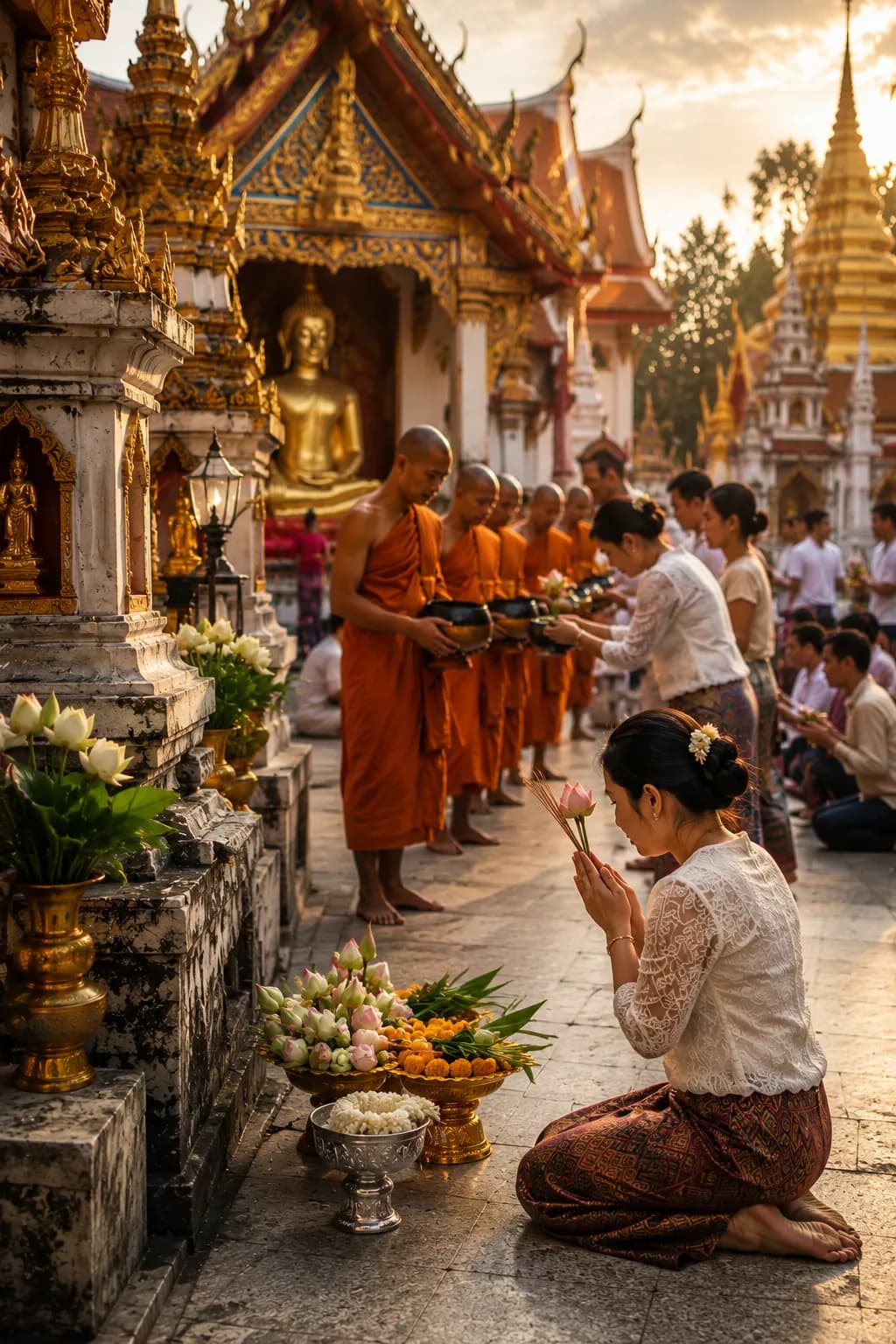
Every year, Thailand’s monastic calendar enters a different rhythm. The rains arrive. Monks traditionally settle into a monastery for an extended retreat. Laypeople make religious commitments. Communities prepare festivals and offerings. The season begins with Khao Phansa, continues through roughly three lunar months and ends with Ok Phansa. Then comes Kathina. For travellers, these names can look like separate festivals on a calendar. Religiously, they belong to one connected cycle.
What Is the Rains Retreat?
Theravada monastic tradition includes an annual retreat during the rainy season. In Pali, it is known as vassa. For roughly three months, monks remain based at a monastery rather than engaging in ordinary long-distance wandering. The rule is more nuanced than a literal three-month ban on crossing the temple gate. Monastic rules contain exceptions and practical details. The broad principle is stability. The rainy season creates a period in which monks settle, practise and live more continuously with one community.
Traditional explanations connect the rains retreat with the practical conditions of ancient India. Wandering monks travelling during heavy rain could damage crops and small living creatures. Settling for the wet season therefore fitted both practical and ethical concerns. Over time, the retreat became firmly embedded in monastic discipline. Thailand adapted the institution to its own seasonal and cultural setting. The result is a religious calendar that still follows a rhythm created in a very different historical environment. That is common in living traditions. Ancient rules acquire new local meaning.
Khao Phansa
Khao Phansa marks entry into the rains retreat. It normally follows immediately after Asalha Bucha. For monks, the day begins the formal period of residence. For laypeople, it can also become a moment for religious intention. Some choose to observe precepts more carefully, reduce alcohol or give up a habit during the retreat. The comparison with Christian Lent is why English often calls the period Buddhist Lent. The analogy is useful but imperfect. The comparison is useful, but the two traditions should not be forced into identical shapes.
Candles have become strongly associated with Khao Phansa in Thailand. Historically, large candles could be offered to monasteries for use during the rainy-season period. In some provinces, that practical offering developed into spectacular cultural festivals. Ubon Ratchathani is especially famous for enormous carved candle sculptures and processions. By that point, the candle has become art, regional identity and tourism as well as religious offering. The festival can expand culturally without losing its Buddhist roots. It shows how religious customs expand.
Monastic Life During Phansa
The rains retreat can provide a more settled environment for study and meditation. A monk remains connected to one monastery for the period. Teachers and students spend longer together. Lay communities know where the monks are based. Some monasteries organise additional religious practice. The intensity varies. A quiet forest monastery can approach Phansa very differently from a large urban temple with constant ceremonies and visitors. The institution is shared. The daily experience is not.
Historically, completing a rains retreat could carry special significance for men who temporarily ordained. This is one reason Phansa appears in discussions of Thai ordination traditions. A man might enter the monastery before the retreat and remain through the full period. Modern work and education schedules can make long temporary ordinations difficult. Shorter periods are common in many contexts. The older ideal still shapes the way monkhood and the rains retreat are remembered. Religion adapts without completely forgetting its previous rhythm.
Lay Practice During the Retreat
Khao Phansa is not only a monastic event. Lay Buddhists may use the three months as a period of additional discipline. Someone might stop drinking alcohol. Another person attends temple more regularly. Others make merit on the opening day and otherwise continue normal life. Participation remains individual rather than following one national programme. This is worth repeating because religious holidays are often described as if the whole country suddenly adopts one practice. Thailand is Buddhist.
Thai people are still individuals. Ok Phansa marks the end of the rains retreat. The monks complete their formal residence period and the monastic calendar opens into a new phase. Across Thailand, local traditions surround the day. Some communities hold processions or temple events. The atmosphere may be strongly religious in one place and highly festive in another. The retreat ends nationally. The celebration is local. That combination appears repeatedly in Thai festival culture.
The End Is Not the End
For travellers, Ok Phansa can look like the conclusion of the season. Religiously, something important follows. The period after the rains retreat is associated with Kathina, one of the most significant annual opportunities for lay communities to support the Sangha. Khao Phansa, Ok Phansa and Kathina make the most sense when understood as one connected cycle. The monks complete the retreat. The lay community then gathers around the monastery in a formal act of support. Kathina is a traditional robe-offering ceremony held after the rains retreat.
The ritual is governed by monastic rules and specific timing. Kathina is therefore more formal than deciding one afternoon to donate a robe. In Thailand, the ceremony has grown into a major social and religious event. Families, businesses and organisations may contribute. Money and supplies can be presented to the temple. Large groups travel together. Some Kathina processions feel closer to a community festival than the quiet image foreigners associate with Buddhist monasticism. The generosity is still the point.
Why Robes?
Robes are one of the basic requisites of monastic life. Offering robes therefore has an obvious practical religious meaning. But Kathina is not only about fabric. The ceremony strengthens the relationship between monks who have completed the retreat and lay supporters who sustain the monastery. That relationship is fundamental to Theravada Buddhism. The monks do not operate as financially independent householders. The lay community supports them. Kathina makes that interdependence visible on a large scale.
Modern Kathina ceremonies often involve substantial fundraising. This can surprise visitors expecting Buddhism to look detached from money. Temples have buildings, electricity, repairs and practical needs. Large religious events also cost money. The presence of fundraising does not by itself reduce the ceremony to commerce. At the same time, the scale and style of giving can vary enormously. A small village ceremony and a major royal or corporate Kathina event belong to the same religious season but look very different.
Royal Kathina
Thailand also has important royal Kathina traditions. The monarchy has historically been closely connected with the patronage of Buddhism. Royal participation in Kathina reflects that relationship. For most travellers, detailed ceremonial protocol is less important than understanding the principle. Kathina exists at many levels of Thai society, from local community support to high-profile national ceremonies. The same religious idea can operate in very different social settings. The rains retreat has generated regional celebrations beyond the monastery.
Candle festivals, boat traditions and local processions can attract large numbers of domestic and international visitors. Some events are now major tourism products. Tourism does not automatically make these celebrations inauthentic. Religious festivals have always been social occasions as well as moments of worship. The better question is not whether tourism has “ruined” the event. It is how the community balances religious meaning, local identity and the attention of visitors.
What Travellers Should Expect
If you are in Thailand during Khao Phansa, Ok Phansa or Kathina season, temple activity can increase. Public-holiday schedules may affect offices. Major regional festivals can create traffic and hotel demand. Local ceremonies may be open to respectful visitors. Do not assume every wat will hold the same event on the same scale. Kathina in particular is organised around individual monasteries within the permitted season. Check local information. The religious calendar creates the window. Communities decide how they fill it.
Visitors often imagine Buddhism as timeless: a monk meditating under a tree while centuries pass around him. The monastic calendar tells a different story. Buddhism has seasons. There are times for movement and times for settling. There are holy days, retreats and ceremonies of support. Khao Phansa begins a period of stability. Ok Phansa ends it. Kathina brings monks and laypeople together after the retreat. Once you understand that rhythm, the Thai Buddhist year stops looking like a collection of unrelated holidays. It starts to look like a living calendar.