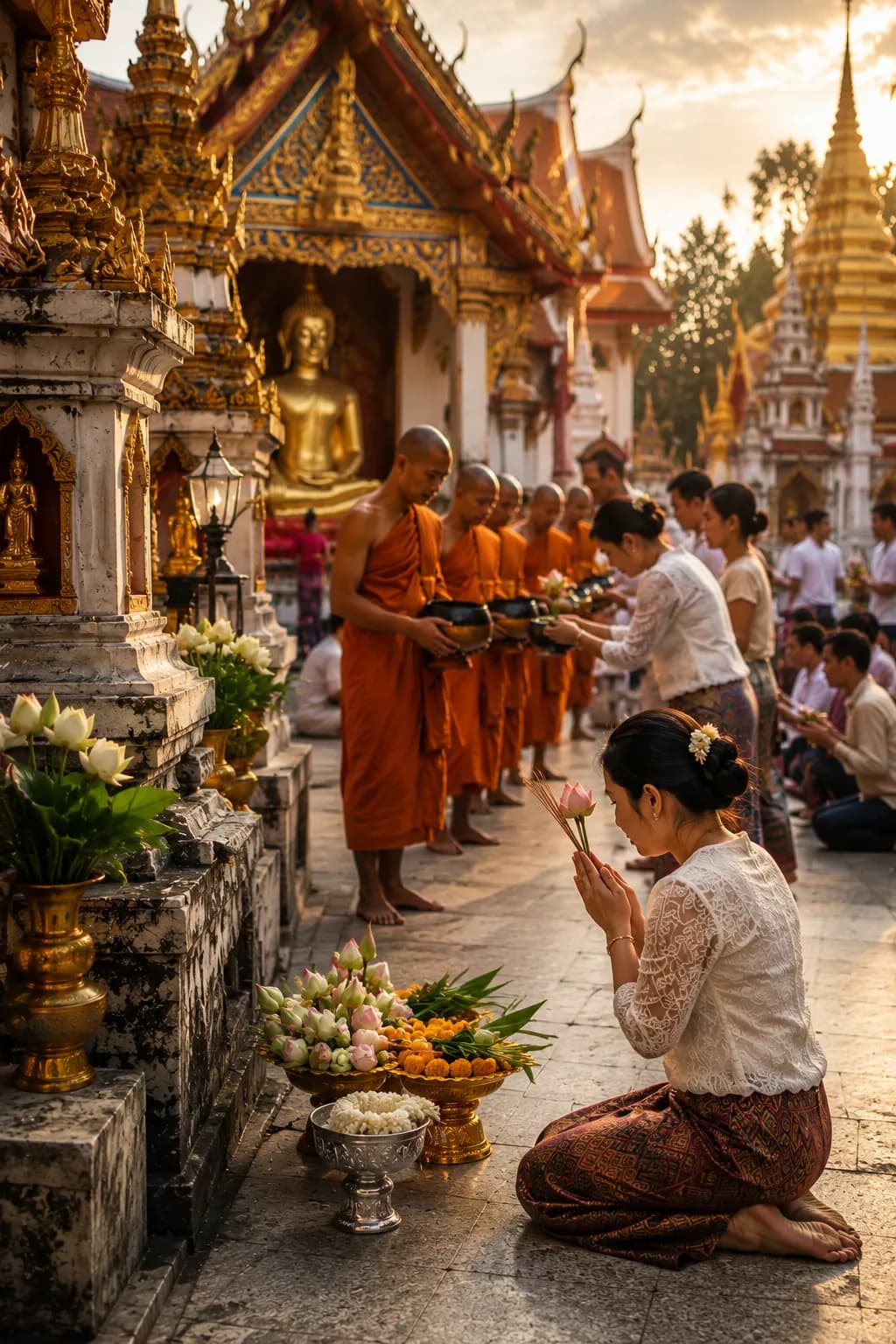
Thailand’s major Buddhist holy days can look similar from the outside. Temples are busy. People make merit. Candles glow after dark. Monks chant and give sermons. Public-holiday rules may affect the normal rhythm of the country. Yet Makha Bucha, Visakha Bucha and Asalha Bucha do not commemorate the same thing. Each day highlights a different part of Buddhist tradition. Together, they trace a kind of religious arc: the teaching of core principles, the life and awakening of the Buddha, and the first public teaching that established the Dhamma and Sangha. For travellers, understanding the difference turns three mysterious calendar dates into a much clearer story.
Why “Bucha”?
The Thai word bucha is related to the idea of honouring, venerating or paying respect. That helps explain why all three days have a devotional character. People may visit temples, listen to sermons, observe precepts more carefully and participate in merit-making. The days are not birthdays in the ordinary modern sense, nor are they festivals built mainly around entertainment. They are religious observances centred on remembering important moments in Buddhist tradition. The festive atmosphere at a large temple comes later.
The religious meaning comes first. All three observances follow a lunar calendar. That means their dates shift against the Gregorian calendar used for international travel. A holiday that falls in February one year may fall in March in another. The exact calculation belongs to the Buddhist lunar calendar rather than a fixed Western date. A travel guide that hard-codes one permanent Gregorian date is therefore asking for trouble. The practical rule is simple: check the specific year.
Makha Bucha
Makha Bucha is associated with a traditional account of an extraordinary gathering of 1,250 disciples of the Buddha. According to the tradition, the monks assembled spontaneously without being summoned, and all were fully awakened disciples ordained by the Buddha. The Buddha then delivered a teaching often connected with fundamental principles of Buddhist conduct and practice. The event is remembered not because of spectacle but because it represents the unity of the early Buddhist community around the Dhamma. In Thailand, Makha Bucha became one of the major annual Buddhist observances.
The teaching associated with Makha Bucha is often summarised through a simple moral framework: avoid evil, cultivate what is wholesome and purify the mind. That sounds almost too simple. Buddhist teaching frequently works that way. A short formula can contain an entire path. Avoiding harmful action relates to ethics. Cultivating wholesome action connects with generosity and moral conduct. Purifying the mind points toward meditation and wisdom. For visitors, this makes Makha Bucha easier to understand as more than “the day of the 1,250 monks.” The gathering matters because of what it symbolises.
Visakha Bucha
Visakha Bucha is among the most important Buddhist observances in Thailand and across much of the Buddhist world. In Theravada tradition, the day commemorates three major events associated with the Buddha: his birth, enlightenment and passing into parinibbana. That combination gives Visakha Bucha enormous religious significance. It connects the beginning of the Buddha’s life, the awakening that made him the Buddha and the final end of his earthly life. The day therefore encompasses the entire Buddhist narrative in a single observance.
Visitors sometimes find it strange that three separate events are remembered on one day. Religious calendars do not always follow the logic of modern biography. The traditional association places the events on the same lunar date in different years. What matters to practitioners is the symbolic unity. The Buddha is born. The Buddha awakens. The Buddha passes beyond the cycle of rebirth. Taken together, those events define why the Buddha matters within Buddhism. Visakha Bucha therefore becomes a day not only of remembrance but of reflection on the path he taught.
Asalha Bucha
Asalha Bucha commemorates the Buddha’s first sermon after enlightenment. Traditionally, this teaching was delivered to five former companions. It is associated with the teaching of the Middle Way, the Four Noble Truths and the beginning of the Noble Eightfold Path as a public Buddhist teaching. The sermon is often described as setting the Wheel of Dhamma in motion. One of the listeners attained a decisive breakthrough in understanding, creating the beginning of the community of awakened disciples. Asalha Bucha is therefore closely connected with the emergence of the Sangha.
Before the first sermon, there was an awakened Buddha. After the sermon, there was a teaching being transmitted to others. That difference is fundamental. Buddhism becomes a living tradition when the Dhamma can be heard, understood and practised by a community. Asalha Bucha therefore commemorates more than a speech. It marks the beginning of transmission. The timing also matters because the following day traditionally begins Khao Phansa, the Buddhist rains retreat. The holy day leads directly into an important monastic season.
What the Three Days Share
Makha Bucha, Visakha Bucha and Asalha Bucha commemorate different events, but Thai observance often shares common features. People visit temples. They make merit. Some observe additional precepts. Monks give sermons and conduct chanting. Evening processions can bring hundreds or thousands of people into temple grounds. The shared forms make sense. All three days focus attention on the Buddha, Dhamma and Sangha. The history being remembered changes. The basic religious vocabulary remains familiar. The most visually distinctive practice for many visitors is wian thian.
Participants walk clockwise around a sacred structure, commonly three times, carrying candles, incense and flowers. The three circuits are traditionally associated with the Buddha, Dhamma and Sangha. At a major temple after dark, the sight can be extraordinary. Lines of candlelight circle the ubosot or chedi while monks and laypeople move slowly together. It is also very easy for tourism to change the atmosphere. If you attend, remember that the people around you are not extras in a night photography session.
Candles, Incense and Flowers
The objects carried during wian thian have symbolic associations. Flowers are beautiful but fade, making them a natural reminder of impermanence. Candles bring light. Incense is connected with reverence and ritual offering. Not every participant spends the procession consciously analysing each symbol. Religious practice does not require a running philosophical commentary in the head. The symbolism forms part of a tradition that people may experience intellectually, emotionally or through repeated practice.
Major Buddhist days often bring additional merit-making. People give food to monks, donate to temples and participate in ceremonies. Some spend more time observing precepts or listening to Dhamma. The day may therefore feel different from ordinary sightseeing hours. Temple courtyards become busy before sunrise. Families arrive together. White clothing may be more common among serious lay practitioners. The atmosphere varies from quiet devotion to a large community event depending on the wat.
Public-Holiday Effects
Major Buddhist observances can also affect ordinary travel. Government offices may close. Banks can run holiday schedules. Current Thai law may restrict alcohol sales on certain major Buddhist holy days. The exact rules and exemptions can change. That makes annual verification important. A religious holiday should not be reduced to whether a bar is open, but travellers still need practical information. Both facts can be true at once.
No. Thailand shares national religious observances, but local temple culture varies. A famous Bangkok wat may host large organised ceremonies. A village temple may hold a smaller event in which everyone knows everyone. Regional customs can add distinctive features. Participation also varies by individual. Some Thai Buddhists attend every major observance. Others may barely notice beyond the public holiday. National religion does not produce national uniformity.
Is It Appropriate for Tourists to Attend?
Generally, temples are open and visitors can observe Buddhist holiday activities respectfully. Non-Buddhist visitors are generally welcome to observe respectfully. At the same time, a holy day is not the ideal moment to behave as if a temple is an empty attraction. Dress appropriately. Follow photography rules. Do not interrupt chanting. If you join wian thian, follow the movement of local participants. Respect does not require imitating religious actions you do not understand. Quiet observation is perfectly respectful.
The easiest way to remember the three Bucha days is through the story each tells. Makha Bucha looks back to the community gathered around the Buddha and a concise statement of Buddhist practice. Visakha Bucha encompasses the Buddha’s birth, awakening and parinibbana. Asalha Bucha remembers the first sermon and the beginning of the Dhamma as a teaching shared with others. They are not interchangeable holidays. Together, they illuminate why the Buddha, Dhamma and Sangha remain at the centre of Thai Buddhism. Once you understand that, the candles become more than a beautiful image. They belong to a story.