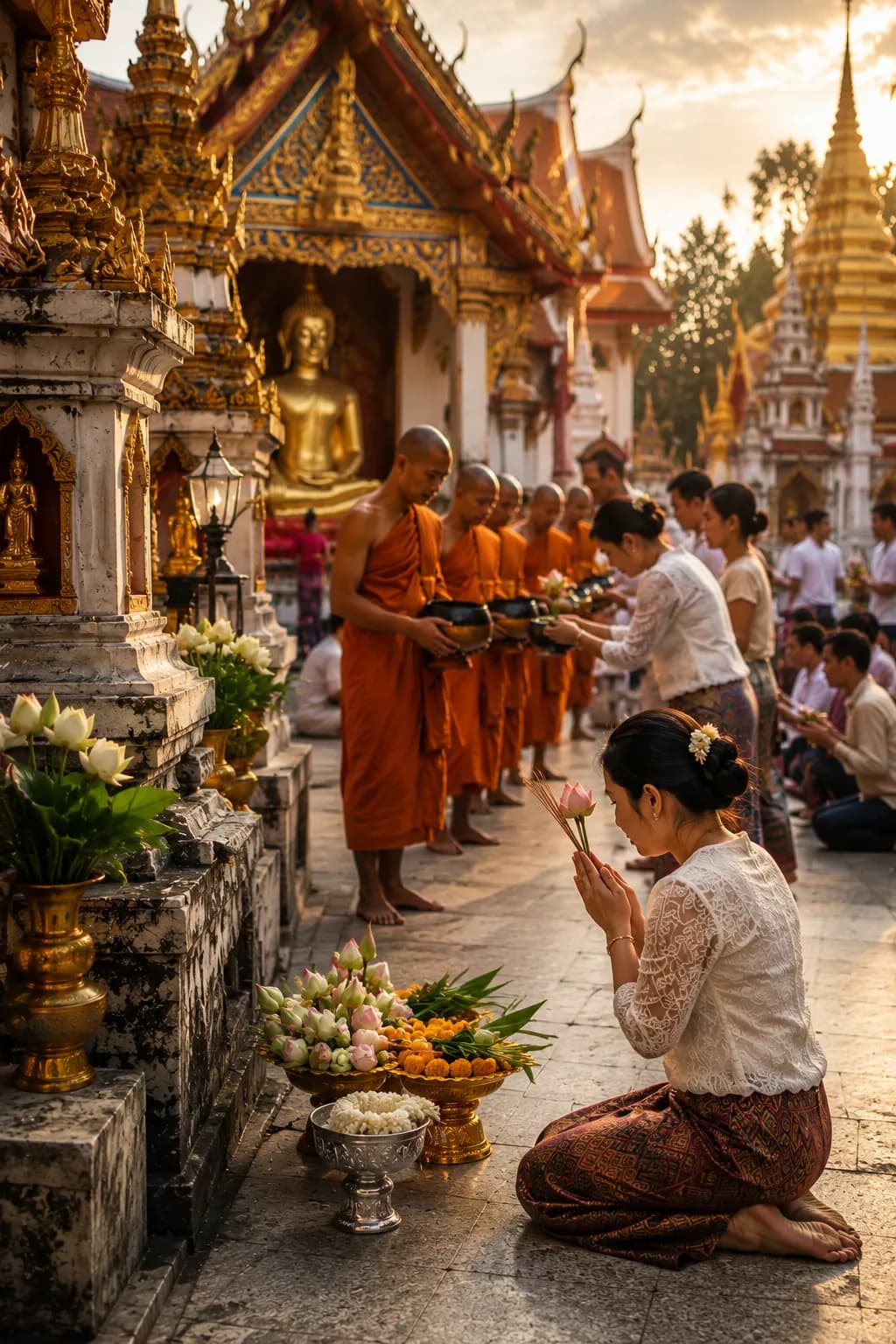
Thailand has public holidays with fixed dates, national celebrations linked to the monarchy and festivals that seem to move around the calendar every year. Buddhist holidays belong mainly to the last group. Many important observances follow a lunar calendar, so their dates shift against the Gregorian calendar used for flights, hotel bookings and international business. That can confuse travellers. The pattern becomes much easier once you understand that Thailand’s major Buddhist days are not random public holidays. They mark events in Buddhist tradition and stages in the monastic year.
Why the Dates Move
Thailand uses the Gregorian calendar extensively in modern life, but Buddhist observances often follow lunar dates. That means a holiday can fall in February one year and March another, or move by several weeks against a Western calendar. Always check the date for the specific year of travel. Do not rely on an article that says a lunar festival “is on 24 February” as if that were permanent. The Thai Buddhist calendar has its own rhythm. That rhythm shapes temple life far more than the fixed number on your international calendar.
Thai Buddhists also observe regular wan phra, or Buddhist holy days. These occur according to phases of the lunar calendar. Temple attendance can increase, and some practitioners observe moral precepts more strictly or spend additional time in religious activity. Most tourists will not experience every wan phra as a dramatic public event. That is useful to remember. Buddhist religious life in Thailand is not limited to a handful of national holidays. The calendar contains a quieter cycle beneath the famous festivals.
Makha Bucha
Makha Bucha is one of Thailand’s major Buddhist holy days. Traditional accounts connect it with a spontaneous gathering of 1,250 disciples of the Buddha and an important teaching summarising principles of Buddhist practice. The holiday is often associated with temple visits, merit-making, sermons and evening wian thian, a candlelit circumambulation of a sacred structure. Participants walk clockwise, commonly carrying candles, incense and flowers. At a major temple, the sight can be beautiful.
It is still a religious observance rather than a staged light show. Visakha Bucha, internationally known as Vesak in many Buddhist countries, is among the most important days in the Buddhist calendar. Theravada tradition commemorates the Buddha’s birth, enlightenment and passing into parinibbana on this observance. Thai temples may hold ceremonies throughout the day. Laypeople make merit, listen to Dhamma and participate in evening processions. Because of the holiday’s religious significance, government regulations may affect alcohol sales and entertainment in some contexts. Those rules can change, so travellers should check current official information rather than relying on an old travel blog.
Asalha Bucha
Asalha Bucha commemorates the Buddha’s first sermon after enlightenment. In Buddhist tradition, this teaching set the Dhamma in motion and led to the formation of the earliest Sangha. The day therefore carries strong doctrinal importance. For travellers, it is also useful because Asalha Bucha occurs immediately before the beginning of the Buddhist rains retreat. That links one holy day to a much larger annual monastic cycle. Khao Phansa marks the beginning of the traditional Buddhist rains retreat.
For roughly three lunar months, monks traditionally remain based in a monastery rather than travelling freely as they might at other times. The retreat developed within the monastic tradition of the rainy season. In Thailand, Khao Phansa has become both a religious observance and the centre of spectacular local festivals. The famous candle traditions in places such as Ubon Ratchathani show how a monastic calendar can become part of regional cultural identity. The festival atmosphere does not erase the religious meaning. Both exist together.
Life During the Rains Retreat
The rains retreat is often described as Buddhist Lent. The comparison is useful for giving foreigners a quick sense of an extended religious season, although the traditions are not identical. Monks may devote additional attention to study, meditation and life within the monastery. Laypeople can also make religious commitments during the period. Some reduce alcohol or other habits. Others attend temple more frequently. Thai Buddhists do not follow one universal programme during the retreat.
The retreat provides a religious framework within which different people choose different levels of practice. Ok Phansa marks the end of the rains retreat. The monastic community returns to a period in which travel becomes less restricted. Different regions celebrate the end of Phansa in distinctive ways. Temple events, merit-making and local festivals can create a very different atmosphere from one province to another. This is a recurring theme in Thai Buddhism. National religious dates provide a shared structure. Local culture supplies much of the colour.
Kathina
After the rains retreat comes the Kathina season. Kathina is associated with the formal offering of robes and other support to the monastic community. In Thailand, Kathina ceremonies can become major community events involving families, businesses and local organisations. Money may be raised. Processions can be festive. Temple grounds fill with people. Calling Kathina merely “a robe donation” misses the social scale of the event. It is a ritualised relationship between the lay community and the monastery after the monks have completed the rains retreat.
One of the most visually memorable practices on major Buddhist holidays is wian thian. Participants walk clockwise around a sacred structure, often three times, carrying candles, incense and flowers. The practice expresses reverence and recollection of the Buddha, Dhamma and Sangha. Visitors may be able to observe or participate depending on the temple. If you do join, follow the local pattern rather than treating the procession as an evening attraction. People around you are engaged in religious practice. That atmosphere deserves the same respect you would give worshippers in a church, mosque or shrine.
What Happens at Temples?
Temple programmes vary. A temple may begin activities early in the morning with merit-making and food offerings. Monks give sermons. Laypeople observe precepts. Ceremonies continue into the evening. Large famous temples may be crowded. Small local wats can feel intimate. If your goal is to understand Thai Buddhism rather than photograph it, a neighbourhood temple can sometimes be more revealing than the major tourist sites. You see ordinary religious life rather than a crowd filtered through tour schedules.
Several major Buddhist observances are official public holidays in Thailand. Government offices and some businesses may close. Banks can operate on holiday schedules. Transport continues, but crowds may increase around long weekends. The exact impact depends on the holiday and location. Tourist businesses in major destinations often remain active even when government institutions close. Check the specific date and current holiday arrangements when planning something important.
Alcohol Restrictions
Thailand has restrictions on alcohol sales associated with certain major Buddhist holidays. The exact legal framework and exemptions can change over time. Do not assume a rule remembered from a previous trip will still apply identically. Bars, restaurants and shops may adjust operations. For travellers, this is less a moral issue than a practical one. If a major Buddhist holiday falls during your trip, verify the current rules.
Thailand4U should explain the pattern, not pretend a permanent list can never change. A temple on a major holy day may be busier and more religiously focused than during an ordinary sightseeing visit. Dress respectfully. Keep noise down around ceremonies. Do not push through worshippers for photographs. If a hall is full, wait. The fact that a Buddhist holiday creates beautiful scenes does not turn the participants into performers. The best photographs often come from stepping back anyway.
Regional Festivals
Thailand’s Buddhist calendar becomes especially interesting when local identity enters the picture. Candle festivals, boat traditions and regional processions can grow around religious dates. Some are now major tourist events. The relationship between religion and tourism is not necessarily a contradiction. Communities can celebrate a tradition publicly while still understanding its sacred meaning. Visitors should remember that the spectacle has religious and local roots.
Religious holidays also reveal how different calendars coexist in Thailand. International life runs largely on Gregorian dates. Official Thai documents may use the Buddhist Era year. Buddhist observances follow lunar calculations. A Thai person can move between all three without finding the system especially confusing. Foreign visitors usually need a little more practice. The solution is simple: when a Buddhist holiday matters to your plans, check the exact Gregorian date for that year.
More Than Days Off
Buddhist holidays are not public holidays with temple decorations. Makha Bucha, Visakha Bucha and Asalha Bucha commemorate central events in Buddhist tradition. Khao Phansa and Ok Phansa structure the monastic year. Kathina strengthens the relationship between temples and lay communities. Together, they reveal Buddhism as a calendar of practice rather than only a set of beliefs. If you happen to be in Thailand during one of these observances, do not treat the changed opening hours as an inconvenience and move on. Go to a temple. Stand quietly. Watch what people are doing. The calendar makes much more sense when you see the religion behind it.