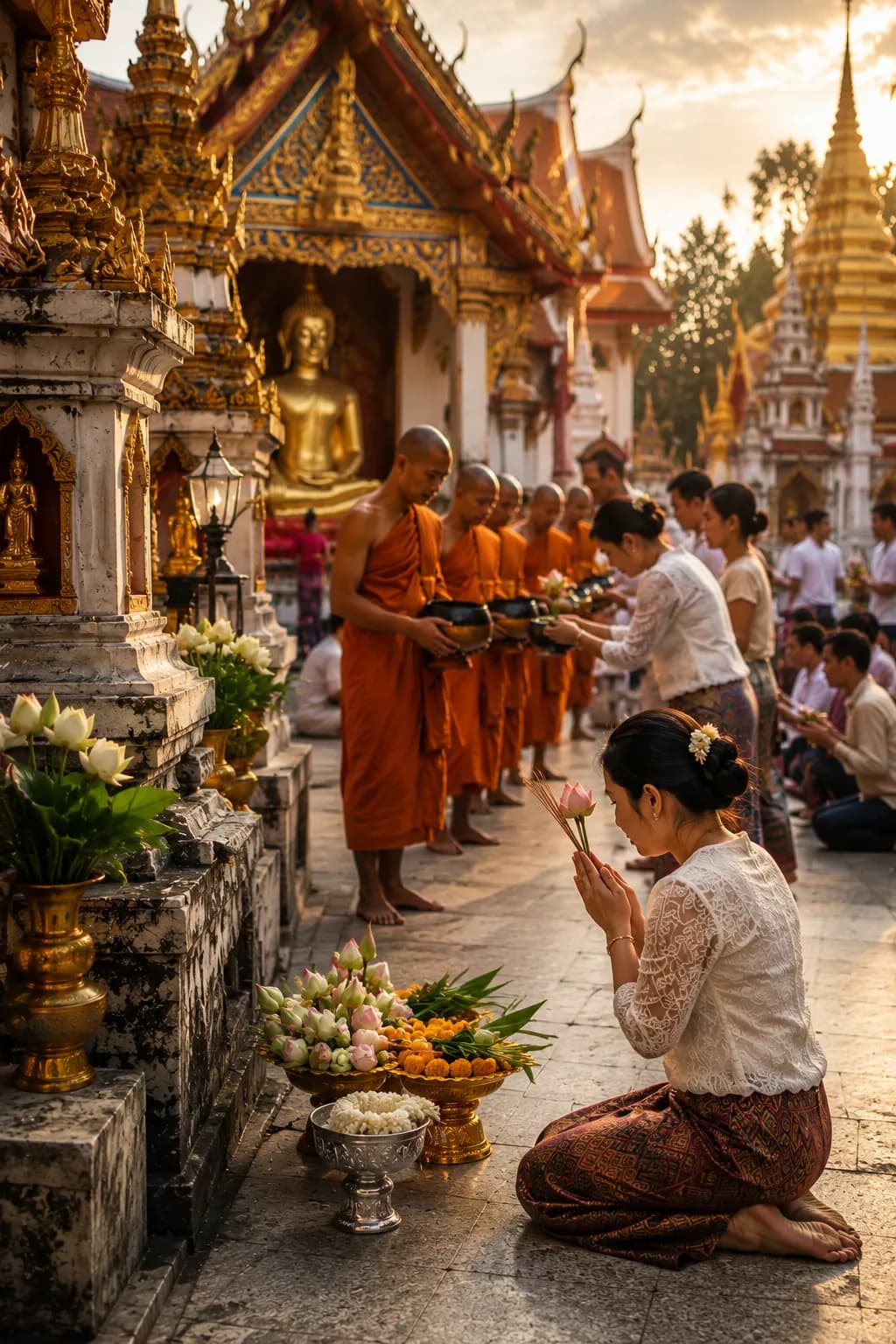
You walk into a Thai temple and see several ornate buildings. One contains the main Buddha image. Another appears almost identical but is locked. A tall chedi rises behind them. Small stone markers sit around one hall. Monks live in plain buildings off to the side. The whole place is called a wat. If you assume “temple” means one sacred building, none of this makes much sense. A Thai wat is better understood as a religious complex. Once you learn the main parts, temple architecture stops looking like a collection of beautiful roofs and starts becoming readable.
What Is a Wat?
The Thai word wat refers broadly to a Buddhist temple or monastic complex. A wat can include sacred halls, stupas, monks’ residences, kitchens, schools, crematoria, meeting spaces and open courtyards. Famous royal temples may be architecturally elaborate. Small rural wats can be much simpler. Thai wats do not follow one universal blueprint. What connects them is function. A wat is a place where a monastic community lives and where laypeople participate in Buddhist religious life. That is why the complex contains both sacred and practical spaces.
One of the most important buildings is the ubosot, commonly translated as ordination hall. This is the consecrated space where formal monastic acts such as ordination take place. It often contains an important Buddha image and can look similar to other temple halls. The key difference is not necessarily architectural. It is ritual status. The ubosot occupies a formally defined sacred boundary. That boundary is what makes the building suitable for certain acts of the Sangha.
Bai Sema
The sacred boundary around an ubosot is marked by bai sema stones. These are among the most useful architectural clues for visitors. If you see stone markers positioned around a hall, you are probably looking at an ordination space. The markers can be simple or highly decorated. Their purpose is religious rather than decorative. They define the consecrated area within which formal monastic ceremonies can occur. Once you know to look for them, you start noticing bai sema everywhere.
Another important building is the wihan, also spelled viharn or vihara in English transliteration. A wihan is generally an assembly or image hall used for worship and religious activities. It can contain major Buddha images and may be more accessible to ordinary visitors than the ubosot. At some famous temples, the building tourists remember most strongly is a wihan rather than the ordination hall. Translating both buildings as “temple” therefore creates confusion. Two buildings can look similar while having different religious functions.
Which Hall Is More Important?
The answer depends on the temple and on what kind of importance you mean. The ubosot has special institutional importance because of ordination and formal Sangha acts. A wihan may contain a particularly revered Buddha image and attract far more daily devotion. Architecture and religious importance do not always line up according to a simple hierarchy. Local history matters. A wat grows over time. New buildings are added. Old images acquire reputations.
The temple complex becomes a record of its own development. The Thai word chedi refers to a structure related to the Buddhist stupa tradition. Chedi can contain relics, ashes or memorial material. They also function as powerful Buddhist symbols. Shapes vary widely. Some are tall and bell-shaped. Others reflect Khmer, Sri Lankan or regional architectural influences. Older temple sites can contain several styles from different periods. A chedi therefore tells you something about both Buddhism and art history.
Relics
Relics occupy an important place in Buddhist religious culture. A chedi may be associated with relics of the Buddha, respected monks or other sacred material. Claims about relics can belong partly to religious tradition rather than modern archaeological proof. A travel article should respect that distinction. You can say a temple venerates something as a relic without claiming a laboratory has verified its ancient identity. Religious significance does not depend on a tourist settling every historical question.
Some Thai temples also contain prang, tower-like structures with strong historical connections to Khmer architectural forms. They are especially prominent in certain central Thai temples and historical sites. Wat Arun’s famous central tower is the best-known example for most visitors. Prang and chedi are not interchangeable terms, even though both can dominate a temple skyline. Thailand’s architecture absorbed influences from different kingdoms and artistic traditions. The roofline of a wat is therefore also a map of history.
Monks’ Quarters
The most important buildings for tourists are not necessarily the ones monks spend most of their time inside. Monks live in residences known as kutis. A kuti can be a simple individual dwelling or part of a larger residential arrangement. In forest monasteries, small kutis may be spread widely through wooded grounds. Urban temples can have denser accommodation. These buildings are usually far less decorative than the sacred halls. That simplicity reflects function.
A monastery needs somewhere to live as well as somewhere to worship. A sala is an open or semi-open pavilion. Thai temples can contain several types used for rest, meetings, teaching, meals or ceremonies. The term appears far beyond temples because pavilion architecture is common throughout Thailand. For travellers, the important point is flexibility. Not every religious activity happens inside an enclosed ornate hall. A simple roofed space can become a classroom, dining area or place for a community gathering. Temple life needs adaptable architecture.
Crematorium
Many working Thai temples include a crematorium. This can surprise visitors exploring a beautiful wat for the first time. Funerals are one of the major social functions of temples. A crematorium therefore belongs naturally within many complexes. Its architecture can range from simple to highly elaborate. If a funeral is taking place, remember that the temple is temporarily serving a grieving family as well as sightseers. The building is not a strange extra.
It is part of the wat’s role in community life. Serpent-like naga appear throughout Thai temple architecture. They guard stairways. They decorate roofs. They emerge in murals and sculpture. Naga belong to a wider South and Southeast Asian mythic world and are important in Buddhist stories as well as local religious traditions. One famous Buddhist narrative tells of the naga king Mucalinda sheltering the meditating Buddha from a storm. Thai architecture transformed naga imagery into some of its most recognisable visual forms.
Garuda
The Garuda has roots in Hindu mythology and became deeply embedded in Thai royal and state symbolism. Garuda imagery also appears in temple art. This is another reminder that Thai sacred architecture draws from more than one historical religious source. Buddhist buildings can contain creatures and symbols with Brahmanic or Hindu origins. Those borrowed visual traditions sit comfortably inside a Buddhist temple. It shows how Thai visual culture developed through interaction.
Thai temple roofs are among the most visually distinctive parts of a wat. Multi-tiered rooflines, steep slopes and elaborate finials create the silhouette tourists immediately associate with Thai religious architecture. Decorative elements such as chofa rise from roof ends. The exact forms vary by period and region. A Lanna temple in the North does not look identical to a royal Bangkok wat. Southern temple architecture can show other influences. Thailand has styles, not one style.
Murals
Temple interiors can contain extraordinary murals. Scenes may depict episodes from the Buddha’s life, Jataka stories about previous lives, Buddhist cosmology, local society and historical events. Older murals can be valuable records of clothing, architecture and ordinary life. Modern temples sometimes add contemporary imagery. That can surprise visitors expecting sacred art to remain frozen in the past. Thai Buddhist art has always interpreted religion through the world artists knew.
A smartphone or modern vehicle appearing in a mural is not necessarily a mistake. The main Buddha image usually organises the visual focus of a hall. Visitors should treat that orientation seriously. People sit facing the image. Monks may occupy designated areas. Feet are kept away from the altar. The architecture guides behaviour. Temple etiquette becomes easier to understand once the building’s sacred organisation is visible. Sacred space actively structures how people move and sit. It structures how people move and sit.
Regional Styles
Northern Thai temples can show Lanna architectural traditions. Central Thailand reflects influences from Ayutthaya, Rattanakosin and earlier periods. Northeastern sites preserve traces of Khmer and Lao cultural worlds. Southern Thailand developed in contact with maritime networks and neighbouring Malay culture. No short list can capture every regional style. The important lesson is to stop assuming the ornate Bangkok temple is the default against which all others are variations.
Thailand’s religious architecture is regional. A temple can contain a centuries-old chedi beside a newly constructed hall. Thai Buddhism is not obsessed with preserving every building in untouched original form. Temples are living institutions. They renovate. They repaint. They expand. Western visitors sometimes prefer ruins because they feel “authentic.” Local worshippers may prefer a functioning new building with proper facilities. Both perspectives reveal different ideas about what a religious site is for.
Reading a Wat
The next time you enter a Thai temple, look beyond the most photogenic roof. Find the sema stones. Identify the ordination hall. Look for the wihan. Notice where monks live. Find the chedi. See whether the complex includes a crematorium, school or meeting hall. Suddenly the wat becomes more than architecture. It becomes a functioning religious settlement. Thai temple architecture succeeds partly because it combines the sacred and ordinary.
The Buddha image sits inside a hall of extraordinary beauty. Fifty metres away, somebody washes dishes. A funeral begins near the crematorium. A dog sleeps beneath a sala. Monks return from alms round. Children cross the courtyard. That is not a contradiction. A wat is not designed to separate religion from life. It is where the two meet.