1. Thailand Already Had It in Its Pocket
Some Thai cultural exports announce themselves loudly. Muay Thai has stadium music and flying elbows. Thai silk has colour and ceremony. Pad Thai arrives in a wok.
Ya dom usually appears halfway through a conversation.
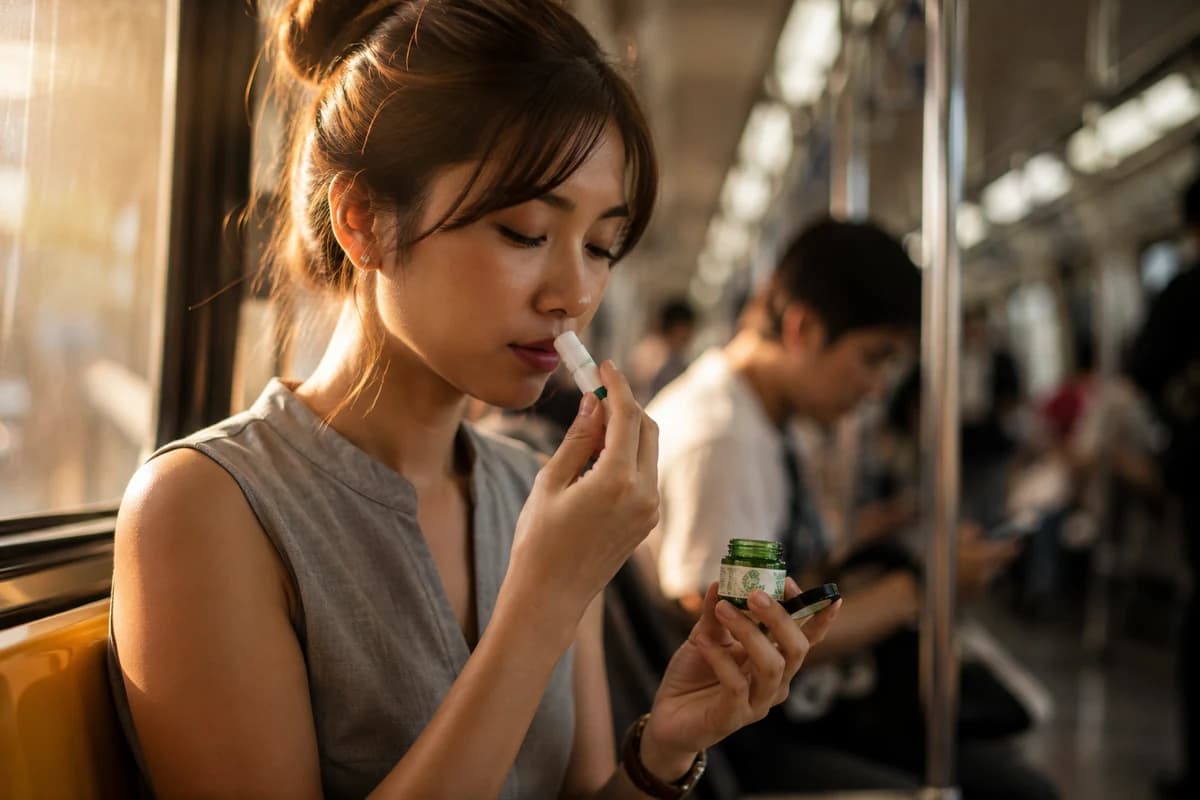
Somebody reaches into a pocket, twists open a tiny tube and takes a quick breath through one nostril. A taxi driver keeps one near the steering wheel. An office worker has one beside the keyboard. A student clips one to a bag. Someone standing in the Bangkok heat borrows one from a friend and hands it back as casually as a pen.
For foreign visitors, the behaviour can be more memorable than the product.
Ya dom literally means something close to “medicine to smell” or “inhaled medicine”: ya is medicine, dom is to smell or inhale. The modern category includes mentholated sticks, two-ended inhalers, liquid aromatic oils and jars packed with dried herbs. They are sold in convenience stores, pharmacies, markets, department stores and online for prices low enough to make impulse buying almost inevitable.
Yet outside Thailand, ya dom has only recently begun to look like a phenomenon. Social media helped. Thai celebrities helped. K-pop fandom helped. New design-led brands helped. So did the green herbal jar that suddenly began appearing in photographs with people who had millions of followers.
By 2025, international lifestyle media were writing about Thai inhalers as a celebrity wellness trend, while Bangkok luxury hotels were offering guests the chance to blend their own versions. What had once looked like one of those small everyday Thai habits tourists noticed in passing was being repackaged as culture, design and soft power.
The important correction is simple. Ya dom did not suddenly become popular in Thailand. The world suddenly became interested in ya dom.
2. Before the Plastic Tube, Thailand Already Loved Fragrance
It is tempting to push ya dom backwards until it becomes an ancient object. That would be too neat.
The modern plastic inhaler is a twentieth-century commercial product. But Thailand had a much older culture of aromatic substances, perfumed preparations and herbal remedies used through scent.
Thai cultural sources trace bu nga ram pai — fragrant mixtures of flowers and aromatic ingredients — to courtly traditions from the late Ayutthaya period. These were not modern nasal inhalers. They belonged to a wider world of scented flowers, perfumed water, borneol, camphor and aromatic materials used on the body, in clothing and in domestic or court settings.
By the Rattanakosin period, aromatic remedies became increasingly visible in written and remembered traditions. Thai PBS highlights formulas such as ya dom som mue, an inhaled preparation associated with Buddha’s hand citrus and the royal household in the reign of King Rama V.
This matters because the modern ya dom did not appear in a culture with no idea that smell could be refreshing, comforting or medicinal. But continuity should not be exaggerated. A sachet of perfumed flowers in a nineteenth-century palace is not the same object as a two-ended menthol inhaler from a 7-Eleven. The ingredients changed. Manufacturing changed. Packaging changed. Regulation changed. The users changed too.
What survived was the idea that volatile scent could do practical work. Menthol, camphor, borneol and aromatic oils eventually became central to commercial inhalers because they create an immediate cooling, penetrating sensation. Herbal jar versions added dried spices, roots, flowers and leaves to the sensory experience, with different producers building formulas around different intensities and scent profiles.
The result sits halfway between medicine cabinet and fragrance culture. That ambiguity would become one of ya dom’s greatest strengths. It could feel useful without feeling clinical. It could smell traditional without looking ceremonial. And once it became small enough to carry everywhere, it stopped waiting at home for somebody to feel unwell.
3. Chinatown, Chinese Medicine and the Rise of Poy-Sian
The clearest bridge from old aromatic remedies to modern mass-market ya dom runs through Bangkok’s Chinatown.
Poy-Sian traces its roots to a small traditional herbal shop established in Yaowarat in 1936 by a Chinese immigrant family. The company did not begin with the exact plastic Mark II inhaler people recognise today. Its own history describes a business that developed through generations, refining formulas and formats before arriving at the two-in-one product that became enormously successful later in the twentieth century.
That distinction is important. Saying “Poy-Sian dates to 1936” is fair as a brand history. Saying “the current Poy-Sian inhaler was invented in 1936” collapses decades of product development into one date.
The evolution itself is more interesting. The company moved from a traditional herbal-shop environment into manufactured portable remedies. A later generation developed a one-way inhaler under another brand, then refined the concept again. The familiar Poy-Sian Mark II eventually combined an inhaling end with a small reservoir of aromatic liquid at the other end.
That two-way design solved an everyday problem elegantly. One side could be sniffed. The other could dispense liquid for external use. The whole thing fitted in a pocket.
By the 1990s, Poy-Sian says the format had become successful enough to substitute, for many customers, for carrying separate balms or medicated oils. The company now describes itself as a major Thai inhaler manufacturer and exporter, with official partners across several regions of the world.
Poy-Sian also demonstrates why ya dom is not simply “ancient Thai herbal wisdom in plastic”. The brand grew from Chinese-Thai herbal commerce, modern factory production, regulatory systems and product design. That does not make it less Thai. It makes it a very Thai twentieth-century story: migration, Chinatown, herbal knowledge, family business and industrial adaptation compressed into something the size of a marker pen.
4. What Are You Actually Smelling?
Open two ya dom and they may smell completely different.
The modern stick format often depends on a relatively small group of powerful aromatic compounds: menthol, camphor, borneol and essential oils such as peppermint or eucalyptus are common. Herbal jars may add a much broader mixture of dried plant material — cloves, cardamom, cinnamon, star anise, citrus peel, flowers, roots and other aromatics depending on the formula.
The sensation is part chemistry, part perception. Menthol activates cold-sensitive receptors in the nose and creates a strong feeling of coolness and airflow. That sensation can make a blocked nose feel more open, even though an inhaler is not the same thing as a medical decongestant treating the underlying cause. Camphor, borneol and essential oils add their own sharp, cooling or aromatic notes.
Thai people commonly reach for ya dom when they feel dizzy, faint, nauseous, stuffy, tired or simply in need of a sensory reset, and product registrations and traditional-use language often reflect some of those uses. That does not mean every claim attached to every herb should be read as modern clinical evidence. Ya dom belongs to a space where traditional medicine, household remedy and everyday habit overlap. It can be genuinely soothing without becoming a cure-all.
The body also learns the ritual. Twist. Inhale. Cold sensation. Strong smell. Brief pause. Back to whatever you were doing.
That speed matters. There is no cup to prepare, tablet to swallow or appointment to book. The effect people value is immediate and sensory.
It also explains why preferences become strangely personal. One person wants something sharp enough to make their eyes water. Another wants peppermint and eucalyptus. Someone else wants a herbal jar that smells like an entire apothecary has been compressed into a container smaller than a coffee cup.
Asking which ya dom is “best” can therefore produce the same problem as asking which chilli sauce is best. You are no longer discussing a category. You are discussing personality.
5. The Stick, the Jar and the Great Ya Dom Split
For years, the classic international image of ya dom was the slim inhaler stick. Poy-Sian became the obvious example: tiny, cheap, colourful, easy to replace and designed to live in pockets rather than medicine cabinets.
Then the jar became cool.
Herbal inhalers had existed in larger containers before social media noticed them, but Hong Thai helped give the format a completely different visual identity. Its famous green jar contains aromatic herbal material rather than looking like a miniature pharmaceutical tube. Open the lid and the experience is broader: less one concentrated jet of menthol, more a cloud of herbs and volatile oils.
The form changed the social behaviour too. A stick is personal and directional. A jar can be opened on a table, passed around, smelled at a distance or photographed as an object. It looks handmade even when produced at commercial scale. Dried herbs remain visible. The package signals “traditional” before anybody reads the label.
This made the two dominant formats culturally useful in different ways. The stick represented convenience. The jar represented herbal authenticity. Neither one is automatically more genuinely Thai. Both are modern products built from older ingredient traditions.
The category has since become much wider. There are rollers, balm formats, liquid drops, inhalers with refillable cartridges, luxury aluminium cases, pastel plastics, twin-scent systems and products designed to hang from phones or bags.
That expansion explains why translating ya dom simply as “nasal inhaler” can feel inadequate. Some are medicine-like. Some are fragrance-like. Some are accessories with menthol inside. And some are now designed with the clear assumption that the customer will want the container to appear in a photograph.
Ya dom stopped being one product format. It became a platform.
6. Why Thailand Never Needed a Ya Dom Comeback
Many products become fashionable again after disappearing for a generation. Ya dom never really left.
Thailand Foundation described it in 2022 as something found everywhere from streets to meeting rooms and across age groups. That broad everyday use is important because it separates ya dom from products revived mainly through nostalgia. People did not need to rediscover inhalers. They needed reasons to keep buying new ones.
Thailand’s climate helps explain part of the appeal. Heat, crowded transport, strong food smells, long commutes and air-conditioned indoor spaces all create moments when an intense cooling scent feels welcome. So do motion sickness, dizziness or a blocked nose.
But practicality is only part of the story. Ya dom also became a tiny behavioural comfort. It gives the hands something to do during a stressful meeting. It can create a brief private pause on a crowded train. It is small enough to carry without planning and cheap enough that losing one is irritating rather than catastrophic.
And losing one is part of the culture too. People buy several. They leave one in the car, one at work, one in a bag and one somewhere they will never find again.
That repeat-purchase behaviour turned an inexpensive remedy into a serious consumer market. Retail data from the early 2020s showed the tube-inhaler segment alone worth more than a billion baht in modern trade channels. By 2025, Thailand’s Ministry of Public Health was describing the wider inhaler market at more than 4.5 billion baht, with herbal inhalers accounting for a substantial part of it.
Those numbers help explain why competition suddenly looks so intense. The product was never commercially trivial. It merely looked trivial because each individual item was tiny.
Once brands realised that younger customers already used ya dom, the obvious question was no longer how to revive the habit. It was how to make the habit visible.
7. When Ya Dom Became Something You Could Style
The generational transformation of ya dom happened through packaging as much as medicine.
Older inhalers often looked exactly like what they were: inexpensive pharmacy products. Newer brands asked a different question. Why should something people carry every day look old-fashioned?
Peppermint Field deliberately targeted younger consumers and by 2022 had built a significant share of the tube-inhaler market. Its marketing moved toward music, celebrities and lifestyle positioning rather than treating the inhaler only as something to buy when feeling faint.
Design-led newcomers pushed further. Creative Thailand has documented brands that redesigned the traditional tube with brighter colours, cleaner forms and packaging aimed specifically at Gen Y and Gen Z. ARMA has described its own challenge almost comically directly: why can’t an inhaler be cool? Its newer products use refill systems, modern colour palettes and forms intended to function as accessories rather than anonymous remedies.
By 2025 and 2026, inhaler cases, character collaborations, keyrings and collectible designs were becoming part of the category. Thai Dom openly markets itself as “the inhaler for the new generation”. Other brands treat scent choices almost like perfume wardrobes.
This is not just cosmetic change. Design alters when a product gets used publicly. A medical-looking tube can stay hidden in a pocket. A brightly coloured inhaler with a custom case can hang from a bag. Once it becomes visible, it becomes social. Once it becomes social, people ask what it is.
That mechanism matters for international growth because ya dom is difficult to explain through advertising alone. The easiest sales pitch is still watching somebody else use one and asking for a sniff.
Thailand’s new inhaler brands understood that the object itself could do the marketing. The product no longer had to look like medicine. It could look like merchandise.
8. Lisa Takes One Photograph
Then came the moment that made “suddenly everywhere” feel literal.
In April 2023, photographs from Lalisa “Lisa” Manobal’s birthday celebration showed the BLACKPINK star holding a Hong Thai herbal inhaler. Fans identified the product almost immediately. Demand surged so quickly that the manufacturer publicly apologised when the relevant inhaler sold out and thanked Lisa for the overnight boost.
This was the classic Lisa effect: an ordinary Thai product turned into an international object of curiosity without a formal endorsement campaign.
The important thing is not that one celebrity created ya dom’s popularity. She did not. The product was already embedded in Thai life and already supported a large market. What she changed was visibility outside that context. Foreign fans were now encountering the inhaler not as something explained in a travel guide, but as something a globally famous Thai performer happened to carry.
That difference is powerful.
Other celebrity sightings followed. International reporting later associated Thai herbal inhalers with figures including actor Chris Hemsworth, rapper Central Cee and several Asian music stars. Thai athletes also brought inhalers into view during the Paris Olympics in 2024, further strengthening the idea that this tiny object was simply something Thais kept nearby.
The product became interesting precisely because nobody seemed to be trying very hard to make it interesting. A celebrity did not hold up a luxury box and read a slogan. She had ya dom in her hand. Fans wanted to know why.
That curiosity converted an everyday Thai habit into cultural export material far more efficiently than a conventional “Discover Thai Herbal Wisdom” campaign probably could have managed.
Sometimes soft power begins with somebody zooming into the background of an Instagram photo.
9. From Convenience Store to Soft Power
Once international attention arrived, Thailand began treating ya dom differently too.
The inhaler was no longer only a household remedy or convenience-store product. It could become a souvenir, a design object, a wellness experience and a symbol of modern Thai herbal culture.
Luxury hospitality provides the clearest example. Four Seasons Hotel Bangkok now offers guests an experience built around creating personalised herbal inhalers. Other high-end wellness properties have incorporated their own ya dom blends into guest programmes. That is a remarkable change in framing: a product associated with pharmacy counters and cheap plastic tubes can now appear inside a luxury hotel library as something culturally distinctive enough to make yourself and take home.
Government language has moved in the same direction. By 2025, Thailand’s Ministry of Public Health was discussing herbal inhalers as part of a broader medical-and-wellness growth strategy. Officials put the domestic inhaler market above 4.5 billion baht and described Thai herbal inhaler production as a sector with significant room for international expansion.
Poy-Sian already exports through official partners across Asia and other regions. Hong Thai’s celebrity visibility pushed a very different herbal-jar aesthetic overseas. New companies now launch with international lifestyle branding in mind from the beginning.
The global appeal is unusually easy to understand. Ya dom is cheap compared with most wellness products. It is tiny. It does not require refrigeration. It is strongly associated with Thailand. It can be used immediately. And it gives tourists something more interesting to take home than another elephant fridge magnet. The category also fits a wider global appetite for portable scent, self-soothing rituals and small “wellness” objects.
But that internationalisation creates a problem Thailand did not have to confront as visibly when ya dom was mostly a domestic habit. If the product is going to represent the country, somebody has to make sure the herbs inside the jar are as good as the story outside it.
10. The Next Battle Is Trust
Global attention can make a small product bigger very quickly. It also makes quality failures much louder.
In 2025, the Thai FDA announced that a production batch of Hong Thai Herbal Inhaler Formula 2 had failed microbiological standards. The company recalled the affected batch and announced tighter production controls. Wider FDA testing that year found three of 39 sampled herbal inhaler products contaminated with mould and pathogenic microorganisms, while compliant products remained on sale.
The episode matters because herbal jar inhalers present a different manufacturing challenge from a sealed menthol stick. Visible dried plant material is part of the appeal. It can also carry moisture and microorganisms if sourcing, drying, storage and processing are poorly controlled.
Thai health authorities responded by emphasising product registration, GMP production, microbial standards and new quality initiatives for the herbal sector. The government has discussed stronger certification and investment in sterilisation and testing as part of its ambition to push Thai herbal products further into international markets.
That is not the end of the ya dom story. It is evidence that the category has reached a new stage. The old challenge was making a strong-smelling portable remedy people wanted to carry. Thailand solved that decades ago. The new challenge is turning thousands of brands, formulas and design experiments into an export category that international consumers can trust.
And that brings the story back to the strange thing about ya dom’s sudden fame.
Nothing about the habit itself is sudden. Thailand had aromatic traditions long before the plastic tube. Chinese-Thai herbal shops helped turn those traditions into modern commercial products. Poy-Sian made the pocket inhaler ordinary. Herbal jars gave the category a new visual language. Young consumers turned inhalers into accessories. Celebrities made foreigners curious. Tourism and wellness brands turned that curiosity into an experience.
The world is now discovering ya dom as though Thailand invented it last week.
Thailand has been sniffing it for generations.