1. A Dessert That Looks Older Than Its Evidence
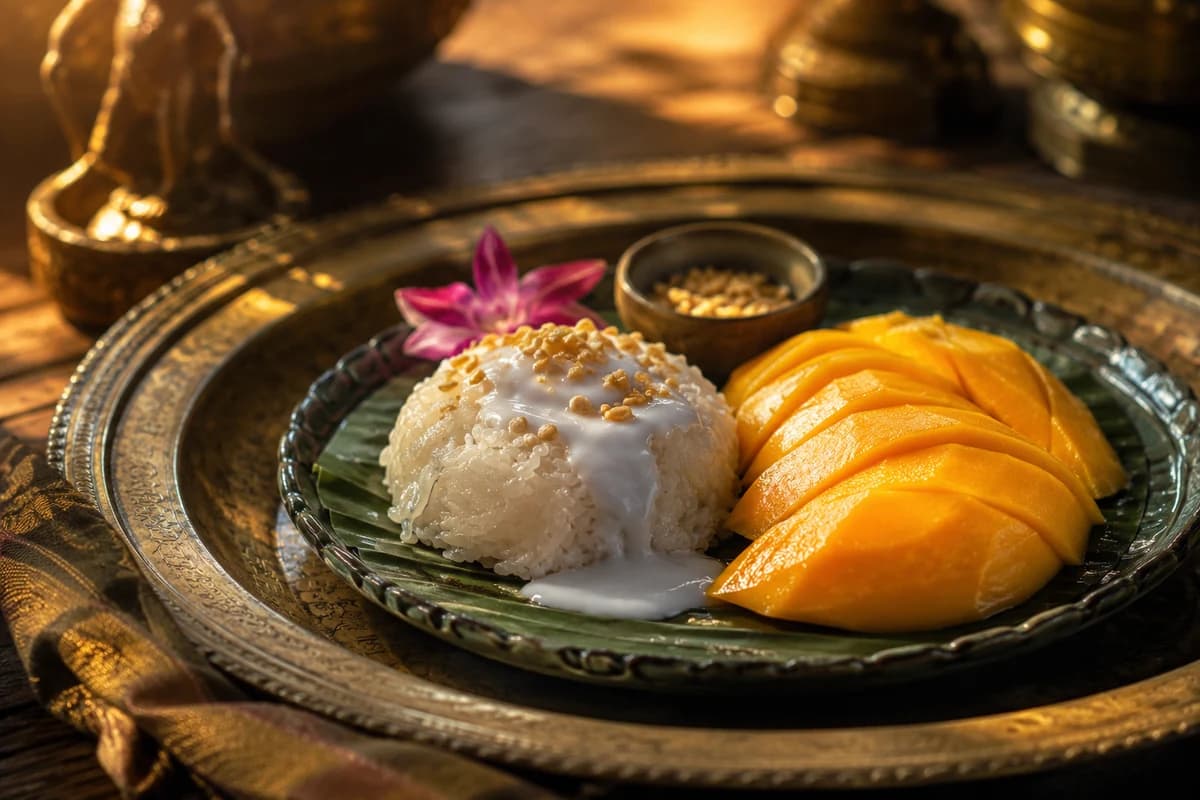
Few Thai desserts explain themselves as quickly as mango sticky rice.
There is no elaborate mould, no complicated pastry, no hidden filling waiting to surprise you. There is mango. There is sticky rice. There is coconut. And if those three things are good enough, very little else needs to happen.
That apparent simplicity makes khao niao mamuang feel ancient. Rice has been grown in the region for millennia, mangoes have long been part of Southeast Asian food culture, and coconut milk appears across Thai sweets. Put the ingredients beside one another and it is tempting to imagine somebody doing exactly the same thing hundreds of years ago.
The historical evidence is less tidy.
There is no securely documented inventor of mango sticky rice, and no single date when the modern dessert can be said to have appeared. Thai sources sometimes push the dish back to the late Ayutthaya period, but the evidence usually cited is indirect. Early Rattanakosin literature mentions mangoes and coconut-seasoned sticky-rice sweets, but not necessarily the familiar plate of ripe mango beside khao niao moon.
By the reign of King Rama V in the late nineteenth century, later Thai culinary accounts place coconut-treated rice eaten with ripe mango in elite household and palace food culture. By the early twentieth century, recipes for coconut sticky rice were being systematised in influential Thai cookbooks.
That gives us a more defensible story. The ingredients are old. The techniques are old. Eating sticky rice with fruit is older than the modern tourist dessert. But the exact moment those elements settled into the standard dish now recognised around the world remains unclear.
Mango sticky rice did not need an inventor. It needed a season.
2. Sticky Rice Was Never Just a Dessert Ingredient
To understand the dish, start with the part international menus usually treat as the supporting actor.
Sticky rice — khao niao — is not simply a sweet ingredient in Thailand. Across northern and northeastern Thailand, glutinous rice has long been a staple food with deep social, agricultural and cultural importance. Research on mainland Southeast Asia shows a broad glutinous-rice zone extending across northern and northeastern Thailand, Laos and neighbouring areas. The crop belongs to a regional food world far larger than one dessert.
That matters because “mango sticky rice” can sound as though Thailand took an unusual type of rice and invented a pudding with it. In much of the country, sticky rice was already ordinary food. It could be steamed and eaten with savoury dishes, used in ritual foods, fermented, pounded, transformed into sweets or preserved in different forms. Its texture, handling and cultural meaning were familiar long before foreign visitors started photographing it beside yellow mango.
The dessert version changes the rice completely. Khao niao moon is glutinous rice that has been soaked, steamed and then mixed while hot with coconut milk or coconut cream seasoned with sugar and salt. The rice absorbs the liquid and becomes glossy, rich and fragrant without turning into porridge.
The verb moon is important. This is not simply rice with coconut sauce poured on top at the last second. The coconut mixture is worked into the steamed grains and allowed to penetrate them, creating a texture that stays distinct yet creamy. More coconut cream may then be spooned over the top, often made slightly salty to push against the sweetness. That contrast is one of the reasons the dessert works. The rice is not neutral.
The geography behind that rice is also worth noticing. The strongest everyday sticky-rice traditions are associated with the North and Northeast, while the internationally famous dessert is now sold everywhere from Bangkok to Phuket. Modern specialist shops can source glutinous rice from northern provinces and coconut from the South, turning ingredients from different parts of the country into one plate. That does not prove the dessert was historically assembled as a deliberate national project. It shows what happened later: improved transport and commercial supply chains allowed a seasonal sweet to become a dependable urban product, even far from the places where its ingredients were grown.
It is sweet, salty, fatty and chewy before the mango even arrives.
3. Mango Season Makes the Dish Make Sense
Mango sticky rice is deeply connected to Thailand’s hot season — and that is not only a romantic association. It is agricultural timing.
Thailand grows a remarkable range of mangoes, but two names matter especially in the dessert story: ok rong and nam dok mai.
Ok rong is an older Thai variety strongly associated with eating ripe alongside coconut sticky rice. Its fruit is generally smaller than the modern export-oriented nam dok mai, with a distinctive aroma, fine sweetness and a little fibre. Thai food writing often treats it as the nostalgic or old-school choice.
Nam dok mai is now much easier for many visitors to recognise. The fruit is larger, smooth-fleshed, fragrant and intensely sweet when fully ripe. It has also become one of Thailand’s major commercial and export mangoes, and its size, colour and low fibre make it particularly photogenic beside a mound of white coconut rice.
Neither variety turns the dessert into a fixed recipe. Shops choose fruit according to quality, season, supply and customer preference, and other mangoes can work too. What matters is ripeness: the fruit needs enough perfume and sweetness to stand up to rich coconut rice without becoming mush.
The seasonality explains why the dessert feels especially right during March and April, when heat is building and ripe mangoes become one of the pleasures of the Thai summer. The dish is rich, but the fruit keeps it from feeling heavy. Cold or room-temperature mango meets warm or freshly prepared sticky rice. Sweetness meets salt. Soft fruit meets chewy grain. Coconut fat meets mango acidity and aroma. A small amount of toasted mung bean or other crisp topping may add one more texture.
The plate looks almost embarrassingly simple. That simplicity is unforgiving. There is nowhere for a poor mango to hide.
Seasonality has also become more flexible than it once was. Commercial cultivation, different varieties and modern distribution mean mango sticky rice can often be found outside the classic hot-season peak, especially in major tourist centres. But availability is not the same thing as perfection. Shops that build reputations around the dessert still talk obsessively about fruit quality, because the best plate depends on mangoes being genuinely ripe rather than simply present. That is one reason the dessert remains tied emotionally to summer even when a Bangkok visitor can find it in another month.
4. Coconut Turns Rice Into Dessert
Mango gets the photographs. Coconut does most of the structural work.
Thai sweets rely heavily on coconut in forms that can look interchangeable to somebody reading an English menu: coconut milk, coconut cream, freshly pressed coconut and cooked coconut sauces. For khao niao moon, richness and balance matter. The coconut liquid mixed into the sticky rice needs enough fat to coat the grains, enough sugar to sweeten them and enough salt to keep the result from becoming flat. A separate topping sauce is often richer and saltier than the rice itself.
That salt is not an accident. One of the easiest ways to make mango sticky rice worse is to make every component equally sweet. Good versions create tension instead: the mango is naturally sweet, the rice is sweet and savoury, the coconut topping can be noticeably salty, and the toasted mung beans are dry and nutty. Each part makes the others clearer.
This also explains why the dessert cannot be reduced to “rice pudding with mango”, a label sometimes used in international descriptions. The rice is not boiled into milk until creamy. It remains visibly grain-like and chewy after steaming, then absorbs seasoned coconut liquid.
The technique belongs to a larger Thai family of khao niao moon desserts. Coconut sticky rice can be served with custard, durian and other toppings or fruit. Mango is the pairing that achieved global fame, but the sweetened rice did not evolve for mango alone. That distinction matters historically: it suggests the modern icon emerged from an existing dessert technique meeting a particularly successful seasonal fruit, rather than from somebody inventing an entire method solely for one plate.
The mango made it famous. The coconut rice gave it somewhere to land.
5. The Origin Story Is Regional Before It Is National
Food arguments become especially loud when neighbouring countries share the same ingredients, and mango sticky rice is no exception.
Glutinous rice is deeply embedded across mainland Southeast Asia, particularly in areas of Thailand, Laos and neighbouring countries. Coconut-milk sweets appear across the region. Mango grows across tropical Asia. Rice eaten with fruit is not an idea that belongs naturally to one modern border, which means it is perfectly possible to find related combinations beyond Thailand.
This does not make the Thai identity of khao niao mamuang imaginary. It means national cuisines are built from regional ecologies and centuries of exchange. The version that became internationally recognisable as Thai developed a very specific structure: coconut-seasoned sticky rice, ripe mango, often a salted coconut topping and a crisp garnish, sold under the Thai name or its English translation and repeated throughout Thailand’s restaurant and dessert culture.
That repetition matters. A food becomes nationally legible because people cook it, sell it, teach it and recognise it — not because every ingredient exists only within one border. The same principle applies to Pad Thai, curry, noodles and countless other foods across Asia. Shared roots do not cancel local identity. They explain it.
In 2026, a Cambodian social-media post describing mango sticky rice as a Cambodian-style dessert triggered another burst of debate in Thailand about ownership and soft power. The argument was predictable, because the dessert is now so strongly tied to Thai identity internationally. But the useful historical response is not to turn food into a territorial map.
The broader rice-and-fruit idea is regional. The globally familiar khao niao mamuang tradition is strongly Thai. Both things can be true at once. Dessert does not need a border dispute.
6. From Home Sweet to Bangkok Institution
Mango sticky rice did not become famous only through household cooking. Specialist sellers mattered.
Bangkok has shops that have built reputations over decades around the quality of their coconut sticky rice, sometimes selling it with several seasonal toppings.
K. Panich, near the Giant Swing in Bangkok’s old city, traces its business to 1932. Michelin describes it as an iconic family-run shop serving mango sticky rice from a recipe handed down through generations, with a process that emphasises ingredient sourcing: sticky rice from Chiang Rai, freshly pressed coconut milk and carefully selected mangoes.
Mae Varee in Thonglor, operating since the 1980s, represents another model. Rather than hiding the season behind a restaurant menu, the shop turns ripe mango into spectacle. Stacks of fruit sit at the front. Packages of sticky rice and mango move constantly through the counter. Thai customers, delivery riders and foreign visitors all queue for essentially the same thing.
These businesses show how a simple dessert becomes a craft profession. Rice has to be soaked for the right length of time. Steaming has to preserve texture. The coconut mixture has to be absorbed while the rice is receptive. Mangoes have to be ripe today, not tomorrow. Coconut cream has to taste fresh. And the proportions need to survive takeaway packaging. None of that is glamorous enough to fit neatly into the phrase “street food” — yet that repetition is exactly what standardises a dish.
Thousands of people learn what mango sticky rice is supposed to taste like because somebody makes the same judgement about rice, coconut and fruit every morning. A national dessert does not need a factory to become consistent. Sometimes it needs a family shop that has been doing the same difficult, simple thing for ninety years.
This specialist economy also separates mango sticky rice from many home desserts. Customers can buy only the coconut sticky rice and pair it with fruit themselves, or buy complete boxes assembled for immediate eating. During peak mango season, famous sellers become part dessert kitchen, part fruit operation and part logistics exercise. The product has a short ideal window: mango changes as it ripens, coconut cream is perishable, and freshly prepared sticky rice does not improve indefinitely in a plastic box. Global fame therefore rests on something stubbornly local — people making and selling a food that is best when the ingredients have been handled correctly that day.
7. Tourism Gave the Dessert a Passport
Mango sticky rice is almost perfectly designed for tourism. It is recognisably Thai without frightening an unfamiliar diner. No fish sauce needs explaining. No fermented ingredient needs defending. No chilli level needs negotiating. The name tells you what will arrive.
That made the dessert an easy companion to the international rise of Thai restaurants and Thai tourism. Visitors encountered it at markets, hotel buffets, cooking schools, street stalls and restaurant dessert menus. Some then found it again at Thai restaurants after returning home. Others first met it abroad and later treated eating the “real” version in Thailand as part of the trip.
The dish also photographs extremely well. Golden mango beside glossy white rice creates instant contrast. Coconut cream adds shine. Black sesame, mung beans or pandan-tinted rice can add more colour. The plate communicates abundance and tropical freshness without requiring much context.
Social media amplified exactly those qualities. By the 2010s, mango sticky rice had become one of the dishes that travel media routinely used to represent Thai food alongside Pad Thai, tom yum and green curry.
That visibility can distort. Thailand has a huge dessert tradition involving eggs, coconut, rice flour, palm sugar, fruit, beans, steaming, grilling and elaborate shaping. Mango sticky rice is not the summary of all Thai sweets. It is simply unusually portable as an idea. Three words explain it. One photograph sells it. One bite makes the coconut-salt-mango balance obvious.
Some foods need cultural translation before they travel. Mango sticky rice travels with subtitles already built in.
8. Then Milli Ate It on Stage
In April 2022, mango sticky rice acquired the kind of publicity campaign money cannot reliably buy.
Thai rapper Milli — Danupha Khanatheerakul — performed at the Coachella Valley Music and Arts Festival in California and finished part of her set by eating mango sticky rice on stage. The moment lasted only minutes. The reaction in Thailand lasted considerably longer. Search interest surged, shops reported increased demand, and images of mango sticky rice spread across social media. Thai government officials immediately began talking about food, culture and soft power.
The timing was almost suspiciously perfect. It was April. Thailand was already in mango season. The dessert was visually recognisable. And a young Thai artist had placed an everyday food into one of the world’s most visible music festivals without presenting it like an official tourism advertisement.
That distinction is important. Soft power works best when it does not look like a government brochure. Milli did not stand on stage and explain the history of glutinous rice agriculture. She ate dessert. That was enough.
Government agencies quickly embraced the moment, and officials discussed promoting mango sticky rice as part of Thailand’s cultural heritage. The broader Thai Dishcovery programme also used traditional desserts as material for modern creative reinterpretation.
The episode did not make mango sticky rice internationally known from nothing. The dish was already famous. What Coachella did was compress the entire modern export story into one image: a Thai cultural product, carried abroad by a Thai performer, consumed casually in front of a global audience and then amplified by millions of people online.
For a dessert built from sticky rice, it travelled remarkably fast.
9. What Global Fame Changes
Once a dessert becomes international, cooks stop asking permission.
Mango sticky rice is now served far beyond Thai restaurants. Pastry chefs turn it into entremets. Bubble-tea shops use the flavour. Cafés serve mango sticky-rice toast, cakes and parfaits. Ice-cream makers fold coconut rice ideas into frozen desserts. Fine-dining chefs rearrange the components until the mango is cut into geometric shapes and the sticky rice is hiding under something that requires tweezers.
Thailand does the same thing. Modern Thai cafés and restaurants reinterpret the dessert constantly, using coloured sticky rice, pandan, black rice, ice cream, new plating and different mango varieties.
This does not mean the traditional version is disappearing. It means the dish has become strong enough to survive variation. The same thing happened to Pad Thai and Sriracha in different ways: once a food becomes globally recognisable, its name begins functioning as a flavour concept as well as a recipe.
There is a limit, of course. At some point a mango-and-coconut dessert with no sticky rice has moved fairly far from khao niao mamuang. But cultural foods have never been protected by perfect repetition. They survive because people keep returning to the reference point.
For mango sticky rice, that reference point remains unusually clear: ripe mango, coconut sticky rice, salted coconut richness, something crisp if you are lucky. Global chefs can build as much architecture around that as they like. The original plate will still be waiting at a Bangkok market with fewer components and a much shorter description.
10. Thailand’s Most Successful Seasonal Dessert
Mango sticky rice became a global Thai icon without a clear inventor, an ancient origin certificate or a single standard recipe. That is not a weakness in its history. It is the reason the history makes sense.
Glutinous rice came from a regional staple tradition with especially deep roots in northern and northeastern Thailand and neighbouring mainland Southeast Asia. Coconut techniques belonged to a much wider Thai dessert vocabulary. Mango supplied the season. Older varieties such as ok rong gave the pairing an established Thai identity, while nam dok mai later became the fruit many visitors recognised.
Households and palace kitchens helped refine coconut sticky-rice techniques. Cookbooks recorded them. Specialist shops turned consistency into reputation. Tourism gave the dessert an international audience. Thai restaurants carried it abroad. Social media made it photogenic currency. Then Milli ate a plate at Coachella and reminded Thailand that one of its strongest cultural exports had been sitting on dessert counters all along.
The dish is now discussed as soft power because the world already knows what it is. That order matters. Government promotion can amplify recognition. It rarely creates affection from nothing.
Mango sticky rice earned affection first.
Perhaps that is why the dessert remains so effective as a symbol of Thailand. It is not ceremonial enough to feel distant. It is not complicated enough to intimidate. It depends on ingredients that are ordinary until somebody chooses them extremely well. And it is seasonal enough to make the first good mangoes of the year feel like an event.
The global story can become complicated. The plate never does.
Rice. Coconut. Mango.
Thailand made the combination unforgettable.