1. Before It Was a Global Sport
Walk through Bangkok today and Muay Thai can appear to exist everywhere at once. There are stadium posters beside shopping centres, gyms filled with foreign trainees, shorts and gloves sold as fashion, televised fight nights, fitness classes, government soft-power campaigns and tourists who arrive in Thailand with training sessions already booked.
That visibility can make the sport feel timeless. The common story is neat: Thai warriors developed a devastating system of unarmed combat centuries ago; that system became Muay Thai; modern fighters are therefore practising essentially the same art in a ring.
History is rarely that tidy.
There is no serious reason to doubt that people in the kingdoms that preceded modern Thailand fought, trained and developed sophisticated methods of unarmed combat. Fighting traditions existed alongside weapons training, local contests, festivals, military life and forms of patronage. But historians working on Muay Thai have repeatedly warned that the evidence is too thin to draw a perfectly straight line from one ancient battlefield system to the professional sport seen today.
That does not make Muay Thai less Thai. It makes its history more recognisably human.
The sport grew because Thailand changed. Roads improved. Regional traditions met one another. The state became more centralised. Western boxing influenced sporting rules. Formal rings and timed rounds became normal. Bangkok stadiums created national stars and professional circuits. Radio and television carried fights far beyond the arena. Tourism brought foreign students into Thai camps. International federations standardised competition abroad. Mixed martial arts introduced a new audience to elbows, knees, clinch fighting and Thai-style kicking.
Muay Thai did not survive by refusing to change. It survived partly because it became extremely good at changing without losing its Thai identity.
That tension — between tradition and reinvention — is the real story.
2. Muay Boran, Muay Thai and the Problem With Simple Origin Stories
One of the easiest mistakes in writing about Muay Thai is to treat three different things as if they were interchangeable: old regional fighting traditions, Muay Boran and modern Muay Thai.
Before the modern Thai nation-state, fighting knowledge was not necessarily organised as one standard national system. Research on pre-modern muay describes regional variation in how fighters wrapped their hands, how they fought and how knowledge circulated. Travel was harder, communities were more isolated and teaching traditions developed locally. What existed was not one national rulebook waiting to be discovered.
Modern writers often use Muay Boran — literally “ancient boxing” — as an umbrella term for older Thai unarmed fighting methods. That is useful up to a point. The problem begins when the label is treated as proof that a single, clearly defined martial art called Muay Boran existed across Siam for centuries in the same form.
Academic work on Muay Thai and Muay Boran has challenged that picture. Scholars including Peter Vail have argued that parts of the modern historical narrative were consolidated as Muay Thai became a national symbol and an international cultural export. More recent research has similarly examined how regional traditions were reframed within a national story.
This matters because popular history tends to reward the best legend, not the best footnote.
Nai Khanom Tom is the obvious example. In Thai popular memory he is the captured Siamese fighter who defeated Burmese opponents and demonstrated the superiority of Siamese boxing. His name has enormous cultural importance within Muay Thai. But cultural importance and modern documentary certainty are not the same thing. The story belongs in the history of how Thai people remember Muay Thai, even when historians are cautious about treating every detail as verified sporting record.
The same applies to claims that one king, one battle or one military school “invented Muay Thai”. Older combat practices clearly matter. So do court culture, local contests, military training and regional schools. But modern Muay Thai is the result of convergence and transformation, not a single invention moment.
If that sounds less dramatic than “an ancient secret weapon of Siam”, it should not. A fighting culture evolving across regions and then being reshaped into a national sport is a far bigger story.
3. From Fighting Tradition to Public Competition
Long before modern stadium lights, muay was also something people watched.
Fighting contests could form part of festivals, ceremonies and public gatherings. They created reputations for fighters and communities, and they placed combat skill in a social setting rather than limiting it to military utility. This is an important bridge in the story: the movement from fighting knowledge to organised spectacle did not suddenly begin when somebody built a boxing ring in Bangkok.
But the older contest world was not modern professional sport either.
As Siam modernised in the late nineteenth and early twentieth centuries, institutions changed around the fighters. Central government grew stronger. Education, military organisation and physical culture became more formal. International influences became harder to separate from domestic development. Western boxing was present in Thailand and provided a visible model of gloves, rings, referees, timed rounds, weight divisions and sporting administration.
The transformation was not simply “Thai tradition replaced by Western rules”. It was a negotiation. Thai fighting techniques remained central, but the environment in which they were performed became increasingly legible as modern sport.
That process also helped turn regional forms of muay into something more national. In an older landscape, a fighter could belong to a local lineage with its own methods. In a standardised ring, competitors needed enough shared rules to meet one another, be judged and build records. Modern transport and communication also reduced the isolation that had helped regional differences persist.
This is why the early twentieth century matters so much. It is the period in which the question stops being only “How did Siamese people fight?” and becomes “How did Muay Thai become a sport?”
The answer is not one reform or one date. It is the accumulation of rules, institutions, promoters, fighters, audiences and changing ideas about what a national sport should look like.
4. When Rules, Rings and Gloves Changed the Sport
The modern Muay Thai ring is so familiar that its rules can feel inevitable. They were not.
Research on the sport's modernisation places major change in the interwar decades of the 1920s and 1930s. Formal rings became increasingly important. Referees and timed rounds created clearer boundaries around contests. Boxing gloves replaced older hand-wrapping practices in professional competition. Weight classes and rules made matchmaking more systematic. The sport became safer in some respects, more standardised in others and easier to promote to large audiences.
Those changes did more than tidy up presentation. Rules change fighting.
A contest with rounds creates pacing. Gloves alter punching and defence. A ring changes movement compared with an open fighting space. Judging creates incentives for particular techniques and displays of control. Weight divisions change who can sensibly fight whom. Promoters and stadium systems reward fighters who can repeatedly perform under a shared format.
Modern Muay Thai therefore cannot be understood as an ancient technical package simply placed inside a twentieth-century ring. The ring helped produce modern Muay Thai.
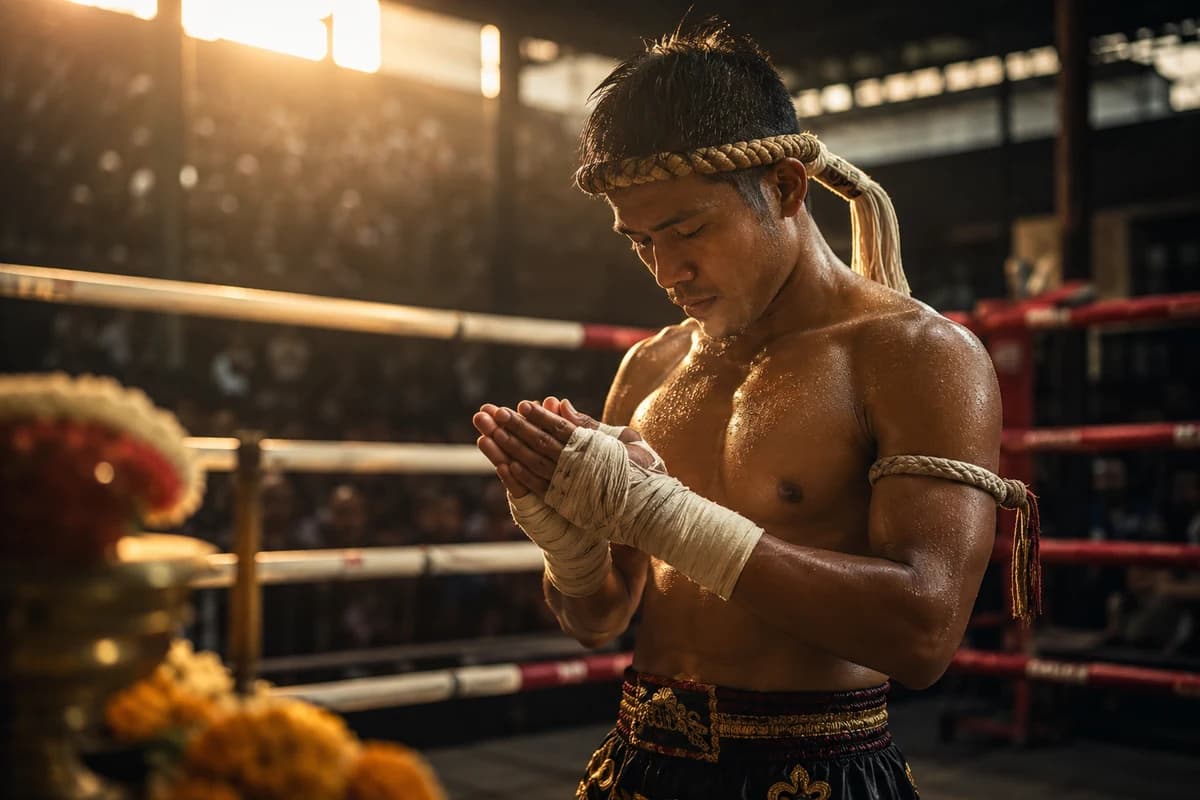
At the same time, Thai elements remained visible around the contest itself. The wai kru and ram muay, the mongkhon worn before a bout, traditional music and the fighter's relationship with teachers all helped distinguish Muay Thai from international boxing. They also became important markers of cultural continuity as the competitive framework modernised.
That combination would become one of Muay Thai's great strengths. A visitor could look at the gloves, ropes, judges and rounds and recognise a modern combat sport. Then the music started, the fighter performed the wai kru, and it was unmistakably Thailand.
5. Bangkok's Stadium Era
If the interwar decades created the framework, post-war Bangkok gave professional Muay Thai its great stage.
Rajadamnern Stadium opened in 1945 and became one of the defining institutions of professional Muay Thai. Lumpinee Boxing Stadium followed in 1956. For generations, success at these Bangkok stadiums represented one of the highest ambitions in a Thai fighter's career.
The stadiums did more than host bouts. They organised rankings, titles, promoters, gamblers, media attention and reputations. Fighters from provincial gyms could enter a national circuit in which a performance in Bangkok carried meaning far beyond one night's result. A local fighting culture now had central arenas through which careers could be measured.
Betting became deeply intertwined with this world. Research on Thai stadium Muay Thai has shown that gambling did not merely sit outside the action; it influenced how audiences interpreted momentum and how tactics developed. Traditional stadium bouts could have rhythms that puzzled newcomers expecting every round to be fought at identical intensity. Experienced spectators were reading balance, control, visible effect, confidence and the changing stakes of the contest.
The post-war decades also helped make Muay Thai part of Thai mass culture. Radio, newspapers and later television expanded its audience. Famous fighters could represent gyms, provinces and styles. The sport carried contradictory social meanings: national symbol on one hand, working-class profession and gambling spectacle on the other.
That contradiction is important. Calling Muay Thai “Thailand's national sport” can hide the fact that professional fighters have often come from economically marginalised backgrounds. For some families, fighting offered income and a route towards social mobility. For others, the profession remained physically demanding and financially uncertain. The glamour of championship belts has always existed beside the harder economics of the camp.
The stadium world has never been frozen in time either. Lumpinee, historically a male-only elite arena, opened its competitive space to women in 2021. Rajadamnern hosted its first women's bout in 2022. New promotions have experimented with production, scoring displays and formats designed for global audiences.
Even the institutions most associated with “traditional Muay Thai” keep changing.
6. Why the Eight Limbs Matter
Muay Thai is commonly marketed as “the art of eight limbs”: two fists, two elbows, two knees and two legs.
The phrase is catchy, but the important part is what those tools create together.
Western boxing specialises in punching. Many kickboxing rules combine punches and kicks, sometimes with limited knee attacks. Muay Thai developed a competitive identity in which punches, kicks, knees and elbows coexist with sustained clinch work. The result is not simply “more weapons”. It creates a different range of problems for a fighter to solve.
A kick can score or damage at distance. Knees become important as the space closes. Elbows make very short range dangerous. The clinch is not merely two tired fighters waiting to be separated; in traditional Muay Thai it can be a technical battle for posture, balance, position and effective knees. Sweeps and off-balancing can demonstrate control even without looking spectacular to an unfamiliar spectator.
This is also why watching Muay Thai with boxing expectations can be confusing. The fighter throwing the most punches is not automatically the fighter controlling the bout. Different rulesets and promotions now judge contests somewhat differently, but traditional Thai scoring culture has placed considerable value on clean effect, balance, composure and visible control.
The rituals around the fight matter too. Wai kru literally expresses respect to teachers, while ram muay is the ceremonial movement performed before the bout. The mongkhon is removed before fighting begins. Traditional music responds to the action and helps shape the atmosphere of the stadium.
These things are not decorative packaging added for tourists. They are part of why Muay Thai has been understood in Thailand as more than a set of efficient strikes.
At the same time, not every gym or international competition reproduces the Thai stadium experience exactly. A fitness class in Stockholm, an amateur tournament in Europe and a five-round Bangkok stadium fight may all use the name Muay Thai while emphasising different parts of the tradition.
That flexibility helped the sport travel.
7. Fighters, Camps and Life Behind the Ring
The global image of Muay Thai often begins with the knockout. The Thai camp begins much earlier in the day.
Running, pad work, bag work, clinching, sparring, conditioning, recovery, weight management and repetition form the less cinematic side of the sport. A professional fighter may spend years inside a social system built around trainers, gym owners, team-mates, family members, promoters and supporters.
Research with Thai fighters shows how important that network can be. A 2023 qualitative study interviewed 43 Muay Thai fighters across four regions of Thailand and found that social support — from camp owners, trainers, family, friends and followers — played an important role in helping fighters continue their careers. The paper also noted that many fighters came from marginalised backgrounds.
That does not mean every Thai fighter is poor, from Isaan or fighting to rescue a family. Those familiar narratives become stereotypes when applied automatically to individuals. But economics has unquestionably been part of Muay Thai's social history. Earlier research identified fighting as a route to income and social advancement, while also showing that even talented fighters could face uncertain long-term financial security.
The camp can therefore be several things at once: workplace, school of technique, social network, source of discipline, business and, for some fighters, a second home.
It is also where the meaning of “teacher” becomes clearer. The wai kru before a bout is not simply theatre. It reflects a culture in which knowledge is received through relationships and in which respect for trainers is built into the identity of the sport.
Modern camps vary enormously. Some remain focused on producing professional Thai fighters. Others mix Thai professionals with foreign competitors. Some have become large international businesses offering accommodation, fitness packages and beginner sessions. Phuket, Bangkok and Chiang Mai in particular have developed training economies in which Muay Thai is part sport, part travel experience and part lifestyle industry.
The old camp and the modern tourism gym are not always opposites. Sometimes they exist inside the same walls.
8. How Foreigners Found Muay Thai
Muay Thai did not become global through one export campaign.
Foreign soldiers, martial artists, kickboxers and combat-sport enthusiasts encountered Thai fighters over decades. Japanese kickboxing developed in dialogue with Muay Thai. International contests and tours exposed more audiences to Thai rules and techniques. Films and television broadened the visual vocabulary. Later, cheap air travel and the growth of Thai tourism made it possible for ordinary enthusiasts to do something previous generations could rarely imagine: fly to Thailand and join a camp themselves.
That changed the relationship between the sport and the visitor.
A tourist could come to Thailand to watch Muay Thai. A Muay Thai tourist came to train.
Academic research now treats this as a recognisable form of sport tourism. A 2020 study of 449 foreign trainees across six regions of Thailand examined the capacity of Thai camps to serve international visitors. Other research on Bangkok trainees has found motives ranging from skill development and serious sporting ambition to personal enrichment and the desire for a distinctive cultural experience. A 2025 study went further, examining foreigners who lived and trained in Bangkok camps while pursuing Muay Thai seriously enough to imagine professional careers.
For Thailand, that is a remarkable cultural reversal. A profession historically associated with Thai working-class fighters became something foreigners were willing to cross continents to learn.
The exchange works in both directions. Foreign demand has created new revenue, new gym models and new international opportunities for Thai trainers. At the same time, international students arrive with their own expectations about fitness, customer service, safety, schedules and what “authentic Muay Thai” is supposed to look like.
Sometimes the most traditional-looking experience is exactly what the tourist wants to buy.
That can produce tension, but it also demonstrates why Muay Thai has travelled so well. You do not need to understand every layer of Thai history before the pads make sense. The sport has a physical language that crosses borders quickly. Then, if the student stays long enough, the cultural layers begin to appear behind it.
9. From Thailand to the IOC, MMA and Global Fitness
By the twenty-first century, Muay Thai was no longer simply a Thai sport with foreign fans. It had become an international sporting system.
The International Federation of Muaythai Associations, founded in the 1990s, built amateur and international structures across national federations. In 2016 the International Olympic Committee gave IFMA provisional recognition. In 2021, at the 138th IOC Session, that recognition became full.
There is an important distinction here: IOC recognition of the international federation does not mean Muay Thai automatically became an Olympic medal event. It means the sport's international governing body achieved formal recognition within the Olympic movement after meeting governance and sporting criteria.
That milestone still says a great deal about how far Muay Thai had travelled.
So does its influence beyond Muay Thai itself. Mixed martial arts made Thai-style knees, elbows, clinch work and kicking familiar to audiences who might never have watched a Bangkok stadium card. Fighters in the UFC and other MMA organisations routinely train striking methods associated with Muay Thai, even when their overall style combines wrestling, Brazilian jiu-jitsu, boxing and other systems.
At the other end of the spectrum, people around the world encounter Muay Thai without any intention of fighting professionally. Gyms market it for conditioning, confidence and fitness. Pads and heavy bags have turned techniques developed for combat into workouts practised in cities around the world.
Thailand has recognised the value of that reach. Recent government policy has explicitly placed Muay Thai among the country's cultural “soft power” assets, alongside food, textiles, performance and other forms of Thai culture intended to travel internationally.
The phrase can sound bureaucratic. The underlying idea is simple: every foreign gym that teaches Muay Thai also teaches the word “Thai”. Every pair of Muay Thai shorts, every wai kru explained properly, every training trip to Bangkok or Phuket keeps the sport attached to its country of origin in a way many globally successful sports are not.
That connection is commercially valuable. It is also culturally powerful.
10. Still Thai, Even When the World Practises It
Global success creates a strange problem for any cultural tradition.
The more people adopt it, the less control the place of origin has over what the name means.
Muay Thai is taught today under many conditions: professional Thai camps, amateur federations, MMA gyms, boutique fitness studios, university clubs and commercial resorts. Rules vary. Training methods vary. Rituals may be central, abbreviated or absent. Some students know the difference between wai kru and ram muay; others know only that elbows are allowed.
Thailand's response has often been to emphasise the parts that make Muay Thai recognisably Thai: terminology, rituals, teacher relationships, traditional music, historical narratives and the sport's national symbolism. International organisations have also incorporated cultural elements into their presentation of the sport.
That desire to preserve identity is understandable. It can also encourage history to become cleaner than the evidence allows. The temptation is to claim that Muay Thai has existed in essentially its present form for a thousand years, because continuity feels more authentic than change.
But Muay Thai does not need that claim.
Its history is already extraordinary without it.
Older regional fighting traditions fed into a modern national sport. Modernisation brought rings, gloves and shared rules. Bangkok stadiums created a professional culture with its own rhythms, hierarchies and heroes. Fighters and camps carried the sport through generations. Foreign students turned training into a form of travel. International federations gave it global sporting structures. MMA and fitness culture introduced its techniques to audiences far outside traditional fight circles. Thailand itself then began using Muay Thai deliberately as cultural diplomacy and soft power.
And through all of those changes, the name stayed attached to Thailand.
That may be Muay Thai's greatest achievement. The world did not simply copy a Thai fighting system and forget where it came from. In most languages, people still call it Muay Thai.
The sport became global without becoming placeless.
It is no longer confined to Thailand. It is no longer identical to the muay practised before modern rules. It is not frozen somewhere between an Ayutthaya battlefield and a Bangkok stadium.
It is a living Thai tradition — and living traditions move.