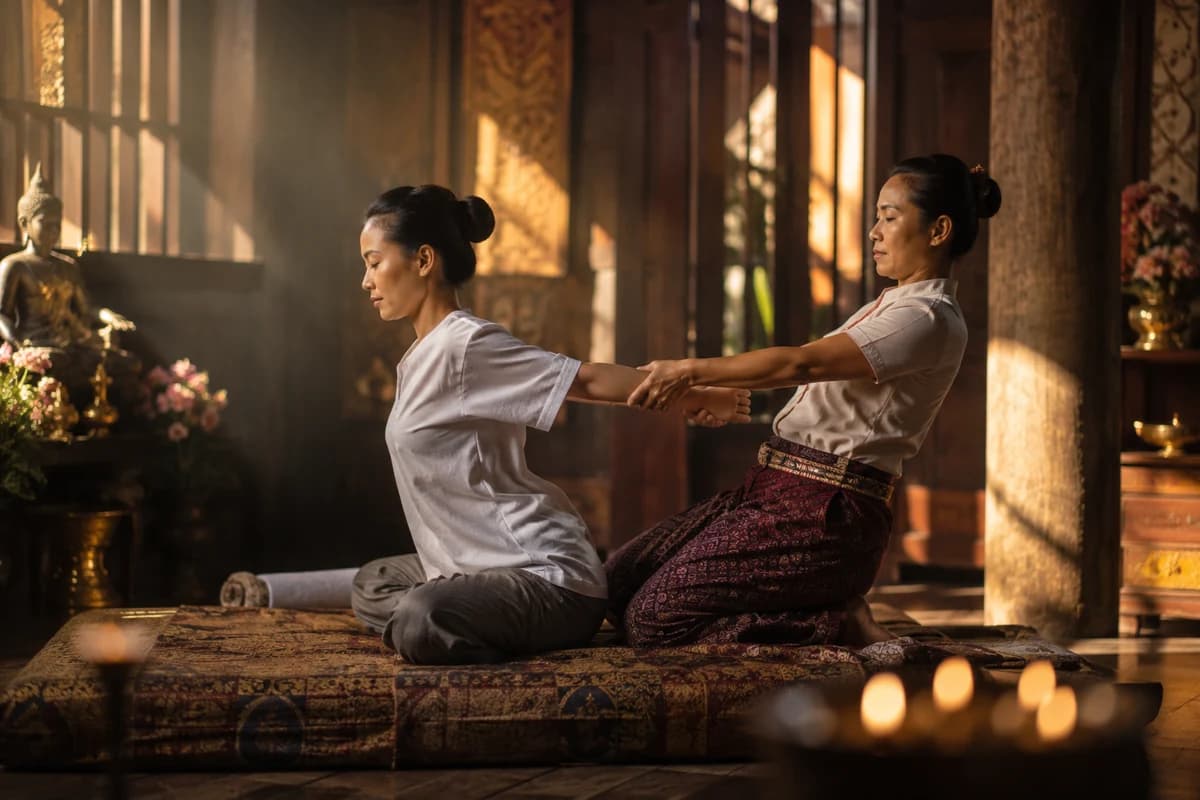
1. More Than a Massage
Walk through almost any tourist district in Thailand and Thai massage can look wonderfully straightforward.
A row of reclining chairs. A stack of folded towels. A handwritten price board. Perhaps the unmistakable smell of herbal balm drifting through the doorway.
Then somebody presses a thumb into a place you did not know could hurt, folds one leg across the other, leans their weight into your hip and makes you briefly reconsider every life choice that led to this moment.
For millions of visitors, that is Thai massage.
For Thailand, it is also something much larger.
Nuad Thai — traditional Thai massage — belongs to the wider world of Thai traditional medicine. It can be used for relaxation, but it also developed as a form of manual care, with its own theories, teaching lineages, practitioner roles and therapeutic traditions. In 2019, UNESCO inscribed Nuad Thai on the Representative List of the Intangible Cultural Heritage of Humanity, describing it as part of the art, science and culture of traditional Thai healthcare.
That distinction matters, because the global image of Thai massage has been shaped heavily by tourism. Outside Thailand it is often marketed as assisted stretching, “Thai yoga massage”, spa therapy or an exotic wellness experience. All of those labels capture something visible. None of them tells the whole story.
The remarkable part of Thai massage is not simply that an old practice survived.
It is that a form of Thai healthcare moved from households, communities, courts and temples into schools, clinics, spas, hotel resorts and cities far beyond Thailand — while still remaining recognisably Thai.
That journey took centuries. It was not a straight line.
2. Before the Spa: Massage Inside Thai Traditional Medicine
It is tempting to tell the history of Thai massage as though somebody invented it on a particular day.
The historical record does not give us that kind of beginning.
Thai traditional medicine developed through a mixture of local healing knowledge and wider intellectual currents that moved through South and Southeast Asia. Buddhist ideas, Indian medical traditions, herbal practice, spiritual understandings of illness and regionally specific knowledge all became part of the medical landscape that developed in Siam.
Massage belonged inside that world.
UNESCO's description of Nuad Thai points to roots in forms of self-care within older Thai rural society. Families and community healers used touch, pressure, manipulation, herbs and other remedies as part of everyday responses to pain and illness. Knowledge could be passed orally, within families, between teachers and students, or through medical manuscripts and temple networks.
There was never only one Thai massage.
Court traditions developed alongside community and folk traditions. Modern Thai sources commonly distinguish between court-style massage, often called Nuad Rajasamnak, and broader common or folk traditions. Court-style practice became associated with formal distance, controlled hand and finger pressure and strict technique. Folk or common forms could use palms, elbows, knees, feet, larger movements and assisted stretches.
Those categories themselves have evolved, and local practice has always been more varied than a neat two-column chart suggests. But the distinction shows something important: Thai massage was not originally a standardised spa sequence exported from Bangkok.
It was a family of practices embedded in Thai society.
Written evidence becomes clearer in the kingdom periods, especially Ayutthaya and early Rattanakosin, where medicine was organised at both court and community level. Records from the reign of King Narai, for example, preserve a substantial royal medical tradition, although surviving texts do not allow modern historians to reconstruct one neat, continuous massage syllabus from that era to the present. What they do show is that manual care belonged beside herbal medicine, diet, midwifery and other forms of treatment rather than existing as a separate leisure industry. This is an important correction to the tourist-era image. Before Thai massage became something a traveller could select from a laminated menu, it existed inside a larger idea of how the body could be cared for.
That makes its later standardisation one of the most important parts of the story.
3. Jivaka and the Problem With the Perfect Origin Story
One name appears again and again in stories about the beginnings of Thai massage: Jivaka Komarabhacca, usually rendered in Thai tradition as Shivago Komarpaj or similar spellings.
Jivaka is not an invented character. Early Buddhist texts describe a physician named Jivaka who was associated with the Buddha and with royal patrons in ancient India. In Thai traditional-healing culture, he became deeply revered as a “father doctor” figure, and invocations to Jivaka remain meaningful in some practitioner and teaching traditions.
What becomes difficult is the next step.
Popular accounts often jump from “Jivaka was an ancient physician” to “Jivaka invented Thai massage 2,500 years ago”. That is much harder to demonstrate historically.
There is no continuous documentary chain showing one individual creating the full system now recognised as Nuad Thai and transmitting it unchanged into modern Thailand. Thai massage developed across a long period, through multiple communities, institutions and bodies of knowledge. Indian and Buddhist medical influence is important, but so are local Thai practices and centuries of adaptation.
This does not make Jivaka irrelevant.
Quite the opposite.
He is important because the tradition itself treats him as important. That is a cultural fact, even where a literal founder story cannot be proven.
The distinction is useful whenever traditional knowledge meets modern historical research. A revered lineage story can tell us how a community understands its practice without necessarily functioning as a dated invention certificate.
Thai massage does not need a single founder to have a deep history.
Its history is actually more interesting without one.
4. Wat Pho: Putting Knowledge on the Walls
If one place has become inseparable from the public story of Thai massage, it is Wat Pho in Bangkok.
The temple did not invent massage. What it did was help preserve, organise and display bodies of knowledge that might otherwise have remained far less accessible.
During the reign of King Rama III, a major programme at Wat Pho gathered and inscribed knowledge on religion, medicine, literature, language and other subjects. Between 1831 and 1841, hundreds of stone inscriptions were installed around the temple. UNESCO's Memory of the World programme now recognises 1,431 of these inscriptions as a remarkable public archive.
Among them are medical texts and illustrations connected with massage.
This is one reason Wat Pho is sometimes described as a kind of early public university. Knowledge that had often circulated through manuscripts, court circles and teacher-to-student transmission was placed where people could see and study it.
The massage material includes diagrams of the body, pressure locations and the conceptual lines known as sen, together with related knowledge such as ruesi dat ton — traditional therapeutic exercises commonly represented by hermit figures in distinctive postures.
The result was not a modern textbook in stone.
It was a public preservation project from a period when Siam was collecting, comparing and organising knowledge during rapid change.
More than a century later, Wat Pho became important in a second way. The Wat Pho Thai Traditional Medical and Massage School opened in 1955. The school helped turn a famous repository of knowledge into a formal teaching institution, training generations of practitioners and later attracting students from abroad.
That combination — old inscriptions plus modern instruction — helped make Wat Pho one of the strongest bridges between traditional Thai medicine and the global wellness world.
Visitors now arrive to see a giant reclining Buddha.
A surprising number also leave knowing where their hamstrings are.
Wat Pho also carries two different UNESCO stories that are easy to mix up. The temple's epigraphic archive was entered in UNESCO's Memory of the World register in 2011 because of the documentary value of the inscriptions. Nuad Thai itself was separately inscribed as intangible cultural heritage in 2019. One recognition concerns a remarkable physical archive of knowledge; the other concerns a living practice transmitted by people. Together they capture the unusual position of Wat Pho perfectly: part monument, part classroom, part historical record and part working institution.
5. What Nuad Thai Actually Does
The version of Thai massage most foreign visitors recognise is usually performed through clothing, often on a mat or firm mattress, without the heavy use of oil associated with many spa massages.
Pressure is central.
So is movement.
A practitioner may use thumbs, palms, forearms, elbows, knees or feet depending on the style being practised. Limbs can be moved through assisted stretches. The recipient may be repositioned repeatedly — lying on the back, side, stomach or sitting upright — while the practitioner uses body weight rather than relying only on muscular force.
That physical appearance explains why Thai massage is sometimes marketed abroad as “Thai yoga massage”.
But that phrase can be misleading if it suggests that Nuad Thai is simply yoga performed by somebody else.
Traditional theory includes the concept of sen: pathways understood within Thai medicine as important to bodily balance and function. Modern teaching often refers to ten principal sen, or Sen Sib. These should be understood as part of a traditional medical framework, not casually translated into anatomical nerves or blood vessels and not presented as scientifically established “energy channels”.
Traditional and biomedical explanations are not identical languages.
Modern clinical research has investigated Thai massage for conditions including musculoskeletal pain, with some studies reporting improvements in pain, flexibility, tension or related outcomes. At the same time, systematic reviews have repeatedly noted limitations in study quality and the need for stronger long-term evidence.
That is a healthier way to describe the practice than either extreme.
Thai massage is not “just relaxation” because it has long-standing therapeutic uses inside Thai medicine.
It is also not a magical cure for whatever happened to be written on a wellness website this morning.
Its traditional concepts, practical techniques and modern evidence should be allowed to remain distinct.
6. From Traditional Knowledge to a Modern Profession
The survival of Thai massage was not guaranteed simply because it was traditional.
During the modernisation of Thai medicine in the late nineteenth and early twentieth centuries, Western biomedicine became increasingly dominant in state institutions. Siriraj Hospital opened in 1888, and modern medical education expanded. Traditional medicine lost institutional ground and, for periods of the twentieth century, sat much further from the centre of official healthcare than it had before.
The revival did not happen overnight.
From the 1980s onward, the Thai state increasingly returned to traditional medicine, herbal knowledge and local medical practices as areas worth preserving, researching and regulating. A government coordinating centre for Thai traditional medicine developed into the Institute of Thai Traditional Medicine in 1993. Legal reforms at the end of the 1990s formally recognised Thai traditional medicine branches including Thai massage. In 2002, a dedicated government department for Thai traditional and alternative medicine was established.
This institutional revival changed the position of Nuad Thai.
Massage could still be learned through community and practitioner lineages, but it increasingly existed alongside approved curricula, professional standards, certification systems, clinics and public-health structures.
That matters because “Thai massage” now describes several overlapping worlds.
There is massage used within Thai traditional clinical practice. There is massage for health and relaxation delivered through regulated health establishments. There is spa massage designed partly around hospitality and tourism. There are local and regional techniques that do not fit neatly into national standardisation.
Modern Thailand has tried to protect the identity of Nuad Thai while also making it teachable, safe and scalable.
That is difficult.
Standardise too little and quality becomes inconsistent.
Standardise too much and a living tradition can start looking like a laminated procedure manual.
Thailand has spent decades negotiating that balance.
Training illustrates the point. Modern government-approved health-massage curricula can specify hours, anatomy, contraindications, hygiene and practical techniques, while therapeutic Thai-medicine training can go much deeper. That does not mean every person giving a Thai massage in Thailand is practising as a traditional medical doctor, and it does not mean every spa treatment is medical care. Thailand's regulatory system separates different scopes of practice and different types of establishment. For visitors, those distinctions are mostly invisible. For the people trying to professionalise Nuad Thai, they are central.
7. Then Tourism Changed the Room
The international success of Thai massage cannot be separated from the rise of tourism in Thailand.
As international travel expanded in the second half of the twentieth century, visitors encountered massage in a country where bodywork already had deep local roots. Over time, massage became increasingly visible within the tourist economy: in hotels, beach resorts, urban shops, wellness retreats and purpose-built spas.
This changed more than the number of customers.
Research on Thai massage and health tourism has described a process of tourism acculturation — in other words, the practice was not simply carried unchanged into tourism. It was also repackaged, interpreted and sometimes modified for new audiences.
That is how a health practice can acquire several identities at once.
To a Thai traditional-medicine practitioner, Nuad Thai may be part of a therapeutic system.
To a Bangkok office worker, it may be relief for aching shoulders after a long week.
To a resort guest, it may be one part of a luxury wellness package.
To a backpacker, it may be a 300-baht decision made because the person walking beside them said, “Trust me.”
Those experiences are not identical, even when the sign outside says THAI MASSAGE.
The spa industry also changed the visual language around the practice. Soft lighting, lemongrass, herbal compresses, aromatherapy, polished interiors and carefully designed treatment menus helped link Thai massage to a broader image of Thai hospitality and wellness.
This was commercially powerful.
It was also culturally transformative.
By the early twenty-first century, Thai massage had become one of the easiest pieces of Thai culture to export because it did not require a museum, a translation or a plane ticket once trained practitioners began working abroad.
Tourism also created a huge range of price points and settings. A neighbourhood shop with mattresses behind a curtain, a hospital traditional-medicine clinic and a five-star resort spa can all use techniques descended from Nuad Thai, yet offer completely different experiences. That should not automatically be read as a simple scale from ‘authentic’ to ‘inauthentic’. Commercialisation can dilute traditions, but it can also create jobs, fund training, introduce new audiences and keep skills economically viable. Thai massage became globally visible partly because it proved unusually adaptable.
The practice could travel through hands.
That human route matters. Unlike a packaged product, massage cannot be exported without somebody learning how to perform it. Every overseas treatment therefore sits somewhere in a chain of training — formal or informal, Thai or foreign, rigorous or superficial. This is one reason debates over certification become more intense as the name spreads. A bowl of tom yum can be disappointing and still be tom yum. Poorly trained bodywork can actually injure someone. The global success of Thai massage therefore makes quality control part of cultural preservation, not merely a business concern.
8. From Bangkok to the World
Once Thai massage entered the international wellness economy, it spread through several routes at the same time.
Foreign students came to Thailand to learn.
Thai practitioners worked abroad.
Massage schools opened courses for international students.
Spa chains and independent therapists incorporated Thai techniques.
Wellness centres in Europe, North America, Australia and Asia began using the words “Thai massage” as a recognisable category.
Like Thai food, Muay Thai and yoga, the practice changed slightly as it travelled.
Some overseas schools emphasised assisted stretching. Others focused on sen theory. Some integrated Thai massage into physiotherapy, sports recovery, yoga teaching or general bodywork. Marketing language created new terms and hybrid styles that would not necessarily be used by practitioners in Thailand.
That is normal for a tradition that becomes global.
But global popularity creates another question: what counts as Thai massage?
Thailand has increasingly answered by emphasising training standards, practitioner skills and cultural knowledge rather than treating the name as a completely free-floating label. Government agencies have promoted certification, upgraded spa and massage standards, and supported Thai practitioners working in international markets.
The scale inside Thailand itself is enormous. Government data from the early 2020s recorded thousands of registered health establishments and a very large workforce of registered service providers in massage and spa businesses.
The point is not the exact number, which changes.
The point is that Nuad Thai is no longer a niche survival from the past.
It is a major modern profession and an economic sector.
The same practice that can be taught beside old medical inscriptions at Wat Pho can now be booked through an app in Paris.
Few forms of traditional Thai knowledge have travelled so far while keeping their national identity so clearly attached to their name.
9. UNESCO, Soft Power and the New Value of an Old Practice
In December 2019, Nuad Thai was inscribed on UNESCO's Representative List of the Intangible Cultural Heritage of Humanity.
The recognition was important, but perhaps not for the reason people sometimes assume.
UNESCO was not declaring that every claim made about Thai massage had been scientifically proven.
It was recognising a living cultural practice: knowledge, skills, teaching, community transmission and a healthcare tradition that people in Thailand continue to maintain.
That distinction fits the story perfectly.
Thai massage matters because it is practised, taught, adapted and passed on — not because it can be frozen into one “authentic” sequence.
Since then, Thailand has leaned increasingly into Nuad Thai as a form of cultural and economic soft power. Government programmes promote Thai massage alongside herbs, spas, wellness tourism and traditional medicine. Standards are being developed not only for domestic services but also for international markets.
In 2026, Thai labour authorities were discussing ways to support certified Thai massage establishments and practitioners in France. Public-health policy has also placed Thai massage inside a much larger ambition for Thailand to become a global medical and wellness hub.
The idea is easy to understand.
Thailand already has a worldwide reputation for hospitality and tourism. It also possesses a traditional wellness practice that foreigners recognise instantly.
Combine the two and Nuad Thai becomes more than a service.
It becomes a national cultural export.
There is opportunity in that, but also tension.
The more valuable the label becomes, the more pressure there is to define standards, protect reputation and separate skilled practice from businesses merely borrowing the name.
Global success creates its own preservation problem.
10. A Thai Tradition in a Global Wellness World
Thai massage is now international enough that somebody can discover it without ever visiting Thailand.
That is an extraordinary transformation.
A practice rooted in Thai healthcare, community knowledge and regional traditions passed through royal and folk contexts, temple inscriptions, modern schools, state revival, professional regulation, tourism and the global wellness industry.
Each stage changed it.
None completely replaced what came before.
That is why the easiest version of the story — “an ancient massage survived unchanged for 2,500 years” — does not do Nuad Thai justice.
The real story has far more movement in it.
Thai massage survived because people kept using it. It endured because knowledge was recorded and taught. It expanded because institutions formalised it. It travelled because tourism brought the world to Thailand and because Thai practitioners later carried their skills abroad.
And it remained recognisably Thai because the culture around it travelled too: the terminology, the teacher traditions, the sen framework, the techniques, Wat Pho, the idea of therapeutic touch and the national identity attached to the practice.
A Thai massage in Stockholm is not the same social experience as one in Bangkok, Chiang Mai or a provincial Thai clinic.
But the connection is still visible.
That may be Nuad Thai's greatest achievement.
It became global without becoming anonymous.