1. The Orange Glass Everyone Recognises
Thai iced tea has reached the point where the colour arrives before the explanation.
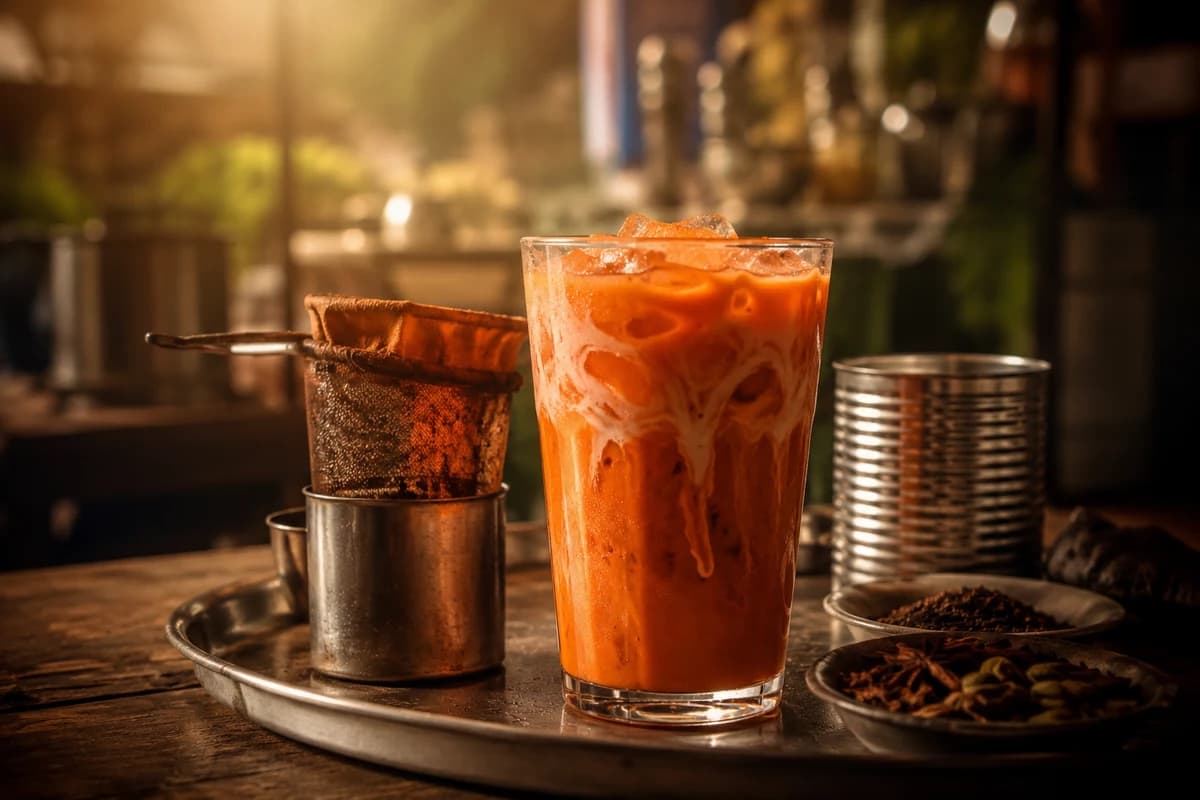
A tall glass of crushed ice. Deep orange tea. A creamy layer of milk spreading through the top. A straw. Enough sweetness to make the idea of dessert feel negotiable.
Outside Thailand, that is usually called Thai tea.
In Thailand, the useful phrase is cha yen — literally “cold tea” — and the version people normally mean is the sweet iced milk tea found at drink stalls, cafés, markets and restaurants across the country.
It looks traditional enough to have existed forever.
It did not.
Tea itself has a long history in the lands that became Thailand. Chinese communities brought tea-drinking traditions through trade and migration. In the northern highlands, Assam-type tea plants have long been used for miang, fermented tea leaves eaten rather than brewed. Written evidence also places tea drinking in Siam centuries before modern cha yen appeared.
But strong black tea mixed with sugar, condensed milk and ice belongs to a much more modern world.
It required manufactured ice to become commonplace. It required preserved dairy products that could survive tropical distribution. It required urban tea shops, imported and locally produced tea, and a market interested in cold sweet drinks rather than only Chinese-style hot tea.
Then brands helped standardise the experience.
One of them — ChaTraMue — would become so closely associated with Thai tea that its red-and-white packets now function almost like unofficial equipment for the drink.
This is therefore not a story about one ancient recipe.
It is a story about several imported things becoming local at the same time.
Much of the tea-drinking culture that shaped cha yen came through exchange.
Condensed milk came from somewhere else.
Commercial ice was a modern technology.
The famous colour was not always there either.
Thailand put the pieces together.
Then the world asked for another glass.
2. Tea Was in Thailand Long Before Thai Iced Tea
The easiest mistake is to begin the history of Thai iced tea with Thai iced tea.
Tea was already part of Siamese life centuries earlier.
Mae Fah Luang University’s Tea and Coffee Institute notes historical contact with Chinese tea culture and points to accounts from the Ayutthaya period describing tea being served to visitors. The details become clearer in later centuries, as Chinese migration and commerce became increasingly important in Bangkok and other trading centres.
That Chinese connection matters.
A 2008 study of Thailand’s tea industry by Terry Commins and Sailom Sampanvejsobha argues that tea was introduced through the country’s long trading relationship with China and then reinforced by Chinese settlement. Tea consumption became widespread, even though the forms of tea being drunk were not yet the sweet orange beverage now sold as Thai tea overseas.
Northern Thailand adds another branch to the story.
Assam-type tea grows naturally or semi-wild in upland areas across provinces including Chiang Mai, Chiang Rai and Mae Hong Son. For generations, northern communities have used leaves from these plants to make miang — fermented tea leaves that are chewed or eaten.
That is an important reminder that “tea culture” does not always mean pouring hot water over dried leaves.
Thailand had tea as a plant, tea as a traded Chinese beverage and tea as a fermented food tradition.
Those histories overlap, but they are not the same thing.
The modern Thai tea industry also developed gradually. Mae Fah Luang University traces serious commercial production efforts to the late 1930s, when private producers began building factories and purchasing fresh leaves from northern growers. Government experimental cultivation followed around 1940, with varieties from abroad later tested alongside local material.
So by the time cha yen emerged as a modern popular drink, Thailand was not simply importing a foreign beverage and adding milk.
It already possessed several different relationships with tea.
What it did not yet possess was the orange glass.
3. Ice and Milk Changed What Tea Could Be
A tropical drink can depend on industrial history more than the menu suggests.
Hot tea requires hot water.
Cha yen requires cold.
Historical reporting in Thailand places the country’s first modern ice factory in 1903, after which manufactured ice became increasingly available in Bangkok. By the 1920s, iced drinks and milk tea were no longer strange ideas in the capital’s cafés and commercial food culture.
The exact path from those earlier drinks to modern cha yen is not perfectly documented.
That is worth admitting.
A 2008 academic review of Thailand’s tea industry states directly that the development of what is now called Thai tea is unclear. Its authors make a simple chronological point: the drink could not take its familiar modern form before condensed milk and crushed ice became available.
That is a much safer starting point than the colourful origin legends repeated online.
There are stories claiming Thai tea came directly from British or Indian colonial tea habits. Others say servants reused tea leaves left by foreign employers. Some attach the drink to one political leader or one precise moment of Westernisation.
The evidence for those tidy stories is weak.
The broader influences are easier to defend.
Chinese tea culture was deeply established in Thailand.
Milk tea existed across colonial and trading networks in Asia.
Condensed and evaporated milk became practical ways to add dairy richness in hot climates before reliable household refrigeration.
Ice turned tea into a cooling urban drink.
Thai vendors then adjusted sweetness, strength and serving style to local demand.
Nothing about that process requires a single inventor.
In fact, the drink makes more sense as a city product: a beverage assembled from new ingredients, new technologies and old habits.
That is often how national favourites are born.
Not through a ceremony.
Through somebody discovering that the sweet version sells better when it is thirty-five degrees outside.
4. Chinatown, a Tea Shop and the 1945 Turning Point
The strongest documented commercial story begins in Bangkok’s Chinatown.
ChaTraMue traces its family tea business to Chinese migration from Chaozhou. In 1925, Sa Pae opened a shop called Lim Meng Kee on Chalermburi Road in Yaowarat, selling teas imported from China.
The shop’s original world was Chinese tea.
Oolong. Green tea. Hot drinks. Imported leaves.
Then war disrupted the business. According to the company’s history, bombing during the Second World War damaged the original shop and the family relocated elsewhere in Yaowarat. Around this period the business also began bringing in red tea — the Chinese term often used for what English speakers call black tea.
ChaTraMue marks 1945 as the beginning of its modern brand.
Its own account says hot Chinese tea was not especially attractive to many customers in Thailand’s climate, so the shop used red tea to make iced Thai milk tea and iced black tea.
This does not prove that nobody in Thailand had ever put tea, milk and ice together before 1945.
It proves something more useful.
By the mid-1940s, a major Bangkok tea business was deliberately commercialising iced red tea for Thai customers, and later built its identity around the drink.
That makes 1945 a strong milestone, not necessarily an invention certificate.
The distinction matters, because successful brands often become larger than the history around them. Once a product dominates a category, the company story can begin to sound like the origin of the category itself.
ChaTraMue unquestionably helped standardise and popularise Thai tea.
It should not be made responsible for every cup that came before it.
What the company did provide was a repeatable product and a commercial bridge between imported Chinese tea culture, changing Thai tastes and the modern beverage market.
The Thai tea story was becoming a brand story.
And the brand was about to turn north.
5. From Imported Tea to Tea Grown in Thailand
Thai iced tea may look like a Bangkok invention, but part of its later identity grew in the northern mountains.
ChaTraMue says that between 1945 and 1965 its business became involved in tea production around Wawee in Chiang Rai Province. The company’s history describes a factory established in Mae Suai district, with the practical difficulties of transporting equipment into the highlands becoming part of the family story.
The factory did not remain there permanently.
What mattered was the direction.
Thailand was developing a stronger domestic tea-growing and processing industry at the same time that demand for tea beverages was expanding.
Mae Fah Luang University’s historical overview describes northern Assam-type tea resources, private factories from the late 1930s and state experimentation from around 1940. Later decades brought more organised commercial cultivation, new varieties and stronger links between growers, processors and national beverage companies.
This creates an interesting reversal.
The tea shop that helped popularise Thai iced tea began by importing Chinese tea.
The drink that eventually became known around the world as “Thai tea” increasingly relied on tea grown and processed in Thailand.
That transition was gradual rather than absolute. Imported tea continued to matter, and different recipes could use Ceylon, Assam-type or blended teas.
But the northern industry gave the drink a deeper material connection to Thailand.
The phrase Thai tea was no longer describing only what happened in the glass.
It could increasingly describe where at least some of the leaf came from too.
Even here, though, there is no single tea plant that defines cha yen.
Different producers use different blends. Strength matters more than delicacy, because the brew has to survive sugar, milk and a large amount of melting ice.
Cha yen is therefore not a tea ceremony built around tasting one rare leaf.
It is almost the opposite.
The tea has to fight its way through everything else and still be noticed.
6. What Cha Yen Actually Is
Order cha yen in Thailand and the basic architecture is easy to recognise.
Strong tea.
Sugar.
Milk.
Ice.
The details are where everybody starts arguing.
Sweetened condensed milk is common because it delivers sweetness and body at the same time. Evaporated milk is often added as well, sometimes poured over the finished drink to create the pale swirl across the surface. Other vendors use fresh milk, non-dairy creamers or their own combinations.
The level of sweetness can range from generous to an event your dentist might wish to discuss privately.
The tea itself varies too.
Commercial Thai tea mixes have helped create a recognisable house style: strong aroma, deep colour and enough bitterness to remain present after dairy and sugar are added. Some vendors brew branded mixes. Others create their own blends or combine several teas.
There are neighbouring drinks that clarify the category.
Cha dam yen is iced black tea without milk, usually sweetened.
Cha manao adds lime and sugar rather than dairy.
Cha ron simply means hot tea and does not automatically describe the same sweet milk drink served warm.
These distinctions are useful, because “Thai tea” abroad can become a vague umbrella term for anything orange, sweet and vaguely Southeast Asian.
Cha yen is more specific.
It is also not automatically a spiced tea in the way masala chai is.
International recipes often add star anise, cardamom, tamarind or vanilla. Some Thai tea blends and recipes do contain flavourings or spices, and Thai government material discussing international recipes lists several of them.
But there is no rule that every authentic glass must taste strongly of star anise.
The drink is defined more securely by strong tea, sweetness, milk and ice than by one universal spice cabinet.
If somebody tells you there is exactly one authentic Thai tea recipe, they have probably never watched two Thai drink vendors make it.
7. Why Is It So Orange?
Now we reach the question everybody eventually asks.
Why is Thai iced tea orange?
The shortest answer is not especially romantic.
Commercial colouring often helps.
Tea brewed by itself produces shades of brown, amber and reddish brown. Milk lightens those colours, but it does not naturally turn ordinary black tea into the intense orange associated with many modern cups of cha yen.
Pre-mixed Thai tea products helped standardise that appearance.
The bright colour became useful, because it created instant recognition. A customer could see the drink from across a food court and know what it was. Restaurants abroad could serve something visually distinct from ordinary iced tea. Photographs reproduced the colour beautifully.
Eventually orange became part of the product’s identity.
That does not mean every Thai tea has to be orange.
In 2025, ChaTraMue itself launched a naturally coloured version of Thai tea without added colouring — a revealing move from the company most closely associated with the famous orange style. The product existed precisely because consumers had become interested in separating tea flavour from the visual expectation built around it.
This is another place where global recipes can turn habit into mythology.
Some articles explain the orange entirely through spices such as star anise or tamarind.
Those ingredients may affect flavour and colour in particular recipes, but they do not adequately explain the vivid consistency of commercial orange Thai tea.
The colour is better understood as part of twentieth-century product standardisation.
Once enough vendors and packaged mixes reproduced the same visual cue, customers learned to expect it.
Then authenticity began working backwards.
A brownish glass could be historically reasonable and still look “wrong” to somebody whose idea of Thai tea was formed in a restaurant overseas.
That is the power of branding.
Sometimes a colour becomes traditional simply because everybody remembers it.
8. The Street Drink That Travelled Through Restaurants
Thai iced tea had one enormous advantage when Thai food began travelling internationally.
It needed almost no explanation.
Many Thai dishes require a new diner to learn a name, a flavour structure or the logic of sharing several plates. Cha yen looks familiar immediately.
It is iced tea.
It has milk.
It is sweet.
The first sip explains the rest.
As Thai restaurants expanded abroad during the late twentieth century, Thai iced tea became an easy menu companion to dishes such as Pad Thai, curries and grilled foods. It gave restaurants a drink that was recognisably connected with Thailand while requiring few unfamiliar ingredients at the point of service, once packaged tea mixes became internationally available.
That packaging mattered.
A restaurant in California, London or Stockholm did not need access to a Bangkok tea stall. It could buy a Thai tea blend, brew it strongly, add condensed milk and reproduce a version close enough for customers to recognise.
The drink therefore travelled differently from delicate regional foods.
It was easy to standardise.
It was cheap relative to many restaurant dishes.
It looked distinctive in photographs.
It tolerated ice, sweetness and variation.
And because it was non-alcoholic, almost anybody could order it.
Thai iced tea also benefited from the wider expansion of Asian milk-tea culture. Bubble-tea shops adopted Thai tea as a flavour. Cafés turned it into frappes, soft serve, cakes and desserts. Ready-to-drink versions appeared. The phrase “Thai tea” began describing not only a beverage but a flavour profile.
That is the same transformation Sriracha underwent in another aisle of the supermarket.
First a specific product travels.
Then the name becomes something manufacturers can attach to other things.
By the time Thai-tea ice cream exists, the drink has already become cultural shorthand.
9. From Street Stall to Global Brand
Cha yen went global through restaurants, but Thai companies eventually followed it.
ChaTraMue moved from tea packets into branded beverage shops, turning something that had long been sold by independent street vendors into a modern chain product.
The expansion became increasingly international.
By 2025, company figures reported by The Nation said ChaTraMue was exporting to 21 countries and operating 114 international branches across 11 markets, including the United States, Singapore, South Korea and China. The company was planning further expansion into additional countries.
Those figures are a snapshot rather than a permanent count.
The more important point is the direction of travel.
A family tea business founded in Bangkok’s Chinatown was now selling “Thai tea” back into the wider world as a branded Thai product.
That is a different phase from the earlier restaurant story.
In the first phase, foreign diners encountered Thai iced tea because Thai restaurants carried the drink abroad.
In the second, Thai tea companies began exporting the brand, store format and product itself.
The drink also became useful soft-power material. Thai government communications celebrated international rankings for Thai iced tea in 2023 and 2024, presenting its global recognition as part of the country’s broader food and cultural appeal.
Rankings come and go.
The symbolism is more durable.
Thai iced tea is now recognisable enough that Thailand can promote it internationally without first explaining what it is.
That is the point at which a domestic drink becomes an export icon.
It also produces a strange circularity.
Chinese migrants helped build the Bangkok tea business.
Imported red tea helped create the modern commercial drink.
Northern Thai production made the leaf more locally rooted.
Thai restaurants carried cha yen overseas.
Foreign customers turned it into “Thai tea.”
And Thai companies then exported that globalised identity back out under Thai branding.
The cup went in a circle.
It just kept getting bigger.
10. A Modern Thai Classic
Thai iced tea is a useful test of what people mean when they call something traditional.
If traditional means ancient, unchanged and invented entirely inside one country, cha yen fails.
Chinese tea-drinking traditions reached Siam through long exchange with China.
Milk products came through modern commercial food systems.
Ice depended on industrial technology.
The modern sweet iced drink emerged in the twentieth century.
Its most famous brand grew from a Chinese-Thai family business in Bangkok.
The leaf increasingly connected to northern Thai agriculture.
The orange colour became strongly associated with commercial blends.
Restaurants abroad then changed the international meaning of the words “Thai tea.”
And yet there is nothing un-Thai about the result.
Thai culture did not merely receive these ingredients.
It organised them into a drink people in Thailand recognised, sold, adjusted, argued about and repeated until the combination acquired its own identity.
That is how culture usually works.
Not by protecting every ingredient from foreign influence, but by making combinations feel local enough that later generations forget how new they once were.
Today, cha yen can come from a plastic cup at a roadside stall, a stainless-steel jug in a restaurant, a branded chain shop in Bangkok or a bubble-tea counter thousands of kilometres away.
Some versions are painfully sweet.
Some are tea-forward.
Some are fluorescent orange.
Some deliberately remove the colouring.
They are not identical.
They do not need to be.
The important continuity is the idea: strong tea made colder, richer and sweeter for a Thai way of drinking it.
Thai iced tea did not become international because it preserved one perfect old recipe.
It became international because it was easy to recognise, easy to adapt and very difficult to forget.
The world remembers the orange.
Thailand made the drink.