Before Bangkok, Before the Landmark
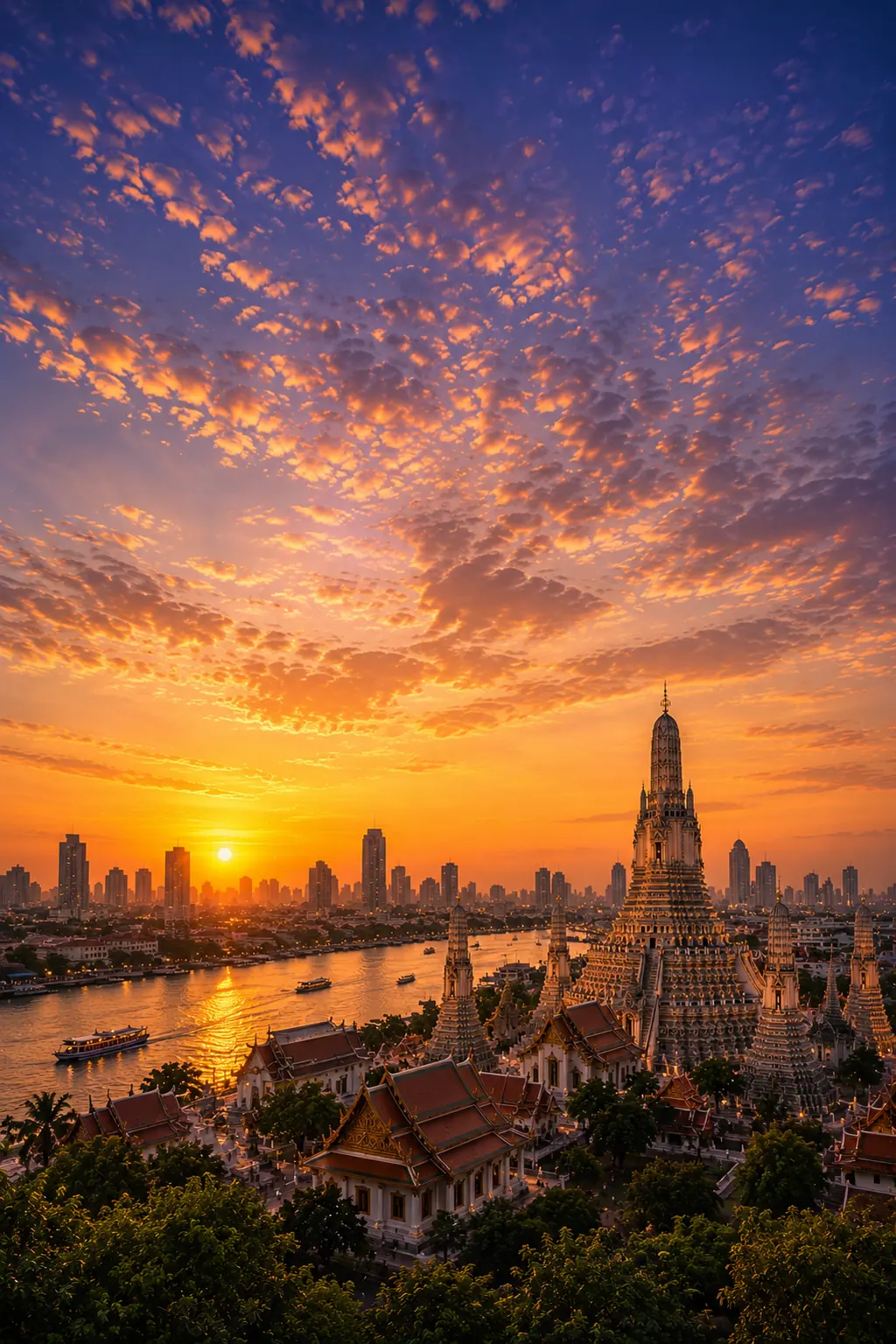
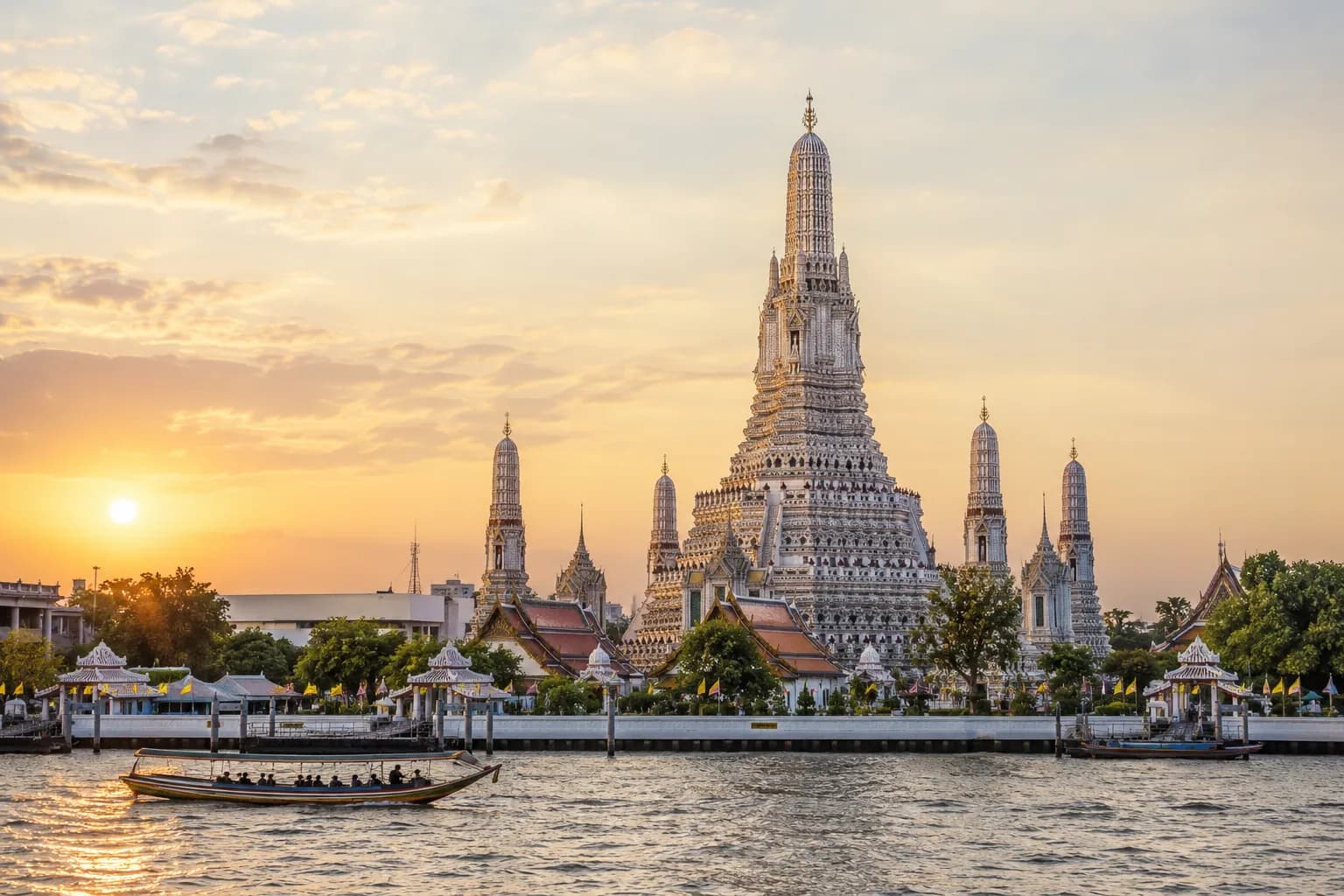
Today, Wat Arun is almost impossible to separate from the image of Bangkok itself. Its central prang rises above the west bank of the Chao Phraya, ferries move across the water below it, and from the opposite bank the temple has become one of those views that immediately identifies the city.
Yet the Bangkok skyline came later. The temple was already here before Bangkok became the capital, before the Grand Palace existed and before the Chakri dynasty began. A Buddhist temple occupied the site during the Ayutthaya period, and what happened around it after Ayutthaya fell in 1767 places Wat Arun directly inside one of the most important transitions in Thai history.
To understand Wat Arun properly, it helps to stop looking at it simply as the Temple of Dawn. For a short but decisive period, this was a temple beside the centre of the kingdom.
Before Wat Arun
Long before the famous porcelain-covered tower existed in its present form, there was a much smaller temple on this stretch of the Chao Phraya. Thai historical records identify the earlier temple as Wat Makok, later also known as Wat Makok Nok. It belonged to the river landscape of the Ayutthaya era, when waterways were not simply scenery but the main routes through which people, goods, soldiers and royal authority moved.
That setting became enormously important in 1767. Ayutthaya, the Siamese capital for more than four centuries, was captured and devastated by Burmese forces. Political authority fragmented, and the old capital was in no condition to resume its previous role.
Among the military leaders who emerged from the collapse was Taksin. He regrouped forces, re-established central authority and chose not to rebuild the capital at ruined Ayutthaya. Instead, the political centre moved downriver to Thonburi, strategically placed closer to the Gulf of Thailand and the maritime trade routes that connected Siam to the wider region.
The small riverside temple suddenly found itself beside the heart of a new kingdom.
Wat Chaeng and King Taksin
During the Thonburi period the temple became known as Wat Chaeng, also romanised as Wat Jaeng. The name is commonly associated with brightness or dawn, and later tradition strongly connects the temple with King Taksin and the idea of arriving at daybreak. The exact origin of the name is less important than the historical transformation that followed.
King Taksin's royal palace at Thonburi extended into the area around Wat Chaeng. The temple effectively became a royal temple within the palace boundary. Monks were not permitted to reside there during this period, an arrangement comparable to Wat Phra Si Sanphet at Ayutthaya, which likewise stood within a royal palace compound and served royal ceremonial purposes rather than functioning as an ordinary resident monastery.
That is difficult to imagine from the modern city. Visitors today see Wat Arun as one famous temple among Bangkok's many temples. In Taksin's capital, however, it stood within the environment of royal power itself.
When the Emerald Buddha Lived in Thonburi
The Emerald Buddha is now so closely associated with Wat Phra Kaew and the Grand Palace that it is easy to assume it has always belonged there. It has not.
After the 1778-79 Siamese campaign against Vientiane, led by Somdet Chao Phraya Maha Kasatsuek — the future King Rama I — together with his brother Chao Phraya Surasi, the Emerald Buddha and the important Phra Bang image were brought to Thonburi. King Taksin had the two sacred images enshrined at Wat Chaeng.
Thailand's submission for Wat Arun to UNESCO's Tentative List records that the images remained there for about five years, from 1779 until 1784. For that short period, the west-bank temple housed what would become the most sacred Buddha image associated with the Thai state.
Both images were transferred to Wat Phra Kaew after the new Rattanakosin capital was established. The later history of Phra Bang follows a separate path; from this point, Wat Arun's story is most directly connected to the Emerald Buddha's move into the new royal temple.
The Capital Crosses the River
King Taksin's reign ended in 1782. Chao Phraya Chakri became King Rama I and founded the Chakri dynasty. Rather than continue to rule from the Thonburi palace, he established the new Rattanakosin capital on the east bank of the Chao Phraya.
There he built the Grand Palace and Wat Phra Kaew. The Emerald Buddha crossed the river and was installed in its new royal temple. Wat Chaeng had stood beside the centre of one capital; the centre of the next was now rising directly opposite it.
That short journey across the Chao Phraya is one of the most revealing episodes in Bangkok's history. The river did not merely separate two neighbourhoods. It marked the transfer from the brief Thonburi kingdom to the Rattanakosin capital that developed into modern Bangkok.
Wat Chaeng did not lose its importance, but its role changed. No longer enclosed within the active royal palace of the capital, monks were again able to reside at the temple. During Rama I's reign, the future Rama II — who lived at nearby Wang Derm Palace — had already begun planning restoration work by 1785. The site was entering a new period of royal patronage that would eventually create the Wat Arun visitors recognise today.
Rama II Begins a New Wat Arun
The temple's modern identity is closely tied to King Rama II. Before becoming king, he had lived at Wang Derm, the former Thonburi palace immediately south of the temple, and took an active interest in restoring Wat Chaeng.
After ascending the throne in 1809, Rama II resumed major restoration work. A new principal Buddha image was cast for the ordination hall, and royal tradition records that Rama II personally modelled the face of the image. He also gave the temple a new name: Wat Arun Ratchataram.
Most importantly for the skyline, Rama II intended to replace the relatively modest existing prang with something far more ambitious. The project was conceived during his reign, but the monumental structure was realised under his successor.
This distinction matters. The Wat Arun associated with King Taksin is historically central to the Thonburi period, but the towering landmark tourists photograph today is largely a creation of the early Rattanakosin era.
Rama III Creates the Skyline
Under King Rama III, the plan for the great prang became reality. The older central tower was transformed into a monumental structure surrounded by four smaller prangs and four mandapas arranged around it. The wider sacred area was redesigned and restored as part of the same programme.
Thailand's 2025 UNESCO Tentative List submission records that the sacred area containing the principal prang, the four subordinate prangs and the four mandapas was completed in 1842. The wider restoration was completed during Rama III's reign, although the king died in 1851 before the temple celebration took place.
The result was not simply a bigger temple ornament. It was an architectural statement intended to carry the weight of a capital-city monument. Thailand's UNESCO documentation describes the central prang as the Maha That of the capital — a sacred structure connected with the idea of the city having a spiritual centre.
From a distance, the prang reads as a single elegant vertical form. Up close, it becomes something completely different: tiers of figures, floral patterns, mythological beings, ceramic decoration and steep surfaces rising above the river. The scale that looks clean and almost simple from across the Chao Phraya becomes dense and intricate at ground level.
King Rama IV later ordered further restoration and gave the temple the name by which it is known today: Wat Arun Ratchawararam.
Reading the Prang
The central prang is more than a tower. Its layout expresses Buddhist cosmology through architecture.
The principal prang is traditionally understood to represent Mount Meru, the sacred mountain at the centre of the universe in Buddhist and Hindu cosmological traditions. The four smaller prangs at the corners represent the four Buddhist continents, while other elements of the complex reinforce the idea of a structured sacred universe organised around a central axis.
The decoration continues that symbolism. Asuras, monkeys, devatas, garudas and representations of Indra appear across the different levels, carrying, guarding and populating the architectural world. These figures are not random ornament added to make the tower more dramatic. They help turn the structure into a model of a sacred cosmos.
This is one reason Wat Arun can be misleading when seen only from a rooftop bar or a boat. The famous silhouette is important, but much of the building's meaning is contained in details that disappear completely at that distance.
Porcelain, Trade and a Temple That Changes with the Light
Wat Arun's surface is one of its most distinctive features. Large areas of the prang are covered with glazed porcelain and ceramic decoration arranged into floral and geometric patterns. From across the river the effect is pale and almost stone-like; close up, colour appears everywhere.
The use of ceramics also fits the world in which the great prang was constructed. Early Rattanakosin Bangkok was deeply connected to regional trade, including strong commercial links with China. Chinese ceramics became an important decorative material in Thai architecture during the period, and at Wat Arun they were used on an extraordinary scale.
The result changes constantly with distance and light. Morning sun catches individual fragments; midday light can make the tower appear almost white; evening turns the surface warmer before artificial illumination transforms it again after dark. The name Temple of Dawn is best understood as a name, not a viewing instruction. Dawn can be beautiful, but Wat Arun does not belong to one hour of the day.
A Temple That Still Belongs to the River
It is easy to treat the Chao Phraya as the foreground of the photograph, but historically the river is part of the reason Wat Arun matters at all.
The capitals of Ayutthaya, Thonburi and Rattanakosin were all shaped by water. In the eighteenth century, the Chao Phraya was infrastructure, defence, trade route and ceremonial space at the same time. Wat Arun's position on its west bank placed it inside that system long before modern Bangkok roads surrounded it.
That relationship has never entirely disappeared. Wat Arun remains associated with royal ceremonies on the river, including Royal Kathin processions. Ferries still cross between the two banks, and approaching the temple by water gives a clearer sense of its historical orientation than arriving solely by road.
The modern visitor therefore sees several Bangkoks at once: the old Thonburi bank, the Rattanakosin royal district opposite, working river traffic, tourist boats and one of the city's most recognisable monuments rising between them.
Why Wat Arun Matters More Than the Postcard
Wat Arun is beautiful enough that it does not need a deeper story to attract visitors. That is precisely why the deeper story is so easy to miss.
The site connects three political worlds. It began as an Ayutthaya-period temple. It became a royal temple beside King Taksin's Thonburi palace and briefly housed the Emerald Buddha. Under the early Chakri kings, it was then reshaped into one of the defining monuments of the new Rattanakosin age.
Very few places in Bangkok make that transition so visible. Across one stretch of river sit the former Thonburi royal landscape, Wat Arun, the Grand Palace and Wat Phra Kaew. The movement of the capital can almost be read geographically from one bank to the other.
That is the part of Wat Arun worth remembering. The famous prang did not witness the fall of Ayutthaya in its present form, and it was not the tower King Taksin saw beside his palace. The temple's importance lies in something more interesting: the site survived each political transition, changed with it, and accumulated new layers of meaning as the capital itself evolved.
The Temple That Watched Bangkok Begin
Bangkok often gives the impression of a city that grew too quickly to preserve a clear beginning. Wat Arun challenges that impression.
Stand on the Thonburi bank and the sequence is still there. Behind the temple lies the landscape of Taksin's capital. Across the Chao Phraya lies the royal city founded by Rama I. Inside Wat Arun itself are architectural layers created by the kings who followed.
The Temple of Dawn is therefore not simply a beautiful object beside the river. It is a marker of where power moved, where sacred symbols moved, and how a new capital defined itself after the destruction of the old one.
Millions of photographs reduce Wat Arun to a silhouette. Its history does the opposite. It turns that silhouette back into a place — one that stood beside the rise of Thonburi, remained important as royal focus shifted to Rattanakosin, and then grew into one of the symbols of the Bangkok that followed.